The 2022-23 All-Value Sire Team: Part 5 – Budding Stars, Near And Far

Settle in, stay a while.

Over the past month, we've taken a look at stallions whose roots are firmly planted in central Kentucky, and ones who will be looking to set those roots in the years to come, but in this final installment of the All-Value Sire Team, we'll be looking at that group in the middle: Stallions just on the other side of the fourth-book swoon, whose roots have just sunk into the ground with the aim of building on early crops.

This can be a tense time for a Kentucky stallion standing for $20,000 or less. Stallions whose first crop or two lit up the board are often seeing their fees rise above that level, while those who didn't could be fighting for their long-term careers in the Bluegrass State. Our job today is to find the special ones who look like they have a long-term commercial future at a major Kentucky stud farm that has priced their stallion with a degree of restraint. There is still a lot of story to be written for this class of stallions, and a top-flight runner or two could change the ending drastically.

This time around, we'll also look at standout regional sires. All but a select few stand below the $20,000 Mendoza line outside of Kentucky, but the value comes in improving those regional mares to compete within their home state and beyond, and hopefully making it worth a breeder's time to put them through the sales ring. Appealing to the commercial market outside of the Kentucky stronghold can be difficult, but sometimes the results speak for themselves.

If you missed out on any of the previous installments, you can get caught up here.

Part 1: The ground rules, Team Captain, and Turf Sire

Part 2: The Rookie and The All-Weather Sire

Part 3: The Veteran and The Sprinter

Part 4: The Freshman and The Prospect

The Future Star: A stallion with two to four crops of racing age in 2023.

First Team: Runhappy
B. h., 2012, Super Saver x Bella Jolie, by Broken Vow
Standing at Claiborne Farm, KY, $15,000

Runhappy at Claiborne Farm.

My, how things can change.

After the champion sprinter's freshman sire season in 2020, where he finished on the fringe of the top 15 by progeny earnings with no stakes winners, Runhappy looked sunk as a serious Kentucky sire. From there, his first crop got better as it aged, and his second crop got good quickly, repairing his reputation from those early hiccups.

Breeders have shown they're willing to put the past behind them, as well. Runhappy saw the second-highest year-over-year gain in mares bred among North American stallions from 2021 to 2022, jumping by 88 mares from 56 to 144.

The commercial market has picked back up on Runhappy as well, improving his yearling average to $57,198 in 2022 after finishing at $47,663 a year earlier. If he keeps popping up with winners and solid graded stakes horses at the rate that he has, that number could continue to rise steadily and create a nice payday in a few years for breeders that got in at this price point.

As a high-achieving sprinter, it's no surprise that many of Runhappy's top runners have earned their stripes around one turn. Of his 10 progeny stakes wins, the scales tip heavily toward the sprinters, including G2 Vosburgh Stakes winner Following Sea, but he's proven that he is by no means one-dimensional at the sport's highest levels.

Runhappy sent a runner from his second crop to this year's Kentucky Derby, Smile Happy, off a win in the G2 Kentucky Jockey Club Stakes around 1 1/16 miles, and runner-up efforts in the G2 Risen Star Stakes and G1 Blue Grass Stakes going as far or longer. Following Sea, for all the success he had as a sprinter, also picked up a Grade 1 placing in the Haskell Stakes at 1 1/8 miles.

Those two runners, along with Grade 2-placed stakes winner Joyful Cadence, have given Runhappy three earners of $500,000 or more from three crops of racing age. Runners like those helped bump his average progeny earnings to $54,062, which was on the higher end among stallions eligible for this divisional honor.

Looking at his rank and file, Runhappy gets 67 percent of his foals to the races, and they win 16 percent of their starts, which both contend with the best in this division.

I saw a lot of Runhappy's foals before I got out to Claiborne to look at the stallion himself for the first time, and working backward like that helped me better understand the source. The Runhappys are sturdy, and they got his shapely rump en masse, but with enough length of leg where they don't fit the cannonball-build stereotype that sprint-leaning stallions can impart upon their runners. The results show he's probably going to get you a sprinter, but his frame suggests he can get you whatever you want if you pair him with the right mare.

After really coming into his own in 2022, both on the racetrack and in the breeding shed, Claiborne Farm raised Runhappy's fee from $12,500 to $15,000; nothing drastic, but a little marker that the stallion's stock is rising. Now that he's got the long-term pipeline to back him up, it just might continue to rise.

Second Team: Cupid
Gr. or ro. h., 2013, Tapit x Pretty 'n Smart, by Beau Genius
Standing at Ashford Stud, KY, $5,000

Cupid

The only stallion that saw a bigger year-to-year gain in mares bred in 2022 was Cupid, who rose by a whopping 97 mares from 77 to 174. Does the stallion have momentum? Yes he does.

For what he can offer a breeder or end-user, Cupid represents incredible value at a $5,000 stud fee. From two crops of racing age, Cupid has proven himself able to get graded-caliber runners over a variety of surfaces and locales, and his low entry price allows for some commercial wiggle room, even if you're not going to find the down payment on your next yacht selling them.

Cupid's resume is as two-turn as it gets, both in his own form – winning four graded stakes races from 1 1/16 miles to 1 ¼ miles including the G1 Gold Cup at Santa Anita Stakes – to his black type-heavy female family. His best runners have been two-turn types, as well, including G2 Santa Anita Oaks winner Desert Dawn and Prince of Wales Stakes winner Duke of Love.

I always forget how big Cupid is until I see him in person again. He's got more height than a typical son of Tapit at stud, but he's so well put together that it's not glaringly obvious until you step up to him. In terms of his curves and proportions, he really just reminds me of Tapit himself, but the next size up.

Stud farms with less self-control would be well within their right to stand Cupid for more than his current advertised fee, but Ashford Stud's commitment to keeping him at $5,000 leaves the door wide open to come out ahead, especially on the racetrack, where his average progeny earnings are over $48,000.

Support our journalism

If you appreciate our work, you can support us by subscribing to our Patreon stream. Learn more.

The Regional Star: A stallion of any age or surface preference who stands outside of Kentucky.

First Team: Central Banker
B. h., 2010, Speightstown x Rhum, by Go for Gin
Standing at McMahon of Saratoga Thoroughbreds, NY, $7,500

Central Banker

Earlier this year, I tabbed Central Banker as the centerpiece of my Regional Sire Expansion Draft, so it would be no stretch of the imagination that he'd end up on a list like this.

Simply put, the Central Bankers go out there and make money. His average progeny earnings of $76,574 puts him in the top 10 among all North American stallions standing for $20,000 or less in 2023, owing in large part to the lucrative New York-bred program. He has one millionaire, five earners of $500,000 or more, and at least 12 runners that have cleared $250,000 or more, and almost all of them are black type earners at New York tracks.

However, this does not mean Central Banker can only beat up on other New York-breds. Bankit, his top earner at over $1.2 million, is Grade 3-placed in New Jersey and Arkansas. Morning Matcha is a stakes winner in Pennsylvania, and she finished second in the G1 Cotillion Stakes, while Bank on Shea won the listed Pelican Stakes earlier this year at Tampa Bay Downs. The money for a New York-bred is often best in New York, but the best of them have shown they can hang with the locals wherever they enter the gate.

What's interesting about Central Banker is that his pedigree, physical and race record heavily suggest he'd throw nothing but sprinters, but two of the three aforementioned runners competed at high levels as routers. His New York-based runners can win at whatever distance they need to run, as well.

Central Banker is exactly what one would expect to see from a son of Speightstown at stud: All power, from the way his neck ties into his body to the way his strong rump leads into an ample leg with plenty of bone. Central Banker was a Grade 2-winning sprinter during his time on the racetrack, and he looks like it.

At auction, Central Banker does better than most standing outside of Kentucky, and better than quite a few within those state lines. His average yearling sale price finished at $33,423 this year, which marked a $12,296 gain from his yearling average in 2021.

At this year's Fasig-Tipton New York-Bred Yearling Sale, Central Banker's average price of $68,500 trailed only stalwart Freud (who'd have run away with this division if his fee hadn't been moved to “Private” for 2023) and Destin (who was sold to stand in Saudi Arabia) among stallions based in the Empire State. That slate of offerings included a $140,000 filly sold to Saratoga Race, which is an incredible day at the office at that stud fee.

A good state-bred in a good state-bred program can quickly make multiples on their early investment. Central Banker puts New York breeders in a great position to achieve that goal.

[Story Continues Below]

Second Team: Sir Prancealot
B. h., 2010, Tamayuz x Mona Em, by Catrail
Standing at Rancho San Miguel, CA, $10,000

Sir Prancealot

Every November, Europe sends over a posse of runners to rough up our best turf horses during the Breeders' Cup, and then they usually go home. The offspring of Sir Prancealot ignored the second part of that story to such a degree that the sire himself came over to make himself comfortable after starting his Northern Hemisphere career in Ireland and shuttling from Australia.

Though his North American ranks have comprised just a handful of runners, their achievements have been extraordinary, including Grade 1 winner Lady Prancealot, four-time Grade 2 winner Beau Recall, two-time Grade 2 winner Madam Dancealot, and stakes winner Ginger Nut. Miss Amulet also finished third in the 2020 Breeders' Cup Juvenile Fillies Turf at Keeneland. All of those have come over the past five years, and they don't include a few other North American stakes-placed runners, as well. There are stallions that spend many more years at stud and send many more horses to the races who don't achieve a fraction of what Sir Prancealot has done without a single U.S.-sired crop. His first North American 2-year-olds will hit the track in 2023.

Now that he's here, the question will be whether he can elevate books of largely regional-quality mares whose pedigrees might not be as turf-focused as his other stops on the road. Many a buzzed-about international stallion has seen his record brought back down to earth when mixed with the American broodmare population.

I feel good about Sir Prancealot's chances to buck that trend, mostly because he's starting with such a solid foundation. He gets 78 percent of his foals to the races, and an outstanding 50 percent winners from horses of racing age. Those numbers put him right in the mix with late turf titans English Channel (79 percent starters, 58 percent winners), and Kitten's Joy (77 percent starters, 54 percent winners. Even if he ticks down a bit with a different kind of broodmare population from what got him here, he'll still be doing a fine job.

Realistically, any turf-leaning sire is going to have a ceiling in North America. They don't run the classics on the grass here, and people shop accordingly. Regardless, we've only gotten a taste of what Sir Prancealot can do in North America, and it's mighty impressive. If his first crop of U.S.-sired runners can carry that momentum next year, we might have something special on our hands.

The post The 2022-23 All-Value Sire Team: Part 5 – Budding Stars, Near And Far appeared first on Horse Racing News | Paulick Report.
Source of original post

Is A Successful Saratoga Meet A Fast Track To The Freshman Sire Title?

The Saratoga Race Course meet has a deeply ingrained reputation as one of North America's major proving grounds for the mettle of a freshman sire, offering some of the deepest 2-year-old competition for both maidens and graded stakes horses.

As one of the meets on the calendar that has the full attention of breeders and stallion operations alike, coming out with a big debut meet at Saratoga can help drum up full books of mares for years to come. In the short-term, however, leading the rookie sires by winners in upstate New York is far from a guarantee that a stallion will finish the year at the top of the freshman list.

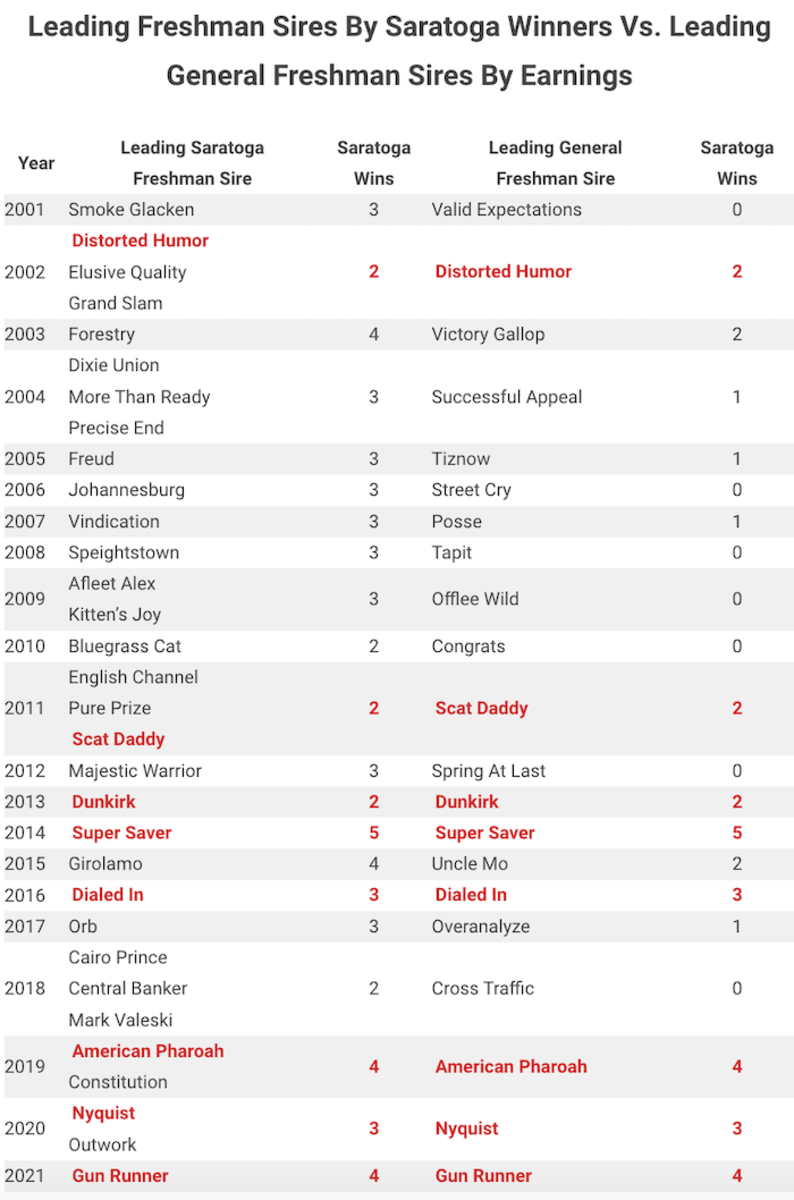
Figures provided by Horse Racing Nation show that the leading freshman sire by winners during the Saratoga meet finished that year as North America's leading freshman sire by earnings in eight of 21 years from 2001 to 2021. In fact, seven stallions that finished the year as the top freshman by earnings went winless during their first Saratoga season.

Of course, this is far from a perfect “Point A-to-Point B” comparison. One metric measures the number of winners, while the other is based on earnings, and the year-end freshman sire race can be heavily influenced by a handful of big-money 2-year-old races over Breeders' Cup weekend.

However, between the high maiden purses in Saratoga and the plentiful stakes opportunities for 2-year-olds at the track, there is plenty of money to be had at the meet, and a sire whose first runners show precociousness in the mid-to-late summer can help a stallion set the kind of pace that could hold sway if the freshmen are blanked in the Breeders' Cup. That margin is best achieved by getting lots of winners at big meets.

Let's take a look at some of the notable sire groups in this data set.

The Record-Setters

Gun Runner

The racing world has been enraptured by the success of Gun Runner's debut crop at stud since they first hit the track last year, and his record-setting freshman season included a powerful stand in Saratoga, where he led all rookie stallions with four wins from 10 starts.

That group included eventual champion 2-year-old filly Echo Zulu, who broke her maiden in Saratoga by 5 1/2 lengths, then dominated the Grade 1 Spinaway Stakes by four lengths. Her Spinaway triumph was part of an epic weekend at the Spa for Gun Runner, who was also responsible for the winner of the Spinaway's counterpart for colts and geldings. A day after the Spinaway, Gunite posted a minor upset in the G1 Hopeful Stakes, kicking away to win by 5 3/4 lengths at odds of 11-1.

Earlier in the meet, Wicked Halo put her sire in the graded stakes win column with a gate-to-wire score in the G2 Adirondack Stakes.

Gun Runner finished 2021 with combined progeny earnings of $4,315,908, which surpassed the previous freshman record of $3,632,214 set by Uncle Mo in 2015. His performance in Saratoga was a clear preview of his meteoric ascent within his class and the overall stallion ranks, but was not as much the case for the previous two record-holders by freshman earnings.

Uncle Mo finished the 2015 Saratoga meet with two wins in 11 starts, which trailed New York-based Girolamo's four winners on the season. His meet was led by Uncle Vinny, who was promoted to first in the G3 Sanford Stakes.

Uncle Mo picked up the freshman sire record from Tapit, who himself eclipsed Danzig's 24-year-old record in 2008 without a single Saratoga winner.

Now considered one of the surest things in the North American stud book, with a progeny record in Saratoga that includes last year's G1 Travers Stakes and G2 Jim Dandy Stakes winner Essential Quality, Tapit went winless from eight starts during his debut Saratoga meet.

Tapit would go on to rake in $2,762,036 from his freshman crop, led by champion and Breeders' Cup Juvenile Fillies winner Stardom Bound.

The Wire-To-Wires

Distorted Humor

Gun Runner is an example of the best-case scenario when it comes to a freshman sire, leading the way in Saratoga before shattering the earnings record. The ones who “only” annexed Saratoga en route to the freshman title without the earnings record, still include some of the biggest recent names in the stud book.

Distorted Humor tied with a murder's row of Grand Slam and Elusive Quality, each with two Saratoga winners, before going on to take the freshman sire title for himself in 2002. Awesome Humor was responsible for both of those wins: the G2 Adirondack Stakes and the G1 Spinaway Stakes.

In 2011, Scat Daddy posted two wins during his inaugural Saratoga meet as a sire, tying with English Channel and Pure Prize, before going on to top the overall standings without the benefit of a Breeders' Cup winner. Scat Daddy didn't have any stakes winners at the Spa that year.

One of the most convincing debuts came from Super Saver, who led all freshman sires by Saratoga wins since 2001, with five, en route to the year-end title in 2014. That group was led by the tag team of I Spent It and Competitive Edge. After winning the G2 Saratoga Special Stakes, I Spent It finished second to Competitive Edge in the G1 Hopeful.

Freshman sires leading their class by Saratoga wins and following through to win the year-end title has become more commonplace in recent years, with four of the past six leaders seeing it through to the end.

Dialed In picked up three winners during the 2016 meet, including G2 Saratoga Special winner Gunnevera, who would go on to earn over $5.5 million during his on-track career.

Three years later, the eagerly-awaited first juveniles by Triple Crown winner American Pharoah hit Saratoga, and his three wins tied with Constitution for the most of the meet. The charge was led by Sweet Melania, who broke her maiden going 1 1/16 miles on the inner turf before finishing her 2-year-old season with a win in the G2 Jessamine Stakes and a third in the Breeders' Cup Juvenile Fillies Turf.

American Pharoah picked up another Saratoga stakes winner in Another Miracle, who parlayed a victory in the Skidmore Stakes into a third in that year's Breeders' Cup Juvenile Turf Sprint.

In 2020, Nyquist's leading season was included a three-win meet in Saratoga, highlighted by eventual champion Vequist, who destroyed the field in the G1 Frizette by 9 1/2 lengths. Lady Lilly, who finished third in that Frizette, broke her maiden earlier in the meet.

Support our journalism

If you appreciate our work, you can support us by subscribing to our Patreon stream. Learn more.

The 0-Fers

As Tapit displayed, the road to the top of the freshman sire ranks does not necessarily have to loop through upstate New York.

Furthermore, Tapit's winless season was not a fluke among stallions that would become breed-shapers.

Street Cry's first crop was a hit machine, featuring 2006 champion juvenile and 2007 Kentucky Derby winner Street Sense, Hall of Famer Zenyatta, and multiple Grade 1 winner Street Boss.

However, his runners went 0-for-2 in Saratoga during his freshman season, while Johannesburg notched three wins to lead the meet. Among those winners for Johannesburg was future meet-leading sire Scat Daddy, who took the G2 Sanford Stakes.

Congrats went on to a long, productive stud career after going winless with five starts in Saratoga. He bounced back with a strong fall season that featured Grade 1 victories by Wickedly Perfect and Turbulent Descent.

Offlee Wild spent several years standing in Kentucky, even after his lone Saratoga runner finished out of the money in 2009. His class-leading success was instead coming in the Midwest, with champion 2-year-old filly She Be Wild. Offlee Wild would later go on to sire Breeders' Cup Classic winner Bayern.

[Story Continues Below]

The Summer Flings

Elusive Quality with longtime groom Steve Clark

Whether they finish the season at the top of the freshman list or not, leading the Saratoga meet by first-crop winners has proven to be a strong indicator of long-term success at stud.

Three leading general sires were once the top freshman sire in Saratoga since 2001: Elusive Quality, Distorted Humor, and Kitten's Joy.

Elusive Quality and Distorted Humor both debuted in 2002, notching a pair of victories. Elusive Quality would become the leading general sire two years later on the strength of Smarty Jones' failed Triple Crown bid, while Distorted Humor claimed the title in 2011 when Drosselmeyer won the Breeders' Cup Classic.

Kitten's Joy shared his Saratoga freshman title with Afleet Alex in 2009, and he'd go on to top the general sire list in 2013 and 2018. His runners won three of 18 starts in Saratoga during his freshman season.

Though Kitten's Joy did not have any stakes winners during that meet, it did serve as a launching pad for the likes of Dean's Kitten, who bested Paddy O'Prado in a maiden special weight on the turf, and later won the G2 Lane's End Stakes en route to a start in the 2010 Kentucky Derby.

Beyond the leading general sires, the roster of stallions who claimed Saratoga's freshman title and finished somewhere besides first on the year-end charts features some of the most proven names in the stud book. Top sires including Grand Slam, Forestry, and Speightstown were leading freshmen at the Spa during their respective meets.

The top spot is not just reserved for Kentucky's best. Freud, an all-time great sire in the New York program, pulled in three victories during the 2005 meet to lead his rookie class. Other Empire State residents to earn that distinction include Precise End (three in 2004), Girolamo (four in 2015), and Central Banker (two in 2018).

Arguably the biggest upset among the group of leading Saratoga freshmen is Mark Valeski, who tied Central Banker and fellow Airdrie Stud resident Cairo Prince with two wins in 2018. He managed that feat with just 15 starters on the year, and with three total starts in Saratoga.

Backtohisroots picked up a 3 3/4-length maiden claiming score in Saratoga, before winning the Atlantic Beach Stakes at Aqueduct two starts later. He was joined at that meet by Network Effect, who won a maiden special weight on debut by three lengths, then went on to finish second in a pair of Grade 3 races at Aqueduct to finish his 2-year-old campaign. He'd become a multiple Grade 1-placed runner.

The strong Saratoga meet helped Mark Valeski relocate from his starting point at Woodford Thoroughbreds in Florida to a spot at Airdrie Stud, but the commercial market never fully warmed up to him, and he was later relocated to Arkansas.

The post Is A Successful Saratoga Meet A Fast Track To The Freshman Sire Title? appeared first on Horse Racing News | Paulick Report.

Source of original post

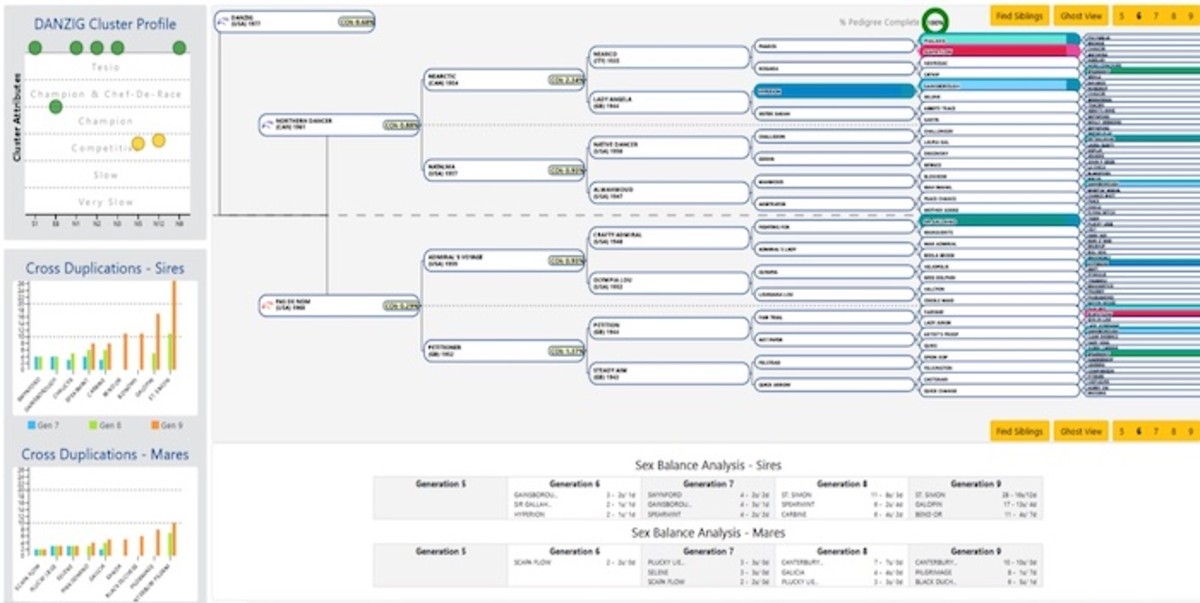
A Deep Dive On Danzig With Pedigrees 360 Software

Danzig is one of the few global breed shapers in the world today, dominant for precocious speed. He is the sireline of champion stallions on every racing continent including Danehill in Australia, War Front in North America, and Invincible Spirit in Europe

This pedigree deep dive breaks out the components of Danzig's pedigree and analyses it from four angles:

– Inbreeding (six generations) (Good)

– Linebreeding (nine generations) (Extraordinary)

– Sex-Balancing (Amazing)

– Full and three-quarters siblings (Excellent)

Danzig's pedigree profile page.

Click here to read the full Pedigrees 360 analysis and explanations of inbreeding, linebreeding, sex balancing, and full and three-quarters siblings.

Click here to visit Pedigrees 360 for more information on this pedigree analysis tool.

The post A Deep Dive On Danzig With Pedigrees 360 Software appeared first on Horse Racing News | Paulick Report.
Source of original post

New Officers, Board Members Announced For Consignors And Commercial Breeders Association

The new officers and board members for the Consignors and Commercial Breeders Association (CBA) were installed at its most recent meeting. Walker Hancock of Claiborne Farm will move from Vice President to become President, Rob Tribbett of Watercress Farm has been named Vice President and Lynn Hancock of Stone Farm will serve as Treasurer. Outgoing president Allaire Ryan will continue to serve the organization as past president.

The board consists of 15 members: eight from the top 20 consignors and seven from other consignors and commercial breeders. Each year a portion of the board rotates off and new board members are appointed to fill those positions from among eligible CBA members.

Scott Mallory (Scott Mallory, Agent), Samantha McGreevy (Taylor Made Sales) and Caroline Wilson (SF Bloodstock) will be joining the board for 2023. Allaire Ryan and Walker Hancock have been appointed to another term.

Those continuing to serve are Conrad Bandoroff (Denali Stud), Carrie Brogden (Machmer Hall Sales), Neal Clarke (Atlas Farm/Bedouin Bloodstock), Pat Costello (Paramount Sales), Liz Crow (ELiTE Sales), Tommy Eastham (Legacy Bloodstock), Lynn Hancock (Stone Farm), Adrian Regan (Hunter Valley Farm), Rob Tribbett (Watercress Farm) and Sean Tugel (Eclipse Thoroughbred Partners).

“The CBA is very appreciative of Allaire's work and progress she made during her time as President. She took the CBA to a new level and I'm pleased to continue to work with her as she takes on her new roll as Past President. I look forward to embracing the many challenges ahead and will work hard to represent all consignors and breeders in hopes of making the sales space better for everyone involved.” said incoming President, Walker Hancock.

The CBA is a trade organization with more than 300 members. The association's membership accounts for over 80 percent of the annual auction revenue in North America, as either breeder or consignor. The CBA works democratically on behalf of every consignor and commercial breeder, large and small, to provide representation and a constructive, unified voice related to sales issues, policies and procedures. The Association's initiatives are designed to encourage a fair and expanding marketplace for all who breed, buy or sell Thoroughbreds.

The association was founded in 2005 and is based in Lexington, Ky.

The post New Officers, Board Members Announced For Consignors And Commercial Breeders Association appeared first on Horse Racing News | Paulick Report.
Source of original post

Verified by MonsterInsights