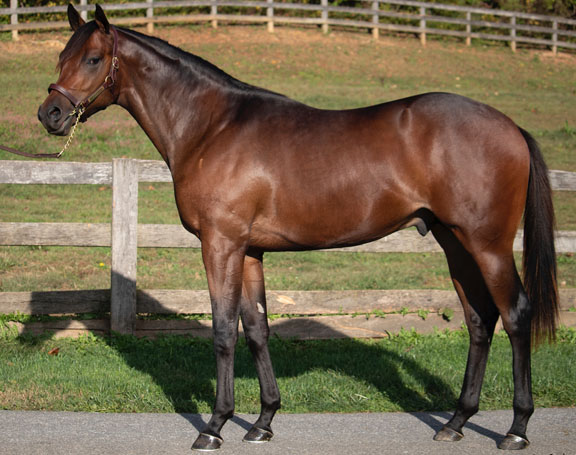
With their superior intelligence, Thoroughbreds are as capable of training their people as much as their people train them. Such is the case with Godolphin's homebred Micheline, who is entered in Saturday's $500,000 Queen Elizabeth II Challenge Cup (G1) Presented by Dixiana.
The 3-year-old filly by Bernardini out of 2007 Juddmonte Spinster (G1) winner Panty Raid convinced her connections early on that she requires special accommodations to lessen her claustrophobia, and she has thanked them by earning $445,978 with four wins, including the Sept. 10 Dueling Grounds Oaks at Kentucky Downs.
Micheline and her companion horse, Colonel, arrived at Keeneland early Thursday morning from trainer Mike Stidham's base at Fair Hill Training Center in Maryland with some unusual baggage: a portable stall. The housing of four wood-lined farm gates and fitted gray tarp for a ceiling soon was assembled outside the Stidham barn, and Micheline took up residence inside with Colonel in the main barn.
“Whenever she ships to another track, that stall goes with her,” Stidham said.
During her early training in Florida, Micheline was so claustrophobic that she was turned out in a paddock instead of residing in a stall. Before she relocated to Fair Hill, an outdoor stall was built.
“She lived there for the summer and then last winter when we went to Tampa Bay Downs, Godolphin bought her a portable stall so she could live just outside the barn,” Stidham said.
While Micheline's situation is unusual, horsemen routinely conjure up clever methods to manage racehorses' individual behaviors. Some horses relax with a goat, small pony or donkey as a companion. Others enjoy a window in the stall between themselves and their next-door neighbor. Inquisitive types like to see plenty of activity, while introverts are more comfortable in a quiet section of the barn.
Micheline has excelled with her special treatment. Third in her career debut last year, she next won the Sorority at Monmouth Park. She opened 2020 with a runner-up effort in the Feb. 1 Sweetest Chant (G3) at Gulfstream Park, and she won Gulfstream's Honey Ryder on May 2. Overall, she has a 4-1-1 record from 11 starts.
“She has been at Fair Hill since her last race and has been training well,” Stidham said. “We are happy that we were invited to the Queen Elizabeth II.”
Florent Geroux will ride Micheline in Saturday's race. Stidham and Geroux won the 2015 QE II with Her Emmynency.
4th-KEE, $70K, Msw, 2yo, 6f, 2:50 p.m. ET
Pricey Rising Empire (Empire Maker) is one of two signed on here for Larry Jones. The $275,000 Keeneland September yearling blossomed into a $700,000 OBSAPR juvenile after a powerful :10 1/5 breeze. He’s half to the long-winded GSW and ‘TDN Rising Star’ Rocketry (Hard Spun). Fox Hill Farms Inc.’s Trump Card (Nyquist) is out of a precocious mare who earned a big figure for a June 2-year-old debut before finishing third in Saratoga’s GIII Schuylerville S. He was a $210,000 KEESEP grad. Cool Quest (Frosted), who cost $10,000 more at the same auction, is half to hard-knocking Canadian champion grass horse Grand Adventure (Grand Slam), who did take the GIII Summer S. as a juvenile. TJCIS PPs
5th-KEE, $71K, OC ($75K), 2yo, f, 6f, 2:50 p.m. ET ‘TDN Rising Star‘ Inject (Frosted) looks to atone for a duel-and-fade eighth-place run in the GIII Pocahontas S. on the stretch out and quick turnaround at Churchill Sept. 3. In her prior start, the daughter of GISW Appealing Zophie (Successful Appeal) and half to GI Belmont S. winner Tapwrit (Tapit) aired by six lengths going short at Ellis Aug. 15. The $390,000 KEESEP buy earned a strong 82 Beyer Speed Figure for her unveiling. Feeling Mischief (Into Mischief), a daughter of precocious GSP True Feelings (Latent Heat), is half to this year’s GIII Robert B. Lewis S. runner-up Royal Act (American Pharoah) and from the family of champion 3-year-old filly Wait a While (Maria’s Mon). She’s been off since an eight-length procession on debut at Colonial Downs Aug. 3 and ships in from trainer Michael Campbell’s Arlington Park base. TJCIS PPs
10th-KEE, $70K, Msw, 2yo, f, 1m, 6:18 p.m. ET
Reiko and Mike Baum’s Illiogami (Tapit) makes her first start here for trainer Rusty Arnold. The $400,000 KEESEP buy is out of talented turfer Odeliz (Ire) (Falco), a Group 1 winner in France and Italy who was also a close second in the 2014 GI E. P. Taylor S. at Woodbine. Candace O (Declaration of War) is a full to 2018 GIII With Anticipation S. hero Opry. Information Mosaic (Bernardini), a $125,000 September pick-up, is out of GSP Artemis (Empire Maker). Her third dam is La Gueriere (Lord At War {Arg}), who annexed the 1991 GI Queen Elizabeth II Challenge Cup S. here before producing the likes of GISW Icon Project (Empire Maker) and the dam of Munnings. TJCIS PPs
Tommy Drury, Jr. had never won a graded stakes race until Bruce Lunsford's Art Collector captured Keeneland's Toyota Blue Grass (G2) less than three months ago. But he'd certainly played a role in the training process for a lot of graded-stakes winners.
Now, after more than 30 years in the trenches and behind the scenes, Drury is embarking on his Triple Crown debut with Art Collector in Saturday's Preakness Stakes (G1) at Pimlico. His sudden burst into racing's spotlight follows decades of paying his dues, both with horses at the top of the game and low-level claimers. Drury's own racing stable consisted mostly of the claimers and horses likely to race at smaller tracks in the region. Any stakes horses or well-bred 2-year-olds likely were being prepared for other trainers.
“I always joked with everybody, 'Eventually one of these horses is going to fall through the cracks,' ” Drury said. “We've kind of been patiently waiting, and that's exactly what happened with Art Collector. The stars aligned for us and it just worked out.”
The 49-year-old Drury represents the thousands of men and women in this country and the world who work seven days a week with horses and never get a chance in the spotlight. On the racetrack, it's known as waiting for the big horse to come in.
Of all things, the health pandemic put the big horse in Drury's life.
Lunsford planned to make a training change when he sent Art Collector to Drury in January to get ready off a layoff. But with the intended trainer, Rusty Arnold, stuck down in Florida for a couple more months in the wake of the COVID outbreak, Art Collector ran with Drury officially his trainer for the first time on May 17 at Churchill Downs. He won by 2 3/4 lengths.
Drury assumed Art Collector would be leaving his barn. But Lunsford — and Arnold — had decided that Drury deserved to keep the colt. That was also the conclusion of Seth Hancock, the head of Claiborne Farm, which long has boarded Lunsford's mares and stands the owner's Grade 1 winner First Samurai at stud. Claiborne also has had horses with Drury.
“I sent Bruce a text and said, 'We're never going to know if he's a good trainer if we don't give him a chance,'” Hancock said of Drury. “Bruce was going to leave him with him anyway, and the rest is history…. And I admire the heck out of Rusty because I think he sent Bruce a text and said, 'You know, that horse ran too good for Tommy Drury. Don't move him to me.' Boy, that's something that doesn't happen anymore.”
Art Collector is Drury's first real shot at the big time, and, so far, he's handled things flawlessly. The son of 2006 Preakness Stakes winner Bernardini is 4-for-4 in his care, winning two Churchill Downs allowance races, the Blue Grass and then the $200,000 RUNHAPPY Ellis Park Derby — all by open lengths and in fast times.
When Art Collector nicked the fleshy part of his left front heel during a routine gallop the day before entries for the Kentucky Derby, Drury did not hesitate to take the colt out of the race. Never mind how big it would have been for Lunsford and him to have their first Derby starter at their hometown track. If he couldn't be 100 percent, Drury didn't want to run. The focus immediately turned to the Preakness.
“I admire what he did before the Derby,” Hancock said. “He could have patched him up, got him over… that's why I like the guy. He always does the right thing by the horse.”
Brian Hernandez Jr., who rides Art Collector, knows what a single horse can do for a career — as Fort Larned did in carrying the jockey to victory in the 2012 Breeders' Cup Classic (G1).
“It's huge for Tommy,” said Hernandez, the trainer's close friend. “I think that's been the best thing about this whole deal, all the press and everything he's getting. People are finally starting to see that, hey, he can get a good horse to the right races. He's done a great job for his whole career training. Now it's gotten to the next level, and that's what you need. It just took the right horse for everybody to see it. And it will be good for him in the long run as well. His stock will get better, and hopefully it will snowball for him.”
Two understated labels of honor in horse racing are calling someone a “horseman” and “a worker.” Drury, by all accounts, is both.
Patty Drury had her only child when she was 16. Thomas Drury Sr. was an exercise rider who generally trained a cheap horse, two or three on the side. Patty Drury can't remember a time when her son didn't want to train horses, at least once he realized his dream of being a jockey wasn't going to happen.
“Tommy is the only person I have ever met who has always known what he wanted to do and has worked toward that without ever changing,” she said. “Tommy has always, always wanted to work with the horses. It's the love of the horses. When he was born, we lived on a horse farm so he's been around horses his entire life.
“He's been telling me since he was about 9 that he was going to have a horse in the Derby some day. As I watched him grow, it seemed like he found his spot in racing. It didn't look like it would really lead to the Derby, but he was making a really good living. Gosh, I'm his mom. If he wins any race, I'm excited. It might as well be the Derby for me if Tommy is in the winner's circle.
“The way he's just stuck to it and built his business, it stays in the back of your mind that, yeah, he could just make this happen. Getting one into the Preakness is every bit just as good. It's not at home, but it's just as fantastic… It's just exciting, unbelievable. I don't even know the words, to be honest. I love it. I love each interview. Maybe it was Mr. Lunsford who said Tommy is the best-kept secret around the racetrack. I have to agree with that.”
Drury attended Marion C. Moore High School near the southern Louisville suburb of Okolona, an area best known in the sports world for producing star quarterback Phil Simms. Okolona is about 14 miles from Churchill Downs, but Drury found a way to get to the track on weekends. He quit school over Patty's objections, telling his mom that they couldn't teach him what he needed to learn.
Drury later earned his GED, but in the meantime, his education moved to Skylight Training Center in Oldham County, east of Louisville and where his dad was working.
“It seemed like he always had something that had been turned out for a year,” Drury said of his father's stock. “There was always something. You couldn't gallop it; it would run off. You don't think about it at the time but now, looking back, I got a lot of education from those horses. It certainly wasn't uncommon to walk into his barn and there would be three horses and two would be standing in ice tubs. Those kinds of horses, they make you a horseman.”
At the same time, Drury Sr. preached to the teenage Tommy, “If you're going to do this, you need to work for the bigger outfits.”
Drury officially began as an exercise rider at age 17 and got his trainer's license at 18. Like his dad, he also worked for other trainers — Frankie Brothers, Bill Mott, Brian Mayberry, a short time for D. Wayne Lukas and Steve Penrod.
“I was kind of like my dad for the next 10 years,” said Drury. “I'd always have a horse, a couple of horses, and galloped on the side. You could just pay attention to how those guys did things, and I started to incorporate some of that into my program.”
Still, he said, “I never thought in a million years I'd be in this situation….
Yeah, there were a lot of days where I drove back from Beulah Park after the last race, had a four-hour drive home and we beat one horse in a 'non-winners of two' for $3,500. It wasn't like I just showed up and got these kinds. There were a whole lot of years getting to this point. It's certainly not something I'm ever going to take for granted.”
A career break came in the unlikely form of Drury being turned down for stalls at Churchill Downs. Drury and his tiny stable returned to the Skylight training center. But rather than being banished, it proved an opportunity, with Hall of Fame trainer Bill Mott sending him a few overflow horses.
“That's when guys started giving me the opportunity to leg up young horses and things of that nature, guys I'd galloped for,” Drury said. “Bill put me on the map. He gave me an opportunity when no one else would, sent me a couple of horses. You tell people for years, this is what I do, this is what I want to do. And nobody really pays much attention. Then all of a sudden you're able to say, 'Hey I've got horses for Bill Mott', and suddenly you have the credibility you need to get going. That's helped me expand. Whether it's Bill or Frankie, Ralph Nicks, Al Stall. All these guys have been such lifelines.
“One of the things I learned from Bill was that you might not be where you want to be today, but with a little patience and time, six months from now you might be exactly where you want to be.”
Horses such as current top older horse Tom's d'Etat, 2011 Breeders' Cup Juvenile winner and 2-year-old champion Hansen and Grade 1 winners Lea and Madcap Escape were all in Drury's care at some stage. The Frank Brothers-trained Madcap Escape, who earned $1 million while going 7 for 9, was one of his first horses for Lunsford.
“He's had his hands on quite a few good horses. He just never had the opportunity” to keep them, Hancock said. “And he's getting that opportunity with Art Collector and making the most of it.”
Today, Drury's operation has about 50 horses at Skylight and 10 at Churchill Downs. His business is about evenly split between his own racing stable and preparing 2-year-olds to race and older horses to make a return to the races for other trainers.
“I've watched him very closely, and I came to the conclusion that if you look at Mott, Frankie and Shug (McGaughey) — all of whom I'm close to — they started as claiming trainers and small guys building their thing,” Lunsford said. “As they did, they did a lot more direct work on horses. So when they got to the better horses, they knew how to get them through injuries and how to do things. Tommy does, too. He had the same kind of background.”
For Drury, it was like winning the Breeders' Cup Classic when Claiborne Farm's 6-year-old gelding Departing – a five-time stakes-winner and $1.9 million-earner who ran in the 2013 Preakness for trainer Al Stall – won a $100,000 stakes at Indiana Grand in his first start for Drury in 2016.
“Can't believe I just won the biggest race of my career, and doing it for Claiborne Farm just makes it that much more special!” Drury wrote on Facebook. The trophy, which he strapped behind the seatbelt, rode shotgun on the drive back.
Departing was second in his next start, coming out with an ankle problem. As much as Drury wanted the gelding to get to $2 million, just because he thought the horse deserved it, he told Hancock he thought it best that Departing be retired.
“Tommy said, 'You know, given who he is, I don't want to try to patch him up and go on. I think it's best we stop on him,'” Hancock said. “That was the right thing to do. Every horse we ever had with Tommy, whatever he would tell me, in my mind it was always the right thing to do. I thought, 'Well, this guy is sure enough all right.' I just became really fond of him, not only as a trainer but as a human being and person. I admired his work ethic, everything about him.”
In a two-month span two years ago, Drury, the father of 19-year-old Matt and 16-year-old Emma, went through the death of his own dad, who had led a difficult and sad life in later years that included addiction and homelessness, and an unexpected divorce. Amidst it all, the dog who'd served as his trusty companion for many years died.
Hancock said he couldn't change anything or alleviate the pain Drury was experiencing, but just maybe this was the time for him to start thinking about his career, his own dreams. As part of that, Drury again started having horses stabled at Churchill Downs, which boosted his profile even before Art Collector. This winter, he might have a small string in New Orleans — the first time he's had horses stabled outside the Louisville area.
“Throw the horses out of it,” Drury said of Hancock. “He's taken me under his wing, and he's a close friend and advisor. His support and encouragement give me the confidence to go out and swing for the fences when it comes to my career.”
Whether Art Collector wins or loses the Preakness, he definitely has raised Drury's trajectory. Lunsford withdrew Art Collector's yearling half-brother (out of the mare Distorted Legacy and sired by the super-hot stallion Into Mischief) from Keeneland's recent auction. The youngster figured to fetch a huge price, but Lunsford instead will race the horse with Claiborne as partner and Drury the trainer.
“We want to help Tommy have a great career,” Lunsford said.
For up-and-coming horsewoman Sabrina Moore, co-owner and operator of GreenMount Farm in Glyndon, Maryland, two of her greatest accomplishments revolve around Maryland breeding and racing.
Last year Knicks Go (Paynter), a colt she co-bred with her mother Angie Moore, was named Maryland-bred Horse of the Year after winning the 2018 edition of the GI Claiborne Breeders’ Futurity and running second in the GI Breeders’ Cup Juvenile behind Eclipse Award winner Game Winner (Candy Ride {Arg}).
{"id":3,"instanceName":"Articles No Playlist","videos":[{"videoType":"HTML5","title":"GreenMount Farm's Sabrina Moore ","description":"","info":"","thumbImg":"","mp4":"https://player.vimeo.com/external/463243423.sd.mp4?s=9edd38c392a47ba5a2b490471439765dcf42f9e7&profile_id=165","enable_mp4_download":"no","prerollAD":"yes","prerollGotoLink":"prerollGotoLink","preroll_mp4_title":"preroll_mp4_title","preroll_mp4":"https://player.vimeo.com/external/457768014.sd.mp4?s=4c622a4137c4a6dbc07e85af3da7af49dd5142e9&profile_id=165","prerollSkipTimer":"5","midrollAD":"no","midrollAD_displayTime":"midrollAD_displayTime","midrollGotoLink":"midrollGotoLink","midroll_mp4":"midroll_mp4","midrollSkipTimer":"midrollSkipTimer","postrollAD":"no","postrollGotoLink":"postrollGotoLink","postroll_mp4":"postroll_mp4","postrollSkipTimer":"postrollSkipTimer","popupAdShow":"no","popupImg":"popupImg","popupAdStartTime":"popupAdStartTime","popupAdEndTime":"popupAdEndTime","popupAdGoToLink":"popupAdGoToLink"}],"instanceTheme":"light","playerLayout":"fitToContainer","videoPlayerWidth":720,"videoPlayerHeight":405,"videoRatio":1.7777777777778,"videoRatioStretch":true,"videoPlayerShadow":"effect1","colorAccent":"#000000","posterImg":"","posterImgOnVideoFinish":"","logoShow":"No","logoPath":"","logoPosition":"bottom-right","logoClickable":"No","logoGoToLink":"","allowSkipAd":true,"advertisementTitle":"Ad","skipAdvertisementText":"Skip Ad","skipAdText":"You can skip this ad in","playBtnTooltipTxt":"Play","pauseBtnTooltipTxt":"Pause","rewindBtnTooltipTxt":"Rewind","downloadVideoBtnTooltipTxt":"Download video","qualityBtnOpenedTooltipTxt":"Close settings","qualityBtnClosedTooltipTxt":"Settings","muteBtnTooltipTxt":"Mute","unmuteBtnTooltipTxt":"Unmute","fullscreenBtnTooltipTxt":"Fullscreen","exitFullscreenBtnTooltipTxt":"Exit fullscreen","infoBtnTooltipTxt":"Show info","embedBtnTooltipTxt":"Embed","shareBtnTooltipTxt":"Share","volumeTooltipTxt":"Volume","playlistBtnClosedTooltipTxt":"Show playlist","playlistBtnOpenedTooltipTxt":"Hide playlist","facebookBtnTooltipTxt":"Share on Facebook","twitterBtnTooltipTxt":"Share on Twitter","googlePlusBtnTooltipTxt":"Share on Google+","lastBtnTooltipTxt":"Go to last video","firstBtnTooltipTxt":"Go to first video","nextBtnTooltipTxt":"Play next video","previousBtnTooltipTxt":"Play previous video","shuffleBtnOnTooltipTxt":"Shuffle on","shuffleBtnOffTooltipTxt":"Shuffle off","nowPlayingTooltipTxt":"NOW PLAYING","embedWindowTitle1":"SHARE THIS PLAYER:","embedWindowTitle2":"EMBED THIS VIDEO IN YOUR SITE:","embedWindowTitle3":"SHARE LINK TO THIS PLAYER:","lightBox":false,"lightBoxAutoplay":false,"lightBoxThumbnail":"","lightBoxThumbnailWidth":400,"lightBoxThumbnailHeight":220,"lightBoxCloseOnOutsideClick":true,"onFinish":"Play next video","autoplay":false,"loadRandomVideoOnStart":"No","shuffle":"No","playlist":"Off","playlistBehaviourOnPageload":"opened (default)","playlistScrollType":"light","preloadSelfHosted":"none","hideVideoSource":true,"showAllControls":true,"rightClickMenu":true,"autohideControls":2,"hideControlsOnMouseOut":"No","nowPlayingText":"Yes","infoShow":"No","shareShow":"No","facebookShow":"No","twitterShow":"No","mailShow":"No","facebookShareName":"","facebookShareLink":"","facebookShareDescription":"","facebookSharePicture":"","twitterText":"","twitterLink":"","twitterHashtags":"","twitterVia":"","googlePlus":"","embedShow":"No","embedCodeSrc":"","embedCodeW":720,"embedCodeH":405,"embedShareLink":"","youtubeControls":"custom controls","youtubeSkin":"dark","youtubeColor":"red","youtubeQuality":"default","youtubeShowRelatedVideos":"Yes","vimeoColor":"00adef","showGlobalPrerollAds":false,"globalPrerollAds":"url1;url2;url3;url4;url5","globalPrerollAdsSkipTimer":5,"globalPrerollAdsGotoLink":"","videoType":"HTML5 (self-hosted)","submit":"Save Changes","rootFolder":"https:\/\/wp.tdn.pmadv.com\/wp-content\/plugins\/Elite-video-player\/"}
“When Knicks Go got Horse of the Year for the Maryland-bred awards, that was really special to me,” Moore recalled. “I’m a little biased, but I love Maryland. I love all the history. To know his name is always going to be there was really cool. We claimed his dam off the track and she was very near and dear to my heart. I thought once in my lifetime I might get a graded stakes horse when I was 50 or something, but for it to happen so soon and out of a mare that was so special to me, it was really surreal.”
This summer, a Bernardini yearling that GreenMount Farm co-bred was named Champion at the annual Maryland Horse Breeders Association’s Yearling Show.
“I’ve been attending the yearling show for years, so to come out on top was something that was so special to me,” Moore said. “The filly had a rough start. Her mom actually had colic surgery when she was by her side. I typically sell as weanlings, but I held onto her because I didn’t feel like she was at her full potential, and I’m really glad I kept her.”
The filly out of stakes winner Mystic Love (Not For Love) went on to bring $100,000 at the Fasig-Tipton Selected Yearlings Showcase, selling to Frank Brothers as agent for StarLadies and Mathis.
Moore’s interest in the industry was piqued early in her childhood when her family moved to Glyndon, Maryland- a community less than 20 miles from Pimlico Race Course.
“As a kid, I loved horses,” Moore said. “My mom went to the Preakness every year and that’s kind of what got the ball rolling. I loved watching the Preakness. I wanted to work with horses, but I didn’t know how. Little did I know how involved everything was to get into it.”
After graduating high school, Moore took a job at a breaking farm, and then worked a stint at the track.
At the same time, her mother was involved in several broodmare partnerships. Eventually, the mother-daughter duo decided to go out on their own.
“We picked up a free broodmare, which was probably the most expensive thing we ever invested in,” Moore said with a laugh.
As their small broodmare band grew, Moore’s local veterinarian encouraged her to foal out the mares herself at their family’s GreenMount Farm.
“She taught me everything,” Moore recalled. “At first it was just our own horses, but there was a need in the neighborhood to outsource and I started picking up clients.”
Now just a few years later, Moore foals out up to 30 mares a year, but she’s discovered her real niche in working with yearlings.
“When I first started, I would take babies out of fields and just start handling them,” Moore said. “It was so rewarding to take these horses that were not so thrifty and sometimes badly behaved, and turn them into professional animals that could do their jobs.”
Moore grew increasingly fascinated with the sales aspect of the business, so she started working with agent and consignor Bill Reightler.
She recalled her first time attending the Keeneland November Sale, “When I got there, my jaw dropped. I was so impressed with the quality of horses. I wanted every bit of it. So I made a five-year plan and I told Mr. Bill, ‘Eventually I want to consign on my own.'”
After working with Reightler for the appointed five years, she took the plunge.
“It was really scary to go out on my own and try to find my own clients,” Moore admitted. “You have to get confident really quickly and be bold. It took a lot of courage, it was a lot of learning and it really pushed me out of my comfort zone.”
The GreenMount Farm banner was first on display at the Fasig-Tipton Midlantic Fall Yearling Sale in 2017 and has been a fixture at the auction since.
“I love Timonium,” Moore said of taking her consignment to the annual Midlantic yearling sale. “Primarily I have Maryland-breds, so selling them here makes more sense. I try to bring nice horses so they stick out more as bigger fish in a smaller pond, as I like to say. But it’s getting tough over the years. There’s some really nice horses here and people are picking up on it. I don’t feel like it’s a disadvantage here instead of going to Kentucky because for a regional market, it’s fantastic. I think if you have the right horse that fits the sale, you’ll sell just fine here.”
In just a few days, Moore’s self-run consignment will have its largest group at the fall auction to date with 10 yearlings cataloged under the GreenMount Farm banner for the two-day sale starting on October 5.
“This year, I feel like I have a really nice, diverse group going in,” Moore said. “I have some higher-end horses and some regional horses that may not have the fanciest pedigrees, but are useful, correct horses that anybody will be able to benefit from.”
Of the current market going into the auction, Moore said, “I was expecting it to be a lot worse, and I think the sales companies have done a really good job in getting horses sold. I’m pretty optimistic. I think everyone is still going to be showing up with their checkbooks.”
Moore has been dipping her toes in the pinhooking game for several years, but she has hopes that one yearling in this upcoming sale could be her breakout find.
Yearling Klimt colt out of Cabo Time | Sara Gordon
At last year’s Keeneland November Sale, the first crop of weanlings by Klimt (Quality Road) stuck out to her.
“I didn’t go down specifically looking for them, but I just kept seeing them in the book. They were so nice physically, but they were selling well and I thought, ‘Man, I should probably move on.'”
When she saw the last Klimt weanling on her short list go through the ring, a colt out of the stakes-placed mare Cabo Time (Grand Slam), she couldn’t leave him behind and purchased the youngster for $36,000.
“After I saw him, I wasn’t really high on anything else. So I went over my budget a little bit,” she admitted. “I hope it will pay off. He’s matured into a really nice horse and I think he’ll suit anybody. He’s really attractive, correct and athletic. I’m hoping he’ll turn some heads.”
Catalogued as Hip 484 for the upcoming Fasig-Tipton Midlantic Fall Yearling Sale, the colt will go through the ring during the second session of the auction.
Moore said she hopes that this sale will serve as a gateway to continue to build her consignment and grow her pinhooking program. While she plans to take her consignment to Lexington someday, her home base will continue to be in Maryland.
“I think when you have a Maryland-bred, it’s a pretty lucrative deal. Our breeder incentives are really nice, and Fasig-Tipton [Timonium] is right up the street. We have a lot of really talented trainers and year-round racing. We have some really nice local stallions for people that want to breed regionally. In the long run, [the Maryland program] helps the breeder out a lot. I think you’re well off here.”