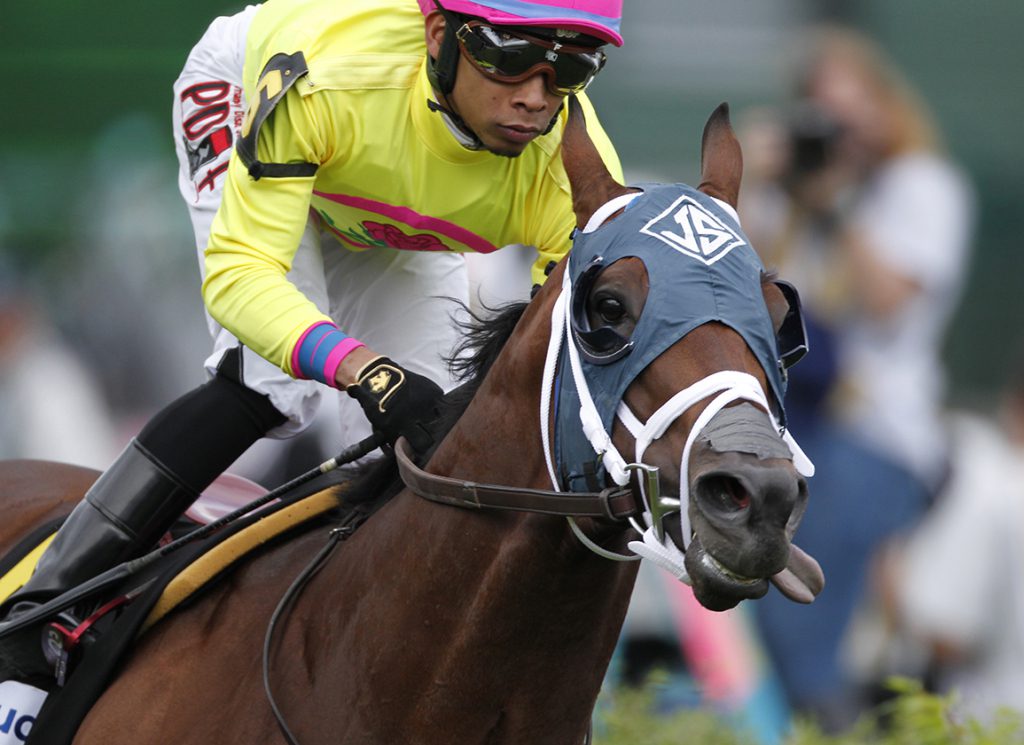
Mischievous Angel Goes Last-To-First To Graduate At Belmont

1st-Belmont, $90,000, Msw, 6-17, 3yo/up, 6fT, 1:08.74, fm, 3/4 length.
MISCHIEVOUS ANGEL (g, 3, Into Mischief–Sabrina's Angel, by Scat Daddy), the only first-time starter in the field and the 2-1 selection with a $600,000 purchase price, spotted the field a step at the break and had only a single rival behind him through a half mile in :45.26. He began to make up ground as the leaders hit the far turn and tipped out to be five wide with room to run at the top of the stretch. Pacesetter Beer Run (City of Light) gave way as Mischievous Angel closed strongly on the outside and prevailed by three-quarters of the length to graduate on debut. Sabrina's Angel, herself a half-sister to GI Xpressbet Florida Derby winner Audible (Into Mischief), is still to be represented by a 2-year-old Curlin filly and a yearling filly by Practical Joke. Sales History: $600,000 Ylg '21 FTSAUG. Lifetime Record: 1-1-0-0, $49,500. Click for the Equibase.com chart or VIDEO, sponsored by TVG.
O-Peter M. Brant and Parkland Thoroughbreds; B-Parkland Thoroughbreds (KY); T-Chad C. Brown.

The post Mischievous Angel Goes Last-To-First To Graduate At Belmont appeared first on TDN | Thoroughbred Daily News | Horse Racing News, Results and Video | Thoroughbred Breeding and Auctions.

Source of original post

Who Will Be This Year’s Leading First-Crop Sire?

From this year's class, which freshman sire will emerge on top? And what sire currently flying under the radar will be the year's biggest surprise? With 2-year-old sales season upon us, over the next few days, we will be hearing from some of the experts.

NIALL BRENNAN

Top Pick: Vino Rosso (Curlin–Mythical Bride, by Street Cry {Ire}). Spendthrift Farm, 2023 fee: $15,000.

The Mitoles were popular at the yearling sales and they sold well at the OBS March sale. They look like they will be early types. There will be some pressure on him because the expectation for him will be for him to get quite a few 2-year-old winners. I have a Vino Rosso who is quite nice. I'll pick Vino Rosso and the reason is, he was a very good racehorse and has the pedigree. He was a very good older horse. But from what we've seen so far, they have quite a bit of maturity and look like they could be summer 2-year-olds. That's impressive for a stallion where you might think they'll be better later on. From the Vino Rossos, I am seeing athleticism and mental maturity. It's between Mitole and Vino Ross, but I'll give the edge to Vino Rosso.

Under-the-radar pick: Demarchelier (Dubawi {Ire}–Loveisallyouneed {Ire}, by Sadler's Wells). Claiborne Farm, 2023 fee: $5,000.

   My under-the-radar pick will be Demarchelier, a son of Dubawi who stands at Claiborne. He was an excellent racehorse in the making who won his first three starts before he got hurt. That reminds me of Danzig, who only had three starts and was retired. I'm not comparing him to Danzig. I'm just saying it is a similar story. He's the only son of Dubawi to stand over here and he had a lot of talent. I bred a mare to him because I thought he was a super value. Like Oscar Performance, he's going to have to step up and prove himself because he's a turf horse standing in America. They are average-sized, which he was. I have two that I really like. They are sharp and forward. I saw a couple breeze well at the March sale. I wouldn't be surprised if he comes up with four or five nice 2-year-old winners on the grass. He has the quality to do that. He has the potential to break out and have some really nice turf horses.

CARRIE BROGDEN

Top pick: Audible (Into Mischief–Blue Devil Bel, by Gilded Time). WinStar Farm, 2023 fee: $25,000.

I think that every year, the early chatter about who is good and who is going to struggle is very telling, so I have learned to listen to that. Last year in January and February, all the talk was about Bolt d'Oro. The year before in January and February, it was Gun Runner. So we bred three mares to him on his bubble year, off the early chatter. So I'm going to have to go with the horse that everyone was talking about, and that was Audible. With Bolt d'Oro, every single person you talked to had one they liked. I felt that was the case this year with Audible. At Saratoga, we sold an Audible filly to MyRacehorse named Lady Blitz, and I bought a microshare just to keep up with her. She has just gone to Todd Pletcher's barn and she is the real deal. Now, full disclosure: I have a share in Audible, but we have shares in a lot of stallions. Before the speed works and everything, that early chatter tells you who the horses are that like to train.

Under-the-radar pick: Maximus Mischief (Into Mischief–Reina Maria, by Songandaprayer). Spendthrift Farm: 2023 fee: $7,500.

Once again, I'm very biased here. We pinhooked him, raised him, sold him at Saratoga, stayed in on him with Cary Frommer, and took him to the 2-year-old sale. He was very fast. I think his horses look just like him. I'm biased, but I do feel like he's got a big shot. He throws a very different physical than Audible, who seems to throw a stouter body type. He was slightly long, and he throws a big, long horse.

JARED HUGHES

Top pick: Omaha Beach (War Front–Charming, by Seeking the Gold). Spendthrift Farm, 2023 fee: $30,000.

I've liked Omaha Beach from the start and he hasn't disappointed at any step of the way. Great physical from a tremendous female family and they've looked like runners as weanlings, yearlings, and now 2-year-olds. I'm excited to see what he can do this year.

Under-the-radar pick: Solomini (Curlin–Surf Song, by Storm Cat). McMahon of Saratoga, 2023 fee: $6,500

The under-the-radar pick is tricky this year due to a lack of depth, but I've liked the Solominis. He was a good 2-year-old who finished first in a Grade I and looks like he could be a standout in the New York market. Curlin is hot as a sire of sires right now with Good Magic waving the flag with three in the Derby.

Want to send in your first-crop sire selections? Email suefinley@thetdn.com.

In tomorrow's TDN: more first-crop sire picks (and lots of red, red wine).

The post Who Will Be This Year’s Leading First-Crop Sire? appeared first on TDN | Thoroughbred Daily News | Horse Racing News, Results and Video | Thoroughbred Breeding and Auctions.

Source of original post

Who is Most Likely to be Leading Freshman Sire of 2023?

With the 2-year-old sales season having kicked off and the first 'baby' races of the year ready to get going in a few weeks, laser focus will be placed on the up-and-coming first-crop stallions. Rightfully so, as we all hunt in earnest for the next breakout young sire. Could there possibly be another Gun Runner in the freshman class of 2023?

A total of 16 young guns in North America have 50 or more current 2-year-olds resulting from their first covers in 2020. A great many more have fewer than 50, but numbers beget opportunities. The leading freshman sire of 2023 is likely to be one of those 16.

It's also a good bet that Spendthrift Farm may repeat Bolt d'Oro's 2022 success as the leading freshman sire, as four of the top five freshmen by number of 2-year-olds stand at the Central Kentucky Farm.

The 16 newcomers are concentrated in Kentucky, with one each also in New York and Florida. What almost all have in common is plenty of sire power behind them. Including two freshmen by Curlin and two by Into Mischief, all of the sires of these leading 16 freshmen have thrown Grade I winners themselves, but not all of their sire sons have done the same.

Conformation, dam side, and athleticism of the new 2-year-olds aside, let's examine the hard evidence based solely on elite performance of other sons at stud by the same sires. Which of these 'Sweet 16' is most likely to find success based on how other sons by their sires have fared?

Audible and Maximus Mischief, both by Into Mischief, standing for $25,000 at WinStar Farm, 150 2-year-olds (Audible), and for $7,500 at Spendthrift Farm, 135 2-year-olds (Maximus Mischief)

It's impossible to overlook Into Mischief, who is coming off his fourth general sire championship. He's got an embarrassment of riches with a plethora of up-and-coming young sire sons in the next few years, including Kentucky Derby winners Authentic and Mandaloun, as well as four-time GISW and Breeders' Cup winner Life Is Good. Getting the first jump are GI Florida Derby winner Audible and GII Remsen S. winner Maximus Mischief. Into Mischief's first major sire sons are Goldencents and Practical Joke, both of whom have already sired a U.S. GISW. In addition, Practical Joke has hot Derby prospect and MGSW Practical Move. Audible was particularly popular at OBS March, with his top two each working in :10 and bringing $500,000 and $425,000, respectively.


And the second freshman by Into Mischief for 2023:


Catalina Cruiser, by Union Rags, standing for $15,000 at Lane's End, 110 2-year-olds

Holding the distinction of being the fourth generation of his sire line (Union Rags-Dixie Union-Dixieland Band) to stand at Lane's End, five-time graded winner Catalina Cruiser could be the first big-time sire son for Union Rags. The latter's only other sire son in a major market is Free Drop Billy, whose first-crop sophomores have not yet broken through on the graded stage. Catalina Cruiser's top 2-year-old specimen at OBS March breezed in :21 and brought $400,000 post sale.


Catholic Boy, by More Than Ready, standing for $15,000 at Claiborne Farm, 104 2-year-olds

Any horse that can win the GI Belmont Derby on grass in July and the GI Travers S. on dirt just over a month later has to be taken seriously. The late More Than Ready was the dual hemisphere phenom whose sire sons include Australia's late Sebring (Aus), sire of at least eight Group 1 winners; the exported Verrazano with one U.S. Grade I winner and two Chilean Group 1 winners; Gimmethegreenlight (Aus) with six Group 1 winners spread between Australia and South Africa; Daredevil, whose first-crop exploits included both a Classic winner and a GI Kentucky Oaks winner; and Custom for Carlos, who stands in Louisiana and came up with a U.S. Grade I winner despite averaging just 45 foals a year.


Demarchelier (GB), by Dubawi (Ire), standing for $5,000 at Claiborne Farm, 70 2-year-olds

Even as the first known son of Dubawi at stud in the U.S., GSW Demarchelier will not suffer from pedigree anonymity as Dubawi is arguably the top sire in Europe. At least five of his sire sons have been responsible for Grade I or Group 1 winners on their own: Al Kazeem (GB), Makfi (GB), New Bay (GB), Night of Thunder (Ire), and Poet's Voice (GB).


Enticed, by Medaglia d'Oro, standing for $5,000 at Darley, 103 2-year-olds

Like Curlin, Into Mischief, and War Front, who also have freshmen sons with first juveniles this year, Medaglia d'Oro is one of the elite stallions of Kentucky with the sustained success of umpteen Grade I winners to his credit. Among his sons, two have sired Grade I winners to date, with Violence holding the top spot as far and away his best sire son so far. Violence has four GISWs, including current Derby favorite Forte. Medaglia d'Oro also has Astern (Aus) with a Group 1 winner in Australia and Bolt d'Oro as last year's top freshman who has not yet broken through with a Grade I winner. Enticed himself was precocious, winning the GII Kentucky Jockey Club S. and placing in the GI Champagne S. at two.


Flameaway, by Scat Daddy, standing for $7,500 at Darby Dan Farm, 116 2-year-olds

MGSW Flameaway's late sire ignited early with his first runners and his success just magnified after his death at age 11. Among the late Scat Daddy's sons to sire a Group 1 winner to date is his undisputed sire son leader No Nay Never, as well as the classy Caravaggio. And then there's Triple Crown winner Justify, who gives the sense he's knocking on the Grade I door after his first American and Australian crops yielded five graded/group winners.

Leofric, by Candy Ride (Arg), standing for $7,500 at Darby Dan Farm, 56 2-year-olds

After the success of Gun Runner, Candy Ride sons are a hot commodity and he will have a steady pipeline of sons with first runners in the coming years, including champion Game Winner and MGISW Vekoma (both with first yearlings this year), as well as GISW Rock Your World (first weanlings this year). GI Clark H. winner Leofric is the early bird among the group that follows Candy Ride's two sire sons who have achieved out-of-this-world success: Gun Runner and Twirling Candy. The former, with only two crops to race, has sired a spectacular six GISWs and another five Grade I performers. The latter is no slouch either, accounting for seven Grade I winners from his eight crops to race. Both also have sired Classic winners. Clearly, when Candy Ride hits, he hits big.

Mitole, by Eskendereya, standing for $15,000 at Spendthrift Farm, 158 2-year-olds

A champion and MGISW who helped contribute to his dam being crowned Broodmare of the Year for 2021, Mitole is one of three freshmen who are charting new territory for their own sires by attempting to become their first established son in the sire ranks. Eskendereya was exported to Japan in 2015 when Mitole was just a foal. The stallion's only other known sire son in the U.S. is Mor Spirit, who stands alongside Mitole at Spendthrift and has yet to have a graded performer in his first crop (now sophomores). Buyers at OBS March liked what they saw: the top three Mitole 2-year-olds all worked in :10 and brought $350,000, $325,000, and $300,000, respectively.


Omaha Beach, by War Front, standing for $30,000 at Spendthrift Farm, 138 2-year-olds

The brilliant Omaha Beach, a triple Grade I winner, looks every bit the part of a stallion who's going to make it. No matter how you look at it–whether it's his sire, the bottom side of his pedigree, his own race performance, his first yearlings–he's hard to fault. Among his first 2-year-olds at OBS March was a $690,000 filly who worked in :9 4/5. The venerable War Front, sire of a surplus of Grade I winners, has had three sons who have made it to the big stage as sires thus far: Declaration of War with Grade I/Group 1 winners in the U.S., Australia, France, and Canada; The Factor with two U.S. GISWs; and Hit It a Bomb with an Argentinean Group 1 winner. Omaha Beach and Classic winner War of Will (first yearlings this year) are among War Front's top sire prospects yet.


Preservationist, by Arch, standing for $10,000 at Airdrie Stud, 76 2-year-olds

GI Woodward S. winner Preservationist and fellow GISW Instilled Regard (whose first foals are currently yearlings) are the last top horses by the late Arch, who died in 2016 just prior to the breeding season, to go to stud. Arch has had two sons sire GISWs: the late Archarcharch, whose last crops were in Korea, and Blame, who has sired five GISWs and counting.


Solomini and Vino Rosso, both by Curlin, standing for $6,500 at McMahon of Saratoga Thoroughbreds, 78 2-year-olds (Solomini), and for $15,000 at Spendthrift Farm, 178 2-year-olds (Vino Rosso)

Is there any limit to Curlin's prowess as a sire? Last year, he topped his own sire and grandsire (Smart Strike and Mr. Prospector)–who tied with a dozen other stallions by siring two Eclipse winners in a single year–when he made history as the only sire to ever have three individual Eclipse winners in a single year. Like Candy Ride and Into Mischief, he's got a number of sons with first crops to the races on the horizon. This year, it's his champion and GI Breeders' Cup Classic winner Vino Rosso and his MGISP Solomini who will send their first juveniles to the races. Curlin has no fewer than four sons who have sired Grade I winners: Good Magic (whose first crop is just three this year), Connect and Keen Ice (whose first crops are four), and Palace Malice. Both Vino Rosso and Solomini had a number of first juveniles at OBS March: Vino Rosso's top was a :9 4/5 breezer who hammered for $550,000 and Solomini's best worked in :10 and brought $200,000.


St Patrick's Day, by Pioneerof the Nile, standing for $3,500 at Journeyman Stallions, 71 2-year-olds

A maiden winner at two and graded-placed at three, St Patrick's Day has the lightest race record of this group, but he's a full-brother to Triple Crown winner American Pharoah. Although the late Pioneerof the Nile has a number of very useful sons at stud, American Pharoah is the first who has broken through with any Grade 1/Group 1 winners. He has a half-dozen of those to his name.

World of Trouble, by Kantharos, standing for $5,000 at Hill 'n' Dale Farm, 89 2-year-olds

A wickedly fast GISW on both dirt and turf, World of Trouble might be the biggest wild card among the freshmen sire ranks in terms of sire power. The only other son of Kantharos at stud in a major market is Bucchero, who stands in Florida and has yet to have a graded performer in his first crop (now sophomores).


Yoshida (Jpn), by Heart's Cry (Jpn), standing for $10,000 at WinStar Farm, 101 2-year-olds

A Grade I winner on both dirt and turf, Yoshida is the only known son of Sunday Silence's Heart's Cry standing in Kentucky. Among Heart's Cry's sire sons is Just a Way (Jpn), who has a 2-year-old champion and Group 1 winner in Japan. Heart's Cry just passed away Mar. 9.

The post Who is Most Likely to be Leading Freshman Sire of 2023? appeared first on TDN | Thoroughbred Daily News | Horse Racing News, Results and Video | Thoroughbred Breeding and Auctions.

Source of original post

Value Sires for ’23, Part IV: First Runners Due

No getting away from it, the young stallions we assess today have already completed their service to many breeders. They've processed a debut crop of yearlings, often on an industrial scale, and many have obliged with the kind of averages that vindicate the familiar, self-fulfilling commercial cycle that so favors new sires: demand generating supply, and the quality incidental to that increased supply in turn increasing demand.

That leaves us with another tricky podium. You can't just congratulate those who have “won” on this system, topping out the first-crop yearling averages. Because the ostensible losers, the ones with disappointing yields and sliding fees and books, have an imminent opportunity to show that they can produce horses that actually run. As such we have remained loyal to a couple of longstanding favorites.

Even for those that meet the initial challenge, it can be a ruthless system. If there's anything more ridiculous than the fidelity to unproven new sires it's the impatience with which most will be promptly abandoned. It's impressive, then, to see how some farms that deal unabashedly in volume are striving to prolong that brief window of opportunity. They might do so with incentive schemes, or by using their home herds, or with the precarious (but true) sales pitch that it's perseverance now-precisely when other breeders are backing nervously away from racetrack exposure-that would yield the biggest return with those sires that do actually elevate their reputation, once people can judge their stock not on a sales dais but out of a starting gate.

Those breeders subscribing to a fourth book this spring know that the resulting foals will enter yearling catalogues at a time when their sires have had a proper chance to show their wares. The first crop will have reached maturity; the second will have had their own crack at the Triple Crown; and a third crop of juveniles will meanwhile have launched. That's why maintaining the flow is so helpful: with a “loaded pipeline,” any stallion that does land running has a chance to keep his name in lights pending the production of foals delivered by the better mares arriving to pay a rising fee.

The farm that dominated this intake-recruiting its first, second and joint-third most expensive start-ups, as well as a cheaper one with outstanding commercial appeal-did so as a striking adaptation of its success with cheaper stallions that had been promoted by various pioneering incentives. Spendthrift could make this upgrade using more conventional, fee-based math. But other hallmarks of its dynamic program remained applicable. Knowing that turnover would be high, they could pitch even these better stallions at a relatively tempting fee; and the dividends duly achieved at the sales by many clients can now be played up, if so disposed, by returning to the same stallion at a reduced fee.

The system has been working smoothly, not only for Spendthrift but for others operating on a similar scale, with several of these stallions having maintained high turnover into third books last season; and largely vindicated, meanwhile, at the yearling sales. But now, in 2023, comes the crunch. We'll begin to find out whether the huge opportunity earned by these stallions will actually be seized by the cavalry of juveniles approaching the gate.

And who knows? We often see these prolific newcomers, with their hundreds of mares, overtaken by neglected rivals once the time comes for deeds, not words.

Bubbling Under:
Measured purely by their auction reception, this intake appears to have registered some pretty strong trends already. Certain sires will be launching their first runners with some conspicuous contrasts in the levels of market confidence behind them.

The big winners, it must be said, have largely worked the numbers game: the four highest averages by debutants at the yearling sales, in fact, were all achieved by the only four stallions that sent over 100 into the ring. To a degree, however, “that horse has bolted.” The quest for value, in the longer term, requires at least some attempt to swim against the tide. Yes, the top gun on our podium happens to be the top gun at the sales-but, as we'll see shortly, we feel he retains plenty of eligibility measured strictly in terms of value.

In the meantime, AUDIBLE certainly deserves a moment of congratulation. Yes, he's one of those that have assembled a staggering harem, starting with a book of 221 and since following through with 189 and 148. But while the sheer breadth of his catalogue footprint will obviously have resulted in a wide spectrum of vendor experiences, he has responded with plenty of headlines.

After reaching $103,813 with his first weanlings, he sold as many as 111 of the 123 offered as yearlings for an average $147,072. Almost inevitably, their progress was not quite so dramatic when measured by median, up to $110,000 from $87,000. But that does mean some major scores were celebrated (topped by a $725,000 colt at Keeneland September).

What's huge for this fellow, however, is that the weanlings offered from his second crop held up exceptionally well. He sold 18 of 22 offered at $96,277 ($87,500 median) and, after a mild clip to $22,500 last year, that has helped WinStar restore his opening fee of $25,000. Anyone with a stake in Audible will be feeling justifiably excited.

MAXIMUS MISCHIEF, another son of Into Mischief, we have long highlighted as too blatant a commercial play not to succeed. He duly received all the numbers that seemed inevitable and has proved equal to that turnover at the sales, advancing his $42,777 weanling average last year to $57,019 for 77 yearlings sold of 93 offered. He takes a break from the podium only because his weanling/yearling medians were essentially stagnant ($39,000/$40,000), while his second crop of weanlings slipped to an average of $25,000 for just 13 sold of 23.

Maximus Mischief | Spendthrift

His precocious profile almost guarantees some big pinhook scores in Florida next spring, however, and conceivably enough early momentum on the track to have a role in the freshman championship. That's certainly the way his supporters must be thinking, as he has followed opening books of 198 and 171 by receiving another 195 mares in his third year at Spendthrift-a pretty stunning vote of confidence. He remains virtually a bet to nothing at $7,500.

Another standing at the same fee, FLAMEAWAY, drew some attention at the yearling sales. Though a tier below the best of his crop, he has been given the volume necessary to recycle versatility and durability of an elite European family. The son of Scat Daddy corralled no fewer than 183 mares in his debut season at Darby Dan, and processed 66 of the 85 offered as yearlings for $49,340-doubling their weanling average of $25,720-including a $425,000 colt at Saratoga. He has maintained three-figure books over the past couple of years, so has every chance of consolidation if igniting on the racetrack from these sparks of commercial promise.

BRONZE: PRESERVATIONIST (Arch-Flying Dixie by Dixieland Band)
$10,000 Airdrie

If you liked this fellow at the outset-and I loved him-then why on earth would you leave precisely at the moment he can turn the dial in his favor?

As a rule, I feel nervous of sires with a major deficit between average and median in their first market testing. But that's more of an issue, to me, with overtly commercial sires trading huge books. The fact is that a horse with Preservationist's profile was never going to start out with consistent demand across the modern marketplace. He was always going to appeal to more far-sighted breeders, who recognized a precious genetic package at an affordable price; and who reckoned him eligible to put a winner under their mare, while hoping that his excellent physique might in the meantime yield the odd score in the sales ring.

And he got plenty of those. Prices like $280,000, $260,000 and $250,000 represented home runs that could only be envied by many who felt they had made a more commercial wager. (And remember that the colt he got into the first session of the September Sale, a rare distinction for a $10,000 rookie, had to be scratched.) Overall Preservationist averaged $40,542 for 47 yearlings sold of 59 offered.

Preservationist | Sarah Andrew

Predictably enough, his books dwindled through his second and third years but he did have a three-figure team to get him started and has obviously produced some pretty striking specimens among them. His own template might suggest that there is a long road to ride first, as he was six when he won his Grade I going two turns. But actually he had plenty of speed, breaking his maiden in 1:09.35. And, besides, anyone who rowed in with him will primarily have been excited that such regal lines–putting King Ranch matriarchs Courtly Dee and Too Chic opposite each other–should have combined to produce an animal of elite appearance ($485,000 yearling when his sire was standing for $30,000) and performance.

The four mares in his dam's third generation include Natalma, Weekend Surprise and Too Chic; and the dynasty (18 graded winners under first three dams!) has been freshly decorated by the emergence of Olympiad, who is out of a half-sister to Preservationist's dam. The latter was herself sadly lost after just two foals, and it's interesting to note that the other ran 46 times and stakes-placed at eight. We know that a son of Arch with his first two dams by Dixieland Band and A.P. Indy will put a lot of “run” into the sheer class of this pedigree. If he only has a fleeting commercial opportunity, at least to start with, here's a horse equipped to draw every last ounce of merit from your mare.

It just feels very auspicious that Preservationist should have produced several yearlings with serious commercial appeal. The bottom line is that no horse in this intake would surprise me less, if happening to turn up a Kentucky Derby winner-and that's not the way he is priced.

SILVER: WORLD OF TROUBLE (Kantharos-Meets Expectations by Valid Expectations)
$5,000 Hill 'n' Dale

I know, I know. This is beyond bold. Because this horse feels aptly named right now. His third book dwindled to 27, and he's now standing at one-third of his opening fee. And there's an obvious reason why. Let's put a name to the elephant in the room: Jason Servis. This was an ex-claimer elevated to stardom by a man facing jail for a doping program.

But let's do something that sets us apart from that person, and try to show some respect to the horse. Sharp Azteca, after all, was trained by another confessed villain in Jorge Navarro-but demonstrably has the genetic merit, whatever suspicions people may have nursed, to have sired more individual winners this year than any other freshman.

World of Trouble, remember, flaunted a ton of natural ability for another trainer before joining Servis, winning by 14 lengths on debut and then beaten half a length in a stakes race, miles clear of the rest, despite bumping the rail. Whatever else may (or may not) have been assisting him later on, moreover, it takes unusual and inherent flair to switch from dirt to turf as indifferently as did World of Trouble when posting his big numbers in the GI Carter H. and GI Jaipur Inv.

So, whatever fears or suspicions people may have, this was an uncommon horse in his own right. And I just feel that he perhaps deserves a second chance after an intriguing market debut, given the reservations that will have been nursed–rightly or wrongly–by many investors.

On the face of it, an average $40,756 for 46 yearlings sold of 56 offered was no more than solid. Of this whole intake, however, no other sire achieved a median ($37,000) so close to his average. Where a lot of his peers were boosting their averages with a handful of home runs from some pretty enormous books, World of Trouble was looking after the people who had used him in a far more consistent way.

A ceiling of $170,000 might be relatively unspectacular, but even that is hugely creditable in such difficult circumstances. And, by giving his stock a platform to demonstrate whether or not they can actually run, one or two pinhookers may end up banking a major dividend from that kind of base come the 2-year-old sales.

Remember that World of Trouble was bred to be very fast. His dam is a Valid Expectations half-sister to prolific sprinter Bucchero-himself, of course, by World of Trouble's sire Kantharos.

World of Trouble | Horsephotos

Look, I don't know. But nor do any of us. I feel sorry for the horse and for any who, having acted in good faith, now find themselves facing steep odds-whether the excellent farm that stands him, or its clients. And the fact is that people obviously liked his stock well enough, perhaps almost despite themselves.

Just imagine if it turns out that everyone has been doing World of Trouble an injustice, and he proves able to throw that speed as a natural genetic inheritance? It's not impossible, and the gamble can now be tried at very small stakes.

GOLD: OMAHA BEACH (War Front-Charming by Seeking The Gold)
$30,000 Spendthrift

All they have to do now is show that they can run. Because if a stallion's career were confined only to a market launch-and that, of course, is precisely how many breeders view things-then this fellow would be quite a paragon.

It might seem pointless, to highlight the guy with the top fee and (by a street) top average of this class. But we've had him on the podium throughout, purely as a value call, and he can only ascend to the top step now that he has delivered in such spectacular fashion at the sales-even as he has taken repeated cuts in fee.

Omaha Beach has proved an ideal vehicle for this particular system: a tempting fee based on high volume; a good yield, as a result, for very many breeders (if obviously not all); in turn incentivizing repeat custom at a diminished fee; and so opening a new cycle.

We liked him even at $45,000, so how could we resist at $35,000 and then $30,000? He was still the same package, a brilliant speed-carrying grandson of Danzig from a celebrated family. And all that has happened in the meantime is that his stock has passed its first auction test with flying colors.

What we especially like is that his excellent weanling returns last year have turned out just to be a base for giddy additional gains: he advanced his $112,736 weanling average ($95,000 median) to $201,689 for 81 yearlings sold of 105 offered ($160,000 median). That's some collective “pinhook”! If these horses are impressing ever more, as they mature, then that has to augur well for the 2-year-old sales next spring-and also, naturally, for their introduction to what is supposed to be their real purpose in life.

Of course, a third consecutive book of over 200 can only work if he now delivers in that way, too. But if he does, this will potentially be the last opportunity to remain ahead of the value curve. As noted above, Audible has also done everything his supporters could have hoped, to this point. But he will cost you $25,000, just as he did at the outset, whereas Omaha Beach will now require only an extra $5,000, instead of an extra $20,000.

By no means all of us feel comfortable with the industrial model that has developed both horses, but they have shown how it can function at its most efficient. And, having started out at the higher fee, Omaha Beach will presumably have received superior mares, too: quality, in other words, to match the quantity.

This time next year, will he have produced the flagship horses to start moving his fee back up? That's the next gamble, but this horse obviously has a lot of believers. And, if you do believe, now is the time to double down.

The post Value Sires for ’23, Part IV: First Runners Due appeared first on TDN | Thoroughbred Daily News | Horse Racing News, Results and Video | Thoroughbred Breeding and Auctions.

Source of original post

Verified by MonsterInsights