Practical Joke Colt Tops Texas Yearling Sale

GRAND PRAIRIE, TX – A colt by Practical Joke brought $110,000 to top Monday's single-session Texas Thoroughbred Association (TTA) Summer Yearling Sale at Lone Star Park.

By the numbers, a total of 175 yearlings sold for $3,240,000. The figures represented a decrease from 2022 when 161 sold for a record $3,416,000 in gross receipts. This term, the average was $18,542, while the median was $11,000 and 77 horses reported not sold.

Foster Bridewell, Director of Horse Sales for the TTA, said of the auction, “Three of our top five offerings were Texas-breds, so that was good to see,” he said. “This was one of our largest catalogs in the history of this sale and we had buyers from several key quadrants–Kentucky, Ocala, California and across the Lone Star State.”

A Practical Topper For Al Pike

Offered as hip 122, the dark bay was purchased by Al Pike, acting as agent. The Apr. 30 foal is out of SW Jan's Perfect Star (Imperialism), dam of UAE Jebel Ali Sprint hero Road Bloc (Street Sense). The native Texan from Palestine, and his wife Salley, relocated this past summer to Highlander Training Center, outside of Dallas. A regular on the pinhooking scene, Pike frequents a bevy of juvenile sales, including OBS March, Fasig-Tipton Midlantic and the Texas 2-Year-Old In-Training Sale.

Practical Joke colt (hip 122) | Olivia Friesen/TTA Sale

Pike said he saw this yearling as an opportunity.

“This one is for me and partners,” said Pike. “I thought he was a stunning Practical Joke, beautiful horse, and I think he's going to grow to be really special. It's just the Practical Joke that sold it and he had some pedigree too. I just thought he was a beautiful colt. This will be one to pinhook for the spring and we'll probably look to go to OBS March.”

Bred by Michael and Linda Mazoch of Texas, the colt was consigned by Scott Mallory, agent.

“He came from Buena Madera and they always do an excellent job in preparing the horses for the sale,” Mallory said. “And it makes it a whole lot easier when you get to the sale because they are well presented. With the recent success of Practical Joke, we kind of thought he'd be fairly popular with the sale. He vetted good, handled himself well up there. And with Texas coming up with the $40,000 maiden special weights, we knew that would add an extra bid or two. I didn't quite think he'd bring $110,000, but I'm happy about it. We thought he'd sell well–I thought he'd sell for $70,000 or $80,000, but $110,000 is excellent.”

Vekoma Colt Takes Home Silver

Late in the session, hip 260, a chestnut colt by Vekoma, brought $90,000 from pinhooker David Scanlon. Out of Winning Saga (Tale of the Cat), the May 12 foal was raised and prepped at Elm Tree Farm in Kentucky and consigned by agent Scott Mallory, who also consigned the topper.

“This colt just showed well the whole time, he had a great disposition, he just looks like he is going to turn into a really beautiful 2-year-old and he was bred by Dr. Fred Willis from Louisiana,” said Mallory.

Competitive Edge Colt Reminds Asmussen of Ryvit

The third highest-priced yearling of the session was taken home by Steve Asmussen's KDE Equine for $85,000. Hip 24, consigned by Highlander Training, was bred by Valor Farm in Pilot Point, Texas.
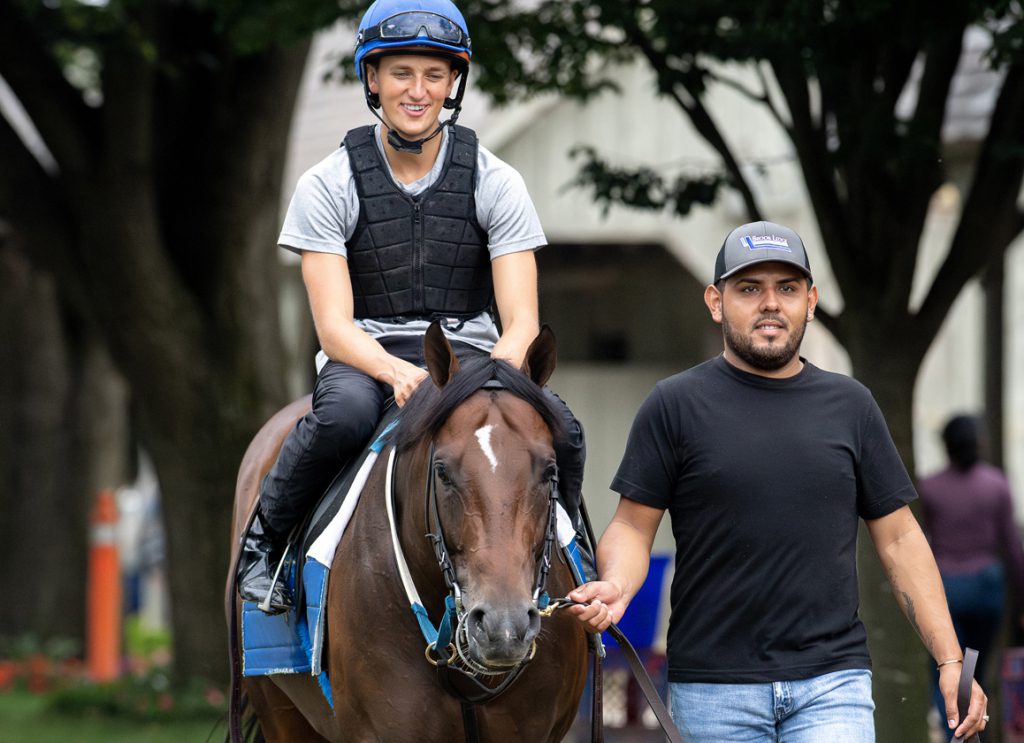
Ryvit schooling at Saratoga with Erik Asmussen up | Sarah Andrew

The Feb. 16 foal is the first foal out of unraced Better Than Mo (Uncle Mo), who counts MSW More Than Most (Indygo Mountain), MSW Worldventurer (Wimbledon) and GIII Miss Preakness S. scorer Red Ghost (Ghostzapper) as half-siblings. His third dam MGISP Alysbelle (Alydar) is a full-sister to Horse of the Year Alysheba.

Asmussen indicated Monday's purchase was prompted by another Texas sale graduate, GIII Chick Lang S. victor Ryvit (Competitive Edge).

“A couple of years ago, I got Ryvit out of this sale,” explained the Hall of Famer. “I think that there are blue collar horses and they have to earn their keep. And it had everything to do that he reminded me of Ryvit. Just a very sturdy and athletic-looking horse and, hopefully, we can create a similar circumstance.”

On behalf of his client Whispering Oaks, Asmussen also purchased hip 110, a Louisiana-bred colt by Spun to Run out of SP Hilarious Brown (Big Brown) for $80,000, in addition to a dark bay filly by Competitive Edge out of Conquest Bebop (Scat Daddy) (hip 51), who also brought $80,000.

Complete sales results can be found here.

The post Practical Joke Colt Tops Texas Yearling Sale appeared first on TDN | Thoroughbred Daily News | Horse Racing News, Results and Video | Thoroughbred Breeding and Auctions.

Source of original post

Casner: Synthetic Tracks Are Safer – Here’s Why

Horse racing is at a survival tipping point. The catastrophic breakdowns that continue to haunt our industry at all tracks racing on dirt is sickening.  The decisions that are made in the short term will determine whether horse racing can endure as we know it. The American public has no tolerance for what they perceive as a sport that is immersed in carnage.

The one decision that would be a major game changer and perhaps offer the potential salvation for the future of horse racing is to convert our racing surfaces to synthetic, beginning with our major tracks.

In the Jockey Club Equine Injury Database (EID) for the year 2022, injuries on dirt were 1.44 per 1,000 horse starts. Turf injuries were 0.99 per 1,000.  Injuries on synthetic were vastly diminished with 0.41 per 1000. This data shows that synthetic surfaces are 3.5 times safer than dirt and 2.2 times safer than turf. These statistics are compelling in showing the exponential safety of today's synthetic surfaces over dirt and turf.

The data is compelling but it doesn't tell “why” synthetic tracks are safer. In 2006, I chaired the shoeing committee for The Jockey Club Welfare and Safety of the Racehorse Summit. We were tasked to examine the safety of toe grabs, which Dr. Sue Stover at the University of California-Davis had shown to significantly contribute to breakdowns. We employed sophisticated high-speed cameras with a closed group of nine horses provided by the jockey school Chris McCarron was leading to understand why toe grabs were contributing to breakdowns. We filmed hoof contact with the racing surface using a variety of shoes with varying toe grab lengths on dirt surfaces and on Keeneland's synthetic track.

The results were dramatic. What we learned was the effect of “slide” on the lower limb of the horse. With Queens plates, the front foot has an average slide on dirt of 3 ½ to 5 inches. The average slide on synthetic was 1 ½ inches. Slide is important to understand. It's the “give” in a horse's stride.

The increased length of slide on dirt causes two things to happen. First, it magnifies torque on a horse's lower limb.  If a horse “toes in” the limb incurs torque medially because of the increased forces on the outside of the hoof. If they toe out, then the torque is lateral with the increase forces on the inside of the foot. And when horses step in holes on a dirt track, the torque can go either way. This doesn't happen on synthetic tracks because of the shorter slide, which greatly diminishes torque. Also, a horse's foot is always landing flat on a synthetic surface as opposed to the cuppy holes that cover a dirt track. Synthetic also provides a much higher energy absorption than dirt with a higher energy return.

A synthetic track with its diminished slide provides a quicker “breakover” which reduces energy expenditure. This is why so many more horses are in the race at the head of the lane. The finishing field spread, first to last, on average goes from 30 lengths on dirt to 20 lengths on synthetic. And because of the diminished energy expenditure, average finishing times have become faster on all tracks that have converted to synthetic.

The second important factor that we were able to measure was the magnified load on the pastern that was presented on dirt. Because of the exaggerated slide and delayed break over on dirt, the pastern continues to load through the stride, increasing its drop by as much as an inch over synthetic.  We were also able to see this increased load when horses landed in the “holes” created on dirt tracks.

As you can visualize, the increased load or drop of the pastern creates excessive strains on the suspensory apparatus of the horse's lower limbs, stretching the “rubber bands” and  magnifying the opportunity for a catastrophic failure. When a horse blows out its suspensory apparatus in a race it leads to a broken leg in the next few strides.

Suspensory and tendon injuries are extremely rare on synthetic but occur way more frequently on dirt because of these magnified strains.

The videos also exposed how lethal toe grabs were on all surfaces. They were especially detrimental on synthetic because they abruptly stopped the foot not allowing any slide. This is why trainers were experiencing hind end and soft tissue injuries early on because they were continuing to use toe grabs on the rear feet.

Catastrophic breakdowns are rarely caused by one bad step although this is more likely on dirt. As most orthopedic surgeons will testify, they are the result of cumulative microscopic injuries that accrue with the thousands of steps a horse accumulates in training and racing. It's the law of physics. Excessive torque and loads on a horse's legs will eventually take its toll. Racing and training on synthetic surfaces greatly diminishes those strains and a horse's natural ability to remodel bone will have a better opportunity to repair and strengthen.

We not only have the irrefutable data over hundreds of thousands of horse starts on synthetic, but we have the notable success of several major tracks that have employed them.

The first is Keeneland. The last meet they ran on synthetic in 2014 was the most successful meet in Keeneland's history at that point. All-time attendance and handle records were set. There were record field sizes, minimal scratches with inclement weather when races were taken off turf. And most importantly, there were zero breakdowns!

Why did Keeneland reconvert to dirt? You need look no further than dirt stallions.

The second is Santa Anita. The last meet run at Santa Anita in 2010 had an injury rate of 0.59 per 1,000 starts. The following year, with dirt racing returned, the fatality rate was 2.94 per 1,000 starts, or five times higher.This is in spite of a poor quality installation that would not properly drain, eventually having a subsurface membrane failure allowing aggregate to float to the surface.

Here are some compelling stats from three tracks currently running on synthetic surfaces: Golden Gate Fields, Presque Isle Downs, and Gulfstream Park.

Golden Gate had an injury rate of 0.38 per 1,000  with 12,986 horse starts in 2021 and 2022 on their Tapeta Surfaces.

Presque Isle race meets in 2021/2022 had  0.24 injuries per 1,000 with 8,178 horse starts.

Gulfstream with its newly installed Tapeta track had the best record of all with only one fatal injury out of 7,085 horse starts with  0.14/1,000. This translates to a 9.7 times safer surface than their dirt track.

Belmont has recognized the advantages of having a synthetic surface with its scheduled completion in the spring of 2024.

Injuries on a national basis have dropped significantly at certain tracks since the implementation of intensified pre-race veterinary examinations of our horses and have the promise of continuing to diminish injuries with mandated requirements by the Horseracing Integrity and Safety Authority.

This current high-level scrutiny of starters combined with the conversion to synthetic tracks will dramatically reduce injuries and show the world that we care.

Horse racing is a sport with a rich history of tradition. The thought of changing the racing surface of the Kentucky Derby to a synthetic surface will not appeal to those that value tradition above the safety of our horses and the survival of our beautiful sport. If we do not take drastic proven steps to significantly eliminate breakdowns we are destined for the fate of Greyhound racing. Today's public has no stomach or tolerance for what they perceive as abuse of our horses.

The “writing is on the wall,” or in our case in the New York Times, CNN, and the six o'clock news. We either quit wringing our hands and doing countless more dirt studies while ignoring the obvious, or we embrace innovative change supported by  data and the laws of physics for the safety of our horses and riders, or we are destined to continue our industry's slow and painful death.

Bill Casner is a longtime Thoroughbred owner and breeder

The post Casner: Synthetic Tracks Are Safer – Here’s Why appeared first on Horse Racing News | Paulick Report.

Source of original post

Verified by MonsterInsights