Lively Trade at Fasig-Tipton July Horses of Racing Age Sale

Early action seemed tepid, but bidding picked up noticeably throughout leading to a lively day of business at the Fasig-Tipton July Horses of Racing Age Sale in Lexington Monday.

“There was lots of activity at all price ranges and a lot of horses got moved and found new opportunities with new buyers,” said Fasig-Tipton President Boyd Browning. “The sale was well-attended. Veterinary activity, which is one of the things that I always look at to kind of evaluate pre-sale interest, was higher this year than last year. We have now had two sales in a row that should provide some confidence in the marketplace.”

The 2-year-old County Final (Oxbow), coming off a runner-up effort in the GIII Bashford Manor S., achieved the night’s highest bid when selling to West Point Thoroughbreds for $475,000. The gray colt was one of six to sell for $200,000 or over on the night.

“It’s rational, but it’s a legitimate marketplace,” Browning said. “It is a balanced market that is equitable for buyers and sellers alike.”

From 182 catalogued lots, 81 sold for a total of $5,072,000. The average was $62,617 and the median was $30,000. There were 38 horses reported not sold for a buy-back rate of 31.9%.

Monday’s auction, coupled with positive results from Fasig-Tipton’s Midlantic 2-Year-Olds in Training Sale two weeks ago, should help to stabilize the market ahead of the fall yearling sales, according to Browning.

“All in all, I am certainly much more encouraged today than I was three weeks ago because we’ve demonstrated with these two sales that there is a viable, legitimate marketplace that exists,” Browning said.

Ennis Scores by a County Mile

Trainer John Ennis heads into the yearling sales each fall working on a strict budget and hoping to take home a yearling who will have success at the track before returning to a horses of racing age auction. The Irishman worked his plan to perfection with County Final (Oxbow) (hip 166), purchasing the colt for just $9,500 at last year’s Keeneland September Yearling Sale and selling him Monday at Fasig-Tipton for $475,000 to West Point Thoroughbreds. In between sales, the gray colt broke his maiden over the turf at Churchill Downs and finished second over the main track in the June 27 GIII Bashford Manor S.

“It was easy to like him really,” Ennis said after watching County Final go through the sales ring Monday. “He looked like a smaller version of what he looked like today. He was a top physical with a professional look to him and a great walk. I’m sad to see him go, but it’s something we’ve got to do.”

Asked about the colt’s bargain basement price last year, Ennis said, “Oxbow, unfortunately, is not that commercial and in the sales ring, especially with yearlings, they want to buy commercial sires. With my budget, buying inexpensive yearlings, I have to go on physicals.”

Ennis was happy to see the colt sell, but he and his partners were prepared to take him home if the price wasn’t right.

“I had a couple of other partners on him and they didn’t mind if we kept him,” he explained. “They would have happily taken him home and taken him to Saratoga and places like that because he’s a runner. They put a high reserve on him and we thought we probably wouldn’t get that because the market didn’t seem that strong. But it was fantastic. I’m over the moon.”

Ennis said the yearling sales-to racetrack-to sales ring route can sometimes be more profitable than pinhooking yearlings to the 2-year-old sales.

“It’s very hard to pinhook yearlings to 2-year-old sales,” Ennis said. “You only get one shot at going a furlong in :10 flat or whatever you need to do and the X-rays have to be super correct at the sales. I feel like, if you buy an inexpensive yearling who looks like a runner and if you win a maiden special weight at some place like Churchill or Keeneland and improve on the next run, no matter who he’s by, they will come and buy him. For me, with my budget, that’s the only way I can do it. I’d love to keep the horse, but this is what I do every year. I love the horse and he’s a fantastic horse. But now it’s back on to September.”

Country Mile will be transferred to the barn of trainer George Weaver with plans to run at Saratoga, according to West Point’s Terry Finley.

“I hope he ends up as a runner, but he’s shown he has a lot of talent,” Finley said. “Everything just fell into place with him and he vetted well. We are going to take a shot. We find that our partners are very open to horses like this that have shown a good bit of ability. It’s very exciting that he ran so well on dirt and turf. We didn’t think he’d bring that much in the ring, but it is what it is.”

Per Capita Joins Red Oak Roster

Recent maiden winner Per Capita (Tapit) (hip 85) will join the Brunetti family’s Red Oak Stable after the operation’s racing manager Rick Sacco went to $325,000 to secure the strapping chestnut from the Gainesway consignment Monday at Fasig-Tipton. The 4-year-old, bred by Gainesway and racing for Gainesway and Peter Brant, graduated in his fourth lifetime start at Churchill May 24 for trainer Chad Brown. He is out of Successful Outlook (Orientate) and is a full-brother to multiple graded stakes winner Anchor Down and graded winner Iron Fist, as well as a half to Grade I winner Sweet Lulu (Mr. Greeley).

“It’s a beautiful page, a very good family and Tapit jumps out at you,” Sacco said of the colt’s appeal. “His race at Churchill was very impressive, not in only in the way he did it, but he ran a 5 3/4s on the sheets, which is kind of extraordinary for a maiden winner, even though he is four.”

Per Capita joins an operation already stocked with older graded stakes performers, led by multiple Grade I winner Mind Control (Stay Thirsty), Grade I placed Bal Harbour (First Samurai), and graded placed King for a Day (Uncle Mo).

“We are trying to buy some racing horses to fill some gaps in our stable,” Sacco said. “We have some good older horses and we are just trying to fill some gaps. This horse came up with all of the curb appeal of the pedigree and then, when I dug into it a little bit more, with the sheet figure that he ran and his physical–he’s a very powerful-looking horse.”

As for where the colt may start next, Sacco said, “I would say we will most likely come back in an a-other-than at Saratoga as the next progression. We haven’t decided who is going to train the horse yet. We wanted to get our hands on him first and then we will figure it out.”

Bradley Strikes for Impeccable Style

Bloodstock agent Pete Bradley, bidding over the phone while in Ocala for the OBS July Sale, went to $275,000 to acquire the graded-placed Impeccable Style (Uncle Mo) (hip 53) on behalf of an undisclosed client. The 3-year-old filly was second behind Shedaresthedevil (Daredevil) in the July 8 GIII Indiana Oaks for the partnership of Gainesway, Catalyst Stable, Paul McInnis, Patty Slevin, LLC and Magdalena Racing and for trainer Ken McPeek.

“It’s not often that you get to buy a graded placed filly who has Oaks points,” Bradley said. “She has been very consistent and she appears to be a filly that is getting better and that’s what we look for when we try to buy a race filly. I think she is a beautiful framed filly. She is a little on the light side, but I’d rather have one on the light side than too heavy. She has some quality to her and obviously she can run.”

A maiden winner at Churchill last September, the dark bay filly was fifth in the GII Rachel Alexandra S. and third in the Bourbonette Oaks earlier this year.

“We are going to give her a little bit of a break just because she will go to a new barn and I always think it’s a good idea to give them a couple of weeks before you do too much with them,” Bradley said. “And then we will point her to some races in September and October.”

Of the final price, Bradley said, “I thought in that price range, she was pretty good value. I think it’s a function of our market being off a little bit, I think she might have been a $350,000 filly last year. I wouldn’t say $275,000 is a bargain, but I’d say that it’s good value for what she is.”

Three Diamonds Restocks

The Wycoff family’s Three Diamonds Farm enjoyed a big day at Keeneland Sunday, winning two races including the GIII Transylvania S. with Field Pass (Lemon Drop Kid), and the operation was busy across town at Fasig-Tipton Monday night. Three Diamonds purchased nine horses at the auction for a total of $499,000.

“We thought there were a lot of nice horses there,” Jordan Wycoff said. “The races are definitely getting tougher because there are fewer of them and there are more horses in them, but we felt it was probably a buyer’s market at this time in the world. We love to race and wanted to go in to the sale like we would any other year, which is to try to buy some good horses that we thought were value that we could race with.”

Three Diamonds’ Fasig purchases were led by Journeyman (Animal Kingdom) (hip 56), who was purchased for $85,000 and is coming off a fourth-place effort in the July 4 GII Eclipse S.

“We like to run on the grass with [trainer] Mike Maker,” Wycoff said of the 4-year-old gelding’s appeal.

Wycoff continued, “There was a lot of Kentucky Downs in our mind as we were looking at these horses. And they might not let us on Saratoga, but we still like winning races there. So that all played a part in buying these horses.”

While the July sale started off slowly, it seemed to build momentum as the evening wore on.

“The sale got really strong at the end,” Wycoff agreed. “We were trying to bid on a few more late and got completely outrun, so we were happy we were able to strike a little bit early. Fifty hips into the sale, I think we had bought six at the time, I was shocked we were able to get those horses for that value and I thought we were going to get a few more. But in the last 100, we got outrun like crazy.”

Three Diamonds has had success buying out of the Fasig July Horses of Racing Age Sale in the past. The operation purchased Cross Border (English Channel) for $100,000 in 2018 and that 6-year-old is now graded stakes placed, while Go Noni Go (Get Stormy), purchased for $100,000 in 2017, won the GIII Bourbonette Oaks.

The post Lively Trade at Fasig-Tipton July Horses of Racing Age Sale appeared first on TDN | Thoroughbred Daily News | Horse Racing News, Results and Video | Thoroughbred Breeding and Auctions.
Source of original post

A Friendly Game Of Texas Holdem?

When playing online Texas holdem there is rarely such thing as a friendly game of poker. If you want to be a winning player at Texas hold em you cannot afford to keep the game friendly. Now you do not have to belittle players and talk trash to win, doing that is simply poor manners and being rude, but you do need to be aggressive in your Texas hold em playing strategy.

A friendly game of Internet Texas holdem consists of not raising the person who is the short stack at the table. A friendly game on Texas holdem online might also include not raising before the flop. There are many techniques that you can use to keep the game friendly, but these friendly techniques are losing techniques.

Particularly when playing a tournament game of free Texas holdem, the goal is to eliminate other players and to be the last one standing. When you get the opportunity to eliminate a player from the tournament you should do so. Allowing another player to remain in the game when you play Texas holdem online is a mistake.

Other players may get frustrated with you when you play Texas holdem aggressively, but your goal is to win, not to make friends. It is acceptable to raise pre flop when you have a good hand, and you should do this even though it may not keep the game friendly. If you are learning how to play Texas hold em you need to be aware that it is appropriate to put another player all in if you have the absolute best hand.

A friendly game of free online Texas holdem would not include a check raise. A check raise is a very effective technique for winning a pot and eventually the game though.

When you play a Texas holdem poker game online you should focus on strategies that result in you winning the game, not making friends.

It is important to be a good sport and to not trash talk though. Trash talking can work against you because other players at the table may make it their sole goal to eliminate you from the game, so be warned.

Multi-pronged Approach To Insect Control Helps Minimize VS Risk

Vesicular stomatitis (VS) is a painful viral disease that causes lesions on the lips, tongue, muzzle, ears, udder, sheath or coronary bands of horses and other livestock. Though most horses recover from the virus on their own, some horses need supportive care to recover.

VS is endemic in southern Mexico and occasionally travels toward the United States. In 2019, 1,144 premises were affected in eight states: Colorado, Kansas, Nebraska, New Mexico, Oklahoma, Texas, Utah and Wyoming. Thus far in 2020, premises in Arizona, New Mexico and Texas have been affected by the disease.

VS can be spread in two ways: through insect vectors and through direct contact with infected animals. To prevent either mode of transmission, increased biosecurity measures should be put in place. This includes implementing strategies to prevent contact of infected animals and contaminated items like feed troughs, tack and equipment.

Using fly spray, fly predators and other methods to control black flies and biting midges, which are known to carry the disease, is important to protect equines from VS. Biting midges love wet areas, so removing wet leaves and mud around troughs or ponds will help minimize potential habitat.

Though most insect activity occurs in warmer months, midges can be more cold-tolerant and spread the disease even in cooler months. It is not known if other insects can transmit the disease, so it's important to control insects on multiple levels, including premise, barn and animal level. This may include keeping horses inside at dusk and dawn or using fans to keep air moving; maintaining well-draining footing around water sources, mowing vegetation and reducing the use of bright lights at night, which attract insects.

Applying insecticides and repellents to animals that are outside is important, but they must be applied repeatedly to be effective. Fly masks, sheets and leg wraps can also be helpful, but must cover where VS lesions occur.

Read more at HorseTalk.

The post Multi-pronged Approach To Insect Control Helps Minimize VS Risk appeared first on Horse Racing News | Paulick Report.

Source of original post

Thanks To Team Effort, OTTB Beats The Odds Against Two Serious Fractures

One morning at Saratoga last summer, a 2-year-old colt lost his rider on the way to the track. After a jaunt around the barn area, he was caught and apparently seemed none the worse for wear, so the pair of them continued on with the work that had been planned for them by the colt's trainer. Both came back to the barn, and for a while, all seemed well. It was until late morning the staff began suspecting something was wrong.

“With some fractures, horses can be sound immediately after they fracture – it's when the adrenaline calms down and they cool out that they can be lame at the walk,” said Dr. Luis Castro of Tiegland, Franklin and Brokken. “We've seen horses come back from racing, even win, and cool out and become lame.”

(Castro requested we keep the trainer and the horse's Jockey Club registered name confidential.)

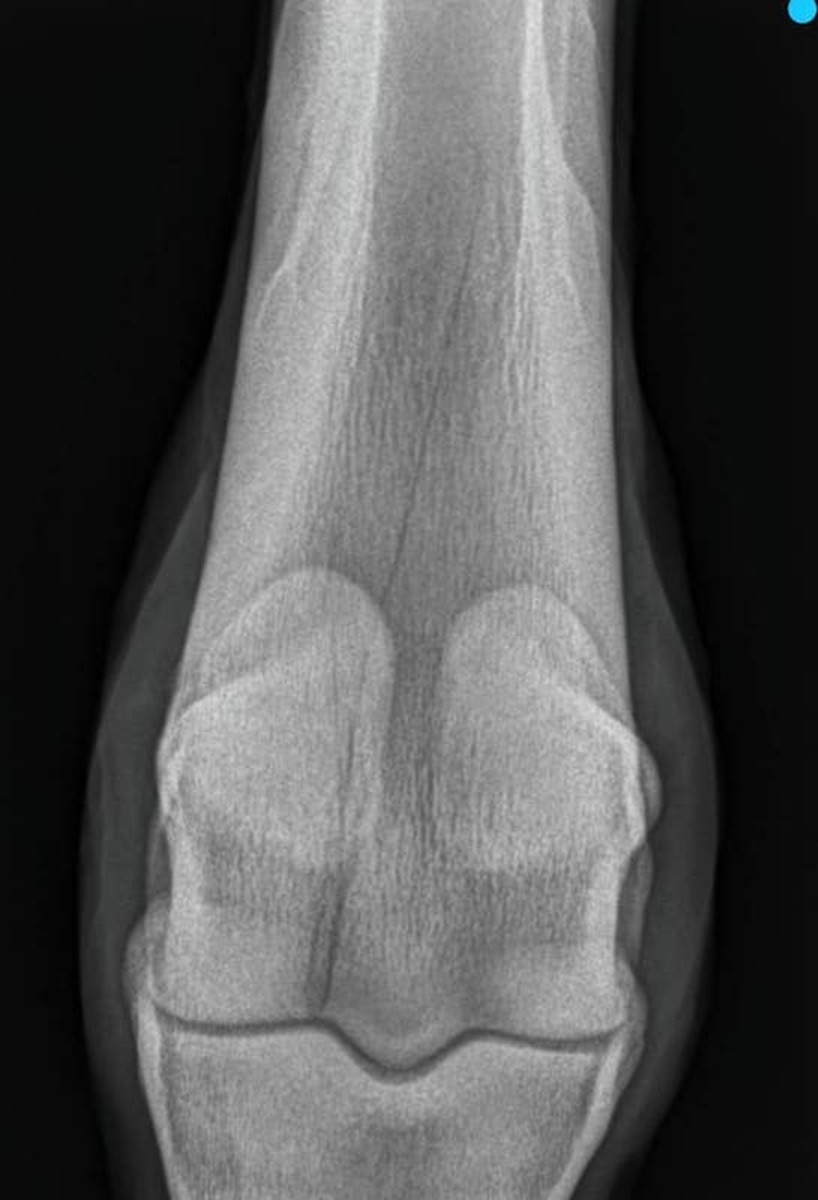
Dr. April Downey, a fellow veterinarian at Teigland, Franklin and Brokken, was called to take a look at the horse. She noticed a lameness in one leg – the other seemed a little abnormal, but not worrisome – and suggested a set of radiographs. Even she wasn't prepared for what she saw in the films.

“The horse had two medial condylar fractures that were spiraling up the leg – left and right front,” said Castro. “I've been doing this a while and I can't remember ever seeing that, to be honest. Condylar fractures are pretty common; medial condylar fractures are less common but not unusual. To see both [legs] at the same time is very unusual.”

“The spiraling fractures that happen medially are in danger of breaking apart pretty easily. They end up going all the way up to the knee and just kind of unraveling. The lateral condylar fractures really don't do that, and that's the one you see more commonly.”

'Medial' refers to the inside of the leg, meaning the horse's fractures started around the ankles and traveled up the insides of each front leg. Spiral fractures are so named because they're the result of a twisting force or impact. In this horse's case, the spiral fractures travelled up the center of the bony column of the cannon bone.

At the time, Castro said he would have given the horse less than a 50 percent chance of survival. The fact the horse had fractures in both legs that could easily worsen was one problem. The horse would have be moved to an equine hospital in order to undergo surgery, inviting more risk. Then there was the risk involved in that surgery – these fractures do best with a plate and sometimes as many as eight screws, but unlike other types of fractures, the biomechanics of the leg can mean the fractures are at risk for further separating if the horse were to take an awkward step when recovering from anesthesia. Then there would be a long recovery with a lot of stall rest, with no room for a misplaced hop of enthusiasm from the young horse.

It wasn't one mountain, but an entire range he would need to get over to survive.

The horse's owner looked at the odds and the expense and wasn't convinced, requesting the horse be euthanized. Castro said he hesitated.

“This horse was kind and he was quiet,” he said. “The best thing about the entire story is that he was the perfect patient. He took care of himself and knew what was going on. I was trying not to euthanize the horse and to give him a chance.”

With very little time to figure out a solution, Castro bought the horse for $1 and a promise not to race him. It was not Castro's habit to buy patients in need, and now he had to figure out what to do with his new horse. He got on the phone and started calling anyone he knew in the area – veterinarians, horsemen – who may be able to help.

In an ideal world, he knew the horse could have undergone a procedure to insert a plate, followed by a pool recovery. A water recovery allows a horse to recover from anesthesia in a weightless state, ensuring they are completely awake before they get back on their feet. Not only was that program expensive, the closest one was at the University of Pennsylvania's New Bolton Center, a five-hour drive away.

Castro reached Dr. Patty Hogan of nearby Hogan Equine, who suggested it may be better to stay close to home and undertake a less complex procedure. Hogan connected Castro with Dr. Katie Dern at Rood and Riddle's Saratoga division and suggested they think about a different type of surgery which could be done standing – meaning, the horse could be heavily sedated and locally anesthetized but not fully unconscious. Dern was game to try what was called a “salvage procedure.”

Rather than inserting a large plate into each leg to stabilize it, the theory was a couple of screws at the base of each cannon bone, combined with a special type of cast up to the knee, could keep everything in place while the top part of the fracture healed.

It was new territory for both Dern and Castro, but they agreed it was the horse's best chance. Castro remembers holding his breath all through the drive from the barn to the clinic and through the procedure.

“It was a bit of a hair-raising situation,” said Castro. “They walk the horse from the stall to the exam room. Dr. Dern is on her knees in front of this tranquilized, blocked horse and she drilled two screws in each leg and he stood there like a champ. Did not move an inch.”

But that didn't mean he was out of the woods yet. Castro knew recovery was contingent on a lot of “ifs.”

“If the two screws hold, if the horse is a calm patient, if no complications occur, you have to put a cast that you cut into a clam shell. You have to create a system where you basically change the bandage underneath and tape it back together, and he's got to stay calm through the whole thing. Oh, and he's got two of them.”

Initial bandage changes went well, and it became clear the horse was ready to leave the hospital, but he also still needed intensive care from the veterinarian team. It made sense to have him back at the track, where Castro and his colleagues could easily check on him frequently, but all horses on the property had to be affiliated with a licensed trainer. Castro again got on the phone and found himself calling longtime client Chad Brown.

“I told one of my clients, Chad Brown, the story and he said, 'Just put him in one of my stalls,'” said Castro. “Chad gave us a stall, a groom, feed, bedding and never batted an eye.”

The veterinary team popped by to check on the horse four or five times a day. Every three days, the team gave him a dose of sedative and walked him carefully to the wash rack for his casts to be untapped, dressings changed, and reattached with self-sticking bandage. And every time, he walked gingerly, quietly, and as if he really had no idea what all the fuss was about.

“Looking back on it, we probably needed [the sedative] more than he did,” joked Castro. “We kept thinking, 'If this horse gets loose, it's all over.' The only thing that wasn't worried was the horse.”

The colt laid down during the day, which Castro was comfortable with since unlike an anesthesia recovery, he could get up with his full sense of balance and alertness.

Gryffin in his new home. Photo courtesy Dr. Luis Castro

It took months of those bandage changes, first at the track and later at Three Ponds Farm in nearby Mechanicville, N.Y. To Castro's amazement, the horse's temper held and his bones slowly healed. When it came time to rehome him, the horse didn't have to look far for his new owner. Paige Montanye, assistant to Castro, had fallen in love with the patient colt and adopted him, renamed him Gryffin, and sent him to Legacy Horse Company in Wyoming, where he now spends his days with a herd of others cantering through open country. Castro said Montanye hasn't yet decided what his future will hold, but it's a bright one.

“This is the crazy thing—that horse is completely sound, and the radiographs are completely normal,” he said. “He doesn't have any arthritic changes in the films that I saw. As far as I'm concerned, he can do anything he wants. Ironically, he could even race, but we have no intention of racing him. He's not just a 'pasture pet' anymore.”

Gryffin's case is one of Castro's most improbable recovery stories in nearly 30 years of practice – and a good reminder that sometimes all a horse needs is a chance.

The post Thanks To Team Effort, OTTB Beats The Odds Against Two Serious Fractures appeared first on Horse Racing News | Paulick Report.

Source of original post

Verified by MonsterInsights
