Souper Escape Drops Back To Six Furlongs For Friday’s License Fee Stakes

Multiple stakes-winner Souper Escape will look to build on a runner-up effort against allowance company last out, cutting back in distance in Friday's $80,000 License Fee for fillies and mares 4 years old and up going six furlongs on the inner turf at Belmont Park.

Owned by Live Oak Plantation, Souper Escape returned off a six-month layoff to run second in her 2020 bow on June 6 at Woodbine. The Medaglia d'Oro filly won the Christiana and the La Lorgnette at Delaware Park and Woodbine, respectively, as a sophomore in 2019 and will be returning to stakes company for the first time as a 4-year-old.

Trainer Michael Trombetta said he was curious to see her in the short sprint after she capped her 3-year-old campaign with a 10th-place finish in the 1 1/16-mile Tropical Park Oaks in December at Gulfstream Park. Both of the Florida homebred's stakes wins came at distances of at least one mile, with the License Fee marking her shortest race on turf.

“She's doing good. She's one of those horses where anything outside a mile, it might be a bit much,” Trombetta said. “I'll take a look at this and see how she fits with this group. Last out, it was a good race back off the layoff, so it gives me good reason to take a look at this.”

Manny Franco will pick up the mount, drawing post 5.

“I think she can run any way,” Trombetta said. “What I don't think she wants are those mile and an eighth races, things like that.”

Trombetta will also saddle A Great Time, who came off a 10-month layoff when she ran third in an allowance contest on May 30 at Laurel Park. The effort marked the Street Magician mare's first start since a second-place effort in the Jameela in July at Laurel.

Hall of Famer John Velazquez will ride from post 2.

Bal Mar Equine's Dalika started her career in her native Germany before arriving in the United States for her 3-year-old year in 2019. Under trainer Al Stall Jr., the daughter of Pastorius twice ran second in stakes, including a game effort in the Grade 2 Mrs. Revere in November at Churchill Downs when just a half-length back to winner Nay Lady Nay in the 1 1/16-mile route.

Dalika's only previous experience shipping into New York resulted in a strong runner-up effort in the Riskaverse last August at Saratoga Race Course. After running all of her first seven North American races between one mile and 1 1/8 miles, Stall entered her in a sprint last out, where she made her first start in nearly five months and posted a two-length win in a 5 1/2-furlong optional claimer at Churchill under jockey Joel Rosario.

“We just want a race with a fast pace,” Stall said. “When she has that it in front of her, it helps. Her last race was visually very impressive. Joel just jogged her past the wire. One turn with a solid pace is what she needs. She runs a better race when you don't grab her and it turns into a wrestling match.”

Rosario will have the return call, breaking from the outermost post 8.

Getmotherarose, the winner of the Grade 3 Honey Fox in February at Gulfstream Park, will try her hand again on the Belmont grass after running ninth on a yielding Widener turf in the Grade 3 Intercontinental on June 6.

Trained by Thomas Bush, Getmotherarose won two turf sprints at Belmont last year. Jose Lezcano will be in the irons from post 3.

Jonathan Thomas will saddle a pair of entrants in Bridlewood Cat and Escapade.

The lightly raced Bridlewood Cat broke her maiden at second asking in October at Belmont and capped her sophomore year with another win against allowance company. The $750,000 purchase at the 2017 Keeneland September Sale, Bridlewood Cat made her first stakes start, finishing fourth in the Correction on March 14 at Aqueduct Racetrack. Irad Ortiz Jr. will ride from the inside post.

Her stablemate, Escapade, ran fifth in her first start of the year in the Lightning City in February at Tampa Bay. She will return to Belmont for the first time since her career debut in June 2017, drawing post 6 and picking up the services of Hall of Fame jockey Javier Castellano.

Rounding out the field is I'llhandalthecash, making just her second stakes start for trainer Ray Handal [post 4, Jose Ortiz]; and Miss Auramet, making her stakes debut in her 12th career start, for conditioner Jorge Duarte, Jr. [post 7, Luis Saez].

The seventh running of the License Fee, slated as Race 9 at 5:36 p.m. will feature on America's Day at the Races, produced by NYRA in partnership with FOX Sports, and airing live on FOX Sports and MSG+.

The post Souper Escape Drops Back To Six Furlongs For Friday’s License Fee Stakes appeared first on Horse Racing News | Paulick Report.

Source of original post

Oceanport Centennial Stakes Headlines Six-Race Opening Day Card At Monmouth This Friday

Awesome Anywhere, who dominated in a starter allowance race at Oaklawn Park two starts ago, heads a field of eight older horses for the first running of the $75,000 Oceanport Centennial Stakes, the feature race on Monmouth Park's opening day card on Friday, July 3.

First race post time on Fridays will be at 5 p.m. with the exception of Sept. 4 (Kentucky Oaks Day), when post time will be 12:50 p.m.

Post times on Saturday and Sunday during the 37-day meet will be 12:50 p.m. except for a noon start Haskell Day on Saturday, July 18.

Parking and admission are free all year except for Haskell Day.

Monmouth Park will open its gates to fans at 11 a.m. daily starting Thursday, July 2, when simulcasting wagering and the William Hill Sports Book will be available for the first time since the track was shut down on March 16 under state-imposed restrictions to fight the COVID-19 virus.

Starting Thursday, fans can enter the track through the Grandstand or Clubhouse entrances only. Upon entry, fans will receive a temperature check and will be asked to fill out a brief health questionnaire.

Masks are required to enter the facility.

No outside food or beverages will be permitted.

The Oceanport Centennial Stakes, at five furlongs, headlines a six-race Friday card that has drawn 57 entries.

Paco Lopez, seeking a seventh Monmouth Park riding title, has the mount aboard Awesome Anywhere, who is trained by Jerry Hollendorfer. A 6-year-old gelding, Awesome Anywhere has won seven of 18 career starts.

The post Oceanport Centennial Stakes Headlines Six-Race Opening Day Card At Monmouth This Friday appeared first on Horse Racing News | Paulick Report.
Source of original post

Daughter of Natagora Debuts at Donny

Observations on the European Racing Scene turns the spotlight on the best European races of the day, highlighting well-pedigreed horses early in their careers, horses of note returning to action and young runners that achieved notable results in the sales ring. Tuesday’s Insights features a daughter of MG1SW Natagora (Fr).

1.00 Doncaster, Novice, £6,400, 2yo f, 6f 2yT
ANGHAAM (IRE) (Frankel {GB}) debuts for Shadwell and is the eighth foal out of the G1 1000 Guineas and G1 Cheveley Park S. heroine Natagora (Fr) (Divine Light {Jpn}). The March-foaled grey, who is a half-sister to the listed scorer Mankib (GB) (Tamayuz {GB}), is introduced by Richard Hannon in a race dominated by the Gredley’s seven-furlong debut second She Do (GB) (Siyouni {Fr), a relative of the G3 Pinnacle S. winner Manuela de Vega (Ire) (Lope de Vega {Ire}) from the Roger Varian stable.

The post Daughter of Natagora Debuts at Donny appeared first on TDN | Thoroughbred Daily News | Horse Racing News, Results and Video | Thoroughbred Breeding and Auctions.

Source of original post

Ask Your Veterinarian Presented By Kentucky Performance Products: What To Do About ‘Parrot Mouth’

Veterinarians at Rood and Riddle Equine Hospital answer your questions about sales and healthcare of Thoroughbred auction yearlings, weanlings, 2-year-olds and breeding stock.

QUESTION: What is “parrot mouth” in a horse, and can it be resolved?

DR. BRAD TANNER: Horses come in all shapes and sizes and so do their mouths. A parrot mouth describes the upper lip that hangs forward and down ahead of the lower lip. This term is synonymous with overbite malocclusion of the incisors of a horse. As the top jaw grows, if it grows at a faster rate than the lower jaw, the front teeth will be extended forward and no longer make contact with the lower incisors. This is what gives the characteristic large, goofy lip of the top jaw that we so often call “parrot mouth.” When an owner raises the top and lower lips, you will notice that those front teeth often times barely contact or sometimes don't contact at all.

Dr. Brad Tanner

Is it a problem?

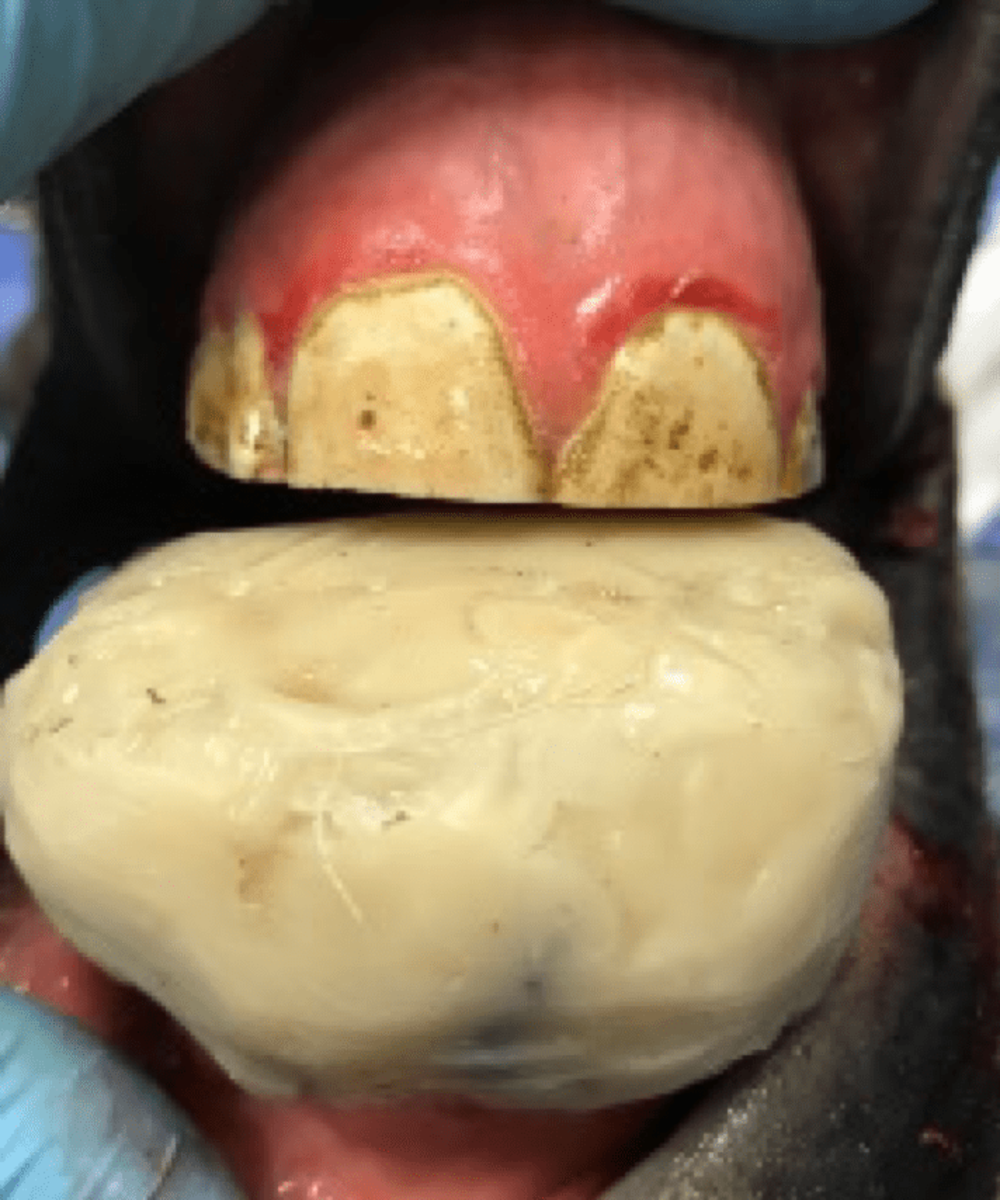
Yes and no. While it's cosmetically unpleasant to look at for some people, does it really affect performance? The answer is that it doesn't if managed correctly. These horses will continue to eat, they will continue to grow and they will not be skinny because of this malocclusion. However, this can be a problem for some horses. The question is whether the only malocclusions present impacting the incisors; if the front teeth that no longer contact, it's possible the entire top jaw could have shifted forward, which can create a ripple effect. This means that the first cheek tooth on top may no longer be grinding on the first cheek tooth on the bottom. Conversely, the last cheek tooth on the bottom may no longer be chewing in contact with the last cheek tooth on the top and the results of this will be large hooks and excessive growth of these teeth.

This image shows the “hooks” that can appear when the top and bottom jaws don't align properly and part of a tooth is not worn down as normal. Photo courtesy Dr. Brad Tanner

This can cause significant problems and pain for horses, as these large hooks cause collateral damage to the soft tissues, gums, and cheeks. This is compounded when a bit is applied to the horse's mouth and a rider asks the horse to put the head into a frame/collection, causing increased contact of these teeth overgrowths and the soft tissues surrounding them. In Thoroughbred racehorses the effects are less dramatic than in dressage and other disciplines. This is due to the fact that racehorses run largely on looser reins with an extended head and neck rather than in flexion of the poll.

Can it be corrected?

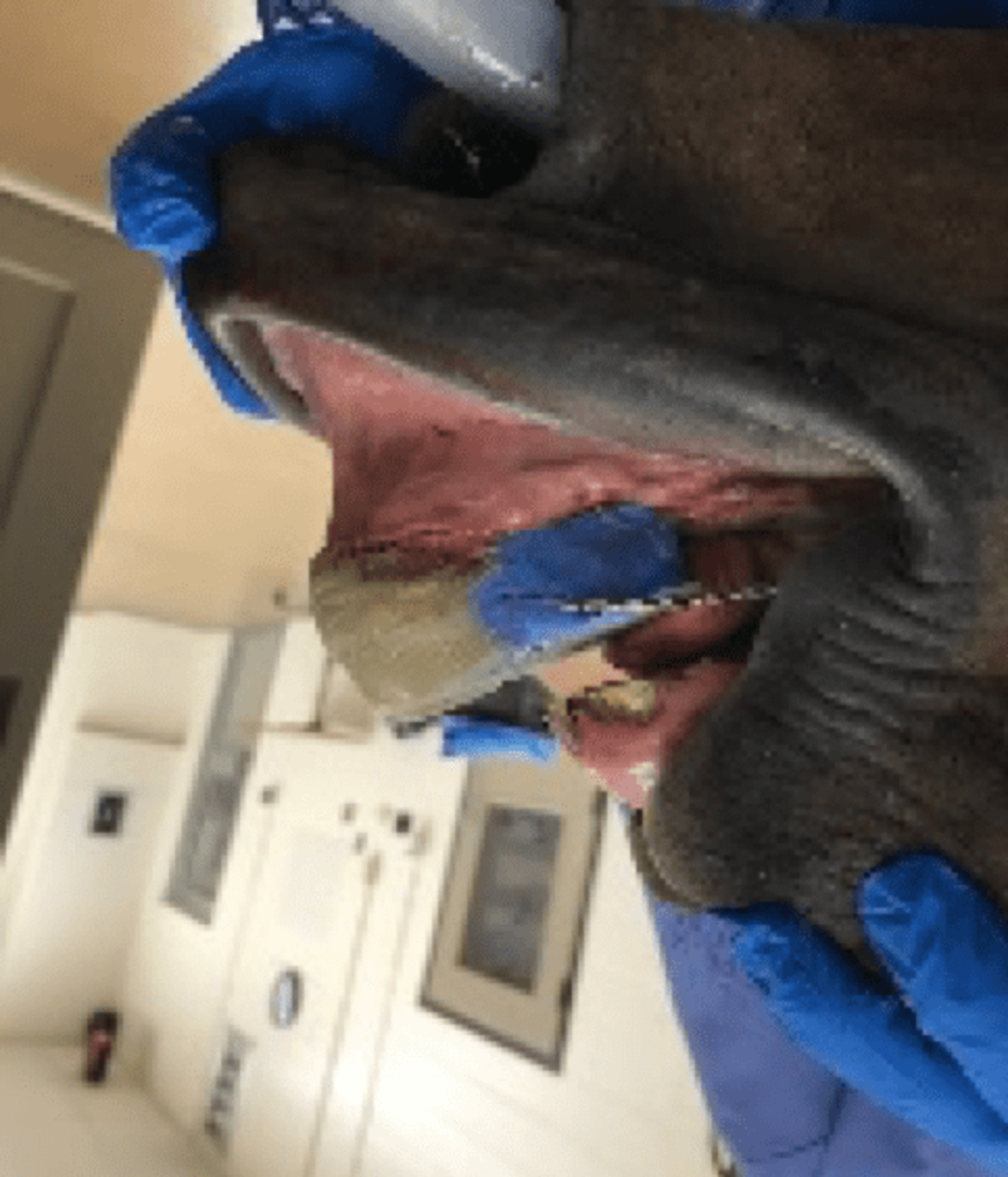
While this is a permanent deformity in adult horses, it can be corrected in young growing foals. Correction should take place between four to six months of age, ideally. As the maxilla (top jaw) is growing ahead of the mandible (lower jaw) at a higher rate, an orthodontic appliance can be applied with orthodontic wires to halt the growth of the maxilla allowing the mandible to catch up. Additionally, an inclined plane is applied in the form of an aluminum plate allowing the lower teeth to engage with it during each chewing motion.

Corrective devices can fix parrot mouth if it is caught early in a horse's life, before skeletal development is complete. Photo courtesy Dr. Brad Tanner

Corrective devices can fix parrot mouth if it is caught early in a horse's life, before skeletal development is complete. Photo courtesy Dr. Brad Tanner

Once the skeletal development of the horse is complete, there is no way to effectively correct the overbite/parrot mouth malocclusion.

How do you manage this problem long term?

Long term management of these malocclusions should be focused on effectively floating and reducing the large overgrowths. These are the overgrowths that form because some teeth are not in occlusion and chewing along one another. Normally, the teeth will grind and wear out at the same rate but when one tooth is not in contact it is allowed to continue to grow through the life of the horse at a rate of three to four millimeters per year. Left unchecked, this can wreak havoc on the horse's mouth and be a painful situation.

Long term management often will require routine floating examinations at six-month intervals on horses that have these types of malocclusions. So long as these are managed effectively the horse will be able to have normal dentition and perform at a normal level. Horses will not run faster or slower because of the parrot mouth. So long as they are managed effectively it should have no influence on performance.

The heritability of a parrot mouth has been called into question for some time. It's often viewed as a heritable trait that can be passed along from generation to generation and is therefore undesirable in breeding stock. Unfortunately, while much research has been done in this area, the heritability of overbites/parrot mouth is a very complex genetic trait. Recent studies have shown there are complex patterns of genetic alleles that are involved in the expression of the genes that lead to this defect. It is difficult to pinpoint exactly which foals could develop this trait and which sires are more or less prone to passing it along because of the complexity of alleles that are necessary to give this result and deformity.

In summary, parrot mouths are not really a big deal for a lot of horses. They have managed to survive for millennia this way and will continue to eat and graze. Proper management of a mature horse with parrot mouth will lead to decreased dental problems, decreased pain, and better performance in a show ring or racetrack. Recognition at an early age does allow for surgical correction and normal dentition for the rest of the horse's life.

Dr. Brad Tanner received his DVM from Auburn University in 2005 and completed an internship at Rood and Riddle thereafter. He is a shareholder in the clinic, where he focuses on advanced dentistry, primary care and reproduction. Tanner became board certified in equine dentistry in 2019.

The post Ask Your Veterinarian Presented By Kentucky Performance Products: What To Do About ‘Parrot Mouth’ appeared first on Horse Racing News | Paulick Report.
Source of original post

Verified by MonsterInsights
