Kentucky Farm Time Capsule: Looking Back At Normandy Farm

Behind Normandy Farm's limestone rock fences along Paris Pike in Lexington, horses were sustained by luxuriant green fields and paddocks long before it was cleaved from famed Elmendorf Farm 70 years ago.

A handful of dedicated owners have maintained this land's hallowed tradition of yielding fine Thoroughbreds ever since the 19th century. This year, as the long tree-lined drive to the historic white-columned main house transforms from spring green to autumn shades of wine-red and gold, the farm awaits another proprietor who will write a new chapter.

Listed on the market for $6.2 million after the death of owner Nancy Polk in 2018, Normandy Farm is one of Central Kentucky's most distinguished landscapes, memorable for its stunning European-style barn seen in the movie “Seabiscuit” and an equine cemetery that includes the sire and dam of legendary Man o' War – Fair Play, whose life-sized bronze statue stands as the noble sentry over 25 graves, and Mahubah.

The farm, located seven miles northeast of Lexington on Paris Pike, is naturally scenic; panoramas gently rolling toward the horizon can be viewed from several vantage points, epitomizing the heart of Central Kentucky's horse country. Miles of black board fencing embracing abundantly rich pasturage provide a sense of space and serenity far removed from the city's congestion.

During the tenure of E. Barry Ryan, the owner, breeder, and trainer who established the 260-acre farm as a separate entity in 1951 and named it Normandy, the pastures nourished mares and foals owned by a distinguished American and international clientele that included Paul Mellon of Virginia, England's Queen Elizabeth II, Alec Head of France, and Stavros Niarchos of Greece.

Yet they were just a few of the many intriguing figures who have been connected to this historical piece of Bluegrass.

Ryan's family had enjoyed a long association, dating from the 1880s, with the family of Joseph E. Widener, who in 1920 secured the several-hundred-acre nucleus of Elmendorf, which had been brought to fame by the wildly rich and colorful Kentuckian James Ben Ali Haggin and once sprawled over 10,000 acres.

Joseph Widener, who later acquired more acreage, built the unusual L-shaped Normandy barn and established the equine cemetery originally on a rise at Elmendorf and which now is located within the boundaries of Normandy.

Widener raced a number of top horses in the U.S. and France prior to his death in 1943. His grandson P.A.B. Widener III, who inherited Elmendorf when his father, P.A.B. Widener II, died in 1949, began selling off the farm in parcels in 1948, and Ryan spent $260,500 for the acreage that became Normandy.

Before the property had been acquired by Widener, it was part of a 2,500-acre Elmendorf main parcel at Ironworks and Paris Pikes purchased after Haggin died in 1914 by Hamburg Place owner John E. Madden.

Like Madden, who was known as the “Wizard of Wall Street,” Ryan's grandfather Thomas Fortune Ryan was a well-known New York financier. He partnered with streetcar magnate P.A.B Widener, the father of Joseph E. Widener, and financier William C. Whitney to consolidate the New York City transit system around at the turn of the 20th century.

Thomas Fortune Ryan also had various other interests in tobacco, railroads, coal, typewriters, diamonds in the Belgian Congo, and oil as well as Thoroughbreds, and he stabled nearly 200 horses at his opulent Oak Ridge estate in his native Virginia, near Arrington in Nelson County.

Normandy Farm in 1949.

It was Whitney's influence that drew Thomas Fortune Ryan into the Thoroughbred world, and he became an enthusiastic participant. He acquired the 5,000-acre Oak Ridge, dating from 1802, in 1909 and set up operations with his initial purchase of 20 Irish mares and the English stallion Sea King, a son of 1896 Epsom Derby and St. Leger winner Persimmon. The stallion later shuttled for stud duty at Hamburg Place, where in 1916 he sired 1920 Kentucky Derby winner Paul Jones.

Decades later, while following the path trod by his grandfather Thomas Fortune Ryan and Widener, E. Barry Ryan's interest in Thoroughbred racing and breeding grew to be international in scope as well as stature, and eventually he became a member of The Jockey Club and a trustee of the Thoroughbred Owners and Breeders' Association. Over many years, beginning with the time he had attended races at Saratoga as a youngster with his family, he developed strong opinions on where he thought American racing was headed, opinions that still hold their value in today's world.

“I remember being completely awed at the magnificence of the beautifully turned-out horses that came to the paddock representing the leading stables in America,” Ryan told Sports Illustrated in 1964. “I have had a varied taste of racing in most parts of this country, in Canada and in England and France. …

“Unfortunately, the emphasis here is less on the sport itself than on an ever-increasing handle earmarked primarily for the benefit of state legislatures. We are losing something, and not the least of this something is the number of U.S. owners who are now racing their stock in Europe, where the game is also getting bigger but has managed to save its pageantry, its traditions and its dignity. … Those are the things I miss here. In England, France, Ireland and Australia, there is an actual interest in and love of the sport and the horse as an individual. In the U.S. the interest is purely in numbers.”

With the purchase of the nearly 262-acre tract of Elmendorf in 1951 that he made into Normandy Farm, E. Barry Ryan transferred his racing, training, and breeding operation from his previous base in Paoli, Pa.

He amassed a broodmare band at Normandy that included a number of high-class racemares and influential producers such as the Blue Larkspur mare Alablue, who produced Ryan-bred Grade 1 winner Alanesian, sold privately to William Haggin Perry, great-grandson of James Ben Ali Haggin.

The Normandy Farm residence in 1952.

Alanesian became the dam of 1968 Hollywood Gold Cup winner Princessnesian, who went on to be the third dam of multiple Grade 1 winner and prominent sire Harlan's Holiday, whose bloodlines have become coveted through the offspring of his leading sire son, Into Mischief. Alanesian also foaled Boldnesian, whose son Bold Reasoning sired 1977 Triple Crown winner Seattle Slew.

Additionally, Alanesian's daughter Quillesian produced Revidere, 1976 champion 3-year-old filly. Alablue also is third dam of Grade 1 winner Cryptoclearance, who sired Breeders' Cup Classic winner Volponi and Belmont Stakes winner Victory Gallop.

Among the other famous horses who grazed at Normandy was Segula, dam of 1955 Horse of the Year Nashua. The daughter of Johnstown joined the broodmare band in 1956 after Stavros Niarchos bought her for a record price of $126,000 from the dispersal of horses that had been owned by the estate of William Woodward Jr. That sale came after Leslie Combs II's then-unprecedented syndication of Nashua for $1,251,200.

Six months after Segula arrived at Normandy, a tornado ripped through the farm, downing trees and destroying a number of small structures. Crews from several neighboring farms responded to aid with repairs and cleanup, and among the helpers was Combs, who, rather than watching Nashua win the $100,000 Monmouth Handicap on television, was busy working a saw on some of the downed trees.

Support our journalism

If you appreciate our work, you can support us by subscribing to our Patreon stream. Learn more.

A multi-talented horseman, E. Barry Ryan trained stakes winners on the flat and over the jumps, including homebred multiple stakes winners Middle Brother, Firm Policy, and 1976 champion steeplechaser Quick Pitch. He also established the bi-monthly equine periodical Classic with the backing of 35 Thoroughbred industry stakeholders.

Ryan died from pneumonia at age 73 while living in Manhattan in 1987.  That same year, Englishman Sir Arthur Williams, a construction magnate based in New Zealand, where he operated Ashford Park Stud in Otaki, bought Normandy Farm at auction for $2.3 million.

Williams' ownership was short-lived, and the farm was back up for sale two years later. He cited managing the farm from abroad as being too difficult.

In the late 1990s, Michigan native and racing fan Nancy Polk became enchanted by the spell of Elmendorf's deep-rooted history and Kentucky horse country when visiting Normandy with a friend. In 1997, she plunged into the Thoroughbred business, paying, paid $2.1 million for Ryan's Bluegrass gem.
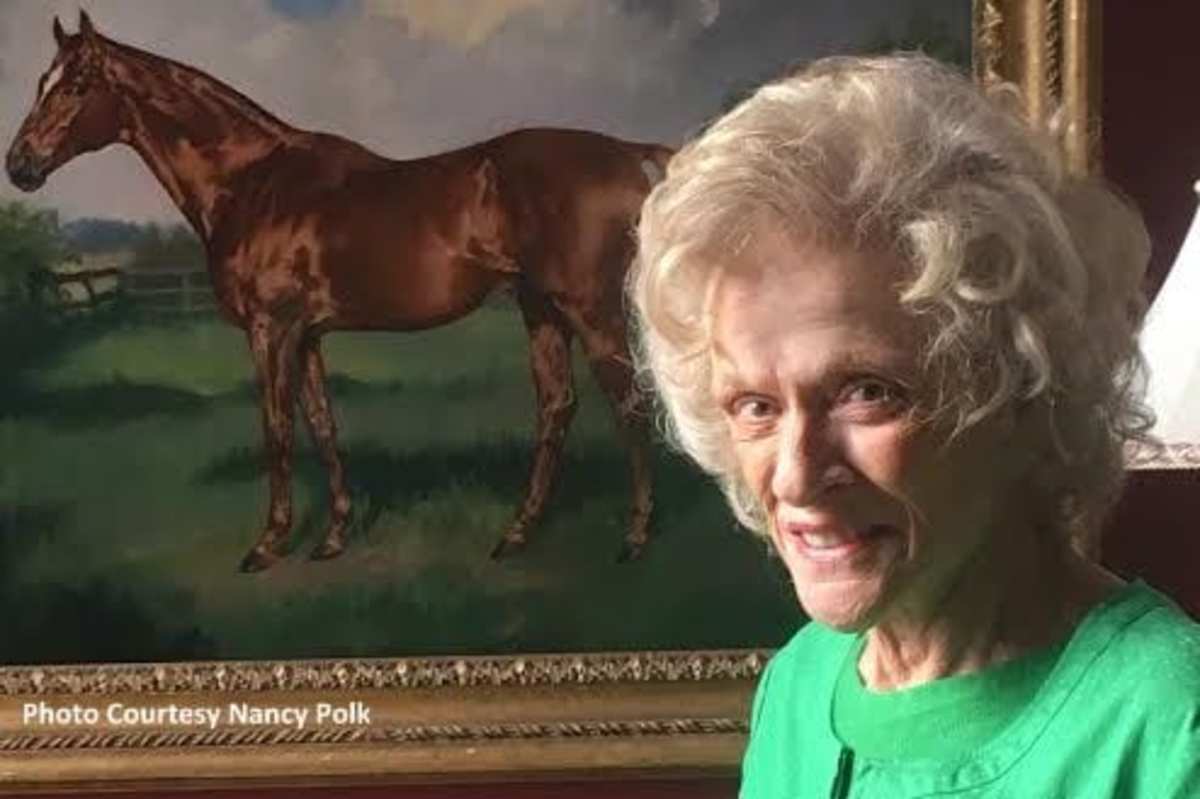
Normandy Farm owner Nancy Polk with a painting of Fair Play, sire of Man o' War.

The origins of the farmland that eventually made up Elmendorf date from at least 1871, when Milton H. Sanford established Preakness Stud on over 500 acres, naming the land for his horse, for whom the middle jewel of the Triple Crown takes its moniker.

Some local historians have suggested that land in the area had probably been previously used for horse breeding by members of Virginia's prominent Harrison family, who bought 1,900 acres in 1822 and named it Elk Hill before expanding to nearly 3,000 acres. Even before then, in 1804, Colonel Abraham Bird of Virginia started construction on what is Normandy's main house, called the Kenney House, which is one of the oldest brick houses in Kentucky.

Afterward, many others left their own marks on the farm's canvas.

Finding inspiration in the pastoral architecture in France, Widener began in 1927 to build the quaint Normandy barn that features a tower rising to a point not unlike an inverted ice cream cone.

His vision for the tower would later include the addition of a clock, so one was imported from a Normandy manufacturer. The clock arrived at the farm in 1935 in 18 hefty boxes bearing weights, pulleys, cogs, discs, and a 150-pound bell, as well as several cast-iron cats, birds, and other creatures to scatter on the barn's slate roof to ward off evil spirits in the French tradition and discourage birds from nesting.

When the clock was assembled, it rang twice on the hour, two minutes apart, a characteristic of Normandy clocks dating from medieval times.

Years later, after time had taken an inevitable toll, Polk lovingly restored the clock and repaired or replaced some of the barn's rooftop creatures.

Another prime attraction of the farm has been the equine cemetery, which has lured thousands of curious visitors over decades.

Widener bought Man o' War's sire, Fair Play, and dam, Mahubah, from the dispersal of horses owned by the estate of August Belmont in 1925.

[Story Continues Below]

Mahubah, bred to no other stallion but Fair Play, produced Man o' War in 1917 at Belmont's Nursery Stud. Winner of 20 of 21 starts he is widely regarded as America's greatest racehorse.

Fair Play was North America's leading sire of 1920, 1924 and 1927, and he also reigned as the leading broodmare sire of 1931, 1934 and 1938. He stood five years at Elmendorf before dying in his paddock in 1929. Mahubah followed in 1931. They were buried side by side at Elmendorf in the shadow of Fair Play's statue, erected at a cost of $100,000.

The cemetery also includes the graves of stallions Chance Shot, Haste, and *Sickle. Twice the leading sire, Sickle is perhaps best known as the great-grandsire of the phenomenal champion and top sire Native Dancer.

Although she did not maintain large numbers of horses after buying Normandy, Polk bred 2015 Breeders' Cup Turf Sprint winner Mongolian Saturday and millionaire stakes winner Daddys Lil Darling, who finished second in the 2017 Kentucky Oaks while carrying Normandy's green-and-white checkerboard silks. Both horses were bred from Polk's mare Miss Hot Salsa, whom she purchased for $100,000 at the 2003 Keeneland November sale.

Daddy's Lil Darling was eventually sold by Polk's estate for $3.5 million to Coolmore at the 2018 Fasig-Tipton November sale.

Normandy Farm's Daddys Lil Darling and jockey Mike Smith win the Grade I, $300,000 American Oaks, Saturday, December 30, 2017 at Santa Anita Park, Arcadia CA.© BENOIT PHOTO

As part of her love affair with Normandy, Polk built a new 22-stall barn with stunning views, and the farm now includes six barns with 83 stalls. Other improvements she initiated included updates to the main house in 2017, while renovations to fences and other buildings have been completed over the past three years.

Three tenant homes and a carriage house, including the historic structure that once served as a watering hole for travelers between Lexington and Paris, complement the farm's main house, which, according to the real estate listing, “boasts grand opulence throughout.”

Polk often said she thought of herself as Normandy's caretaker, with her goal to leave it better than she found it so that the next owner will be well prepared to craft a new era in the saga of this Thoroughbred landmark.

The post Kentucky Farm Time Capsule: Looking Back At Normandy Farm appeared first on Horse Racing News | Paulick Report.

Source of original post

12 Questions: Richard Knight

First job in the Thoroughbred industry?

Mucking out at Guirys 1 in Coolmore Ireland on my year out from University. I think there were 20 foals in the barn – 18 by Sadler's Wells and two by Danehill.

Biggest influence on your career?

Ultimately, my father, who introduced both my brother William and I to racing. He loved his National Hunt and we spent many a happy afternoon at Huntingdon and Towcester. Later in life, both Richard Henry and Simon Mockridge played major roles in my experience and development.

Favourite racehorse of all time, and why?

Desert Orchid. I was 10 when he won the Gold Cup and he was a grey who jumped well – everything me and my grey pony at the time aspired to be.

Who will be champion first-season sire in 2023?

Too Darn Hot.

Greatest race in the world?

The Derby.

If you could be someone else in the industry for a day who would it be, and why?

MV Magnier. MV works very hard and I would imagine his day-to-day is incredibly diverse from selecting young stock to managing the paths of future champions. I love that diversity.

Emerging talent in the industry (human)?

He has already emerged, but at only 24 years old, I am going to say Tom Marquand. I am sure Tom will be champion jockey in the near future.

Name a horse TDN should have made a Rising Star, and didn't?

Checkandchallenge – I so hope he will provide my brother William with his first Group 1 winner in 2023.

Under-the-radar stallion?

Once again, I am not sure quite how under the radar they are, but I think both Saxon Warrior and Cracksman are set for big years ahead.

Friday night treat?

Chinese takeaway.

Guilty pleasure outside racing?

Watching Rugby Union.

Race I wish I'd been there for…

The Wow Signal's Prix Morny Group 1 win. I think I was inspecting yearlings for the Goffs UK Premier sale. Any winner celebrating with John and Sean Quinn is good fun, so I really missed out with his Group 1 win.

The post 12 Questions: Richard Knight appeared first on TDN | Thoroughbred Daily News | Horse Racing News, Results and Video | Thoroughbred Breeding and Auctions.

Source of original post

Modest Kingscote Reaping Benefits of Getting Out More

Richard Kingscote is far too nice. He is also a damn good jockey. And if people hadn't realised that before this year, they certainly do now.

The 36-year-old is no newcomer to racing's main stage but until this past season he had to a degree been cast as a reliable sidekick to leading actors such as Frankie Dettori and Ryan Moore. Dettori is one of only a few jockeys who is instantly identifiable by his first name alone, and in true 'Frankie style' the recent announcement of his retirement allows him a year-long celebratory tour that will doubtless be to the benefit of the sport, for Dettori is box office; a crowd-puller. Kingscote is quite the opposite, but only in personality, not when it comes to talent.

“I think that being introverted has probably made it that little bit harder to move my career forward,” he admits. “Because racing is the sort of sport where you have to integrate, you have to be involved with people. And I've noticed the last couple of years, particularly, the more outgoing people, the social people, are the people that get offered jobs and get moving forward just because they're out there. They're putting themselves out there, and I don't put myself out there a great deal.”

That could be about to change. In fact, in a way it already has. Kingscote's imminent departure for a winter riding stint in Florida came about from his recent trip to Bahrain, where he was runner-up in the G3 Bahrain International Trophy on Passion And Glory (Ire) for Godolphin. 

He explains, “I was having a few drinks with someone and they said, 'Would you be interested in going to America?' Usually, as soon as I've finished I'd scurry off to my room and wouldn't be seen again. So just being that little bit more outgoing and putting myself in that position, I've been offered a stint in America. Maybe I need to learn to be a little bit more of a people person. Doors open because you're putting yourself there, where I never really have, whether that's just shyness or the way I am, I don't really know, but maybe it's something I ought to start looking into.”

I think that being introverted has probably made it that little
bit harder to move my career forward

Kingscote became a Group 1-winning jockey back in 2014 when guiding Brown Panther to glory in the Irish St Leger during his days as stable jockey to Tom Dascombe. He also hit the top level again in the G1 Flying Five aboard Havana Grey (GB), who is now one of the most exciting young sires in Britain. His riding career, which is now closing in on 20 years, has been peppered with stakes wins, but it was 2022 which can be considered his true annus mirabilis as the name Richard Kingscote was added to that special roll of honour reserved for jockeys to have triumphed at Epsom in the Derby. 

Following his victory on Desert Crown (GB) he was quizzed about his relatively new association with one of the greatest Derby-winning trainers of all time, Sir Michael Stoute. 

“We get on well because neither of us likes to talk much,” was his response, and it is easy to see why Kingscote has fitted in so well at Stoute's Freemason Lodge, proving a more than able addition to the riding ranks when Ryan Moore is fulfilling his obligations for Ballydoyle. 

Desert Crown, who also won the G2 Dante S., has only ever been ridden in public by Kingscote, who has only twice partnered his second hugely significant winner of the year, Bay Bridge (GB). He won on the four-year-old on both occasions, including the G1 QIPCO Champion S., and it is easy to imagine the partnership remaining intact in the high-profile races which Bay Bridge will be contesting next year. 

Explaining his growing connection with Stoute following his departure from Dascombe's former base of Manor House Stables in Cheshire, he says, “Tom and I were together for a long time and it was a difficult decision to move on from there. He'd supported me so much and I had a good job that a lot of lads would've loved, and I did. I liked working with Tom, we got on very well and I had the opportunity to get on some nice horses over the years.”

He continues, “But it's very difficult to get hold of those horses, and I was lucky to get an opportunity with Sir Michael. Over the last four or five years, I had the odd couple of rides and winners for Sir Michael, and maybe two or three years ago I asked if I was in Newmarket would I be able to pop in and ride out.

“I've never be one to push myself forward and try stepping on people's toes and I don't like to be forceful or pushy. So I would never have been there too much, but if I stayed [in Newmarket], they were happy to have me in. And then I think with Covid, Sir Michael and Ryan were quite aware that Ryan may not be able to travel back and forward from Ireland as much as in normal years. So I don't know how it went or why I was picked, but I was asked if I'd become more involved and obviously I was delighted about that. I think for any jockey to be involved with a yard like Sir Michael's is a privilege. It's a big deal.”

Despite Kingscote's rising profile, and his impending arrival at Gulfstream Park being announced in a press release from the racecourse, we still don't know a huge amount about the jockey. When this is pointed out to him as we speak just before Christmas, he replies, “There's not much to know. But that's all right.”

He continues, “I'm quiet and I'm private. I prefer to stay at home. I'm actually out tonight to William Buick's party and tomorrow I'm going to the BBC Sports Personality of the Year awards. It's the first time I've been invited and now it's coming to it, I'd almost rather just stay at home, but I'm going anyway, because it's nice to be involved with those things; how often are you going to get invited to the Sports Personality of the Year? So I thought I'd give it a go.”

While he does undoubtedly keep a much lower profile than some of his weighing-room colleagues, Kingscote is an engaging interviewee. The only question he deflects is the unfair query as to which of Desert Crown or Bay Bridge he'd prefer to ride if he could only ride one (“I know which one it would be but it's not fair to say”) and he adds of his Derby winner, who is on the comeback trail from injury, “He's very exciting. I saw him about a month ago and he looks great. And he's got such a great temperament.”

Kingscote's most successful year numerically came in 2021 when he rode 128 winners, the fifth time he has reached three figures. In 2022 he is just shy of that mark on 98, and he has not ridden in Britain since signing off for a well-earned break with a winner at Lingfield on December 10. This year, however, has by any measure been his best yet on the racecourse. 

“The Derby was surreal and it was huge,” he recalls, before adding modestly, “But my horse was a steering job, so I think winning at Ascot, not having just the one Group 1 this year but also having the second one, just really cemented it a little bit in being a very good year.

“We went to Ascot [on Champions Day] with no expectation as well, which was great, because Baaeed was such a strong favourite.”

He adds, “And it could well be a very exciting year with both of them staying in training.”

Now based not far from Lambourn, Kingscote grew up in the south-west of England in Weston-super-Mare and started riding as a 12-year-old. In his typically guileless fashion he admits that he was a complete outsider to racing.

I was just that far away from racing, I had absolutely no idea, but I just said I like riding horses and I like going fast so I'll be a jockey

“My mum got a pony and my brother and I started having riding lessons once a fortnight,” he says. “I didn't really like school and because I was little I said I'd like to be a jockey. I knew nothing about it, honestly, I'd never have even watched a Flat race in my life. But mum found out about the Newmarket [British] Racing School, and I did the nine-week course there. I was unbelievably green. I think Frankie was probably the only jockey I've ever heard of, even though [Kieren] Fallon had been multiple champion jockey. I was just that far away from racing, I had absolutely no idea, but I just said I like riding horses and I like going fast so I'll be a jockey, which was probably quite naive, but somehow we got there.”

What Kingscote is too modest to mention, of course, is that the getting there “somehow” didn't just happen but was the consequence of his own hard work and professionalism, as well as the talents which had become apparent once he started riding. Like many young riders, he found that his career seemed to be stalling once he had finished his apprenticeship with Roger Charlton but, heading up to Cheshire with Tom Dascombe when the latter accepted the job as trainer at Michael Owen's Manor House Stables, he steadily earned the respect of the racing community as one of the most hard-working, loyal and reliable jockeys in the game as he and Dascombe established themselves as a formidable partnership, particularly to be feared at their local track Chester.

Though Kingscote has steadily earned bragging rights, there is no hint of the arrogance that sometimes comes with the confidence needed to be a top-level sportsman. In fact, more than most people, he is only too aware of the slings and arrows of outrageous fortune that lurk in every life. Last year his younger brother Karl, who had been working at Denford Stud at the time, had a mountain-biking accident which has left him paralysed. 

“Karl now lives with mum near Ffos Las,” he says. “We're still close even though he doesn't live 20 minutes away any more. One of our major hobbies is that we are both gamers. We speak almost every day, and we play together online. So we speak a lot still, which I think is quite good for him, and good for me as well.”

What has also been good for the jockey after the cut and thrust of the season is taking a proper break to spend some time with his wife Ashleigh and their two young children before he departs for America.

“It's hard to take time off as a jockey, particularly, obviously, in the summer it's just not the done thing,” he says. “So come the winter you ought to allow yourself a little bit of downtime and I often take things easier but still like to ride for my people. I've not ridden for a few weeks and I won't be riding until the new year.”

Frankie Dettori, who started his own American sojourn with three Boxing Day winners at Santa Anita, may have stolen his thunder but it is unlikely Kingscote will be complaining about that. In fact, despite his considerable success and experience, he appears to be approaching his forthcoming trip in mid-January with a degree of trepidation.

“Obviously I've been to a few Breeders Cups but it's my first proper stint riding anywhere else really, bar Australia when I was an apprentice. I think I'll be quite green about it all, to be honest,” he admits, his natural and unconscious modesty shining through as, from Gulfstream's point of view, they will be welcoming not the bit player which he still views himself as, but one of the highest-achieving jockeys in the world.

“I'm a bit nervous about it, but I am looking forward to it. Everyone seems quite excited that I'm going over. I did a radio show yesterday and all of a sudden got loads more American followers on Twitter.”

By the time he returns, Kingscote will likely have plenty more, for while he may not trumpet his own talents in the way in which an American audience will be more accustomed, he is certainly a rider to follow. 

The post Modest Kingscote Reaping Benefits of Getting Out More appeared first on TDN | Thoroughbred Daily News | Horse Racing News, Results and Video | Thoroughbred Breeding and Auctions.

Source of original post

Santa Anita Cancels New Year’s Day Card Due to Steady Rain

Santa Anita was forced to cancel its New Year's Day racing card Sunday as steady rain soaked the Southern California area throughout Saturday night and into early Sunday morning. The rain began as a light drizzle Saturday morning, but increased in strength throughout the completion of the program, continuing throughout the night.

The holiday card's expected feature, the GIII Santa Ynez S., will be run next Sunday. Santa Anita Director of Racing Chris Merz said entries will be reopened and the field will be drawn on Thursday. The Santa Ynez will share the spotlight next Sunday with the GIII Sham S.

Four of Sunday's overnight races that were canceled–races three, five, six and eight–will be brought back as “extras” for Friday's card, which was drawn Sunday. According to Merz, with another substantial rainstorm forecast to hit the area midweek, there will likely be no turf racing Friday.

“We're probably going to be stuck with another all-dirt card,” Merz said.

Racing is expected to resume at the Arcadia oval Monday with 10 races and a first post at noon. Merz expects both the main track and training track to be open for training Monday after both were closed Sunday.

The post Santa Anita Cancels New Year’s Day Card Due to Steady Rain appeared first on TDN | Thoroughbred Daily News | Horse Racing News, Results and Video | Thoroughbred Breeding and Auctions.

Source of original post

Verified by MonsterInsights