Last year, we conducted a popular Q and A series called 'Smaller But Still Super,' where we featured veteran trainers who have built a competitive racing stable with relatively small numbers (click here to view the archive). This year, we will highlight trainers who have already cut their teeth as novice trainers, but now have a few years of experience under their belt and are looking to make a name for themselves as they grow their stable. We'll talk about the challenges that come with hanging out your single, advice for trainers setting out on their own, how the incoming class of young trainers differs from previous generations and more.
Kelsey Danner's family has been a fixture on the racetrack for generations, so the horsewoman always knew she would dedicate her life to the industry. She started off working for her father Mark Danner, a trainer on the Kentucky circuit and at Oaklawn Park for nearly three decades, and later got experience working for D. Wayne Lukas, Ian Wilkes and Carl Nafzger. She then spent five years as an assistant for Wayne Catalano.
After 12 years of working as an assistant, Danner made the decision to go out on her own in 2017. She only had 73 starts in her first two years, but got the ball rolling with 19 wins in 2019. Two years later, she surged past her first million-dollar mark with over $1.3 million in earnings, plus 36 wins, and then one-upped herself last year when she surpassed $2 million in earnings.
Danner is based at Palm Meadows in the winter, but travels throughout the year from Gulfstream to the Kentucky circuit, Colonial Downs, and more. With 45 horses under her care, Danner's highest earner is gearing up for her 3-year-old season. NBS Stable and Elements Racing's Danse Macabre (Army Mule) got her first stakes win at Kentucky Downs last summer and was third in the GIII Matron S. in her last start.
What has been the key to your stable's growth since you first opened?
My last few years have definitely been my best years. I'm a bit more content with where I'm at as far as the clientele and the horses I have. For the last three years, I got to have some nicer, young stock and they're still in my barn now, so it has been nice to watch them develop and I've gotten to win a few stakes races.
What do you think makes your training style unique?
I think a lot of my focus is on exercise riders. I have some really good riders and we do things a little bit different in the morning. We will do breezing with groups of four and five horses so that they will get hit with dirt. We spend a lot of time on their backs. Our sets take a little bit longer. We do less sets but for a longer period of time.
What has been the biggest thing you have learned since going out on your own?
Some of this I already knew because not only was I an assistant for years, but I was also the daughter of a trainer. I would say the biggest challenge initially is getting horses, and the second part is maintaining your expenses and your payroll. You need to make sure that you don't spend more than what you're bringing in.
Another important thing is having good-paying clients. They're without a doubt the most important aspect of it and you learn that the hard way.
Do you think most trainers' success is defined by their ability to train or by the quality of the horses they receive?
I would say it's about the quality of the horse. You have to have the stock. It's kind of a chicken-or-the-egg thing. The quality of the horse is pretty much the factor in everyone's success, whether it is owners or trainers.
If you could give one piece of advice to someone going out on their own this year, what would it be?
(Laughs) Don't do it.
I guess it would be to have the experience before you do it. I think right now, with how the racing offices are struggling for entries to fill, be prepared with as much experience as you can get beforehand and make sure you have a decent-sized bank account.
I think a lot of times, you see with young trainers that they were only an assistant for maybe one trainer and only for a few years.
Training requires a lot of experience. There are things that can't be taught. There's not a book on how to train horses. I think that the more experience you have before going out on your own, the better your chance of having mentors. New trainers need people you can call up and ask advice. By building relationships with people that you've worked for previously, that's how you do it.
What is something that you think this incoming generation of trainers does better than the generations before them?
Probably embracing the digital age as far as communication with clients. Clients are more likely to receive videos, pictures, and text messages. I feel like when I was younger, a lot of owners lived near their horses and they would come out to the track more often. I think that now, technology is what the younger generation does more.
Last fall you became a member of HISA's Horsemen's Advisory Group. Why was that something that you wanted to be a part of?
I think that our industry is in the middle of a big change, hopefully for the better. It remains to be seen which way this is going to go, but I thought I would like to at least be part of what the change is going to be so that I could understand it a little bit more and maybe offer some advice or opinion.
Obviously racing need changes. Hopefully HISA is the organization that will help us have more uniform rules and things like that. It's easy to knock it or to sit back and say that it won't work. But I think that without change, we probably won't make it. And it takes the whole industry to get there. So we do need change and I would like to be a part of it. The industry is my career and my livelihood and I hope it lasts for many years to come.
Who is your favorite horse that you've ever had in your stable?
I would have to go with Gladys (Medaglia d'Oro). She was a full-sister to Rachel Alexandra. She was very spirited and had a neat personality.
Is there an up-and-coming horse in your barn that we should know about?
I have a couple nice young horses. Danse Macabre (Army Mule), who won a stake at Kentucky Downs last year, is getting ready to get back next month. Dunedin (Munnings), who finished fifth but only got beat by a neck in the GIII Futurity S., comes back next month too.
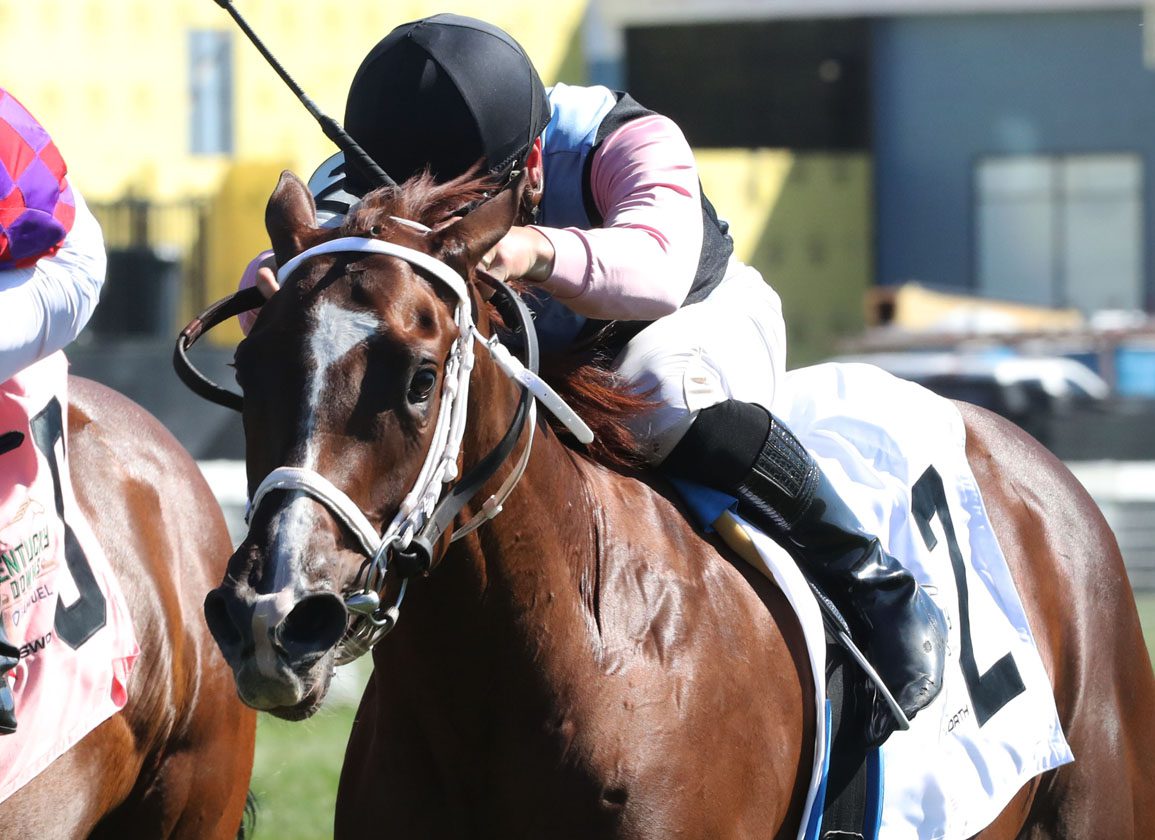
Ainsworth Untapable S. winner Danse Macabre is preparing for her 3-year-old debut | Coady
What is your favorite restaurant to go to after a big win?
I like the little Thai joint by Gulfstream.
If you aren't at the track, what can you be found doing?
Right now I'm in the middle of remodeling my house.
If one change was made to racing that would make your life easier, what would it be?
Probably if they got rid of statistics in the racing form. I do think it hurts the industry a little bit because you're more likely to not help the racing office fill races because you're worried about your statistics.
Carl Nafzger used to say that you needed to give a horse five races until you knew what the horse was. One going short, one going long, one on the slop, one from behind, etc.
What is your biggest hot take? It can be racing-related or completely random.
Winning first time out isn't everything. I think it can sometimes damage a horse. There's a lot of pressure that if a horse doesn't win first time out, they're not a very good horse because everyone is worried about percentages.

The post Earning Their Stripes: Kelsey Danner appeared first on TDN | Thoroughbred Daily News | Horse Racing News, Results and Video | Thoroughbred Breeding and Auctions.
Source of original post
