Taking Stock: Is SGF-1000 a PED?

[Editor's note: Gary and Mary West are clients of Werk Thoroughbred Consultants, of which Sid Fernando is president and CEO. WTC recommended the 2014 purchase of Maximum Security's dam, Lil Indy, for $80,000 at Keeneland January for the purpose of breeding her to New Year's Day, a stallion owned by the Wests at that time and the sire of Maximum Security.]

“Just the facts, ma'am.”

The iconic line “just the facts, ma'am” is associated with the character of Sgt. Joe Friday from the 1950s cop show “Dragnet” starring actor Jack Webb in the title role of an LAPD detective. You may be too young to remember the series, but it's likely you're aware of the phrase, because it's become a part of the lexicon. That's what happens when things get repeated over and over again.

Three years ago, when the government indicted and arrested 27 individuals (it went up to 31) in what it called a wide-ranging “doping” scheme, most of us heard about the “drug” SGF-1000 for the first time. Since then, we've heard of it over and over again. This substance was specifically associated with two high-profile trainers, Jorge Navarro and Jason Servis, who'd been under investigation and were caught on tape admitting to each other that they'd used it on most of their stock.

Servis trained Maximum Security (New Year's Day), a Gary and Mary West homebred who finished first in the $20 million Saudi Cup three years ago with Coolmore as a partner. Maximum Security has yet to be declared the winner, because the following month the government issued the indictments that named the colt as the most famous recipient of SGF-1000. After this, the Saudi regulator paused purse distribution from the race, pending the outcome of its own investigation of the government's case.

In the indictment and subsequent filings, the government referred to SGF-1000 as a “customized PED,” and that label as a performance-enhancing drug has stuck. Press coverage has repeatedly referred to it as a PED and “dope.” At this stage, “dope” and “SGF-1000” are as synonymous as “dope” and Epogen, or “dope” and customized analgesics, or “dope” and “red acid,” some of the other PEDs mentioned in the indictment.

Three months ago, in early December, Servis pled guilty to two charges: a felony count of misbranding and adulterating a generic version of unprescribed clenbuterol, and a misdemeanor count of misbranding and adulterating related to SGF-1000 use. Servis admitted to judge Mary Kay Vyskocil that Maximum Security, while under his care, had been administered SGF-1000 by a veterinarian. Because SGF-1000 is the only substance that the government has said was administered to Maximum Security, its use and chemical makeup are of importance to the Saudis as they close in on a decision.


Widespread Use

It's important to understand that the government's case wasn't about “dope” per se; there are no federal laws about the doping of racehorses. Instead, the government relied on felony counts related to the misbranding and adulteration of substances used in interstate commerce under the Federal Food, Drug, and Cosmetic Act to indict and convict these individuals.

In almost all of these cases, however, the misbranded and adulterated substances were bona-fide PEDs, and the government could rightfully say that it had stopped several doping schemes. However, in the specific matter of SGF-1000, it appears the government was aware the substance wasn't a PED since at least September of 2019.

During the course of the last three years, I've read more than a thousand pages of court filings and spoken to several trainers who've admitted off the record to using SGF-1000 on some of their horses. None of them thought he was “doping” horses or doing anything illegal. Some are big names in the business, others smaller trainers.

One told me he had three horses shipped to him in Florida from a facility in New York with three bottles of SGF-1000 for his vet to administer. “Their vet prescribed it. I don't know if it helped,” this trainer said. “It was hard to tell, but the show horse people in Wellington seemed to feel it helped horses recover from work. I was told it was popular with them.”

I asked him if he'd speak on the record. “No, I'd get crucified in this environment we're in now with the Feds and drugs and HISA,” he said. “But SGF-1000 has been around for a while.”

As far back as 2014, Medivet, the company that sold SGF-1000, was openly advertising the product in print trades, radio racing shows, and online, and a rep for the company posted this on Facebook on Nov. 24, 2014: “To all my Facebook friends who are involved with horses: I want to share with you two great products that are drug free and chemical free that will maximize the health and wellness of your performance horse.” This was an overture to the dressage and eventing crowd in Wellington. One of the products he described was SGF-1000, of which he said, “USEF [US Equestrian Federation] approved for competition.” I don't know if this was true or not about USEF, but Medivet and its reps were openly hawking the substance in broad daylight, not peddling it conspiratorially under the cover of darkness.

“There was nothing nefarious about it,” said another, bigger New York-based trainer, who also spoke on the condition of anonymity and admitted that a multiple Grade l winner of his now at stud in Kentucky was once on it. “Dr. [Kristian] Rhein–he had a big practice in New York–dispensed it as something that was great for recovery and wellbeing. He was a good vet, especially on soundness. He'd trot a horse up and back and tell you right away where a problem was. I didn't think anything of it, and I think it did help my horse recover after works or races. A vet always prescribed and administered it. You know, Dr. Rhein had a lot of clients, and everyone knew everyone else was using it until they put it out on that overnight in September that no one was permitted to use it. When that came out, I got scared, and I never used it again after that. No one told us it was illegal before.”

In September of 2019, NYRA, at the direction of the New York Gaming Commission, put a note on the bottom of its daily overnights saying the use of SGF-1000 was prohibited. Perhaps the FBI alerted the commission and NYRA that SGF-1000 use on its grounds was widespread. By this time, the FBI already had Dr. Rhein, one of the co-owners of Medivet, boasting on tape that he'd sold “assloads” of the substance, and we've subsequently learned from court filings that Medivet was making “millions” from the sale of it. All of this makes it obvious that SGF-1000 was being used by more than just Navarro and Servis.

On Aug. 3, 2021, Dr. Rhein pled guilty in federal court to a felony charge of drug misbranding and adulteration. The government has a list of Dr. Rhein's clients who purchased and used SGF-1000 and is aware that some of these trainers had horses for well-known owners, some of whom belong to elite industry organizations. From court filings, the government also is aware of the labs that made the SGF-1000 – “unregistered facilities,” according to the Department of Justice, in California and Australia. These labs shipped SGF-1000 to Medivet's facility in Kentucky for packaging. The government's case that SGF-1000 was misbranded is convincing.


Just the Facts, Ma'am

As far as SGF-1000 is concerned, however, it appears that government prosecutors, who repeatedly called it a PED in court filings and press releases, may not have been correct. In a court filing that noted an FBI application to search emails of one of the owners of Medivet, an FBI agent wrote this in part about SGF-1000: “I have further learned that the Hong Kong Lab did not detect the presence of any growth factors or growth hormones in the sample that was analyzed, but did detect the presence of sheep amino acids.”

A person with direct knowledge who is not authorized to comment on the matter told me FBI investigators don't believe SGF-1000 was a PED, unlike other substances that were named in the indictments.

According to court filings, New Jersey regulators and a confidential source working with the FBI took blood samples from Maximum Security after he was administered SGF-1000 in early June of 2019. The confidential source dispatched the samples to the Hong Kong Jockey Club lab, and the testing came back negative for PEDs. During this time frame the HKJC responded with this email note – obtained from court filings – to the confidential source: “We had analysed (sic) the content of the SGF 1000 from Medivet some years ago. It is listed to contain a combination of growth factors, peptides, proteins, and signal molecules obtained from ovine placental extract. No detectable amount of growth factors was found but collagens common to ovine or bovine origin were detected.”

SGF-1000 originated in Australia and since 2014 has been tested by a number of other reputable organizations with no relationship to Medivet, including the Racing Medication & Testing Consortium (RMTC), Australian authorities in 2015, and UC Davis Maddy Laboratory, and not once in these tests has it been positive as a PED, according to court filings. Each time, however, it tested for sheep collagen, which is widely used in the manufacture of facial creams and other human skin-care products.


Government Test

According to court filings, government agents had obtained a bottle of SGF-1000 by July of 2019 and “sent the substance to a laboratory in Hong Kong for testing to determine the precise chemical contents of that substance.”

The thinking here seemed to be that SGF-1000 didn't test in Maximum Security's blood, but it would from the actual sample straight out of the bottle.

The results of that test have never been publicly revealed. If SGF-1000 did contain PEDs, wouldn't the government have publicized it? If it didn't test positive, the government wouldn't be under any obligation to share the results, because the charges of misbranding and adulterating have nothing to do with whether a substance is a PED or not.

Tellingly, after Servis pled guilty to the misbranding charge for SGF-1000, the DOJ press release did not use the words “performance-enhancing drug” or “PED” in reference to SGF-1000 – an about-face from before; instead, the government noted that Servis was guilty of having SGF-1000 administered to horses after NY regulators said the substance was illegal to use in Sept. of 2019. The federal misdemeanor charge was essentially for a state regulatory violation.

The government had a chance to reveal the results of its 2019 test but never did.

The government had access to the “unregistered” labs that manufactured SGF-1000 and could have readily exposed the ingredients that went into the formulation of the substance, but it never did.

Based on the standing facts, SGF-1000 was a misbranded substance, but it was not a PED.

And by the way, the exact line “Just the facts, ma'am” was never uttered by Sgt. Joe Friday, either. It's an urban legend. That's what happens when something gets repeated over and over again.

Sid Fernando is president and CEO of Werk Thoroughbred Consultants, Inc., originator of the Werk Nick Rating and eNicks.

The post Taking Stock: Is SGF-1000 a PED? appeared first on TDN | Thoroughbred Daily News | Horse Racing News, Results and Video | Thoroughbred Breeding and Auctions.
Source of original post

Mott-Trained Arthur’s Ride Off Derby Trail

Arthur's Ride (Tapit), who impressed by taking pace pressure on the lead and clawing out a 1 1/2-length victory in a Feb. 11 one-turn-mile MSW at Gulfstream Park, has been sidelined and won't be pursuing prep races leading up to the GI Kentucky Derby.

Trainer Bill Mott disclosed the news in a Tuesday phone call. The Hall-of-Fame conditioner did not want to elaborate on the colt's condition.

“He's off the Derby trail. He's going to have to have some time off. He's on vacation, probably for the rest of the season,” Mott said.

Owned by Glassman Racing, Arthur's Ride had been ranked as the No. 9 contender on last week's installment of the TDN Top 12 list of Derby prospects.

After starting his career with a pair of seconds in two seven-furlong MSW contests at Saratoga, Arthur's Ride ($250,000 KEESEP) caught the eye at 2-1 odds in his sophomore debut by repulsing multiple bids on the turn and in deep stretch while earning an 89 Beyer Speed Figure.

The post Mott-Trained Arthur’s Ride Off Derby Trail appeared first on TDN | Thoroughbred Daily News | Horse Racing News, Results and Video | Thoroughbred Breeding and Auctions.

Source of original post

Horowitz On OTTBs Presented by Excel Equine: Benefit of Putting Spotlight On The Horse During Race Broadcasts

There are many ways to present horse racing during a broadcast of the Sport of Kings. There's the sport, the gambling, the stories about the people involved, the history, and more.

When I appeared on the international broadcast of last Saturday's Obaiya Arabian Classic at the Saudi Cup that was carried by Fox Sports in the United States, I was prepared to talk about all of these things. However, Nick Luck and Michelle Yu, two of my favorite and most well-versed racing broadcasters, asked me something that isn't often discussed on horse racing television but should be: about the breed itself.

Admittedly, the fact that there was an Arabian race broadcast on sports television networks throughout the world was a special occasion, but the same conversation could be had about the Thoroughbred or Quarter Horse breeds. That could lead to more of an understanding about horses in general that could help with racing's messaging about how the sport plays a positive role in the lives of horses, both on and off the track.

Here's how the conversation went, and if you are inclined to watch the whole clip in the tweet embedded here, I hope you'll appreciate how seamless the conversation went from racing as a sport to horses as the special animals that make racing one of the most intriguing sports in the world.

“You know all about the Thoroughbreds, but you've got a real passion for the Purebred Arabians. Just tell me why,” Nick said.

I proceeded to answer about the long careers of these horses, how they race all over the world, and the rivalries that they develop. Then, I decided to go slightly off track, which was probably slightly off script.

“Recently, I started riding myself, and I have an Arabian that I event on,” I said. “So, you put it in front of an Arabian—we just mentioned about distances and surfaces, but any type of sport as well—and the Arabian, with the mind that they have, will likely excel at it.”

That could have, maybe even should have, been the end of the conversation. After all, the horses were walking behind our set in the parade ring.

However, Michelle asked a follow-up question, “What additional passion did you find for the Arabian once you started to ride an Arabian?”

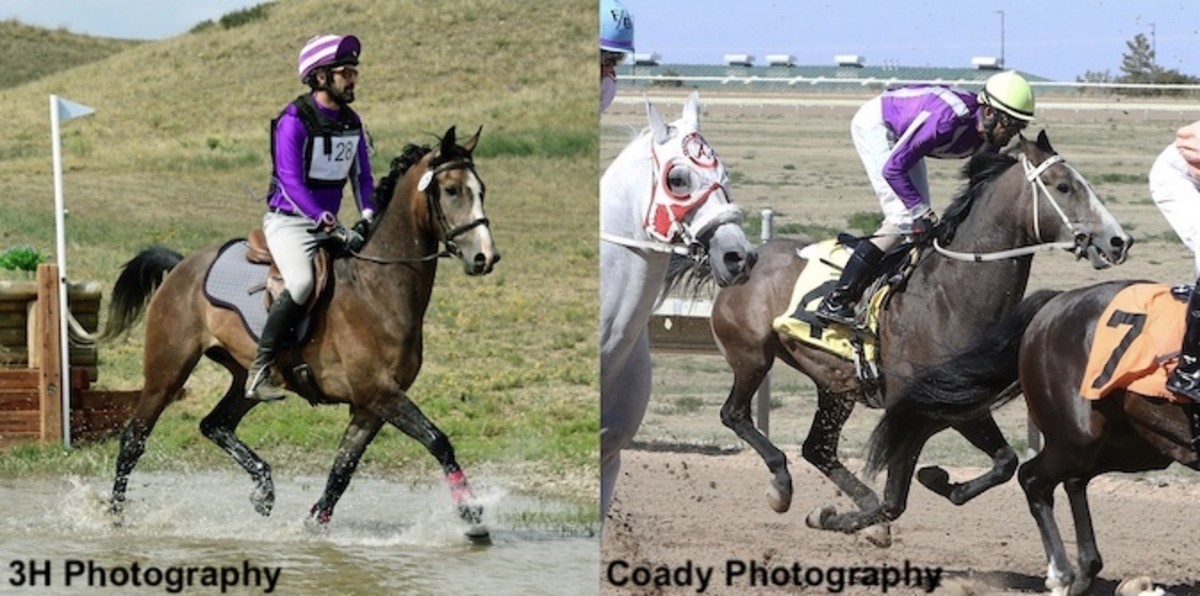
“Just how keen they were,” I responded, and I proceeded to talk about our family's Arabian, AA Two Face, that we evented and raced simultaneously last year.

It was a brief cool moment to share about the versatility of racehorses without it seeming forced.

AA Two Face competes in the USEA's Area IX Eventing Championships (left) one month before racing in the Emirates Breeders VIP Stakes at Bally's Arapahoe Park. And, yes, the author is wearing the horse's racing silks for eventing.

Then, it was time to get back to the horses in the race, with my segue being, “But he was nowhere near racing the caliber of these horses.”

Nick, being the professional he is, chimed in, “So the truth of it is, they can do anything, but today, Jonathan, we've got to find the one that can do anything the fastest.”

We switched to talking about the race, and racing would be the focus for the remainder of the broadcast, as it should be.

That racing broadcasts are willing to take a moment to celebrate racehorses as athletes beyond just racing can play a role in assisting with racing's image and social license to operate.

NBC Sports did something similar with Whitmore during its coverage of the 2022 Breeders' Cup Sprint, a race Whitmore had won two years earlier. They showed footage of the celebrity chestnut gelding winning at Keeneland and then competing down the road in Lexington at the Kentucky Horse Park in Competitive Trail at the Retired Racehorse Project Thoroughbred Makeover. Donna Brothers rode Whitmore for her coverage of the Sprint.

“He's really become a little bit of a mascot for the Thoroughbred racehorses that have moved into other sort of disciplines,” Brothers said in an exchange with NBC Sports' Ahmed Fareed. “I don't know what you think, Ahmed, but he's doing great out here.”

It turns out Donna, while aboard Whitmore, interviewed Irad Ortiz Jr., who rode Elite Power to victory in the Breeders' Cup Sprint two years after riding Whitmore to win the same race at the same track. Elite Power would then go on to win the Riyadh Dirt Sprint in his next race at the Saudi Cup, where retired racehorses also got their moment in the spotlight thanks to the approach Nick and Michelle took to their race coverage. I hope that continues during coverage of this year's Triple Crown races and more because it's a positive narrative for horse racing.

Announcing horse races inspired Jonathan Horowitz to become an advocate for off-track Thoroughbreds, as well as to learn to event on OTTBs and to expand his announcing of and writing about equine sports to horse shows around the United States. He also works for the United States Eventing Association and runs the Super G Sporthorses eventing barn with his wife, Ashley. He can be reached on Facebook and Twitter at @jjhorowitz.


The post Horowitz On OTTBs Presented by Excel Equine: Benefit of Putting Spotlight On The Horse During Race Broadcasts appeared first on Horse Racing News | Paulick Report.

Source of original post

2023 Hall of Fame Finalists Announced

North America's richest horse Arrogate (Unbridled's Song) is among the nine equine finalists for the 2023 National Museum of Racing's Hall of Fame class. Additionally, six trainers and one jockey account for the 16 total individuals who will make up the ballot, which will be chosen by the Museum's Hall of Fame Nominating Committee.

The other finalists are Blind Luck (Pollard's Vision), California Chrome (Lucky Pulpit), Game On Dude (Awesome Again), Havre de Grace (Saint Liam), Kona Gold (Java Gold), Lady Eli (Divine Park), Rags to Riches (A.P. Indy), and Songbird (Medaglia d'Oro); trainers Christophe Clement, Kiaran McLaughlin, Graham Motion, Doug O'Neill, John Sadler, and John Shirreffs; and jockey Corey Nakatani.

Hall of Fame voters may select as many or as few candidates as they believe are worthy of induction to the Hall of Fame. All candidates that receive 50 percent plus one vote (majority approval) from the voting panel will be elected to the Hall of Fame. All of the finalists were required to receive support from two-thirds of the 15-member Nominating Committee to qualify for the ballot. Ballots will be mailed to the Hall of Fame voting panel this week and the results of the voting on the contemporary candidates will be announced on Tuesday, Apr. 25. That announcement will also include this year's selections by the Museum's Historic Review and Pillars of the Turf committees.

To be eligible for the Hall of Fame, trainers must be licensed for 25 years, while jockeys must be licensed for 20 years. Thoroughbreds are required to be retired for five calendar years. All candidates must have been active within the past 25 years. The 20- and 25-year requirements for jockeys and trainers, respectively, may be waived at the discretion of the Museum's Executive Committee. Candidates not active within the past 25 years are eligible through the Historic Review process.

The late Arrogate, whose bankroll of $17,422,600 ranks him as North America's wealthiest racehorse of all time, won the Eclipse Award for 3-Year-Old Male in 2016 and holds the North American record for highest career earnings with $17,422,600. Overall the gray Juddmonte Farms homebred won four Grade/Group I races in the care of Hall of Fame trainer Bob Baffert. He was unraced as a 2-year-old and broke his maiden in his second career start in 2016 and in his first stakes appearance set a track record of 1:59.36 when winning the GI Travers S. by 13 1/2 lengths, the only time in Saratoga history a horse has gone 10 furlongs on the dirt in less than two minutes. He also won the GI Breeders' Cup Classic at Santa Anita and set a Gulfstream Park dirt record of 1:46.83 in the 1/8-mile GI Pegasus World Cup in his 4-year-old debut. He then captured the GI Dubai World Cup to become the all-time earnings leader. Arrogate was retired with a record of 7-1-1 from 11 starts. This is his first year of eligibility for the Hall of Fame.

Blind Luck won the Eclipse Award for champion 3-year-old filly in 2010. Trained by Hall of Famer Jerry Hollendorfer and co-owned by Hollendorfer in partnership with Mark DeDomenico LLC, John Carver, and Peter Abruzzo, Blind Luck earned $3,279,520 from a career line of of 22-12-7-2 and earnings racing from 2009 through 2011. She won a total of 10 graded stakes, including six Grade Is: the Kentucky Oaks, Oak Leaf S., Hollywood Starlet S., Las Virgenes S., Alabama S., and Vanity H.

Havre de Grace won the Eclipse Awards for Horse of the Year and champion older female in 2011. She was trained Anthony Dutrow at ages 2 and 3 and by Larry Jones thereafter. She was campaigned by Rick Porter's Fox Hill Farms throughout her career. She was second to champion and fellow finalist Blind Luck in the GII Delaware Oaks and Alabama S. in 2010 and earned her first graded stakes victory later that year in the GII Cotillion. In her 2011 Horse of the Year campaign, she beat Blind Luck in the GIII Azeri and went on to win Grade Is in the Apple Blossom, Woodward against the boys and Beldame. She made one start as a 5-year-old in 2012 to win the listed New Orleans Ladies' S. and was retired with a career record of 16-9-4-2 and earnings of $2,586,175.

Kona Gold | Sarah K. Andrew

Kona Gold won the Eclipse Award as champion sprinter in 2000 and set a six-furlong track record at Churchill Downs when he won the GI Breeders' Cup Sprint. Campaigned by the partnership of trainer Bruce Headley, Irwin and Andrew Molasky, Michael Singh, et al, Kona Gold raced from 1998 through 2003 with a record of 30-14-7-2 and earnings of $2,293,384. He set a track record for 5 1/2 furlongs at Santa Anita and won a total of 10 graded stakes, including the Grade I San Carlos H. He retired in 2003 and served as Headley's stable pony for a few years before being sent to the Kentucky Horse Park's Hall of Champions until he died in 2009.

Rags to Riches won the Eclipse Award for champion 3-year-old filly in 2007, a campaign highlighted by an historic victory in the GI Belmont S. She was trained by Hall of Famer Todd Pletcher for owners Michael B. Tabor and Derrick Smith and broke her maiden in her second career start at Santa Anita to begin a five-race win streak, including four Grade 1s–Las Virgenes S., Santa Anita Oaks, Kentucky Oaks and the Belmont, where she defeated two-time Horse of the Year Curlin. She retired with a record of 7-5-1-0 and earnings of $1,342,528.

California Chrome won Eclipse Awards for Horse of the Year in 2014 and 2016, as well as champion 3-Year-Old Male in 2014 and champion Older Male in 2016. Trained by Art Sherman for Perry Martin and Steve Coburn, and later Taylor Made Farm, California Chrome won a total of 10 graded/group stakes including the Kentucky Derby, Preakness S., Santa Anita Derby, and Hollywood Derby in his first Horse of the Year campaign in 2014. In 2016, he surpassed Hall of Famer Curlin for the North American earnings record, which was subsequently broken by Arrogate. Overall, California Chrome won at seven different tracks retired with a career line of 27-16-4-1, $14,752,650. is his first year of eligibility for the Hall of Fame and after a few years at stud in Kentucky, stands at Arrow Stud in Japan.

Game on Dude | Horsephotos

Game On Dude won 14 graded stakes over his five-year career from 2010 to 2014, including eight Grade Is., he compiled a record. He was owned by the partnership of Joe Torre's Diamond Pride LLC, Lanni Family Trust, Mercedes Stable LLC, and Bernie Schiappa and trained by Baffert. He is the only horse to win the Santa Anita H. three times (2011, 2013, 2014), setting a stakes record in the 2014 edition by covering 1 1/4 miles in 1:58.17. Game On Dude also won the GI Hollywood Gold Cup and GII San Antonio S. twice each, as well as single editions of the GI Pacific Classic, GII Californian S., GII Charles Town Classic, GIII Lone Star Derby, and GIII Native Diver S. In 2013, Game On Dude swept the three signature Grade 1 races for older horses in California–the Santa Anita H., Hollywood Gold Cup, and Pacific Classic — becoming only the second horse to win those three events in a single year, joining Hall of Famer Lava Man. He retired with a career line of 34- 16-7-1 and earnings of $6,498,893. He is currently a resident at Old Friends in Kentucky.

Lady Eli, who was trained by Eclipse Award winner Chad Brown, won the 2017 Eclipse Award for Champion Turf Female. She won her first six starts, including Grade I victories in the 2014 Breeders' Cup Juvenile Fillies and 2015 Belmont Oaks. And after suriving a year-long battle with she returned in 2016 to win the GI Flower Bowl and finish second in the GI Breeders' Cup Filly and Mare Turf. She retired with a record of 14-10-3-0 from 14 starts with earnings of $2,959,800. This is her first year of eligibility for the Hall of Fame.

Songbird | Coady Photography

Songbird won Eclipse Awards for champion 2-Year-Old Filly in 2015 and champion 3-Year-Old Filly in 2016. Trained by Jerry Hollendorfer for Fox Hill Farms, Songbird won the first 11 races of her career, including Grade I victories in the Del Mar Debutante, Chandelier, Breeders' Cup Juvenile Fillies, Santa Anita Oaks, Coaching Club American Oaks, Alabama, and Cotillion. As a 4-year-old she also won consecutive Grade Is in the Ogden Phipps and Delaware H. Overall, Songbird posted a record of 13-2-0 from 15 starts and earned $4,692,000. This is her first year of eligibility for the Hall of Fame.

Clement, 57, has won 2,334 races to date with purse earnings of more than $159 million in a career that began in 1991. The French-born Clement trained three-time Eclipse Award winner Gio Ponti, as well as 2014 GI Belmont S. winner Tonalist. Clement has won 262 graded stakes and his first Breeders' Cup race in 2021 when Pizza Bianca captured the GI Juvenile Fillies Turf.

Motion, 58, is making his second appearance on the Hall of Fame ballot, has won 2,638 races to date with purse earnings of more than $143 million in a career that began in 1993. He won the Kentucky Derby and G1 Dubai World Cup with champion Animal Kingdom, trained two-time Eclipse Award winner Main Sequence and has won four Breeders' Cup races. Main Sequence accounted for one of those Breeders' Cup wins, as did Better Talk Now, Shared Account and her daughter Sharing. A native of Cambridge, England, Motion has won 192 graded stakes. He has trained 11 horses that have earned $1 million or more, including Miss Temple City, who defeated males in both the Shadwell Turf Mile and Maker's 46 Mile. Motion has won training titles at Keeneland and Pimlico and ranks fourth all time with 37 stakes wins at Keeneland.

O'Neill, 54, has won 2,6762 races to date with purse earnings of more than $153 million in a career that began in 1988. He won the Kentucky Derby and GI Preakness in 2012 with I'll Have Another and a second Derby in 2016 with Nyquist. O'Neill has trained five Eclipse Award winners–I'll Have Another, Maryfield, Nyquist, Stevie Wonderboy, and Thor's Echo–and has won five Breeders' Cup races. A native of Dearborn, Mich., O'Neill won nine graded stakes with Hall of Fame member Lava Man. O'Neill has won five training titles at Del Mar, where in 2015 he became the first trainer to win five races on a card there. He has also won four training titles at Santa Anita, including a record 56-win meet in the winter of 2006-2007, and ranks third all time there with 971 wins.

Shirreffs, 77, has won 565 races, including 107 graded events, with purse earnings of $51.9 million. He is best known for training Hall of Famer Zenyatta, a four-time Eclipse Award winner with 19 consecutive victories, i3cluding 13 Grade Is. Shirreffs won the 2005 Kentucky Derby with Giacomo at odds of 50-1.

Kiaran McLaughlin | Horsephotos

McLaughlin, 62, who is making his first appearance on the Hall of Fame ballot, won 1,809 races with purse earnings of $130,031,267 (including international statistics) from 1995 through 2021. He ranks 20th all time in North American earnings and has saddled 179 graded/group stakes winners, inclduding, three in the Breeders' Cup races–2006 Classic (Invasor), 2007 Filly and Mare Turf (Lahudood), and the 2016 Dirt Mile (Tamarkuz). He won the 2006 Belmont S. with Jazil.

Sadler, 66, who is appearing on the ballot for the first time, has won 2,728 races with purse earnings of more than $145 million (15th all time) in a career that began in 1978. He has won 188 graded stakes, including the Breeders' Cup Classic with Eclipse Award winner Accelerate in 2018 and Horse of the Year Flightline in 2022. He also trained champion Stellar Wind and has conditioned 10 horses that have earned $1 million or more–Accelerate, Flightline, Stellar Wind, Switch, Higher Power, Catapult, Flagstaff, Hard Aces, Healthy Addiction, and Iotapa. Sadler ranks No. 2 all time at Del Mar in both wins (532) and stakes wins (85). At Santa Anita, he ranks second all time in wins (1,046) and seventh in stakes wins (82).

Nakatani, 52, won 3,909 races with purse earnings of $234,554,534 million in a career that spanned from 1988 to 2018. He ranks 14th all time in career earnings and won 341 graded stakes. Nakatani won 10 Breeders' Cup races (one of only 10 riders to do so), including four editions of the Sprint. He won three riding titles at Del Mar, two at Santa Anita and one at Hollywood Park, as well as four Oak Tree meetings. Nakatani won a record 19 stakes during the 2006-2007 Santa Anita meet, breaking the track's previous single-meet record held by Hall of Famer Laffit Pincay, Jr. He ranks eighth all time in stakes wins at Santa Anita with 134 and ninth in overall wins at there with 1,075. He also stands second all-time at Del Mar with 108 stakes wins and sixth in overall wins with 705.

Chaired by Edward L. Bowen, the Hall of Fame Nominating Committee is comprised of Bowen, Caton Bredar, Steven Crist, Tom Durkin, Bob Ehalt, Tracy Gantz, Teresa Genaro, Jane Goldstein, Steve Haskin, Jay Hovdey, Alicia Hughes, Tom Law, Jay Privman, Michael Veitch, and Charlotte Weber.

The Hall of Fame induction ceremony will take place on Friday, Aug. 4, at the Fasig-Tipton Sales Pavilion in Saratoga Springs, N.Y., at 10:30 a.m. The ceremony is open to the public and free to attend.

The post 2023 Hall of Fame Finalists Announced appeared first on TDN | Thoroughbred Daily News | Horse Racing News, Results and Video | Thoroughbred Breeding and Auctions.

Source of original post

Verified by MonsterInsights