Over The Limit? Equine Ultrasounds Can Cause Vets To Test Positive For Alcohol

Veterinarians may get a false positive in a breath alcohol test after administering an abdominal ultrasound, a study by Dr. Valentina Vitale out of the University of Pisa reports. 

The false positives are from inhaling fumes of the rubbing alcohol used to saturate the area receiving the ultrasound. Similar false positives have been found from using alcohol-based mouthwashes or from inhaling alcohol vapors from hand sanitizers.

Practitioners performing ultrasounds are often exposed to the alcohol vapors for significantly longer than others are exposed to hand sanitizer fumes or mouth washes, Vitale explained. 

Though ultrasounds can vary in duration, in some cases, like colic, they can be repeated multiple times. If a veterinarian who performed an ultrasound (or multiple) is pulled over by police and given a breathalyzer, he or she may have a false positive test.

To test the theory that a positive breath test would be found after an ultrasound was performed, Vitale and a team of researchers had six people perform 36 ultrasounds (six each) on the same 20-year-old Standardbred mare owned by the University of Pisa in Italy. 

Each person poured the ethanol solution from a jar or sprayed it and examined the horse for 10, 30 and 60 minutes. A breathalyzer test was given immediately after the exam and then at 5-minute intervals until a negative test occurred. 

The tests showed that alcohol was detectable on the breath of the operators for up to 60 minutes after the procedure, with a median of 7.5 minutes. “Positive” tests – those that are greater than 0.05 percent, which is the legal limit to drive – were detected for up to 35 minutes after the conclusion of the exam. Positive tests that were within the legal limit to drive (0.018 to 0.05 percent) were detected for up to 55 minutes after the exam, with a median time of 5 minutes. 

The amount of alcohol used also significantly affects the detectable level of alcohol. The operators who used more than 33 fluid ounces of ethanol tested positive for longer. 

In 83 percent of cases, a positive result occurred immediately after the ultrasound, no matter how much ethanol was used. All participants tested positive several times during the experiment. 

While those performing the ultrasounds may not have blood alcohol levels that are raised as much as when drinking alcohol, there is an increase in blood alcohol levels following exposure. Though this may not trigger impairment commonly associated with alcohol, it may make operators more reactive to alcohol cues and encourage drinking behavior.

The team recommends that practitioners wait at least 35 minutes after an abdominal ultrasound before driving. 

Read more at HorseTalk. 

The post Over The Limit? Equine Ultrasounds Can Cause Vets To Test Positive For Alcohol appeared first on Horse Racing News | Paulick Report.

Source of original post

Q & A With Breeders’ Cup President and CEO Drew Fleming

This past year was a good one for the Breeders' Cup. Returning to Keeneland for the first time since the pandemic year of 2020, the event generated a global wagering total of $189.1 million, which set a record, 3.4% higher than the previous mark. The Breeders' Cup also produced big numbers when it came to the total economic impact for Keeneland, Lexington and the surrounding community. It was announced Friday that a survey conducted by University of Louisville Economics Professor Thomas E. Lambert, Ph.D., showed that the Breeders' Cup was responsible for a total estimated economic impact of $81,846,897. It was the second-highest economic impact recorded in Breeders' Cup history, following the record set in 2017 at Del Mar. On the track, it was a spectacular two days of racing, highlighted by a memorable win by Flightline (Tapit) in the Breeders' Cup Classic.

How is it that the Breeders' Cup's momentum never seems to wane and what's ahead for racing's championship event? We posed those questions and more to Breeders' Cup President and CEO Drew Fleming.

TDN: The handle figures are particularly impressive as the Friday card yielded a record $66.1 million in handle and the Saturday card produced $122.9 million in handle, also a record. What has caused the growth in handle and what needs to be done to see that it continues to grow?

DF: We are very grateful to the horseplayers that have been supporting us and our Thoroughbred industry for a long time. At the Breeders' Cup, we take pride in the fact that we have the best horses in the world competing, which equates to really great betting races. Additionally, the Breeders' Cup, for many years, has been conducting its own global pool and we had 27 countries last year bet into the common pool. We had an additional six countries betting separately. One of the things that the company continues to invest in, not only in time but capital, is in the awareness of the Breeders' Cup as a whole. We felt we ran an effective awareness campaign last year, which caused an increased consumption of content as well as generating additional wagering dollars.

TDN: As they are proud of saying, Lexington is the horse capital of the world. There are racing fans all over the country, but it's just different in Lexington. How does that factor into the success of the 2022 Breeders' Cup?

DF: The moment you get off the plane in Lexington, Kentucky, horse racing is in the air. You go to a restaurant, a bar, a coffee shop, people are talking breeding, training, owning race horses. It's a way of life. The city was so welcoming. Unfortunately, in 2020 we weren't able to have fans due to the pandemic. We told the city we would be back as soon as we could. We were able to come two years later and deliver on that promise and they could not have been more thankful. The hospitality was everywhere. People were thrilled to have fans back and were also very thrilled to have the World Championships back in Lexington and to be able to showcase our industry.

TDN: The 2020 numbers aren't applicable because of the pandemic. Before that, the last Breeders' Cup at Keeneland was in 2015. The economic impact numbers from 2015 to 2022 increased by 27.8%. What was different about 2022 versus 2015 that the number increased the way that it did?

DF: A couple of things played a role. The brand and the demand for the Breeders' Cup continues to grow. Last year, we had people from all 50 states purchase tickets as well as 18 countries. Because the brand continues to grow we continue to see investment not only in the Breeders' Cup but in the surrounding areas when we are there.

TDN: It's not just Lexington. The entire state of Kentucky is horse-crazy and Louisville is also a great racing town. We haven't seen the Breeders' Cup at Churchill Downs since 2018 and it is not scheduled for there either this year or next. Is there any reason for that and what is the status of the event returning to Churchill Downs?

DF: Churchill is a great partner and we enjoy working with them and had a very successful Breeders' Cup there in 2018. Normally, we don't talk about future host sites until we have made a host site announcement. With the impact and the success of the past few times we have been in Kentucky, I anticipate that shortly in the future we will be back in Kentucky.

TDN: You had a superstar in the Breeders' Cup this year in Flightline. What impact did he have and can you address both the business aspects of the event and the excitement level that he brought to the event. Fifty years from now, people will still be talking about his win in the Classic.

DF: NBC compared Flightline's performance to Secretariat. Any time you have a horse like that there will be increased interest, not only for the Breeders' Cup but for the sport as a whole. It was amazing to see him deliver in the horse capital of the world. Being a hometown boy, seeing him come around the turn and the energy he generated was just amazing. It's something I will remember for the rest of my life. One thing about the Breeders' Cup that we are so proud of is that we know we're going to have the best horses in the world competing. In 2015, we had American Pharoah, who was the first 'grand slam' winner. That was also amazing. You feel humbled to be a part of that. As far as a monetary impact, that's hard to quantify. But we knew with him there would be increased interest and that was evident when he came into the paddock. It was like the Beatles were coming on stage.

TDN: Flightline aside, what were some of your favorite moments from this Breeders' Cup?

DF: There was not a dry eye in the house when Cody's Wish won. That was such a tremendous and compelling story. It's great when racing can tell feel-good stories like that. It was also great just having the fans come back after we couldn't have fans in 2020.
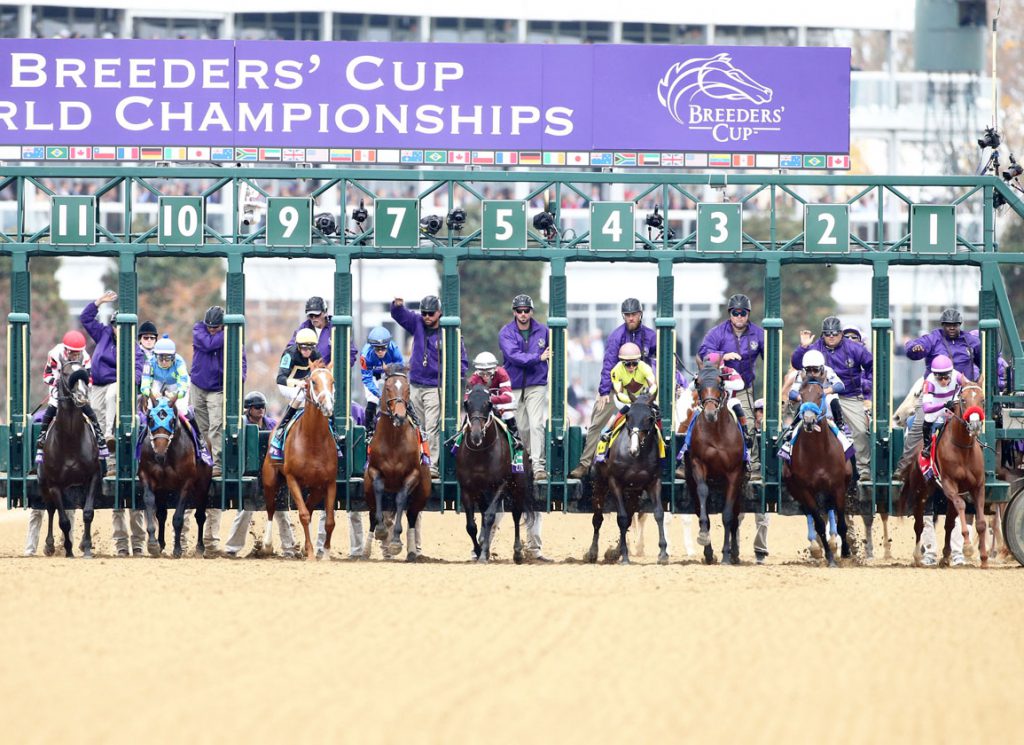
The horses break from the gate in the Dirt Mile | Coady

TDN: The Breeders' Cup Festival has become a big part of the whole experience. It's not just two days anymore. You have several events leading up to race day. Can you tell us a little bit of the history of this and how much has the Festival helped when it comes to things like economic impact?

DF: In addition to having the two best days of racing, the Breeders' Cup is a celebration of equestrian life. Like most major sporting events across the globe, it's important to have a festival component so that fans can come and see what a beautiful area the event is taking place in, be welcomed, have great hospitality and celebrate the equestrian lifestyle. We want them to walk away and say, 'Wow, not only was that two great days of racing, but it was a wonderful vacation, a wonderful experience and I want to come back.' In any of the cities that we are in, we work with the locals to develop that festival and to highlight key aspects of the region to our visiting guests.

TDN: NYRA is trying to get a loan from the state so that it can refurbish Belmont Park. You are on the record saying that if this gets done the Breeders' Cup would love to come back there. Your thoughts on a return to New York?

DF: We're incredibly supportive of NYRA and we will support any redevelopment at Belmont. We have a great relationship with the executive team at NYRA. I am having dinner Wednesday night in New York with (NYRA CEO) David O'Rourke. We wrote him a letter several months ago with the title, 'If you build it we will come.' The Breeders' Cup sticks to its word.

TDN: The Breeders' Cup has not been to Belmont since 2005, understandable because the current track is not a good fit when it comes to hosting an event like this. How much has the Breeders' Cup missed New York?

DF: We very much miss New York. There's so much energy up there and they are large investors in the game. We look forward to coming back. If they build it we will be there.

TDN: What can you tell us so far about what's in store for this year's Breeders' Cup at Santa Anita when it comes to new initiatives and things you can do to maintain the momentum?

DF: One of the challenging but also fun things when it comes to working for a company like the Breeders' Cup is that we are always innovating. We are continuing to move the ball forward on technological advancements in viewing and look forward to working with NBC, FanDuel and some other partners to continue to make sure that those who are watching have many different angles and experiences when it comes to watching the sport. Along with having great views of the San Gabriel mountains, we want to make sure that they have a world-class time when it comes to hospitality. We will continue to work to advance the culinary offerings and will have some exciting things to announce in the near future. We will also have some new ticket packages that we are putting the final touches on to make sure, again, that everyone has the best experience possible.

TDN: You brought up FanDuel. It's obvious that racing needs to find a way to attract the sports bettor and we need to have the FanDuels of the world offering betting on the Breeders' Cup and all racing on their sports betting platforms. Where do things stand when it comes to getting the sports bettors to follow and bet on the Breeders' Cup?

DF: Hats off to FanDuel for advancing the technology so there can be an aggregated wallet experience for the sports bettor. It's a tremendous marketing opportunity for our sport to be on the same bookshelf as the NFL, the NBA and MLB. Horse racing will be able to be cross-marketed from a wagering standpoint to those who are already wagering on other sports. This is one of the largest marketing opportunities we have had in a long time.

The post Q & A With Breeders’ Cup President and CEO Drew Fleming appeared first on TDN | Thoroughbred Daily News | Horse Racing News, Results and Video | Thoroughbred Breeding and Auctions.

Source of original post

Tejano Twist Favored Over Nine Sprint Veterans In Oaklawn’s Whitmore

Tejano Twist is the 3-1 program favorite for the $200,000 Whitmore Stakes (G3) for older sprinters Saturday at Oaklawn in Hot Springs, Ark.

Probable post time for the six-furlong Whitmore, the eighth of 10 races, is 4:22 p.m. (Central). Racing begins at 12:35 p.m. The card also features the $500,000 Essex Handicap (G3) for older horses at 1 1/16 miles.

The projected 10-horse Whitmore field from the rail out: Spankster, David Cabrera to ride, 124 pounds, 8-1 on the morning line; Tejano Twist, Francisco Arrieta, 124, 3-1; Miles Ahead, Martin Garcia, 117, 15-1; Edge to Edge, Nik Juarez, 124, 4-1; Empire of Gold, Lane Luzzi, 119, 15-1; Baytown Bear, Maclovio Enriquez Jr., 117, 20-1; Flash of Mischief, Cristian Torres, 124, 9-2; Pirate Rick, Rafael Bejarano, 119, 12-1; Cogburn, Ricardo Santana Jr., 124, 7-2; and Morello, Flavien Prat, 117, 15-1.

Tejano Twist and the speedy Edge to Edge are both trained by 2015 local champion Chris Hartman. Tejano Twist, a late-running son of Practical Joke, had won three consecutive starts before finishing second, beaten four lengths, by millionaire Grade 1 winner Gunite in the $150,000 King Cotton Stakes at six furlongs Jan. 28 at Oaklawn. Gunite's winning time over a sloppy track was a meet-best 1:08.89. With Gunite now based in the Middle East, Tejano Twist is favored to notch his third career stakes victory and second since Hartman claimed the gelding for $80,000 last June at Churchill Downs.

“No Gunite this time,” Hartman said. “That should be a little bit of help, for sure. He's a little hard to run down. We've got one horse on the front that's been doing really good and another one coming from the back. Hopefully, we can get a good result there. It looks like they're both coming into the race really live.”

Edge to Edge has recorded two sharp front-running allowance victories at the 2022-2023 Oaklawn. The six-furlong races went in 1:09.30 and 1:09.65.

Hall of Fame trainer Steve Asmussen, who conditions Gunite, will send out Grade 3 winner Morello and Cogburn, who has been favored in all six lifetime starts.

Morello, in his Oaklawn debut, finished fourth, beaten 9 ¾ lengths by Edge to Edge, Feb. 17. Cogburn is poised to grab his first career stakes victory after narrow misses last spring in the $150,000 Bachelor at Oaklawn and the $200,000 Chick Lang (G3) at Pimlico. Cogburn, in his 4-year-old debut and first start against older horses, was a Feb. 5 allowance winner at Oaklawn. Cogburn's winning time over a fast track was 1:09.67.

“He's always been fast,” Asmussen said. “He's run some very fast races and that's a good quality in a racehorse.”

Flash of Mischief looks to rebound from a fifth-place finish in the King Cotton for trainer Karl Broberg. Flash of Mischief won the $150,000 Ring the Bell Stakes at six furlongs Dec. 10 at Oaklawn.

The Whitmore is the final major local prep for the $500,000 Count Fleet Sprint Handicap (G3) at 6 furlongs April 15. The Whitmore is named for seven-time Oaklawn stakes winner Whitmore, the country's champion male sprinter of 2020.

The post Tejano Twist Favored Over Nine Sprint Veterans In Oaklawn’s Whitmore appeared first on Horse Racing News | Paulick Report.

Source of original post

CHRB Approves Redirection Of ADW Purse Revenue To Cover HISA Fee

The California Horse Racing Board conducted a meeting on Thursday, March 16, at the Le Meridien Hotel in Arcadia. Chairman Gregory Ferraro chaired the meeting, joined by Vice Chair Oscar Gonzales and Commissioners Dennis Alfieri, Damascus Castellanos, Brenda Washington Davis, and Thomas Hudnut.

The audio of this entire Board meeting is available on the CHRB Website (www.chrb.ca.gov) under the Webcast link. In brief:

— At the request of the Thoroughbred Owners of California (TOC) and racetracks, the Board approved a redirection of revenue from Advance Deposit Wagering that would normally go to Thoroughbred purses and commissions in order to pay the balance of California's 2023 fee to the Horseracing Integrity and Safety Authority (HISA). In expectation that step two of HISA's program will go into effect as scheduled on March 27,  California's proportional share of HISA's operating budget is $6,729,297. Largely through the efforts of CHRB staff, HISA is crediting California for the equine drug testing and research program that California will continue to pay for and perform on behalf of HISA, as well as sample collection, out-of-competition testing, and investigations, reducing the fee to $1,579,297. CHRB Deputy Executive Director Cynthia Alameda has been a principal in this cooperative effort with HISA. Commissioner Davis thanked CHRB Executive Director Scott Chaney and staff for a “job well done” in obtaining the credits.

CHRB and industry leaders helped guide HISA in the drafting of rules covering safety and drug testing, so HISA's rules largely reflect California's existing program, meaning California licensees will not experience much change under HISA. However, in his report to the Board, Chaney pointed out one major difference. Under HISA, which only regulates Thoroughbred racing, any drug testing positive on a post-race sample will result in the automatic disqualification of the horse and redistribution of the purse. The applicable HISA rules under section 3220 are Rules 3221 and 3321, Disqualification of the Covered Horse Results (a) Automatic Disqualification of Results.

Currently in California, disqualification only occurs for the most serious Classes 1, 2, and 3 infractions. Under HISA after March 27, what California classifies as Classes 4 and 5 violations also will require disqualification. Dr. Jeff Blea, the CHRB's equine medical director, reported there were four Class 4 violations (for methocarbamol and phenylbutazone overages) in January and February, but as those were out-of-competition samples, not post-race, there was no race result from which they could have been disqualified under HISA even had they occurred after March 27.

— Staff reported on the possibility of asking the Board to strengthen the CHRB's existing Inclement Weather Policy, primarily to further limit training activities on the main track and training track after inclement weather has forced those surfaces to be sealed (packed down to prevent seepage of water into the cushion). Training is the major focus because far more horses exercise in the morning than race in the afternoon and night, so training poses the greatest risk when surfaces have been unsealed but not yet fully settled. California racing executives have voluntarily canceled more than a dozen racing programs this year due to heavy rains.

— After stakeholders in Northern California reported they had not been able to reach agreement over a disputed week of racing despite months of negotiations, the commissioners made the decision for them by allocating the fourth week of August to both Golden Gate Fields and the Humboldt County Fair, meaning both tracks will run racing programs simultaneously (overlapped) in 2023. Vice Chair Gonzales cast the only negative vote in that decision. This action finalized all 2023 dates allocations in the state.

— The commissioners voted to withdraw their support for legislation, at least for this year, which would provide greater statutory funding for jockey welfare and backstretch medical services after representatives of the Jockeys' Guild and California Thoroughbred Horsemen's Foundation reported they will have sufficient funding for at least one or two more years, largely through assurances by the TOC and other supporters.

— Chaney reported on progress to hinder match racing at non-sanctioned locations in California. People for the Ethical Treatment of Animals (PETA) and other animal rights advocates have contributed to this effort.

— Representatives of Race Track Chaplaincy of America gave a presentation on their program, which ministers to the spiritual, emotional, physical, social, and educational needs of those persons involved in all aspects of the horse-racing industry.

— The Board authorized four of the racing fairs in Northern California to run their racing programs as one longer race meet for pari-mutuel purposes.

— The Board authorized distributions of race day charity proceeds by the Del Mar Thoroughbred Club, Santa Anita, and Golden Gate Fields to designated beneficiaries. Notably, Del Mar voluntarily contributed an additional $62,337 to its distributions. A representative of 1/ST Racing (formerly Stronach Group, owner of Santa Anita and Golden Gate) reported they contribute hundreds of thousands to charitable efforts beyond the statutory requirements in California.

The post CHRB Approves Redirection Of ADW Purse Revenue To Cover HISA Fee appeared first on Horse Racing News | Paulick Report.

Source of original post

Verified by MonsterInsights