As noted by colleague Bill Finley earlier in the week, we've just passed the 50th anniversary of Secretariat's sophomore debut. Yet even two years ago hardly anyone had heard of an unraced son of Tapit, meanwhile acclaimed by many as the best American Thoroughbred since.
Okay, so he had been a seven-figure yearling; and everyone who had participated in his education knew that he was something special. In fact, John Sadler was so aware of the impending responsibility that he was saying nothing. For one thing, if people had any inkling of the talent he was about to detonate, the races wouldn't have filled. But also because this, like all secrets, was a burden as well as a privilege.
Looking back, Sadler accepts that doing justice to Flightline felt like so intense a duty that it could not come without some personal cost.
“I kind of devoted my time to him to a point where I probably shut some people out,” he admits. “The odd dinner at night, that kind of thing. I really drilled down, I said to myself, 'I'm going to walk this walk with this horse.' I wanted to be right alongside him, every step, because I knew it was going to be so special. So here I am today, light mood, happy as heck, because I always said my time to celebrate would be when it was over. Very early on, I said to myself: 'I'd like to pitch a perfect game.' That's a career goal. And we did.”
But so much of life is about the pursuit, rather than the actual moment of fulfilment. Sadler, tall and bronzed, looks in great shape at 66. But now that he has consummated a generational dream, can he still maintain the same motivation?
“We've been pondering that a lot,” he acknowledges. “But like B. Wayne Hughes of Spendthrift Farm used to say, 'My health insurance is that group of yearlings over there.'”
So, while he knows that he can hardly expect another Flightline, Sadler also feels that the true horseman's appetite, happily enough, can never be finally sated.
“I'm pretty confident I'll have a lot of good horses come my way, because I still want to do it,” he says. “If there's a time to not do it, I'll know when that is. Somebody said I'd retire right after Flightline. But rushing into a decision like that, with horses, is always rash. Time will see where we're at. I've got some really good young people in my operation. They've invigorated me the last several years and really make me excited about the future. My assistant Juan Leyva is just going to be a phenom, and I've a couple of other guys like that. So I'm really not feeling a lot of pressure.”
And, actually, that's just why it's appropriate to catch up with Sadler now, when the dust has settled and Flightline is embarking on a new career at Lane's End. Because the horse himself was such a meteor, burning with almost agonizing brightness as it became clear how fleeting his passage was likely to be, that he almost became a communal possession. As such, we rather lost sight of his more intimate context: of the decades of groundwork that prepared Sadler for the task that would define his career.
That long accretion of experience didn't just make him eligible, but also duly appreciative. Yes, he could feel vindicated–not least after the notorious torments he endured, for much of his career, at the Breeders' Cup–but the true gratification was personal, not public. Because for the great horsemen, it's about the process, the daily and seasonal cycles of engagement. If that ultimately produces a champion, then it all makes sense. And, that being so, then of course you continue with the immersion.
“Totally, a lifestyle,” he replies, when asked how he views his vocation now. “It's the journey that I've always loved: horses coming in, and seeing where they go. You don't want to be like a claiming trainer, slashing around here and there, but to develop horses. I think that's where my strong suit is. And for this to hit at this time, in the latter part of my career, is so special. When I started out, I wanted to be known as a good professional. I know I achieved that. But then to get these great horses is gravy on my career.”
Because don't forget that Sadler started out right at the other end of the scale. With no background in the game, he learned under tough, old-school horsemen, and laid the foundations of his own career with tough, fast Cal-breds.
“I've had to battle stereotypes my whole career,” he muses. “When you're a young trainer, you get locally-bred horses and those happen to be sprinters. And we did well with them. So, as I started getting better horses over the years, and won important races over a distance of ground, that's fun. But every year they'd write how Sadler can't win at the Breeders' Cup. And you'd be beaten a head. Or find yourself running against Miesque. I think I did that three years, and I ran against Goldikova a couple of times, too. And when you do that, it doesn't matter if you have the best turf horse in California.”
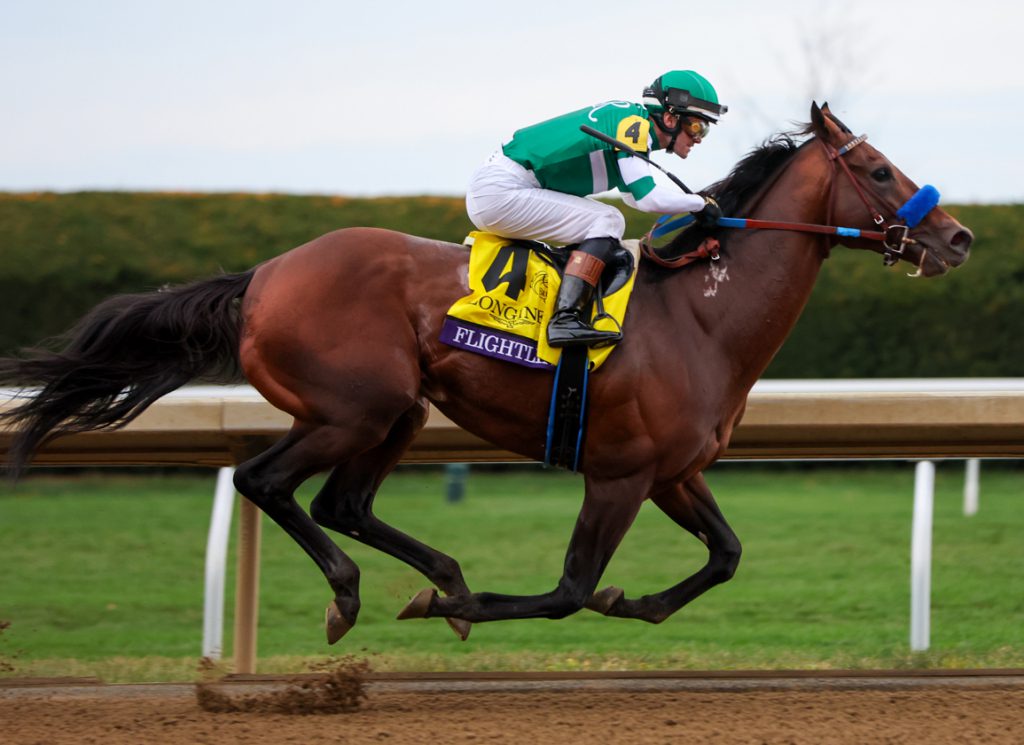
Flightline | Breeders' Cup Eclipse Sportswire
But if Sadler had a long wait for the best materials, in one respect he could not have been more blessed.
“Oh, absolutely!” he exclaims. “I came under a brilliant class of horsemen. They may not have all been perfect human beings. In that era, they might have smoked or drank too much. But they were self-made guys and really knew what they were doing.”
He absorbed priceless insights assisting racetrack vet Dr. Jack Robbins, observing the day-to-day methods of clients like Ron McAnally and Gary Jones.
“It was great practice,” he says. “I loved that we were going in all these different barns: you could take something from every one of them and then build your own program. And Dr. Robbins himself was so smart. A tremendous veterinarian, obviously, but also a successful horse owner, one of the charter members of the Oak Tree Racing Association. Tough guy, opinionated guy, smoker, drinker, but just a great man.”
Robbins could see that his protégé was unusually attentive. Sadler might say, “Oh, Doctor, I went over to such-and-such a barn and suggested a vitamin shot for that horse.” And Robbins would reply, “Oh John, no, that was a terrible idea!” And then he'd wink.
Sadler also learned a great deal as assistant to Dave Hofmans, though his big break came in 1979 when Eddie Gregson had taken on a big client and was looking for someone, he could trust to take four or five to Golden Gate Fields. There were things going on–a pari-mutuel strike, people shipping out–and Sadler quickly learned not to turn down horses. By the end of spring, he was up to 30 or 40.
Gregson's heartbreaking end, by his own hand, still grieves all who knew him. “He was really a bright guy, very sensitive, he knew food and wine and was very cultured,” Sadler recalls. “It caught everybody off guard, nobody saw that coming. But you never know what goes on with people. A great guy and a great trainer also.”
Besides these mentors, Sadler cherishes no less affection for the horses who also assisted his education. He'll never forget the $100,000 match, at Santa Anita in 1991, where his Cal-bred speedball Valiant Pete (The Irish Lord) beat Quarter Horse champion Griswold in a world record dash. And then there was the $50,000 claim Olympic Prospect (Northern Jove).
“He didn't run very well the day we claimed him,” Sadler recalls. “But he became really an important horse for me, early on. You couldn't train him very hard, but he ended up winning every sprint stake in the state. One day Patrick Valenzuela got on him, I can't remember what happened to the usual jock, in a race called the Potrero Grande [now the GIII Kona Gold S.]. He just let him roll, and they went that first half-mile in 42-and-change. And won! I mean, he was tiring at the end. But I've never seen that, before or since.”
With that kind of background, it meant a great deal to Sadler gradually to disclose a mastery with two-turn horses. Whatever pinnacle it might also represent in the story of the breed, let's not forget that Flightline last summer–by a bewildering 19¼ lengths–was his barn's fourth different GI Pacific Classic winner in five years, all owned (part-owned, in this case) by Sadler's cherished patrons at Hronis Racing.
That streak was started by the slow-burning Accelerate (Lookin At Lucky), whose campaign at five would have made him a lock for Horse of the Year but for landing in the same ballot as an unbeaten Triple Crown winner. He remains Sadler's richest runner at $6.7 million. “I just love him to death,” Sadler says. “His foals are going to be like him, they'll be later types, but I've two or three [of his first crop] that I really like and I'm expecting a lot of them to come forward as the year goes on.”
But Flightline was a freak from the outset. “He never hid his talent,” Sadler says. “April Mayberry called me from the farm and said, 'John, this horse gives me goosebumps.' She's been doing it a long time, and the only other to give her that feeling had been Zenyatta. So, we were expecting a lot when he came in. And even after the first, short piece of work, we were all just going, 'Wow.'
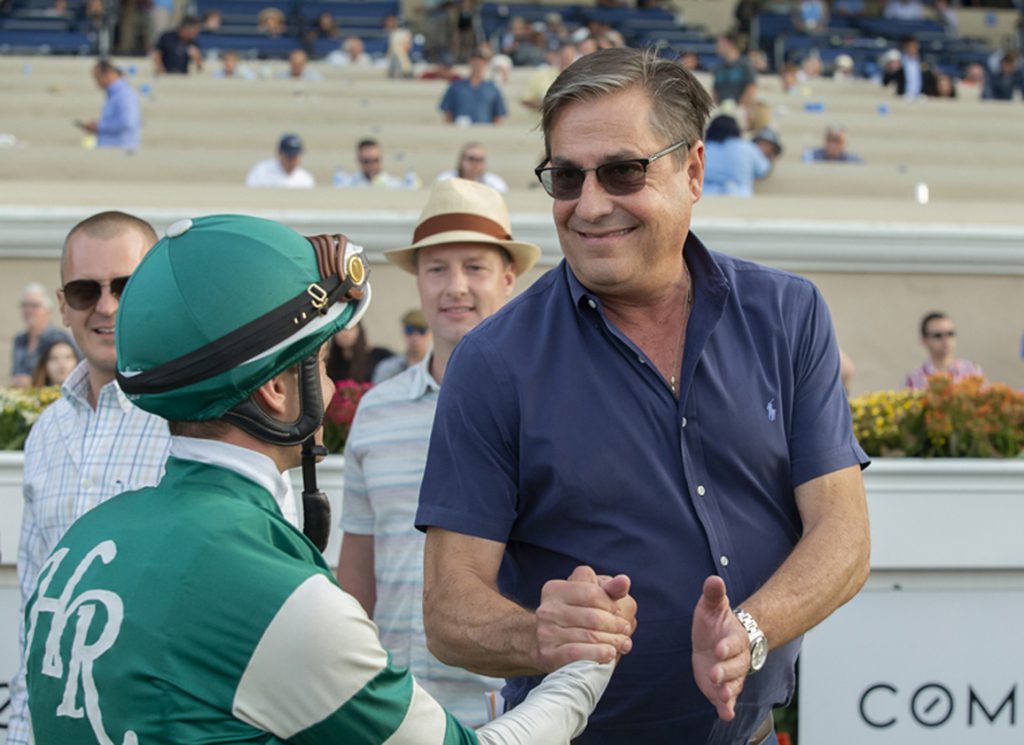
John Sadler with Flavien Prat | Benoit
“I mean, usually, I have to train them up. This horse, it was just a straight line. He's already there. He was so willing, from day one he just wanted to do it. Most of the early training was about getting him to relax and carry his speed. Even when he broke a little slow, he was very keen to charge out there between horses and push them aside. So, it was just about calming him down a little.”
While it was bittersweet only to race Flightline six times, Sadler absolutely understood his retirement. It would have been virtually impossible to find domestic opposition, unless or until a sophomore champion proved willing to take him on, while the insurance of fresh challenges overseas would have been eye-watering.
Whatever life after Flightline may comprise, it's been an incredible odyssey for the stockbroker's son who gazed across a paddock fence one summer vacation and fell in love with the horses grazing there. It should plainly end in the Hall of Fame, for which Sadler has a belated nomination this year. In some ways, perhaps he doesn't stand out from the production line of his profession merely in terms of his craggy six feet and four inches. And he does admit that there have been times when he has sensed a little resistance, notably in East Coast perceptions.
“You get that a little bit,” Sadler concedes with a shrug. “But you know what, when you've been training a long time, I don't really let those things bother me. I love training a stable of horses. I like where I train. I'm very comfortable doing what I'm doing. And, when you've been doing it a long time, you tend to end up with clients that are people you really like. So, I feel I'm in a good place. Like I said, I've hit most of the marks I want to. You can't worry about that kind of stuff. I mean, anything can happen with horses–and that's what's fun.”
That willingness to fight your corner, feisty and independent, was something he always loved about the California circuit.
“I was always trying to model after the guys that might not have had the best horses, but were always very hard to beat,” he remembers. “Even back then, they went out and won everywhere. I loved Tommy Doyle going over to win the Belmont [in 1975, with Avatar]. When California ships out, the results have always been amazing–and continue to be, to this day.
“We don't have gaming or casinos but we have the most beautiful tracks in the world and we always hold our own. Yes, when there's 15 protestors, versus 40,000 on opening day, and I'm signing autographs with Flavien Prat for an hour and a half, it's the 15 protestors that get all the noise. But California's led the way in all sorts of reforms. It's an adjustment, but you either embrace it or get stuck in the past.”
Sure enough, California has now given us one of the all-time greats soon after producing the only Triple Crown winners of modern times; not to mention a mare that arguably reached a wider public than any of them. Zenyatta's trainer, incidentally, is also deservedly nominated for the Hall of Fame–and would certainly join Sadler in stressing their shared debt to David Ingordo, now purchaser of three GI Breeders' Cup Classic winners.
“I was a friend of David's father so I've known him since he was in short pants,” Sadler says with a chuckle. “Actually, I do have a picture of him in short pants! He calls me Uncle John sometimes. So, it's been fun for me, and a source of great pride, to see how his business has developed. He's a tremendous, tireless worker, and obviously brilliant at it.”
Whether on behalf of his closest circle, then, or the entire Turf community, Sadler says he's profoundly grateful for the benediction he shared over the past couple of years.
“Many of the horses Flightline beat were really never the same afterwards,” he remarks. “He was a very dominant colt. At the Breeders' Cup one morning, Juan was coming off the track just as Epicenter was going up and Juan said he could feel Flightline rise up under him, literally making himself bigger like a rooster, as that horse came by.”
And something else happened that week. One morning Sadler's phone rang and there was Ron McAnally, 90 years old and still rooting for that lofty young man who used to follow Dr. Robbins round the barn.
“John,” McAnally said. “Don't let those photographers bother Flightline. I had that once with a horse, they were pestering him every five minutes, and he didn't run any good.” Sadler hardly needed telling, but was still blown away. “Okay, Ronnie, I really appreciate that.”
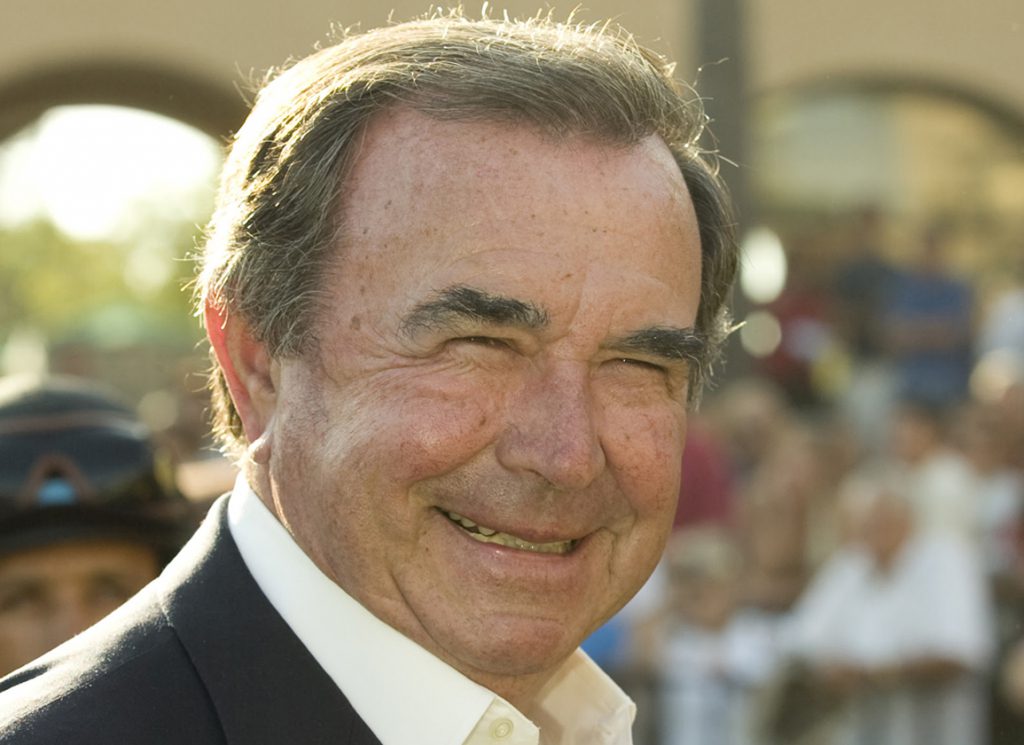
Ron McAnally | Benoit
McAnally, of course, had bred Rock Your World (Candy Ride {Arg}), who won the GI Santa Anita Derby for Sadler a couple of years ago. That connection had given him an extra buzz, and now it was adding something memorable to the Flightline adventure, too.
“That was a special call for me,” Sadler says. “He's one of the good guys and it was great that he wanted to pass that on to me, that he was still thinking of me. Like I said, as a young trainer I relied on the older guys a lot. I had great mentors. You'd sit around in the cafeteria, and these guys were so colorful, some of them in that era were doubtless politically incorrect–but they knew their stuff.”
By the same token, nothing pleases Sadler more today than when a young trainer seeks his counsel. Evidently that doesn't happen as often as a generation ago.
“That's a shame because horsemen are really very generous with their knowledge,” Sadler says. “I think to be a good horseman is intuition based on experience. And I do have the background: I walked hots, I groomed, I came up from the bottom of the stable. I didn't come in at the management level. So, I put in the years. And it's been a great journey. None of this happened overnight. It's like the guy that did 50 movies before he won the Academy Award. It's a lifetime of work.”
The post Sadler Staying On Flight Path appeared first on TDN | Thoroughbred Daily News | Horse Racing News, Results and Video | Thoroughbred Breeding and Auctions.
