The X-Ray Files: Liz Crow

The TDN sat down with bloodstock agent Liz Crow for this fourth offering in a series presented in cooperation with the Consignors and Breeders Association (CBA). Through conversations with buyers and sellers, the series looks to contribute to the discussion on radiograph findings and their impact on racetrack success.

Bloodstock agent Liz Crow, who has an ever-expanding list of accomplished sales purchases, as well as a burgeoning book of pinhook successes with partner Paul Sharp, admits there are subtle distinctions between buying to race versus buying for resale.

“There are several different findings for a horse that you can live with to race, but you can't buy to pinhook,” Crow said. “Some of those things, for example, are the moderate to severe sesamoiditis and juvenile tendonitis. Those horses will be perfectly fine and perfectly normal if you give them time, but you can't put them right into a 2-year-old sales cycle because you can't give them that time. They have to get ready and start breezing. Moderate to severe sesamoiditis requires 60 to 90 days before you break them. Obviously, you just don't have 60 to 90 days [for a pinhook prospect]. You've got to start breaking them when they get to your farm and they need to be breezing by January. And that just doesn't give you enough time. So it's all about timing.”

Whether it's searching for a racing prospect or a potential pinhook, Crow said the biggest part of her job may be determining what is consequential and what isn't on the vet report.

“I think your relationship with your vet is very important,” she said. “Not trusting just the vet report or what the vet reports say, but actually forming a relationship with the vet and having that line of communication where you can have a discussion. You as the agent, and with your client, you have to take that information and make that decision based on what you're given.”

Crow has been shopping the sales for over a decade and has learned to value just that type of relationship she has developed with Dr. Jeff Berk.

“I've been doing this for quite a while now and I've used the same vet my entire career,” Crow said. “I have listened to Dr. Berk read vet reports to me and talk to me about this for 12+ years at this point. We vet 400-500 horses in September alone. Oftentimes, Jeff will say to me in September–we are obviously all moving so fast–he will say, 'Call me on this one, let's talk about it.' And that means this is not a black-and-white thing. I honestly think it's a toss-up for what's more important for my job, whether it's picking out and finding a horse that has talent or is it really deciphering these vet reports.”

She continued, “Vet reports to me are very subjective. They are not black and white. If you get three different vets that give you three different opinions–and that happens more often than not–they are giving you their opinion. They cannot tell you if this horse can or cannot make the races. They are using their experience to tell you what they think based on what they found in the X-rays. But these are not facts. So the most important thing for me, as an agent, is to decipher what that means and if it fits for what my client is trying to do with that horse.”

Crow has built a career on finding horses on a budget who go on to do great things on the racetrack. She purchased future champion Monomoy Girl for $100,000 at the 2016 Keeneland September sale and was able to acquire subsequent Grade I winner Jack Christopher for $135,000 at the 2020 Fasig-Tipton October sale.

“Sometimes the best thing you can do for your client is find that horse that doesn't vet perfectly, but may be very athletic,” Crow said. “I've had a lot of success doing that and I think it's a great way to approach it, as long as your client is clear and understands the risk.”

After purchasing Monomoy Girl in 2016, the filly went on to win the 2018 GI Kentucky Oaks and twice won the GI Breeders' Cup Distaff. The two-time Eclipse champion provided Crow a case-in-point.

“Monomoy Girl had moderate sesamoiditis behind in both hind ankles and she had an OCD removed behind as well,” Crow said. “Dr. Berk and I had a discussion about it and I was completely comfortable with bidding on her based on what he had told me. And I think it did bother a few people, from my understanding. But that's the thing, when you get three or four different vets, they all have different opinions. I think that's part of the problem, all of the opinions.”

Over the years, Crow has developed an understanding of what are significant issues and what issues she can deal with.

“If your vet says the horse has this, this, this and this, I sort of go through it and immediately think, a P1 plantar fragment behind, a lucency in the upper joint, mild sharpening in the upper joint of the right knee, those things are all fine. I know those three findings. Like a sharpening in the knee, any finding in the upper joint of the knee, mild to moderate sesamoiditis that scans well, a fragment in the back of the ankle, these things don't mean anything really. They are just comments, a differentiation of normal. I think that there are a lot of findings that are just that, a differentiation of normal. And deciphering what is acceptable and what isn't is not as easy as just looking at the vet sheet. Monomoy Girl is a great example of a horse that, if you read her vet sheet without any sort of context or discussion, you could think she could have problem, but she didn't and none of those things bothered her throughout her entire race career.”

Advancements in veterinary scans provide potential buyers with a treasure trove of information to work through. That's not a bad thing, according to Crow.

“You can never go wrong with more information,” she said. “I am not going to say it's a bad thing that we have better information. I am just going to say that every horse has  something and it's very rare that you vet a horse that is perfectly clean. You have to learn what you can live with. Most good horses have something. It would be great to continue to inform these buyers that horses don't have to be NSA [no significant abnormalities] to be able to be purchased.”

Click to read previous The X-Ray Files: with Tom McCrocklin,  David Ingordo or Ciaran Dunne.

The post The X-Ray Files: Liz Crow appeared first on TDN | Thoroughbred Daily News | Horse Racing News, Results and Video | Thoroughbred Breeding and Auctions.
Source of original post

Cross Country Pick 5 Features Horseshoe Indianapolis, Belmont Park

The New York Racing Association will host a Cross Country Pick 5 on Saturday featuring an all-stakes sequence from Belmont Park and Horseshoe Indianapolis.

The Cross Country Pick 5 requires bettors to pick the winner of five select races from tracks across the country. The minimum bet for the multi-track, multi-race wager is 50 cents. Wagering on the Cross Country Pick 5 is available on ADW platforms and at simulcast facilities across the country with each week featuring a mandatory payout of the net pool. The Cross Country Pick 5, boasting a low 15 percent takeout, offers sequences with races from Belmont Park and partner tracks across the country.

The sequence kicks off at 5:28 p.m. Eastern in Race 10 from Horseshoe Indianapolis, the $100,000 Indiana General Assembly Distaff Handicap at 1 1/16-miles on turf for older fillies and mares. Henrietta Topham arrives off a narrow triumph in the Grade 3 Mint Julep on June 4 at Churchill Downs for trainer Geoff Mulcahy, looking to notch both her third consecutive victory and third career stakes conquest. The Carlo Vaccarezza-trained Sweet Dani Girl looks to improve from two placings in graded events in her last two outings, while the Brad Cox-trained Juncture makes her third state-side outing on the heels of a win in the Ouija Board Distaff on May 29 at Lone Star Park.

Action switches to Belmont Park to commence the first of four graded events to close out the sequence, beginning with the Grade 1, $750,000 Belmont Derby Invitational in Race 10 [5:49 p.m.]. The Andrew Balding-trained The Foxes makes his American debut off a fifth in the Group 1 Epsom Derby, which followed a determined neck victory in the Group 2 Dante at York. A talented field includes the pair of graded stakes-winners Webslinger and Boppy O for Hall of Fame trainer Mark Casse; dual graded stakes-placed Far Bridge for Hall of Famer Todd Pletcher; and last-out Grade 2 Pennine Ridge-winner Kalik for four-time Eclipse Award-winning trainer Chad Brown.

The sequence heads back to Indiana for Race 11 [6:03 p.m.], the 1 1/16-mile Grade 3 Indiana Oaks for sophomore fillies. Graded stakes-winner Taxed makes her first appearance since a breakout win in the Grade 2 Black-Eyed Susan for conditioner Randy Morse. She'll face steep opposition from Grade 1 Ashland-winner Defining Purpose for trainer Ken McPeek and the graded stakes-placed Lily Poo for trainer Michael McCarthy in a competitive field of eight.

The penultimate leg features sophomore fillies sprinting 6 1/2 furlongs in the Grade 3 Victory Ride [Race 11, 6:21 p.m.] at Belmont, led by undefeated starlets Maple Leaf Mel and Dazzling Blue. The former enters from a strong win in the Grade 3 Miss Preakness on May 19 to make her first start for conditioner Melanie Giddings while the latter steps up to the graded ranks for the first time off an 8 3/4-length optional claiming romp on the same day at Churchill for Cox. They will have their perfect records challenged by last-out Grade 2 Eight Belles-winner Red Carpet Ready for trainer Rusty Arnold and the Brown-trained Interpolate, who was a close second last out in the Grade 2 Beaumont in April at Keeneland.

The sequence closes out in the Hoosier State with the Grade 3 Indiana Derby [Race 12, 6:40 p.m.], a 1 1/16-mile test for sophomores. Dual Grade 1-placed Verifying was last seen finishing a game second in the Grade 3 Matt Winn on June 11 at Ellis Park where he earned a 101 Beyer Speed Figure for Cox. Act a Fool has won his last four starts for conditioner Larry Rivelli, including the Hawthorne Derby on turf last out for his first stakes coup. The field also includes Grade 3 Gotham victor Raise Cain for trainer Ben Colebrook; multiple graded stakes-placed Hayes Strike for McPeek; and Georgie W, who is undefeated in two starts and won a local allowance by 9 3/4 lengths last out for trainer Will Walden.

Free Equibase past performances for the Cross Country Pick 5 sequence will be available for download at https://www.nyra.com/belmont/racing/cross-country-wagers.

America's Day at the Races will present daily coverage and analysis of the spring/summer meet at Belmont Park on the networks of FOX Sports. For the complete broadcast schedule, visit https://www.nyra.com/belmont/racing/tv-schedule.

NYRA Bets is the best way to bet every race of the Belmont spring/summer meet. Available to horse players nationwide, the NYRA Bets app is available for download today on iOS and Android at www.NYRABets.com.

Cross Country Pick 5 – Saturday, July 8

Leg A: Horseshoe Indianapolis, Race 10 –Ind. General Assembly Distaff H. (5:28 p.m. Eastern)

Leg B: Belmont Park, Race 10 – G1 Belmont Derby Inv. (5:49 p.m.)

Leg C: Horseshoe Indianapolis, Race 11 – G3 Indiana Oaks (6:03 p.m.)

Leg D: Belmont Park, Race 11 – G3 Victory Ride (6:21 p.m.)

Leg E: Horseshoe Indianapolis, Race 12 – G3 Indiana Derby (6:40 p.m.)

The post Cross Country Pick 5 Features Horseshoe Indianapolis, Belmont Park appeared first on Horse Racing News | Paulick Report.

Source of original post

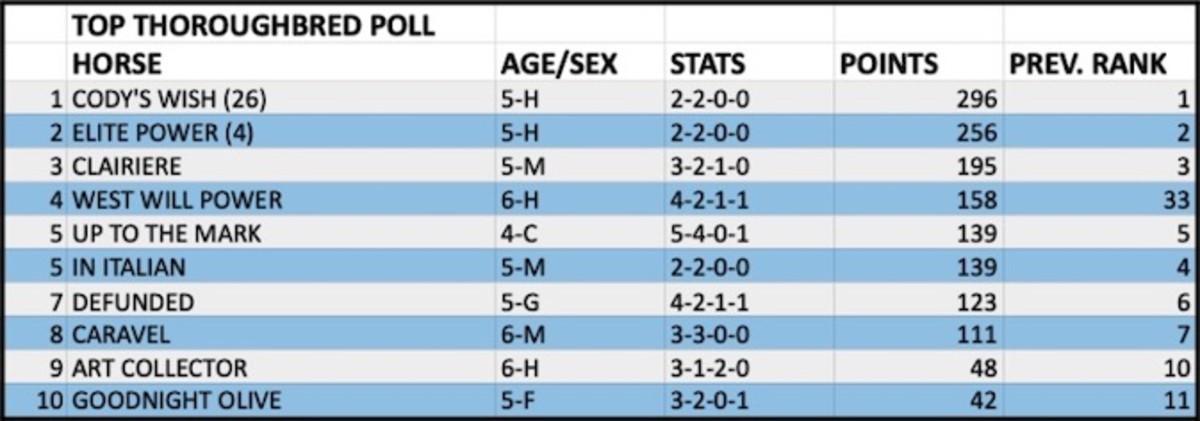
NTRA Poll: West Will Power Moves Into No. 4 Spot With Stephen Foster Victory

Gary and Mary West's West Will Power raced into the NTRA Poll's top 10 on July 1 with his half-length victory over a fast-closing Rattle N Roll in the Grade 1 Stephen Foster Stakes — run this year at Ellis Park after the final weeks of the Churchill Downs meet were moved to the Henderson, Ky., track.

Under Flavien Prat, West Will Power was winning his first career Grade 1 stakes, defeating fellow G1 winners Rattle N Roll, Proxy, and Stilleto Boy, among others. Both Proxy (previously No. 8) and Smile Happy (No. 9) were knocked out of the top 10 with their losing performances in the Stephen Foster. Goodnight Olive moved up to the 10 spot.

West Will Power was sent away the 2-1 favorite in the 1 1/8-mile contest.

Cody's Wish, unbeaten in two starts this year, remains at the top of the NTRA Poll with 26  first-place votes.

This is Week 23 of the 2023 NTRA Top Thoroughbred Poll conducted by the National Thoroughbred Racing Association (NTRA), covering racing performances through July 2. Voting is conducted by national media.

The Top Thoroughbred poll represents horses competing for Horse of the Year. The Top Thoroughbred Poll concludes on Tuesday, Nov. 7 following the Breeders' Cup World Championships.

Rankings is done on a 10-9-8-7-6-5-4-3-1 basis with first place votes in parentheses, 2023 record and total points. A-S: Age-Sex, Sex: C-colt, G-gelding, H-horse, F-filly, M-mare, R-ridgling.

Other horses receiving votes: RATTLE N ROLL (38), FORTE (17), PRETTY MISCHIEVOUS (16), MAGE (11), SMILE HAPPY (8), TWO PHIL'S (8), PROXY (8), GUNITE (7), ARCANGELO (7), ARABIAN LION (7), TAIBA (4), MODERN GAMES (3), COUNTRY GRAMMER (2), EMMANUEL (2), NEST (2), ZOZOS (2), PLAYED HARD (1)

The post NTRA Poll: West Will Power Moves Into No. 4 Spot With Stephen Foster Victory appeared first on Horse Racing News | Paulick Report.

Source of original post

Op/Ed: In Extending Baffert Ban, Churchill Downs Has Gone Too Far

With the Churchill Downs spring meet, which was moved over to Ellis Park, winding down, it appeared that Bob Baffert would soon be able to put the worst of his problems behind him. Baffert was serving a two-year suspension from Churchill Downs that came in the aftermath of Medina Spirit (Protonico) testing positive for a substance banned on race day after crossing the wire first in the 2021 GI Kentucky Derby. The suspension forced Baffert to sit out the 2022 and 2023 runnings of the Derby, the race that is at the core of his operation. It was a huge price to pay. The end of the meet on Sunday was supposed to mark the end of his ban and give Baffert the green light to run at Churchill, the other tracks owned by the company, and in the 2024 Derby.

Instead, Churchill announced Monday that Baffert's ban had been extended through the calendar year 2024. The decision, Churchill said in a statement, was “based on continued concerns regarding the threat to the safety and integrity of racing (Baffert) poses to CDI-owned racetracks.”

It was a stunning announcement, and not just because it was unexpected. To extend the ban, based on what are best described as flimsy accusations, is overkill. Baffert served his time, his punishment was up and it was time for him to prepare for his return to the Kentucky Derby next year. Justice was not served here.

Baffert's problems began before the 2021 Derby. He had accrued a number of positives over a short period, including one with Gamine (Into Mischief) in the 2020 GI Kentucky Oaks. When Medina Spirit tested positive for betamethasone, Churchill Downs clearly had had enough.

“Failure to comply with the rules and medication protocols jeopardizes the safety of the horses and jockeys, the integrity of our sport and the reputation of the Kentucky Derby and all who participate. Churchill Downs will not tolerate it,” read a statement issued by the track at the time.

A two-year suspension followed. Baffert's problems only mounted. He received a 90-day suspension from the Kentucky Horse Racing Commission and New York Racing Association banned him for what turned out to be a year.

Baffert vowed to fight the charges “tooth and nail,” and that's what he did. He and his legal team based their defense on the supposition that the betamethasone got into Medina Spirit's system, not through an injection. but through an ointment used to treat a skin rash. That, they contended, meant that the positive should have been excused. That never seemed like a winning argument. The betamethasone was in the horse's system. That's all that mattered, and not how it got there. But Baffert kept fighting and contested every one of the suspensions as what seemed like a never-ending series of appeals worked their way through the legal system. As late as this year's GI Belmont S., Baffert was still out there stating his case. In an interview with Fox he said that if he had to do things over again regarding the Medina Spirit matter he wouldn't have done anything differently and that he didn't break any rules.

That apparently didn't go over well in the Churchill Downs corporate suites.

“Mr. Baffert continues to peddle a false narrative concerning the failed drug test of Medina Spirit at the 147th Kentucky Derby from which his horse was disqualified by the Kentucky Horse Racing Commission in accordance with Kentucky law and regulations,” Monday's statement from Churchill read. “Prior to that race, Mr. Baffert signed an agreement with Churchill Downs which stated that he was responsible for understanding the rules of racing in Kentucky and that he would abide by them. The results of the tests clearly show that he did not comply, and his ongoing conduct reveals his continued disregard for the rules and regulations that ensure horse and jockey safety, as well as the integrity and fairness of the races conducted at our facilities. A trainer who is unwilling to accept responsibility for multiple drug test failures in our highest-profile races cannot be trusted to avoid future misconduct.”

There's no doubt that Baffert could have been handled the situation better and that a more prudent strategy would have been to shut up, take his lumps and wait patiently on the sidelines for his suspension to run its course. Had he done so, it's likely that Churchill Downs would have reinstated him Monday rather than extending the ban.

Whether Baffert “peddled a false narrative” or not, no one deserves to be penalized–and penalized severely–for exercising their right to defend themselves. And that's what Churchill has done to Baffert. Put in the same situation, most anyone would have done the same. By no means does anything he did constitute a case of “continued disregard for the rules and regulations that ensure horse and jockey safety…”

Another troubling aspect to this latest twist in the Baffert-Medina Spirit saga is that there's no telling what Churchill will do next. In its statement, Churchill gave no assurances that it will drop the ban at the end of 2024. Rather, it said that it will re-evaluate Baffert's status at the time. Do we know that they will ever welcome Baffert back at their tracks? We don't.

Baffert is far from perfect and he never deserved to get a free pass for what he did. He should have been far more careful, not only with Medina Spirit, but with all the horses he had that tested positive. Instead, and at the very least, he was sloppy and took his eye off the ball. How did he and his veterinarian not know that treating Medina Spirit with the ointment Otomax could result in a positive? All of this would have been an issue with any trainer in any race, but when it comes to the biggest name in racing and the sport's marquee race, you definitely have a problem.

So maybe Baffert deserved some of the penalties, especially the one handed down by the Kentucky Horse Racing Commission. But at some point, the crime and the punishment need to fit. We no longer need to debate whether or not Churchill Downs was justified in banning Baffert for two years. That ship has sailed. The relevant issue now is the extension of the ban and for what reason. Since the original suspension was announced, Baffert has done nothing wrong and has not violated any rules or had any more positives. He should be on his way back and that he's not suggests that Churchill Downs has a vendetta against him. It's not right.

The post Op/Ed: In Extending Baffert Ban, Churchill Downs Has Gone Too Far appeared first on TDN | Thoroughbred Daily News | Horse Racing News, Results and Video | Thoroughbred Breeding and Auctions.

Source of original post

Verified by MonsterInsights