With First Event Approaching, National Thoroughbred League Regroups

The National Thoroughbred League (NTL), a racing start-up meant to bring the league concept to Thoroughbred racing, will debut Sept. 3 at Kentucky Downs, but the first few events on the schedule will be run under a format different than what was envisioned when the formation of the league was announced.

Under the original concept, all horses performing in NTL races were to be owned by the League itself and would be portioned off to six teams representing different cities. Each team was to have six horses and the team that accrued the most points during the series was to earn a $1-million bonus.

But NTL President of Horse Operations Tom Ludt said that no horses have been bought and there are no immediate plans to do so. Instead, Kentucky Downs will run the $500,000 National Thoroughbred League H. on Sunday, Sept. 3. Though the race is meant to bring attention to the NTL, it will be open to all horses. Despite being owned by outside interests, the jockeys riding in the race will wear NTL silks.

“This is not going to fail,” Ludt said. “We have made some changes to make it better for the long term. It's all about building up the League. We have pivoted into a different scenario for 2023 so that we are bigger, stronger and better organized. We're going to learn a lot for 2024.”

The second event on the NTL schedule is set to take place at the Meadowlands on the weekend of Oct. 13 and 14. Ludt said the plan for the Meadowlands event is to also have a race recognizing the NTL but, again, one open to all horses. Under the original schedule, the NTL was to go from the Meadowlands to Los Alamitos to Tampa Bay Downs. Ludt said plans for the Los Alamitos and Tampa Bay Downs races are still in flux.

Ludt said he advised the League's founders that buying horses at this time was not economically feasible.

“I talked them out of buying horses right now,” Ludt said. “I told them that when you look at what we're trying to accomplish this is a major task and when you look at the amount of money that needed to be spent on these horses it was tough. It's a start-up and we've run into some issues.”

Ludt said that one of the problems was that the races held at Kentucky Downs and the Meadowlands were scheduled for the grass, while the Los Alamitos and Tampa Bay Downs races were to be run on the dirt. That meant that any League horse who was a grass specialist would have nowhere to run for several months. Horses in the League are not permitted to run in outside races.

“We were going to run three or four events and then these horses were going to sit and the expense to keep them in training was going to be huge,” Ludt said. “So why buy them now? I talked them into not buying the horses. Some people are going to jump on that and say we failed. No, we have a plan.”

Ludt said he approached NTL organizers and suggested there are other ways to fill the teams' rosters other than buying dozens of horses. He also said he suggested that horses in the League be allowed to run in non-League races, but was told that is not in the League's plans.

“I told them, don't own the horses,” he said. “Instead, get creative. Look into partnerships. But they believe the League needs to own horses long term. That's fine, but you have to look at the numbers. Just the day rate alone for all these horses is going to be huge.”

Ludt said that even though the Kentucky Downs race will look different from what was originally planned, it will benefit the League. The NTL envisioned all of its races turning into events and is linking each one to such things as wine and food festivals and entertainment. On the night before the Kentucky Downs race, there will be a live performance by DJ Pee .Wee (aka Anderson .Paak) at Nashville's Wildhorse Saloon.

“The way this thing set up, it is an event business with horse racing,” he said. “The truth of the matter is it needs to start off with more events and less horse racing. The goal is to grow the game. We don't need the Tom Ludts of the world to become a fan of the League. They already are racing fans. We need to get people like our neighbors and turn them into racing fans by exposing them to the League.

“At Kentucky Downs, let's have a an opening blowout event, a launch party. The people at Kentucky Downs are super behind this. Kentucky Downs is maybe the only track in America that has more money than they know what to do with and they were willing to put up a big race. Horses will run in our silks, but it's just that we won't own the horses. It's going to be great. It's just not the way we wanted to do it a year ago.”

So far as 2024 goes, Ludt said the plan is for the NTL to operate under the original plan and that he will begin the process of buying horses sometime early next year. He said there may be as many as eight teams in the League in 2024 and that the racing schedule will expand beyond the four racing dates scheduled for this year.

The post With First Event Approaching, National Thoroughbred League Regroups appeared first on TDN | Thoroughbred Daily News | Horse Racing News, Results and Video | Thoroughbred Breeding and Auctions.
Source of original post

Frank L. Jones, Jr. Succumbs to Long Illness

Frank L. Jones, Jr., a prominent owner, breeder, and servant to the horse industry through decades of work on the boards of several Thoroughbred organizations, passed away Thursday, Aug. 10 after a long illness. The Louisville businessman was 87.

In addition to other roles, Jones spent more than 30 years as the owners' vice president of the Kentucky Horsemen's Benevolent and Protective Association (HBPA), where he was instrumental in negotiating contracts for owners and trainers with racetracks. He was also chair of the Kentucky HBPA's finance committee and a legislative liaison. He was vice chair of the Kentucky Horse Racing Commission (KHRC), first appointed in 1997 by Gov. Paul Patton, reappointed in 2008 by Gov. Steve Beshear, and appointed again in 2020 by Gov. Andy Beshear. Jones was also a long-time board member and secretary of the Kentucky Racing Health & Welfare Fund, which provides health resources and financial assistance to the Commonwealth's backstretch workers.

Jones was also president of the Kentucky Thoroughbred Owners in 1998-1999 and was a member of the American Horse Council, Thoroughbred Owners and Breeders Association, and the Kentucky Thoroughbred Association. Last October he was selected as a member of the Horseracing Integrity & Safety Authority (HISA)'s Horsemen's Advisory Group. He was honored with the Warner Jones Award, which recognizes individuals for outstanding contributions to Kentucky racing, in 2019.

“The Kentucky horse racing and breeding industry wouldn't be in the strong position it is in today without the passion, commitment, and leadership of Frank Jones, Jr.,” said Churchill Downs CEO Bill Carstanjen. “From his meaningful contribution to the Kentucky HBPA to his impact on the Kentucky Horse Racing Commission and as past president of the Kentucky Thoroughbred Owners, our sport and community lost a dear friend and tremendous advocate, and we at Churchill Downs lost a valued partner. He will be greatly missed, and our thoughts are with his family and countless number of friends and colleagues during this difficult time.”

Born in Louisville in 1937, Jones attended Western Kentucky University and spent time in the U.S. Air Force. A variety of savvy business dealings, including in swimming pool equipment and supplies, led to him being nominated as an Ernst & Young Entrepreneur of the Year in 1989 and 1990. However, it was a chance encounter with trainer Jerry Romans, Sr. that led to his decades in the horse industry. He bought his first horse in 1968 for $1,500 and exclusively used Romans and his son, Dale, as trainers. He was leading owner at the spring meets at Churchill Downs in 1989, 1990, 1992, and 1995. The star of his stable was Tapitsfly (Tapit), who won the inaugural Breeders' Cup Juvenile Fillies Turf, as well as the GI Just a Game S. and GI First Lady S. Jones sold the filly in 2012 at the Fasig-Tipton Kentucky November sale for $1.85 million to Katsumi Yoshida.

A number of industry leaders released statements as news spread of Jones's passing Thursday. Among them were KHRC Chairman Jonathan Rabinowitz, who said, “The passing of Frank Jones is a huge loss for not only his family and friends, but the entire horse racing industry. As a valuable member and vice-chairman of the KHRC Commission and secretary of the Kentucky Racing Health and Welfare Fund, he used his voice to elevate other horsemen, serving and providing guidance to backstretch workers who cannot afford medical assistance on their own. We have all lost a great friend who will be dearly missed.”

Jones is survived by his wife, Nancy Delony Jones, to whom he has been married four years. His first wife, Gloria Jones, passed away after 58 years of marriage. Arrangements are pending.

The post Frank L. Jones, Jr. Succumbs to Long Illness appeared first on TDN | Thoroughbred Daily News | Horse Racing News, Results and Video | Thoroughbred Breeding and Auctions.

Source of original post

Arizona Horsemen Looking For Other Solutions As Turf Paradise Future Remains Uncertain

Horsemen in Arizona are still awaiting final word on the future of the upcoming and future racing seasons as organizers scramble to get winter dates in place.

Earlier this year, reports surfaced that Turf Paradise, which normally runs winter-spring dates in the state, was being sold. In late July, the news broke that the Phoenix track would not open as usual in November.

During a meeting of the Arizona Racing Commission on Aug. 10, officials with Arizona Downs in Prescott Valley and the Arizona Horsemen's Benevolent and Protective Association revealed they had been in discussions to shift dates from Turf Paradise to Arizona Downs. Arizona Downs did not apply for 2023 racing dates by the deadline this year, and rumors had indicated it was also under contract to sell. The track was previously the subject of criticism from the commission over its bleak finances, and that will likely come into play if the track wants to run run some of Turf Paradise's dates.

“There is no guarantee to anybody in this – I want to make that perfectly clear,” said Tom Auther, managing member of Arizona Downs ownership, of the possibility the facility could pick up dates starting in November.

The next regularly-scheduled meeting of the Arizona commission is Sept. 14, which would make for a tight turnaround for dates approval. Auther was cautioned by commissioners and staff that the track would need to submit all financial reports as soon as possible for review, and that it should also be prepared to submit a business plan that would show number of race days, number of races per day, daily purses, and operating expenses compared to projected total revenue.

Auther said several unnamed entities have discussed investing in a meeting to make it more financially viable.

Jerry Simms, current owner of Turf Paradise, said it's still possible racing could take place there this winter. According to Simms, the current deal to sell the track to James Watson's CT Realty has a few more steps to go before it's complete. Watson has a Sept. 15 deadline by which financial approvals need to be in place and will have the chance to back out at that time. Simms reported Watson has candidly said he's 50/50 on whether he'll continue to move forward with the deal. If he does, the closing date is set for mid-December.

Watson has indicated he could be interested in continuing racing at Turf Paradise in the short-term, though the long-term plan is for development of the property.

[Story Continues Below]

After he announced the track would not open in November, Simms said he received numerous calls from other entities that wanted to buy Turf and keep it as a racetrack long-term, including one from the owner of Louisiana Downs. Under the terms of his contract with Watson, though, he can't enter into talks with anyone else as long as Watson's deal is still on.

“I'm willing to help,” Simms told commissioners. “I want horse racing to continue in Arizona. I do not want horse racing to end.”

One thing Simms was clear about – he's not willing to reopen racing in November himself.

“The HBPA worked very hard to put a deal together and in the end we were told that Jerry Simms is 77 years old, he's tired, he doesn't want a race meet anymore and we have to wait till there's a new buyer,” said Leroy Gessman, executive director of the Arizona HBPA.

“I've had to loan the track over $12 million in the last few years to keep it open,” Simms said. “I did that because I thought we were going to get [HHR] machines. I felt we had a very, very good chance to get them from [former] Gov. [Doug] Ducey and that didn't happen.”

Part of the sticking point, according to Simms, was the 50/50 split of OTB profit between the track and the horsemen, which he said should be 60/40 in favor of his track. He doesn't expect Watson would be willing to take the 50/50 terms he turned down from the Arizona horsemen, but regardless the horsemen would have to negotiate their own deal with Watson to keep racing. Simms also acknowledged that if OTB operations come to a halt, interest from future owners in keeping Turf Paradise running will likely decline, since they'd be faced with trying to rehire staff for those facilities.

“Then I strongly urge you to get back to the negotiating table and I would strongly urge the horsemen to think about the big picture here,” said Chuck Coolidge, chairman of the Arizona commission.

The post Arizona Horsemen Looking For Other Solutions As Turf Paradise Future Remains Uncertain appeared first on Horse Racing News | Paulick Report.

Source of original post

Breeders’ Cup Presents Connections: For DeMasi, ‘Just Being Around The Horses Is So Enjoyable’

It isn't always success on the biggest stage that keeps horsemen enjoying the task of waking up in the earliest hours of the morning. For 60-year-old Kathleen DeMasi, the first female trainer inducted into the Parx Hall of Fame, it's something much less tangible that keeps her love of the sport alive.

There's a moment that happens over the course of training a racehorse, she explained, when everything just starts to come together.

“When the light comes on and they really figure it out, and they start doing well for you, that's a big thrill,” DeMasi said. “When you finally get a horse to click, he's finally figured it out and is starting to do things right, and then he starts to show himself in the afternoon, that's probably the thing that really keeps me going.”

That moment isn't the same for every horse, of course, and sometimes it happens more by chance than by some grand design. All That Magic, winner of Monmouth's $104,000 Incredible Revenge by a nose in her first stakes try, was definitely the latter.

“I couldn't get a dirt race for her to go, so I decided, 'Why not try her on the turf?'” said DeMasi. “As we have found out, she's a different horse on the grass. It was a fun surprise!”

Now four-for-four in turf sprints, All That Magic's win in the 5 ½-furlong Incredible Revenge came nine days after a six-length romp at Monmouth against allowance company at five furlongs on the grass.

“I wasn't really worried about the added distance (her previous three wins were at five furlongs on the grass) because she has been drawing away in her wins lately,” the trainer continued. “My biggest concern was having just nine days rest. But she is just very good right now.”

It's hardly the first time DeMasi has had a filly step forward on the grass. The best horse she has trained, at least in terms of career earnings, was a filly named Joya Real.

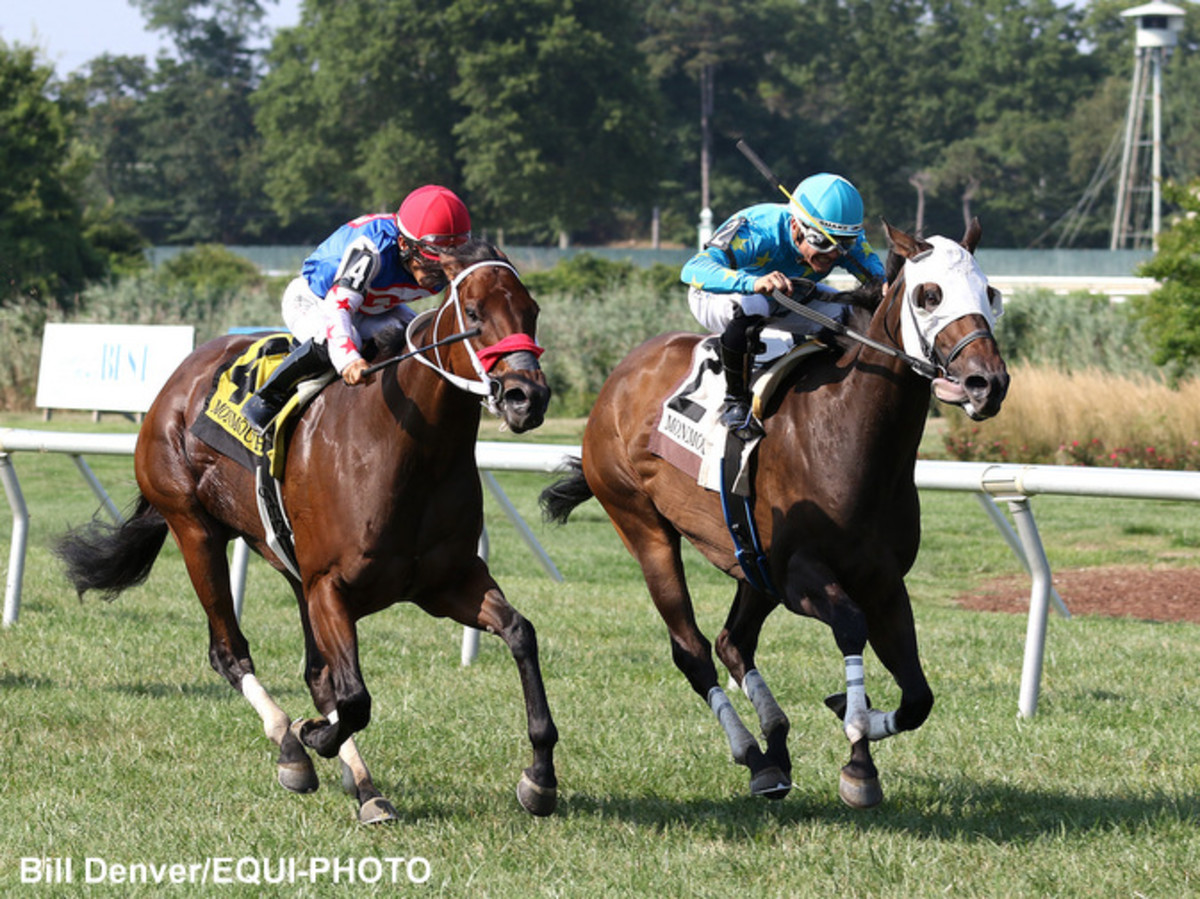
All That Magic #2 (R) with Nik Juarez riding battles Train To Artemus #4 and Paco Lopez to win the $100,000 Incredible Revenge Stakes at Monmouth Park

“She was a horse that we had been running on the dirt, and she had knocked out a few conditions,” DeMasi said. “There was no race that I could find for her, but there was a race on the turf at Parx, and she won!”

Joya Real went on to win three stakes on the turf, and might have won a few more were it not for the rise of a tough female turf sprinter named Lady Shipman in the Mid-Atlantic around the same time. Overall, Joyal Real won 10 of her 30 career starts for earnings of over $450,000.

“Maybe I'm more apt to try a horse on the grass than some folks,” DeMasi posited. “People seem to think I do well with turf horses, especially turf fillies, and maybe it's just because I've been a little more experimental with them.”

That willingness to experiment has paid off over the course of her career: DeMasi has saddled a total of 1,744 winners thus far, including 465 under the Pewter Stable banner she launched with her husband, Greg.

Many of those Pewter Stable winners have been homebreds, the couple taking advantage of the Pennsylvania breeding program for both their own runners and a few sales yearlings. The DeMasis also stand their own stallion in the state, Winchill, a stakes-winning son of Tapit they owned and trained.

“We all know that the breeding business can be so emotionally up and down, so my hat's off to anyone who breeds a horse,” DeMasi said. “It's a good way of keeping around a quality mare rather than just selling her, but when you add up all the money and the time and the loss… We've been through it ourselves, and I've heard the stories, so to see one of those babies go on and do well is just an unbelievable feeling.

“It was really gratifying when (homebred) Winning Time won the Pennsylvania Nursery Stakes last year. He was a baby who took all summer to get ready, because he was very immature, but then he peaked at the right time and won the Nursery. Standing there in the winner's circle, it was like watching some movie made for Disney! My groom actually rubbed both the stallion and the mare, and then the baby!”

Greg DeMasi also enjoys picking horses out at the sales.

“He knows pedigrees, and I know physicals,” Kathleen DeMasi quipped. “My husband, he's such a huge sports fan, and he knows all the numbers. I think he would have made a great scout for baseball, and that's part of why he enjoys the 2-year-old sales so much. He loves trying to find the right potential in horses, and seeing them mature just like rookies in baseball.”

All That Magic was one of those picked out at the OBS Sale, purchased for $40,000. Though the filly made just one start as a 2-year-old, she's clearly blossoming in her new home on the grass.

“It's hard to win four in a row in any kind of race,” said DeMasi. “I think right now I will probably look at a race in Maryland in early September at Pimlico; I think she'll like that course. Now that she's established herself as a turf horse, we kind of can map out where we're going with her. We've always been big believers in letting the horse tell you when they're ready. They don't always have to be racing year-round.”

It's a mantra that's served DeMasi well throughout her career, dating back to 1984. It likely stems from her time spent working under Rick Dutrow Sr.; DeMasi had grown up in Pony Club, and her parents owned a few cheap racehorses, but it was nothing like the education she got in the elder Dutrow's barn.

“He was just a really great guy to work for and you learned a lot and listened and watched,” she said. “He was the kind of guy where if you make a mistake, he'd explain why you made the mistake and tell you how to fix it.”

DeMasi reflected on those early days in the racing game, looking back fondly at her time spent all over the Mid-Atlantic region.

“Back then, there was a different group of people working at the track, more families and generational horsemen,” DeMasi said. “When I was a groom, I think I had one horse that went over to the paddock with a lip chain, but now they almost all do. I question sometimes in my mind: Is it the way we're brought up in this industry, or is it the way we're breeding the horses now?

“Is that part of the reason that HISA was needed? It used to be that you apprenticed under somebody, worked under somebody, and I just think today that the old-school theory of putting in time and learning from the ground up isn't as common.

“But you have to grow with the times. I've been a board member of the Pennsylvania horsemen's association for over 15 years, which is also part of the Thoroughbred Horsemen's Association; when all this change was coming around with HISA, our organization was already sort of already doing a lot of stuff that they're doing now.”

For example, DeMasi was instrumental in getting Pennsylvania's first Thoroughbred aftercare program off the ground. Turning From Home was launched in 2008, and has provided over 3,650 former racehorses with a safe retirement.

“That's been one of the big changes I've seen in the industry,” DeMasi said. “But the whole world is changing, really. I've sort of been just quietly doing my thing in the Mid-Atlantic, so it's not like you're going to see my name all over the place. But this is what I love to do. Even though you might be tired or whatnot, just being around the horses is so enjoyable.”


The post Breeders’ Cup Presents Connections: For DeMasi, ‘Just Being Around The Horses Is So Enjoyable’ appeared first on Horse Racing News | Paulick Report.

Source of original post

Verified by MonsterInsights