Perhaps it is called the Hopeful Stakes because that's the most anyone can ever be with a Thoroughbred. But if nearly any purchaser at Keeneland over the next couple of weeks would like to be contesting that race, a year from now, then one consignor might give them not just hope but something closer to confidence.
Okay, so a trifecta for Eaton Sales graduates in the Saratoga Grade I last year featured only the winner, Forte (Violence), from the 2021 Keeneland September Sale. Runner-up Gulfport (Uncle Mo) and third Blazing Sevens (Good Magic) were respectively sold through the Eaton drafts at Fasig-Tipton's July and Saratoga Sales. Nonetheless it was an achievement all the more remarkable for the fact that champion juvenile Forte and Blazing Sevens, subsequently runner-up in the GI Preakness, were both pinhooked through Reiley McDonald's own farm, Athens Wood LLC.
Another complement to his supervision of a flagship sales agency, moreover, is the band of around 20 broodmares resident there. These diverse silos help McDonald to stay tuned into the marketplace from every side, but bring much satisfaction besides. One of those mares has produced Defunded (Dialed In) to win another Grade I this year, in the Hollywood Gold Cup. Only last weekend McDonald had winners in his own silks at Saratoga and in a stakes at Colonial Downs, while last month he co-bred a €1 million Wootton Bassett yearling sold at Arqana.
Such is the constant action resulting from the long experience that has brought us to McDonald's office in downtown Lexington. And while there's an intensity here, for sure, it is accompanied by a breadth of perspective that also permits a fulfilling life away from the business. (McDonald, indeed, typically spends half his year with his partner, Cricket, in Connecticut.)
“That was unbelievable,” he acknowledges, when reminded of his Hopeful achievement. “But really, I've done this so long, I don't get too excited, don't jump up and down, because there are so many that don't work out-you have to take the good and bad just the same.” He pauses and chuckles. “And, of course, we only just about broke even on Forte!”
Every year, with a couple of partners, McDonald pinhooks a dozen or so weanlings. Having found Forte for $80,000 at the preceding November Sale, they had to settle for $110,000 from Repole Stable & St. Elias when bringing him back to the same ring.
“Forte is one of the prettier horses you'll ever see, but at that time nobody wanted a Violence,” McDonald recalls. “And then Jacob West walked up, right as he was going into the ring, and said, 'What's your reserve?' I told him he had to bring more than a hundred. All those brilliant horsemen, and it came down to just one guy, one bid.”

Reiley McDonald (left) with Scott Dilworth | Keeneland
But such are the vagaries of this business-and such, duly, is McDonald's achievement, over the past 28 years, in maintaining both quality and quantity since taking on the game-changing agency founded by Lee Eaton.
He has actually started to scale back somewhat, having concluded that sheer volume is nowadays less sustainable. As he says, it costs as much time, labor and administration to sell a horse for $2,000 as for $2 million. Eaton Sales still has over 100 yearlings catalogued at Keeneland, but there have been times when they might have processed as many as 350 at that sale, following maybe 50 at Saratoga.
“That was a dangerous managerial feat and I don't think anybody can pull it off,” McDonald says. “It's so hard to find the help now. I really do worry about the animals, with the kind of help that's out there. And these days, if you're selling a horse for, call it $50,000 or less, you're losing money. Because some of the consignors have cannibalized themselves, reducing fees to a point where there's very little profit margin at the end of the day.”
By the time Eaton (and partner John Williams) stepped down, quite apart from a formidable address book, McDonald could feel no less grateful for his mentorship.
“Lee was like so many people who are successful in business,” McDonald reflects. “He worked hard, and demanded that the people around him worked hard. And he really was smart, always thinking of how you might do things differently, and better. He made it a much more professional business. The 'good old boy' stuff went out the window. The big parties before the July Sale, I mean, we never really did that. We just stuck to trying to make that horse look as good as it could. That was the whole thing: how do you present the horse?
“It used to be the old 'baggy pants' off the farm. But Lee hired all these guys from Virginia who would come in with their creased pants, and they really knew how to show a horse. And suddenly smart guys like Ed Cox, even Warner Jones as good as he was, started to sell with Lee. When you walked into his courtyard at Saratoga or Keeneland, it was definitely different: very clean, very professional–like they all are now. He really did set the standard.”
No less crucially, there were also corresponding advances in preparation, heeded to this day by McDonald.
“He decided to build huge run-in sheds and turn his horses out,” he says. “He was the first to do that. He didn't bring them up in the winter. And I follow the same program. Now, if it's a horrible, icy wet night, we bring everything in, and he would too. But they were out 99 percent of the time. And he developed his own feed. We've modified it over the years, but I still feed the same cubed feed.
“He was very good about horses' weight, getting the proper conditioning to each yearling-which is something that surprisingly few people do well. Back in the day, people wanted yearlings to be almost obese. Lee started to make them look more like racehorses.”
Before joining Eaton, McDonald had spent 10 years under John Finney at Fasig-Tipton, gaining a comprehensive insight into the market. Under head inspector Bobby Powell he learned the optimal physique of a commercial yearling, and as sales announcer he came to understand the functioning of the marketplace itself. “At the time John Finney was probably the smartest guy in the business,” McDonald says. “That's where I really learned about the business of horses, valuations, matings.”
There were other paths McDonald might have taken, having studied Animal Science at Cornell (where he captained the lacrosse team), but he has basically been working with horses since he was 13. The family had moved to the country, the kids got a pony, there was a horse farm down the road. He went to school five minutes from Pimlico, and would run in “smelling of manure and throwing on a tie to get to assembly.” The teenage McDonald then cut his racetrack teeth under Maryland hardboot B. Frank Christmas.

Tom Van Meter | Keeneland
“He was one of the real old-timers,” he recalls. “Quite a crusty character, always chewing tobacco and spitting, always with the hat and the coat on. He was a trainer, but also had a farm and a stallion. We were breeding mares, we were breaking all our horses, we legged up everything on the farm.”
One way or another, then, the young man who took over the sales agency had plenty of miles on the clock. “Then Tom Van Meter bought a 20 percent interest, and he was my partner for about 20 years,” McDonald says. “Tom was a vet, he was sort of the country boy while I was more the city boy. So we had different sets of clients, and that worked for a long time. But that's when the business was huge. We were doing too many horses.”
In admitting as much, and with Eaton having been such a trailblazer, does McDonald sometimes feel that he has helped to create a monster? This, after all, has become an industry where horses are routinely exploited through several investment cycles before they get anywhere near the gate.
“I feel like I've probably overseen the sale, personally, of more horses than anybody,” he replies. “Which, the last couple of years, doesn't make me the proudest guy in the world. Because I really feel like our business has deteriorated a good bit. And I don't mean just the selling business, but the racing, to a large extent.
“I think often we interfere way too much with these horses. By 'we' I don't mean us, I mean the industry. The more I learn and observe about what's happening on the tracks, the more disappointing I find it. And we're losing fans, and alienating the non-horse public.”
This conversation, it should be noted, took place before the recent traumas at Saratoga. In other words, McDonald was already thinking in terms that have meanwhile come to feel imperative. He feels that the spirit of reform behind HISA is vital, albeit that early mistakes were made: overreaching, not consulting adequately. “I think the trainers got a double whammy,” he says. “They didn't have a lot of say in it, and then a lot of the responsibility was put onto them. But we need HISA and it will get better–as it has to. Like anything worth doing, it needs time and we all need to work on it.”
Nor does he feel that the current use of the crop can last. (“Three strikes and you're out,” he recommends. “One to start, one to steer, one to finish.”) But for all the challenges we face, the magic of the horse itself abides. That's where every fulfilment begins–and many opportunities, too. Standing in the back ring at the 2016 Keeneland November Sale, for instance, McDonald saw a Touch Gold mare led past.
“Oh, she's really pretty,” he murmured to himself. In fact, she reminded him of Scarlet Tango, a mare he had once found in the same ring for $35,000. Five years later, having meanwhile produced GI King's Bishop winner Visionaire (Grand Slam), he sold her on for $850,000 to Stonestreet.
“I can't afford to buy a whole package: race record, pedigree, everything,” McDonald says. “But I can buy looks.” While this mare actually had multiple stakes placings, she cost barely more than Scarlet Tango at $37,000. And Wind Caper is now dam of Defunded, sold for $210,000 at Keeneland September in 2019 and hitherto winner of $1.6 million.
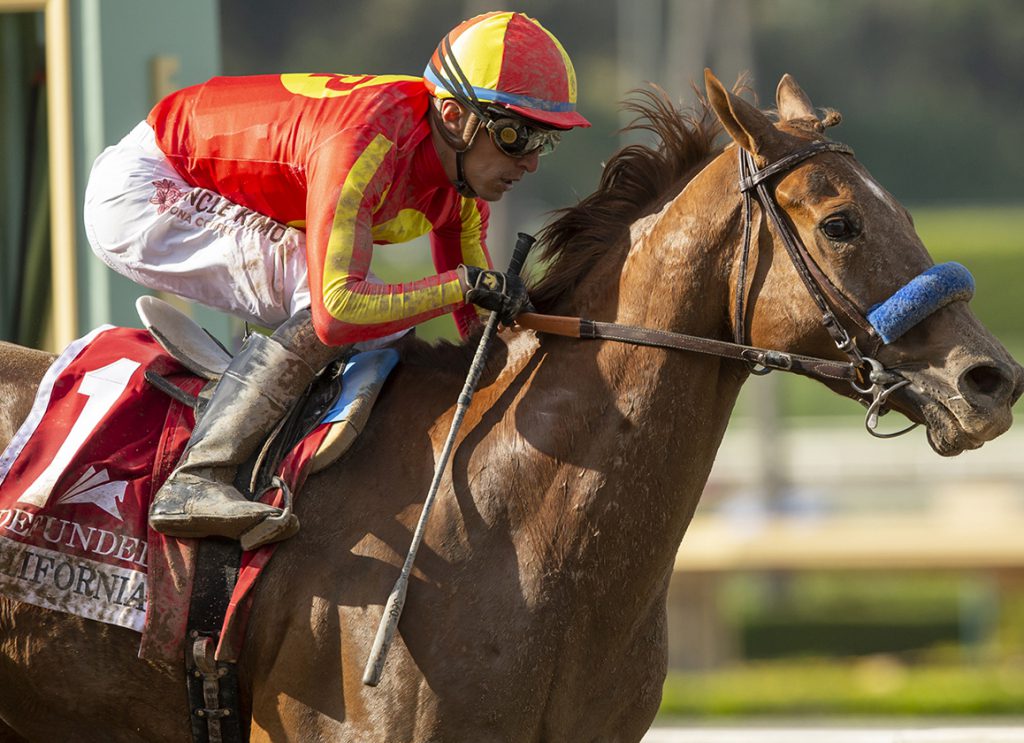
Defunded | Benoit
“I don't breed the fanciest pedigrees,” McDonald says. “But they come up to that little farm and do really well. It was a cattle farm for 300 years, all with the same family. It was about to be developed into 10-acre 'piano-key' lots when four other guys and I bought it. I kept 120 acres, and it's just great land. It's heavy in limestone, it's been fertilized for hundreds of years. And I kind of stick to the old 'leave' formula: leave them out, leave them alone, just keep an eye on any problems creeping up.”
“They're well raised, and the guys have been on the farm for years. Chuchie has been with me 35 years, was on the old Eaton Farm when he was 18. These are the best guys I've ever seen with foals, it's magic to watch their hands.”
But many of the elite performers whose photos are crammed onto the walls have obviously come through the core business of the agency. And here, McDonald says, how you handle people counts for at least as much as how you do horses. Before anything else, he needs to understand his clients' risk tolerance: where they might have slack, when they might race a horse, and so on. Because the market itself is never predictable. Neither Hard Spun nor Omaha Beach made their September reserves, for instance, McDonald eventually persuading the late Rick Porter to take both. (“You're now about $60 million to the good from those two horses,” he told Porter later. “Don't you think I should get a share?” Porter replied: “On the next one!”)
Unique Bella, the daughter of Tapit and Unrivaled Belle (Unbridled's Song), had over 160 shows at the 2015 September Sale and was not vetted once.
“So, you got the best horseman from around the world looking at this filly,” marvels McDonald. “She toed in a little bit, and had a $399,000 reserve. And one person runs up to me, right as she's walking into the ring, and says, 'Can I see the vet report?' And runs back inside. There was one bid at $400,000, and it happened to be Carlos [Heller] at Don Alberto. And look what he got: one of the great mares of that decade. She was gorgeous. So sometimes it just blows your mind.”
Unique Bella and Hard Spun were both bred by Betty Moran, owner of Brushwood Stables, who became another cherished influence.
“An angel was on my shoulder the day I bumped into her, in 1991, and she told me she'd just lost her general manager,” McDonald recalls. He volunteered for the role and they worked together for nearly 30 years, perhaps their most memorable moment actually being with a steeplechaser, Papillon (Ire), in the 2000 Grand National. “Mrs. Moran only wanted to compete at the highest level,” McDonald notes. “And we built and maintained one of the best 20-head broodmare bands in the country. She was a best friend, confidante-and tough boss!”
That highest level, however, is never always confined only to the top of the market–and that, of course, is what drives the whole business.”
“How about Victory Gallop, who I sold many moons ago for $25,000?” says McDonald. “He had a chip in a stifle, and three ankles. Pug Hart bought him and said, 'I can't keep this horse.' This was before the repository. And I said, 'Well, essentially, he's sold, but let me talk to the owner.' And he agreed to take $10,000 off. So, they got Victory Gallop for $15,000! But I could count so many good horses that [apparently] had big, big problems. I purchased Mitole for very little [$20,000 September yearling] because he had a lot of writing on the vet report, but he was a horse of exquisite conformation.”

Kenny McPeek | Sarah Andrew
Like many experienced consignors, McDonald reckons to know buyers' tastes well enough to pull out a horse they haven't even asked for. “The only guy I still can't figure out is Kenny McPeek!” he admits. “He has bought so many good horses through auction, and I still don't know what he looks for. But that's really what puts it all together for us: knowing both sides, the seller and the buyer. And that takes a long time to do. That's why anybody who wants to get into the consignment business, you have to be willing to get on an airplane, to be everywhere and see everyone.”
While he isn't comfortable with everything about the industry, or the way it has changed over the past 40 years, McDonald emphasizes an undiminished passion for the sport.
“We've got a lot of hard work to do, but there are still great parts to it,” he says. “I do feel blessed to have been able to do what I have. It all comes from being hands on. My favorite thing I ever did in my life, and the thing I was best at, was on top of a horse. You learn so much if your hands have learned to absorb what the animal is telling you. Even today I love showing a horse at the sales.
“I don't know, I just love this animal. It's incredible. I mean, last night I was walking around the foals, just thinking how lucky I am, to be in that moment, with these beautiful little animals coming up to you. I still love it.”

The post Different Hats Keep McDonald Ever Hopeful appeared first on TDN | Thoroughbred Daily News | Horse Racing News, Results and Video | Thoroughbred Breeding and Auctions.
Source of original post
