Each week a panel of media members, horseplayers, and Breeders’ Cup World Championships officials release a poll tabulating their votes on the top contenders for the 2023 Longines Breeders’ Cup Classic which will be held on Nov.
Author: News
Classic Winner Channel, In Foal To Wootton Bassett, To Sell At Arqana’s Vente d’Elevage
La Motteraye Consignment will offer Classic heroine Channel (Ire) (Nathaniel {Ire}) during the Arqana Vente d'Elevage from Dec. 9-12.
A winner of the G1 Prix de Diane, the 7-year-old is a daughter of the G1 Cheveley Park S. winner Magical Romance (Ire) (Barathea {Ire}). Carrying to Wootton Bassett (GB), the daughter of Love Magic (GB) (Dansili {GB}) is also from the same line as standouts Alexandrova (Ire) (Sadler's Wells), Magic Wand (Ire) (Galileo {Ire}), Chicquita (Ire) (Montjeu {Ire}), Philomene (Ire) (Dubawi {Ire}) and Pacifique (Ire) (Montjeu {Ire}). Her eldest foal is the 2-year-old filly Million Miles Away (Fr) (Sea The Stars {Ire}), while her yearling colt is by Kingman (GB) and she has a Wootton Bassett filly born this year.
Bred by Kilcarn Stud, the €18,000 Goffs Orby yearling turned €70,000 Arqana May juvenile won half of her six starts and over $670,000 for Francis-Henri Graffard and Samuel de Barros.
The post Classic Winner Channel, In Foal To Wootton Bassett, To Sell At Arqana’s Vente d’Elevage appeared first on TDN | Thoroughbred Daily News | Horse Racing News, Results and Video | Thoroughbred Breeding and Auctions.
’40 Days Of Giving’ Beneficiaries Speak Up: ‘For Us, It’s Personal’
The Breeders' Cup is in the midst of its “40 Days of Giving” program that puts key Thoroughbred industry charities in a collective spotlight with a fundraising twist: This year's initiative involves a money-matching effort in which donors selected by each charity will match up to $1,000 raised by the general public on that charity's designated day. On the final day of the drive, the Breeders' Cup itself will match up to $20,000 in donations, with funds raised on that 40th day to be distributed evenly to all participating charities.
“It's the lead-up to the 40th running of the Breeders' Cup championships. So we're taking 40 days and 11 different charities, and we're trying to raise as much money as possible for all of these charities that are doing incredible work within our industry,” said Stefanie Palmieri, the vice president of events for Breeders' Cup, Ltd. “And the idea behind the match is that we can engage the public knowing that if they donate, there's a potential for their donations to be doubled.”
The charities that will benefit are the California Thoroughbred Horsemen's Foundation, the Ed Brown Society, the Edwin J. Gregson Foundation, The Foundation for the Horse, the Grayson-Jockey Club Research Foundation, the National Museum of Racing and Hall of Fame, the Permanently Disabled Jockeys Fund (PDJF), the Race Track Chaplaincy of America, The Jockey Club Safety Net Foundation, the Thoroughbred Aftercare Alliance (TAA) in partnership with the California Retirement Management Account, and the Winners Foundation.
“We started on Sept. 21, and the last day of the match program is Oct. 30,” Palmieri said. “But all of the links to donate will remain open through all of the Nov. 3-4 Breeders' Cup races so we can continue promoting and drive as many donations as possible.
“So far, we have hit our matches on quite a few of those days. I think people are really interested and engaged with it,” Palmieri said. “The program is really designed to support a variety of different causes within the Thoroughbred industry, and we selected the charities to represent a cross-section of focus areas.”
Two points stood out when TDN spoke with executives of some of the charities that the Breeders' Cup selected to participate. The first is that our sport operates differently than others in that it relies on a multitude of industry-facing organizations to keep the game going on a daily basis. The second is that most of these worthy causes generally have to compete for the same relatively small pool of Thoroughbred-supportive donors.
Yet those who run the charities say they welcome this opportunity to have so many good causes featured together under one fundraising umbrella, because a program like 40 Days of Giving raises not only money, but the profiles of everyone involved.
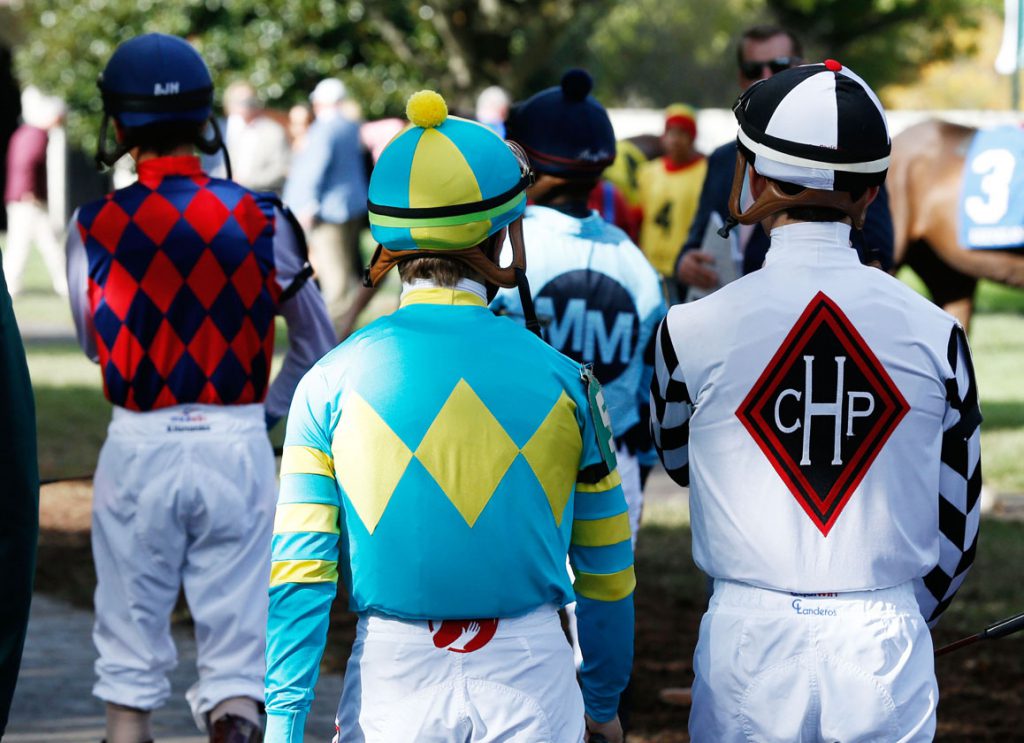
Jockeys heading to the paddock | Coady Photography
“When an organization like the Breeders' Cup says they're going to dedicate weeks of bringing awareness to the charities, we're obviously thrilled,” said Shannon Kelly, the executive director of The Jockey Club Safety Net Foundation. “And I always have felt the Breeders' Cup should be the moment we're promoting our industry's charities, because all eyes are on the Breeders' Cup.”
Since 1985, The Jockey Club Safety Net Foundation has operated as a charitable trust that provides, on a confidential basis, financial relief to needy members of the Thoroughbred industry and their families. Its assistance recipients range from jockeys, trainers, exercise riders, and grooms to office personnel and other employees of tracks, racing organizations, and breeding farms.
“Obviously, the Breeders' Cup has a huge platform to promote the work of charities,” Kelly continued. “They have a lot of eyes and followers. A lot of charities like us in the industry, we have small staffs and we're working quietly as best as we can. So having an arm like the Breeders' Cup's marketing arm push this is fantastic. And I think it's just a nice way to show they're dedicated. It gives us a boost, some traction to what we do.”
“The reality is we're all asking the same donors,” Kelly said. “We're a small industry. So I think it's good to make it a collective program, and not everyone on their own going after the same donors. I think it makes it a little bit easier from a fundraising perspective.”
Nancy LaSala has been the PDJF's president since its inception in 2006, and she accepted the dual role of executive director three years later. The PDJF provides financial assistance to some 60 former jockeys who have suffered catastrophic on-track accidents, most of which involve paralysis or traumatic brain injury. She said that although each specific charity focuses on its niche, they all fall into broader categories that she likened to three-legged stool that needs even support to remain standing.
“We need to care of our human athlete. We need to take care of our equine athlete. And we need to take care of our racing community infrastructure, which is basically the backside. If we could support those three bases, I look at them as the three prominent prongs of horse racing,” LaSala said.
“I don't think our donor base resides much outside of racing,” LaSala said. “It's nice to be part of a platform that includes so many industry charities. We very seldom get the chance to do that, for the greater benefit of all.”
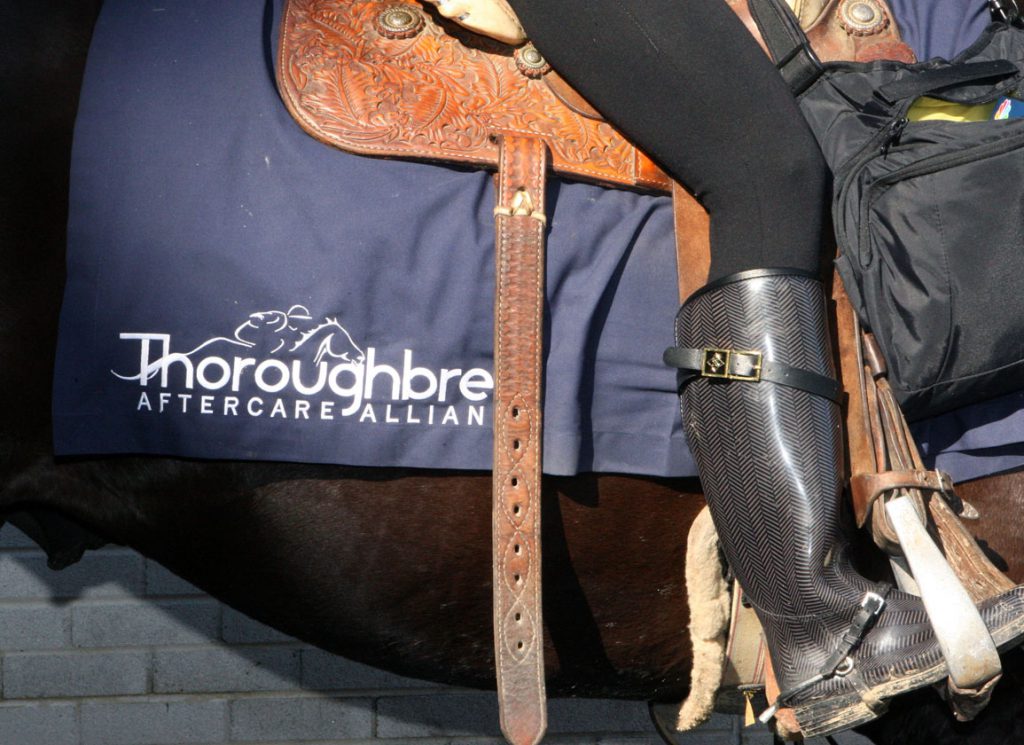
TAA saddle towel | Coady Photography
Stacie Clark Rogers has been with the Thoroughbred Aftercare Alliance since its inception in 2012, and has been the organization's operations consultant since 2014. The TAA accredits, inspects, and awards grants to more than 80 approved aftercare organizations at around 180 facilities to retrain, retire, and rehome Thoroughbreds using industry-wide funding.
“As the official aftercare charity of the Breeders' Cup, we're always happy to be included in the event and to have the recognition for all the 80-plus organizations that we have,” Clark Rogers said. “It's the one time where we can help them raise some attention for aftercare on the national and international level. It's really inclusive that they've had so many charities be a part of this. It's great to have such a community spirit with the Breeders' Cup.
Palmieri said the Breeders' Cup left it up to each charity to select their own donors who are providing the matching incentives.
“I like the idea of choosing our match donor because it's helped me identify some people that we wanted to draw attention to,” Kelly said. “I went for people who support us throughout the year and are always looking to support more, and I think it gives them some publicity as being actively involved in supporting the industry, not just owning horses or breeding horses or whatever their business is. I think it's good promotion for them, too, to say we have some really good people and groups that want to help.
“We're a really unique industry, because not a lot of other big sports have in-house charities,” Kelly said. “Our charities are there for the future of the sport, to keep it moving. For us, it's personal.”
The post ’40 Days Of Giving’ Beneficiaries Speak Up: ‘For Us, It’s Personal’ appeared first on TDN | Thoroughbred Daily News | Horse Racing News, Results and Video | Thoroughbred Breeding and Auctions.
Bloodlines Presented By Walmac Farm: The Unlikely Legacy Of Lure
Multiple champion Lure (by Danzig) was one of the grandest and popular racehorses of the 1990s.
The high-spirited bay son of a leading sire and out of a stakes-winning daughter of another leading sire, Alydar, was a source of amazing talent. He set a track record at Belmont Park in his debut at two and ran a dead-heat with Devil His Due (Devil's Bag) in the Gotham Stakes at three, but trainer Shug McGaughey knew something wasn't quite right with the talented colt because he threw in some clunkers in between efforts of excellence.
Putting the colt on the turf changed his outlook and his future. Lure won his turf debut by 10 ¼ lengths at Saratoga as a 3-year-old. The colt never ran on anything else again, and in 18 starts on that surface, Lure won 11 and was second in six. Earning more than $2.5 million, his victories included two runnings of the Breeders' Cup Mile, and Lure was elected to the National Museum of Racing and Hall of Fame in 2013.
A horse with the speed that Lure clearly possessed and with an exceptional pedigree created immense interest in Lure as a stallion when he was retired to stand at Claiborne Farm, where he was born and raised. Alas, his fertility was so bad that the farm had to file a claim for their fertility insurance on the horse. Purchased from the insurance company by Coolmore, Lure proved a consistent disappointment in his fertility, no matter where he stood or how he was managed.
Returned to live out his years at Claiborne Farm after he was pensioned from stud duty in 2003, Lure died from the infirmities of old age in 2017. He was 28.
Few would have expected Lure to found an enduring male-line branch for his illustrious sire Danzig, due to Lure's marginal fertility that produced 133 named foals, but nobody told Orpen, who was a member of Lure's first crop.
In fact, Orpen was the star of the crop for Lure because he won the G1 Prix Morny at Deauville in France as a 2-year-old and ran third in the G1 Irish 2,000 Guineas at the Curragh at three. Sent to stud, Orpen flitted around the globe like a swallow, standing at stud in Ireland, France, Argentina, and Australia, and he sired champions in Argentina, Peru, Saudi Arabia, Singapore, Slovakia, and Turkey.
Argentina, in particular, proved a fertile field for the stallion's plow, and that is the homeland of Didia, winner of the G2 Rodeo Drive Stakes at Santa Anita. John Stuart, bloodstock agent and raconteur, said that “Didia was bred by a longtime friend and associate, of 20 years or more, down in Argentina, Dr. Ignacio Pavlovsky.
“This filly was really talented, had been a champion there, had a strong dam behind her, and as a result, she was expensive,” Stuart concluded. The mare had won her last three races in Argentina, including the G1 Enrique Acebal and G1 Copa de Plata-Roberto Vasquez Mansilla-Internacional, before her purchase by Merriebelle Stable.
Support our journalism
If you appreciate our work, you can support us by subscribing to our Patreon stream. Learn more.From six starts in the U.S. for Merriebelle since her importation last year, Didia has won five and finished second in the G1 New York Stakes to Marketsegmentation (American Pharoah). Didia is being pointed for the Breeders' Cup and then a potential appearance at the Fasig-Tipton November sale.
Didia is one of 15 champions credited to Orpen by Equineline statistics, and the stallion is listed with 120 stakes winners. These are not the only fascinating statistics associated with Orpen, however. From 21 crops of racing age, he has 3,134 foals, which is the second-largest number of foals that I can find among flat-racing stallions.
Among other noted sires with great longevity, Galileo leads all and has 3,234 foals, exactly 100 more than Orpen, and has 371 stakes winners. Among active sires, there are Medaglia d'Oro (2,348; 164); Uncle Mo (1,753; 92); Into Mischief (1,620; 138); and Curlin (1,253; 96).
Orpen died from complications of colic surgery in Argentina in early 2021, and his last foals are of racing age. So his overall foal numbers should be fairly set, and he will no doubt have additional stakes and perhaps champions.
One such is Davide, a full brother to Didia who was sold as a yearling to race in Singapore and is a champion there. With racers of championship quality from both hemispheres and across multiple countries, Orpen has spread the influence of Lure far and wide.
The post Bloodlines Presented By Walmac Farm: The Unlikely Legacy Of Lure appeared first on Horse Racing News | Paulick Report.