Kentucky Derby Purse Raised By Churchill Downs To Record $5 Million, 50-Race Stakes Schedule Cumulatively Worth $25.6 Million

The 150th GI Kentucky Derby scheduled for Saturday, May 4 will be the richest in history as the purse for America's greatest race has been elevated to a guaranteed $5 million, Churchill Downs Inc. (CDI) said in a release Wednesday.

The $2 million increase to the race highlights a record-setting, 50-race stakes schedule cumulatively worth $25.6 million for Churchill Downs' 2024 Spring Meet, which will be run over 43 dates from April 27-June 30/

The Derby purse structure was the subject of a Chris McGrath TDN interview with John Sikura, where he questioned the $3 million purse. The cause was later taken up by Mike Repole.

Prize money for the stakes schedule increased 25% or $5.1 million from last year's $20.5 million lineup which is due to historical horse racing. Prior to the debut of historical horse racing at CDI's Derby City Gaming in September 2018, that year's Spring Meet featured 32 stakes races worth $8.8 million. There are now 18 additional Spring Meet stakes, and prize money for horsemen in those events has grown 190% or by $16.8 million.

“These record purse increases are a symbol of the health of horse racing in Kentucky,” said Bill Carstanjen, CEO of Churchill Downs Incorporated. “Churchill Downs Incorporated's over $1 billion investment into live and historical horse racing in Kentucky over the last five years has meaningfully strengthened the entire Kentucky Derby Week and year-round racing program. It's important to acknowledge the state legislature for its commitment to working closely with private enterprise in a truly collaborative partnership to support the continued growth of Kentucky's signature industry.”

Thirty-eight of the 2024 Spring Meet stakes races received significant purse hikes, including $250,000 boosts to each of the following: the $1.5 million GI Kentucky Oaks; $1 million GI La Troienne S.; $1 million GI Churchill Downs S.; $1 million GI Derby City Distaff; and $750,000 GII Churchill Distaff Turf Mile. Each of the track's seven Grade I events, including the Old Forester Bourbon Turf Classic S. and Stephen Foster S., feature a minimum $1 million purse.

With a record $5 million in prize money now guaranteed for the Kentucky Derby, the winner will receive the event's highly sought-after gold trophy, a $3.1 million payday and possibly millions more as a stallion after retirement from racing. Also, $1 million will be awarded to the runner-up, $500,000 to third, $250,000 to fourth and $150,000 to fifth.

Previously, the Kentucky Derby purse had been worth $3 million since 2019, and was $2 million from 2005-18 and $1 million from 1996-2004.

“It is truly gratifying to view the steady growth of the Churchill Downs racing product and the entire Kentucky horse racing and breeding industry, which bettors around the world have embraced,” said Churchill Downs Racetrack President Mike Anderson. “Through the purses generated by the racing association and the Kentucky Thoroughbred Development Fund, Kentucky horsemen and horsewomen are reaping the benefits of Churchill Downs Incorporated's historic investment as we celebrate this year's milestone 150th Kentucky Derby.”
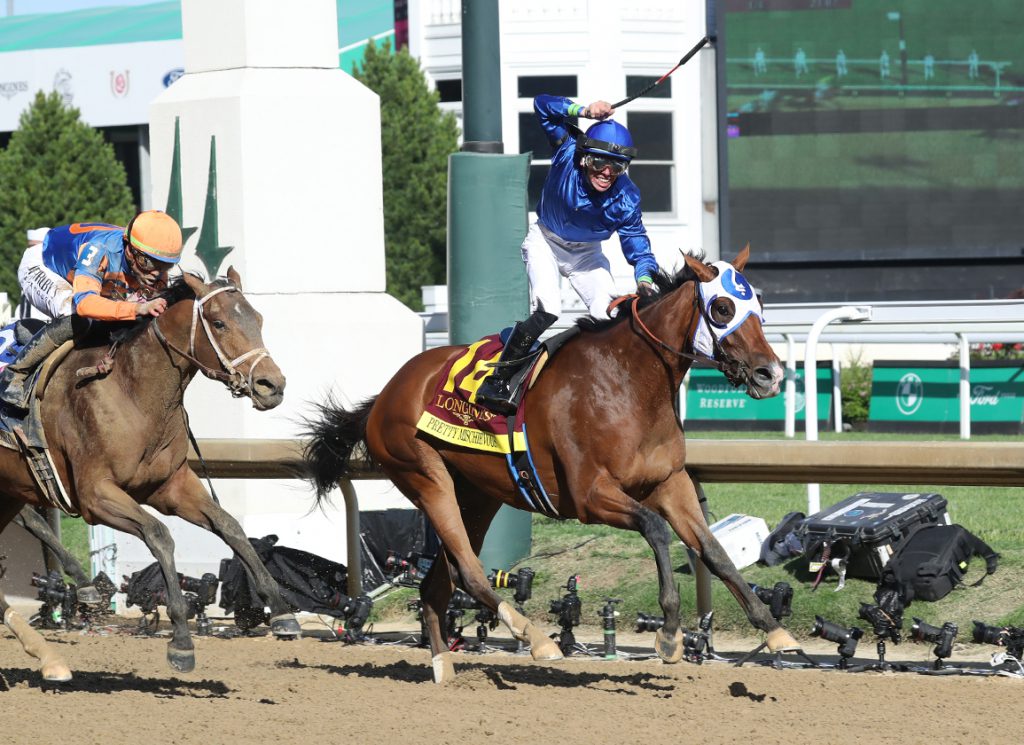
Pretty Mischievous | Horsephotos

At $1.5 million, the 1 1/8-mile Kentucky Oaks–the Derby's sister race staged one day prior on Friday, May 3–remains the nation's most lucrative race for 3-year-old fillies. It had been worth $1.25 million since 2019, and was $1 million from 2011-18 and $500,000 from 1996-2010.

All told, there will be a record 22 stakes races cumulatively worth $17.5 million staged over Kentucky Derby Week (April 27-May 7), including nine stakes totaling $10.8 million on Derby Day and seven totaling $5.3 million on Oaks Day.

Four races on Kentucky Derby Week will offer horses an entry and travel incentive to run in some of Europe's most prestigious races. The winner of the Old Forester Turf Classic will receive a berth to either the one-mile G1 Queen Anne S. or the 1 1/4-mile G1 Prince of Wales's S. at Royal Ascot in mid-June. Earlier on the Kentucky Derby Day program, the winner of the GII Twin Spires Turf Sprint will receive an entry to the G1 King's Charles III S. (formerly known as the King's Stand), also staged at Royal Ascot.

Three-year-old turf specialists in the GII American Turf and GII Edgewood S. can receive their entry to either the G1 Betfred Derby or G1 Betfred Oaks at Epsom Downs. The winner of the American Turf on Kentucky Derby Day will receive an entry and travel stipend to compete in the Betfred Derby while the winner of the Edgewood on Kentucky Oaks Day will receive the same benefits for the Betfred Oaks.

The first condition book of scheduled races is being finalized by Vice President of Racing Ben Huffman and is expected to be published in late January. More than $57 million in total prize money is expected to be offered during this year's Spring Meet (pending Kentucky Thoroughbred Development Fund final approval). Purses for maiden races will be $120,000 while allowance races will range from $127,000 to $141,000.

Spring Meet stall applications are due Friday, Mar. 1. Following its annual closure for wintertime renovations, the Churchill Downs stable area will reopen Tuesday, Mar. 19. The first day of training on the main dirt track will be Friday, Mar. 22.

For the second consecutive year, Churchill Downs Incorporated's nearby Trackside Louisville, which accommodates more than 500 horses, has remained open year-round for wintertime stabling and training for racing at Turfway Park in northern Kentucky.

The post Kentucky Derby Purse Raised By Churchill Downs To Record $5 Million, 50-Race Stakes Schedule Cumulatively Worth $25.6 Million appeared first on TDN | Thoroughbred Daily News | Horse Racing News, Results and Video | Thoroughbred Breeding and Auctions.

Source of original post

Apprentice Jockey Luis Marcano Dies In Motorcycle Accident In Puerto Rico

Luis Yamil Marcano, who spent most of 2023 riding at Belterra Park, before returning to his native Puerto Rico in October to ride at Camarero, died Sunday night from injuries he sustained from a motorcycle accident. He was 19.

The news was first reported on Camarero's Facebook page, which posted the following: “Camarero Racecourse regrets the sudden death of rider Luis Yamil Marcano. Luis graduated from the Agustín Mercado Reverón Equestrian Vocational School in 2022 staying active since then in races at Camarero Racecourse and several racecourses in the United States. Our deepest condolences to all his family and friends. May he rest in peace!”

According to reports, Marcano was traveling on a white 2009 Honda CRF-450 motorcycle which was hit by a Ford F-150 vehicle. That driver of that vehicle fled the scene.

Sources close to Marcano said he was planning to return to the U.S. to ride at Tampa Bay Downs.

He made his debut Jan. 1, 2023 and won on his second career mount. He raced 382 times and rode 52 winners. He also was active at Thistledown, Horseshoe Indianapolis, Ellis Park, Churchill Downs, Keeneland, Mahoning Valley and Turfway Park.

The post Apprentice Jockey Luis Marcano Dies In Motorcycle Accident In Puerto Rico appeared first on TDN | Thoroughbred Daily News | Horse Racing News, Results and Video | Thoroughbred Breeding and Auctions.

Source of original post

Cobb And Tribbett Elected To KEEP’s Board Of Directors

The Kentucky Equine Education Project (KEEP) unanimously elected to their board Shannon Cobb to serve as chair and Rob Tribbett to serve as vice chair, the non-profit said in a release Wednesday.

The pair will replace Case Clay and David Ingordo, who will both continue their service on the KEEP Board.

Cobb, the Chief Operating and Financial Officer at Red Mile Racing and Gaming, and Tribbett, Vice President of the Consignors and Commercial Breeders Association in Lexington, Kentucky, and General Manager of Watercress Farm in Paris, Kentucky, bring a wealth of experience to KEEP's strategic direction.

“It's an honor to be entrusted with the position of Chairman at KEEP,” said Cobb. “I am eager to collaborate with our Board of Directors and the entire equine community to drive further growth and prosperity for Kentucky's vibrant equine industry. I am committed to upholding KEEP's mission and ensuring its success.”

Will Glasscock, KEEP's executive director said, “The appointments of Shannon Cobb as Chairman and Rob Tribbett to these roles reinforce KEEP's commitment to fostering industry expertise and leadership within our board. Their combined experience and dedication will undoubtedly steer us toward continued success in promoting and advancing Kentucky's thriving equine economy.”

Click here for more information about KEEP.

The post Cobb And Tribbett Elected To KEEP’s Board Of Directors appeared first on TDN | Thoroughbred Daily News | Horse Racing News, Results and Video | Thoroughbred Breeding and Auctions.

Source of original post

Dear Patrick: With Respect, I Disagree

Since the publication of Patrick Cooper's letter suggesting that the Irish Derby should be shortened in distance we have had a predictably mixed response in correspondence on the subject.

You can find Cooper's letter in full here. In essence, it highlights the fortunes of two Frankel colts, the Irish Derby and Grand Prix de Saint-Cloud winner and Arc runner-up Westover and the Dewhurst and 2,000 Guineas winner Chaldean, both of whom raced for Juddmonte. The latter is now a Juddmonte stallion at Banstead Manor Stud, while Westover is about to embark on his first season for the Yushun Stallion Company in Japan.

It is worth pointing out that another son of Frankel, the Derby and King George winner Adayar, plus his fellow King George winner Hukum, have both also been exported to Japan. This lack of a Flat stud berth in Europe is not a problem solely affecting Irish Derby winners, though admittedly the last three winners prior to Auguste Rodin are all now at Coolmore's National Hunt division, along with another King George winner, Pyledriver.

In the cases of Westover, Adayar and Hukum, however, there are also extenuating circumstances, up to a point. It is easy to understand that neither Darley nor Juddmonte want to retire two new sons of Frankel to their stallion units for the forthcoming season. Juddmonte, after all, has the goose who lays the golden eggs, Frankel himself, while Darley has Cracksman, who has recently been joined by Triple Time. Like Chaldean, the latter is a Group 1-winning miler and therefore, in the current climate, deemed to be an easier sell to breeders. It is a depressing fact, but I can see that it makes business sense.

Hukum is of course a son of Sea The Stars and, had his full-brother Baaeed not retired to Shadwell's roster the year before him, then it is hard to imagine that homebred Hukum would have joined Adayar on the plane to Darley Japan, despite the retirement of Mostahdaf – yet another Frankel – this year.

Cooper ended his letter with the plea: “Shorten the Irish Derby.”

He is not alone in considering this the best option. John Hammond, trainer of one of the best Irish Derby winners of the modern era in Montjeu, agrees with him, and said, “I was always in favour of the Prix du Jockey Club being reduced to 2,100m, even though it wasn't unanimously popular at the time.”

The difference then though was that the shortening of the Jockey Club coincided with the extending of the G1 Grand Prix de Paris, which is also only open to three-year-olds and has been run over 2,400m since 2005 (having also been run at up to 3,100m in its history, and at 2,000m from 1987 until the most recent change).

Hammond added of the Prix du Jockey Club, “It was silly having two 2,400m Derbys so close to each other while the only 2,000m Group 1 for three-year-olds only was the Lupin which was effectively a Derby trial and frequently a weak race. The Jockey Club is a better race now and I would imagine the average field size has increased too. Everyone has a crack now, the milers, mile-and-a-quarter horses and mile-and-a-half horses. Last year a champion 2,400m horse won and a top miler was second.”

Ireland has no such option to alternate between Group 1 races for three-year-olds. If the Irish Derby is shortened the only Group 1 race beyond 10 furlongs and available to three-year-old colts would be the Irish St Leger in September, which is also open to older horses. How can Ireland pride itself on being the cradle of the Thoroughbred if this becomes the case?

Hammond is not the only supporter of Cooper's argument. Charlie Murless also got in touch to say, “I hate to say it because I grew up on the Curragh, and all my life Irish Derby Day was a very special day and a very special race. Sadly no longer, for a number of reasons (a large number!) in addition to Patrick's excellent breeding rationale. The distance must be changed.”

We can count Hammond as Irish-assimilated despite being English-born and a long-term resident of France because he spent many of his formative years in Ireland. Cooper and Murless, too, have longstanding ties to the race and feel that it must be shortened. Is that the answer though? I do not believe so, but then I live on the other side of the Irish Sea. 

Another Brit, Gerard West, contacted us with a strongly-worded email. “This would be catastrophic for Irish and European racing,” he said. 

“The very foundations of our racing are based on our variety of race distances, something that has attracted breeders from all over the world. Breeders are no longer breeding to race, they're breeding for the yearling and foal sales ring. Stallion masters are recruiting colts for that purpose too. 

“For some years now come Derby time it's not a matter of who's going to win but more a matter of who's going to stay. We not only need staying types for the Flat but National Hunt too.”

We all have a metaphorical hill on which we would die, and mine is that if it ever comes to pass that the Derby is shortened from a mile and a half I would find it hard to continue my association with racing, notwithstanding the fact that it was a mile race for its first four runnings. Of course Derby Day is now nothing like Frith's great painting of the 1850s depicting all manner of human life on the Epsom Downs. 

The painter described in his autobiography his first visit to Epsom in 1856: “My first Derby had no interest for me as a race, but as giving me the opportunity of studying life and character it is ever to be gratefully remembered. Gambling-tents and thimble-rigging, prick in the garter and the three-card trick, had not then been stopped by the police.”

Whether or not we are to be grateful that the police are now more preoccupied with animal rights protesters is a moot point, but Derby Day was always a great occasion for all walks of society. It is less so now, but in England the day and the race still feel special. 

Is that the same in Ireland? I have been at the Curragh for the Irish Derby too infrequently to know, though Alamshar's downing of Dalakhani is a race that will stay with me for as long as I retain my memory. But that was two decades ago, and straight after some truly special years of the race being won by Montjeu, Sinndar, Galileo, and High Chaparral.

If Irish Derby Day no longer feels special, surely it is the occasion that needs work as much as the race itself. The recent switching of days and times can't have helped it to retain its identity and importance for racegoers.

Since Montjeu's time the resurgence of Ballydoyle in the Aidan O'Brien years has also occurred. The trainer won his first Irish Derby in 1997 with Desert King and has claimed another 14 victories since then. Has this domination aided the race's demise, or without the support of Coolmore would it have dwindled further? It is worth noting that between 1980 and 2000, the race was won by 14 non-Irish trained horses from 11 different stables. This century, that number has been reduced to four: Hurricane Run (trained in France), and Jack Hobbs, Hurricane Lane and Westover (from Britain). A reduction in overseas challengers is certainly an issue, but then there are not too many stables beyond Ballydoyle which regularly field a runner in the Derby at Epsom either. 

There are implications beyond Ireland for the race being shortened, including what effect it may have on the Eclipse, which last year was run six days after the Irish Derby. Admittedly, in 2023, both races were won by colts from Ballydoyle who would have been kept apart anyway. In Westover's year, he would surely have won the Irish Derby had it been over 10 furlongs, but would that have increased his commercial appeal enough to have pushed Chaldean aside? I don't believe so.

We are venturing towards a situation of the tail wagging the dog. We need a balance in our breeding because we need sprinters, we need milers, we need middle-distance horses and we need stayers. That is the beauty and the allure of racing in Europe: the variety, underpinned by Classic bloodlines in order to achieve the pinnacle of producing that rare horse who has the class and turn of foot to race over a mile and a half at the top level. Don't think for a moment that that's a slow horse.

It is a self-fulfilling prophesy that if we stop standing and using Derby winners and their like at stud, then sooner or later we won't be able to breed horses to run over that range of distances. In fact, it is easy to envisage the day when horses can barely stay the mile of the Guineas. Good luck then trying to sell our racing product overseas. Why would they want to buy the same horses they can breed at home? 

The two best horses in the world last year, Equinox (Jpn) and Ace Impact (Ire), both won major Group 1 races over 10 furlongs, but it hurt neither of their careers to win over a mile and a half. In fact, the Japan Cup and the Arc were respectively their crowning glories.

Ireland has a long way to go to return its once-special race to its halcyon days but it should try, whether through a different approach to race programming for budding middle-distance colts, breeder incentives, or a significant bonus connected to the Irish Derby for horses who have won a Classic elsewhere. But whatever else happens, do not shorten the Irish Derby.


The post Dear Patrick: With Respect, I Disagree appeared first on TDN | Thoroughbred Daily News | Horse Racing News, Results and Video | Thoroughbred Breeding and Auctions.

Source of original post

Verified by MonsterInsights