Champion Sprinter Muhaarar Starts New Chapter at Haras du Petit Tellier

For a horse who won the G2 Gimcrack S. as a juvenile before torching the sprinting scene with a sequence of four straight Group 1 victories the following year, Muhaarar (GB) has been a surprisingly slow burner in his second career as a stallion, certainly compared to the fast start that was expected of him when he was retired to stand his first season at Sheikh Hamdan Al Maktoum's Nunnery Stud in 2016.

It seemed like all the ingredients were there for Muhaarar to make an immediate and significant impact, a two-year-old winner in May who was blessed with brazen speed on the racecourse and the fiercest of support from Sheikh Hamdan in his second career at stud.

Not only did Sheikh Hamdan send a handful of Shadwell's best mares to his prized homebred in that first year, but he also went to great lengths to secure the pick of Muhaarar's debut yearlings at the sales in 2018, including the top-priced filly at 925,000gns.

It was an immense show of faith from the legendary owner-breeder in the hope that Muhaarar might one day prove to be a worthy successor to his grandsire, Green Desert, the flagship stallion on the Shadwell roster for many years and a hugely influential sire of sires, having produced the likes of Cape Cross (Ire), Invincible Spirit (Ire) and, of course, Muhaarar's own sire, Oasis Dream (GB).

Perhaps the best compliment that can be paid to Muhaarar is that he was arguably a better racehorse than any of them. Having made the breakthrough in Group 1 company when winning the inaugural running of the Commonwealth Cup at Royal Ascot, Muhaarar then went on an unstoppable run which saw him add the G1 July Cup, G1 Prix Maurice de Gheest and G1 Champions Sprint S. to his unique haul.

A few other top-class performers came along shortly after him in what can often be a muddled sprinting division, the likes of Battaash (Ire)–also trained by Charlie Hills for Sheikh Hamdan–Blue Point (Ire) and Harry Angel (Ire), but none of them achieved what Muhaarar did in winning four Group 1 races in the same season.

However, whereas Blue Point romped to top honours in the first-season sire ranks last year, having 41 individual winners in Britain and Ireland, it's fair to say that Muhaarar found it altogether tougher going with his first runners four years earlier.

Ranked joint-sixth among the leading first-season sires in Britain and Ireland in 2019, Muhaarar did have a black-type performer among his 12 winners in that first crop of two-year-olds, the Group 3-placed filly Unforgetable (Ire), but otherwise it was a rather forgettable debut year.

Better was to come in 2020 when Muhaarar was the leading second-season sire in Britain and Ireland with 44 individual winners. His 17 juvenile winners included Sheikh Hamdan's G3 Horris Hill S. hero Mujbar (GB), plus Amo Racing's Baradar (Ire), who won two of his first three starts before finishing third in the G1 Futurity Trophy.

It was Muhaarar's 27 three-year-old winners that year who surprised most observers, though, chiefly with the range of distances they were capable at. Unforgetable continued to look cut from the same cloth as her sire when Listed-placed over five and a half furlongs and Group 3-placed over seven, but Muhaarar's other highly-rated runners in Britain and Ireland included Albaflora (GB), runner-up in the Listed Noel Murless S. over a mile and five furlongs, while, in France, Paix (Ire) won the G3 Prix de Lutece over a mile and seven.

It's in France that Muhaarar finds himself in 2024 for the third straight year. It was announced in the autumn of 2021–just a few months after the death of Sheikh Hamdan–that Muhaarar would be relocating to Alain Chopard's Haras des Faunes in Bordeaux where he covered 54 mares at a fee of €5,000 in 2022 and 124 mares at a fee of €7,500 in 2023.

Now, Muhaarar is limbering up for his first season standing at Haras du Petit Tellier following a deal which saw him make the move from Bordeaux to Normandy in August last year. Shadwell owner Sheikha Hissa retains half of the shares in the stallion, with the other half being made up of a consortium of French breeders.

Eric Puerari of Haras des Capucines is at the helm of the new syndicate, managed by Capucines Bloodstock, and it's clear in his view that Britain's loss is France's gain with a stallion who has so much to offer–if not the guarantee of speedy, two-year-old winners which eventually saw his popularity on home soil decline.

“It's a very exciting, new adventure,” Puerari begins when explaining how the stallion came to be at Haras du Petit Tellier. “Muhaarar had been leased in the south-west with Haras des Faunes for two years. My partner, Michel Zerolo, loved the horse and we made an offer to Shadwell to purchase half of him.

“He didn't totally convince the English breeders because they thought his progeny were not precocious enough. They take a bit of time to come [to hand], but they're durable and very resistant. They've won all over the world–France, England, Ireland, United States, everywhere. He's a very versatile sire and they can win from six furlongs to a mile and a half.”

Muhaarar stands at an increased fee of €14,000 this season–albeit still a fair way below the £30,000 he stood for in his first three years at Nunnery Stud–following what was arguably the most successful year yet for his progeny on the racecourse in 2023.

The versatility Puerari speaks of was certainly on show throughout last year. G1 July Cup runner-up Run To Freedom (GB) and G3 Bengough S. winner Annaf (Ire) both achieved notable results over six furlongs, while Israr (GB) won the G2 Princess Of Wales's S. and Trevaunance (Ire) filled the runner-up spot in the G1 Preis Von Europa, both races run over a mile and a half.

Above all else, the highlight in 2023 was provided by Classic hero Marhaba Ya Sanafi (Ire), who became Muhaarar's second individual Group 1 winner in the Poule d'Essai des Poulains before going on to finish third behind the top-class pair of Ace Impact (Ire) (Cracksman {GB}) and Big Rock (Fr) (Rock Of Gibraltar {Ire}) in the G1 Prix du Jockey Club.

Incidentally, Muhaarar's first Group 1 winner was Shadwell homebred Eshaada (GB) when she won the Fillies & Mares S. back in 2021. That was a thrilling contest in which she just held off paternal sibling Albaflora by a short head after the two talented, middle-distance performers had gone head-to-head for much of the Ascot straight.

Neither filly finished with the same ferocity that Muhaarar did when blitzing down the same straight to win the Commonwealth Cup and Champions Sprint S. six years earlier, but clearly there are other qualities which have been passed down, both from him and his maternal grandsire Linamix (Fr), a noted influence for stamina at stud.

Expertly unpicking Muhaarar's pedigree, Puerari says, “Interestingly, he has inbreeding on both sides to Lyphard and Mill Reef who were two real champions of their time. They are the two grandsires of the dam of Oasis Dream.

“Muhaarar traces back to Pugnacity, one of the top-class mares of Major Holliday's breeding operation. Pugnacity was the dam of Relkino, who was a champion horse in England. He was by Relko and you'll find again that Relko blood in Linamix.

“Linamix is a top broodmare sire. He's the broodmare sire of Kendargent and it gives that will to win to his progeny. And this is very important when you are breeding, to try to find blood with a will to win.”

Everything seemed to come easily to Muhaarar in most of his Group 1 victories, but that will to win was certainly in evidence the day he won the July Cup, looking on the back foot for much of the race before edging ahead close home to get the verdict by a nose.

The last few years of Muhaarar's stallion career have arguably been characterised in much the same way, having to fight hard for every bit of success he's enjoyed having been written off in some quarters, deserted by many of the breeders who rushed to him early on.

Now, Muhaarar can start to enjoy the fruits of his labour with a limited book of up to 130 mares due to visit him at Haras du Petit Tellier in 2024, the most expensive stallion on a roster which also includes Elvstroem (Aus), Recoletos (Fr) and The Grey Gatsby (Ire).

Jean-Daniel Manceau, responsible for stallion nominations at Capucines Bloodstock, says, “He will be used by plenty of French and international breeders, including Henri Bozo from Haras des Monceaux, Guy Pariente and Jean-Claude Seroul, who races all of his stock. He will also be supported by Shadwell, obviously. They will send a full-sister to the champion mare Taghrooda.

“We also have a good group of shareholders. We've got the Dubois family who will support him a lot. They have bred already some very good horses this year, and in the past, like Sauterne and Elusive Princess.

“We've also got Haras de Saint Pair [owned by Andreas Putsch], a very good breeder here in France, and Peter Kavanagh of Kildaragh Stud. And, obviously, we have Haras des Capucines who will support him a lot with some of our best mares.”

The post Champion Sprinter Muhaarar Starts New Chapter at Haras du Petit Tellier appeared first on TDN | Thoroughbred Daily News | Horse Racing News, Results and Video | Thoroughbred Breeding and Auctions.

Source of original post

Swanbridge Goes To 150k For Winning Daughter Of Quevega At Goffs

Princess Vega (Ire) (Beat Hollow {GB}), a winning daughter of six-time Cheltenham festival scorer Quevega (Fr) (Robin Des Champs {Fr}), proved to be worth the wait at the Goffs February Sale when selling as one of the last lots through the ring [431G] on Thursday evening for €150,000 to agent Gerry Hogan on behalf of Swanbridge Bloodstock . 

It was Liz Lucas's Swanbridge Bloodstock who signed for the Order Of St George (Ire) filly out of Princess Vega at the November National Hunt Sale at Goffs for €48,000 last year. According to Hogan, so pleased are the new owners with their Order Of St George filly from the top-notch family, they decided to push the boat out to secure the dam who was sold by the Irish National Stud in foal to Walk In The Park (Ire).

Hogan said, “She was bought for Swanbridge Bloodstock, who bought the Order Of St George, who is the daughter of this mare. She's a nice mare and the pedigree speaks for itself. They know the family and they were very anxious to get her.”

It was Catherine Magnier who pushed Hogan furthest and filled the role as determined underbidder. The pair were left fighting it out from the six-figure mark for Princess Vega, who, like her superstar dam Quevega, was trained by the champion trainer in Ireland, Willie Mullins.

Princess Vega, a winner of a Tramore bumper on debut for Mullins, will now join the broodmare band of Swanbridge Bloodstock in Britain, which features well-known mares like Alasi (GB) (Alflora {Ire}), Intense Tango (GB) (Mastercraftsman {Ire}), Western Victory (Ire) (Westerner {GB}) and more. 

Graduates of the British National Hunt breeding operation includes Midnight River (GB) (Midnight Legend {GB}), Prince Of Scars (Ire) (Flemensfirth) and last year's impressive Goffs UK Spring Sale Bumper winner Crest Of Glory (GB) (Black Sam Bellamy {Ire}).

Princess Vega proved to be the highlight of the two-day sale which saw turnover fall by 29% to €3,082,400 compared to 12 months ago. The average fell 19% to €12,898 while the median was also down 11% to €8,000. The clearance rate stood at 65%.

Goff chief executive Henry Beeby commented, “As ever Goffs February has been dominated by weanlings and once again has delivered the highest-priced Flat and National Hunt weanling of the February sales season by some margin. That is the strength of the sale and what sets it apart as, like November and December, Kildare Paddocks was awash with pinhookers finalising their 2024 yearling drafts and adding to their three-year-old stores of two years' time which led to several lively bidding duels for those youngsters adjudged to be the most commercial.  

“Of course, a clearance rate of 65% is a clear mirror of the autumn sales season and those the market deemed less appealing were friendless in the ring. However, the familiar cry of 'it's hard to buy the good one' was as evident as ever and we are all having to adapt to the evolving nature of the market.”

Beeby added, “Trade for the breeding stock session mirrored the weanlings with keen competition for some headed by the €150,000 top price and less interest in others but we have welcomed a diverse overseas contingent over the two days who are enticed year after year by the undeniable quality of Irish bloodlines and the proactivity of ITM working alongside the Goffs Purchaser Attraction Team and our superb international agents. Indeed, buyers from Denmark, France, Germany, Italy, Libya, Poland, Saudi Arabia, Spain, Turkey, UK and Zambia have all featured in the results and ensured a truly cosmopolitan feel to the sale.

“So Goffs February confirms its market leading status again with two vibrant sessions and a big crowd from start to finish. As ever, we extend our thanks to each vendor and all our purchasers for we are nothing without them.”

“It's Not Rocket Science,” – Havana Grey Continues To Shine

Willie Browne: bought a Havana Grey weanling for €90,000 | Goffs

There's no such thing as a dull day when it comes to Havana Grey (GB). The Whitsbury Stud-based stallion lit the touch paper to the February Sale on Wednesday when a colt of his was knocked down to Yeomanstown Stud for €85,000 and the big results kept coming for the sire sensation on Thursday when top judge Willie Browne signed for a Havana Grey filly under the banner of JB Bloodstock to the tune of €90,000. 

That meant that Havana Grey accounted for three of the top five weanlings sold at Kildare Paddocks this week. The €90,000 filly (lot 291) was offered by The Castlebridge Consignment on behalf of her breeder Tommy Severns, who was rightfully overjoyed by the result.

He said, “I've loved her from day one. She was always a pretty classy filly and the dream was to keep her, but as a small operation, we have to keep trading. Billy Jackson-Stops felt she would stand out a bit here, so we targeted this sale as a result. 

“It's all a credit to the team at Stoneyhill Stud in Gloucestershire, where she was born and bred. We then sent her to Triermore Stud in County Meath, where Paul McDonnell and Terry Denning do a great job. The filly has thrived since she went there and having seen the videos, she looked great on the complex, so Bill and his team at The Castlebridge Consignment deserve a lot of praise too.”

The January-born Havana Grey filly is out of the Selkirk mare Scots Fern (GB), a three-time winner. Scots Fern has already produced two winners, Giava Dream (GB) (Oasis Dream {GB}) and Hebridean Nomad (GB) (Ulysses {Ire}), from five foals.

Severns added, “It's our (Stonehill Stud) second year in operation and a result like this is so important. Ed Harper deserves a lot of credit, too, as he was very strong on Havana Grey and advised me to use him. 

“We've got six mares at home, so we're a pretty small operation, though a result like this may help us to go out and improve the quality of stock on the farm. I'm a polo player by day, so I'm currently in Argentina. I'm actually gutted to not be there, but that's the way it is.

“Scots Fern has been great for us and she foaled a smart filly by Perfect Power (Ire) last week. We haven't finalised our mating plans for the year, but there are an exciting bunch of stallions on the list so far.”

For Browne, who revealed to be down on numbers with regards to his foal purchases in 2023, the Havana Grey filly proved to be exactly what he was searching for. The legendary breeze-up trainer and pinhooker admitted that his new acquisition didn't come cheap but explained how she could slot into any yearling sale in the autumn. 

He said, “She is a very good model and I couldn't fault her in any way. She was plenty expensive now but I suppose that's what you have to pay to get a Havana Grey these days-it's not rocket science. 

“I actually underbid another Havana Grey earlier in the day so I am very pleased to have gotten her. I usually buy around 12 foals a year and we were down on numbers this time round. They were very hard to buy in the winter. This filly could come back to the Orby or even to Book 2 but I've been very lucky selling at Goffs down through the years so we might keep her for the Orby.”

The post Swanbridge Goes To 150k For Winning Daughter Of Quevega At Goffs appeared first on TDN | Thoroughbred Daily News | Horse Racing News, Results and Video | Thoroughbred Breeding and Auctions.
Source of original post

Richard Pugh Leaves Role With Tattersalls Ireland To Join HRI

Richard Pugh and Freya Hammer have been appointed to the Racing Department of Horse Racing Ireland, HRI announced on Thursday.

The former is now the head of Racing and Insights and will report to the director of Racing, Jonathan Mullin. Previously with Tattersalls Ireland since 2012 and their director of Horses-in-Training Sales since 2015, he will be responsible for the management of the Racing Department and the Race Planning Function. Pugh will also cease in his role of director of Point-to-Point Services, which he co-founded in 2003.

Hammer is the new senior data insights manager and will begin her role in May. She will report to the head of Racing & Insights. Her earlier roles include Flutter from 2018 and she is currently trading business insights manager at BoyleSports, which she joined in 2022.

The post Richard Pugh Leaves Role With Tattersalls Ireland To Join HRI appeared first on TDN | Thoroughbred Daily News | Horse Racing News, Results and Video | Thoroughbred Breeding and Auctions.
Source of original post

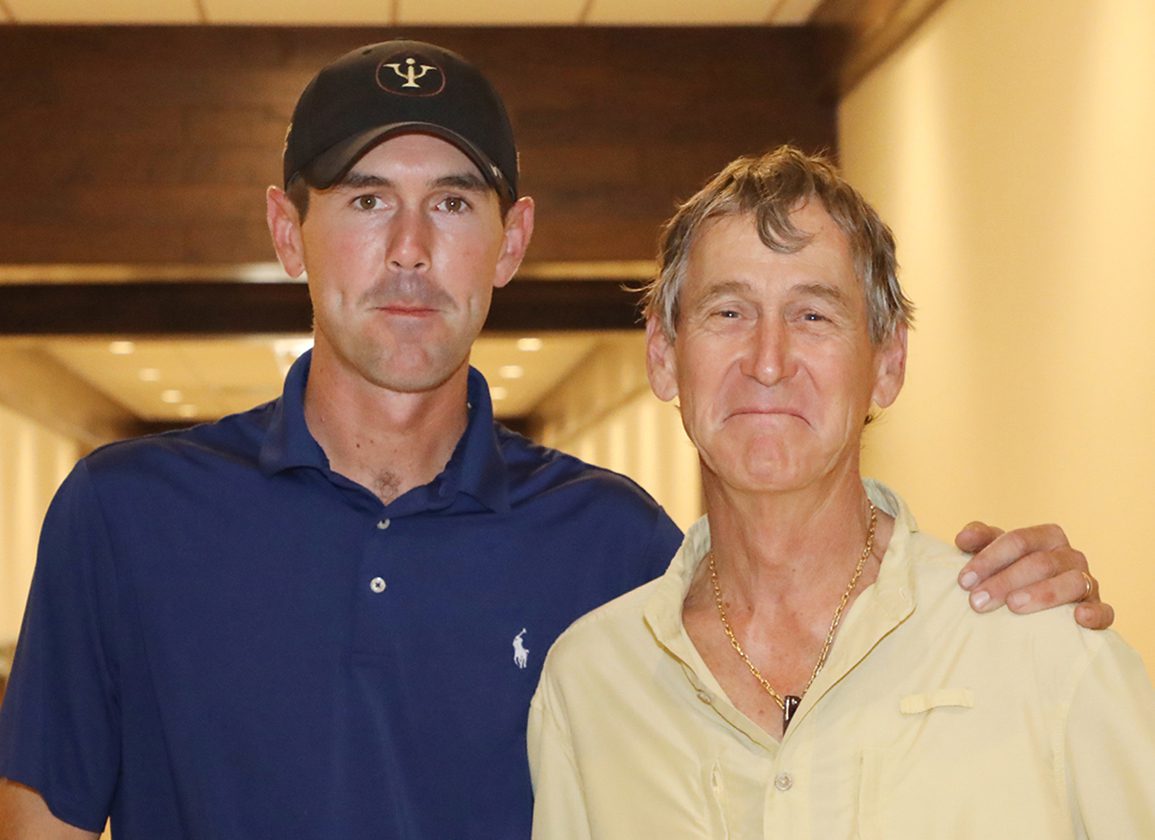
De Meric’s Odyssey Brings Him ‘Home’ To Horses

The island is still there, nearly 50 years later, which would have surprised Nick de Meric at the time. He'd have assumed that there could be nothing left by now.

“Because they were basically mining it off the map,” he recalls. “It was made of iron ore. So they had these massive Euclid trucks, wheels high as a building. And all these men on shift work, living in long huts. Not quite a prison environment, but it was all-male, tropical heat, nothing to do but drink beer and play cards. A lot of these guys would have a cooler beside them while driving these huge trucks on night shift. So there were accidents. Some that drove over cliffs. Most of them, if they weren't already, were on the way to becoming alcoholics. Either running away from bad marriages, or from the law. They all had a story.”

This young Englishman was still in the early chapters of his own tale, one that would eventually bring him into our community as one of the most respected horsemen in Ocala. Back then, however, the Australian toughs working Koolan Island (next stop Indonesia) must have found him an object of some curiosity.

How did he get here? Well, horses had already long captured his imagination. Back in England, he'd shown ponies as a boy, moved onto eventing and steeplechasing, worked in racing yards. He'd passed up a university place to read English and Philosophy to make a first trip to Australia, working on a cattle ranch; went home to dabble in journalism; then a stint in agricultural college. At one point he exercised horses over the ancient gallops of Salisbury Plain for one of the great throwbacks of the English Turf. As somewhat of “a rebel and a wanderer,” however, de Meric was soon resuming his travels, returning Down Under to work a couple of years under Tommy Smith.

“A great trainer,” de Meric recalls. “Very much in the Woody Stephens, Jack Van Berg school. He would chew a few of them up, but when he found a good one, nothing was too good for them. And there were some great horses in the stable at the time. So that was a really good education.”

But the routine was numbing: up at 3 a.m., all the usual chores but also hours at the walk, riding and leading, round city blocks, in the mornings and then bareback in the afternoons. Or vanning over to Mascot Bay to swim them–behind a rowing boat.

“So picture this,” de Meric says. “Your legs are over the back of the boat and you've a shank in your hand, and there's a guy behind you rowing. A lot of horses, the first time they swim, they say, 'I'm not going in there. I'm not going there. Okay, I'm going.' And they practically get in the boat with you.

“One time a filly got loose and disappeared into the mangrove swamps. They found her two weeks later, standing there with her head down, covered in crab bites and sores. Dehydrated, but alive. And actually I think she was able to race again.”

Next de Meric bought an old car and drove up the coast with a pal. “We followed this little road through the rainforest, and it opened up onto a massive beach, just miles and miles of sand,” he recalls. “And we were like, 'Yee-hah!' And we're doing 'donuts' over the sand. Well, guess what? The car gets slower and slower, until eventually it sinks up to the hubcaps. And then suddenly that huge beach starts to get smaller and smaller, as the tide came in. I remember standing on the roof of the car, saying, 'We need to get our s*** out of here.' So we threw what we could into a backpack, waded ashore, and hitchhiked the rest of the way to Cairns.”

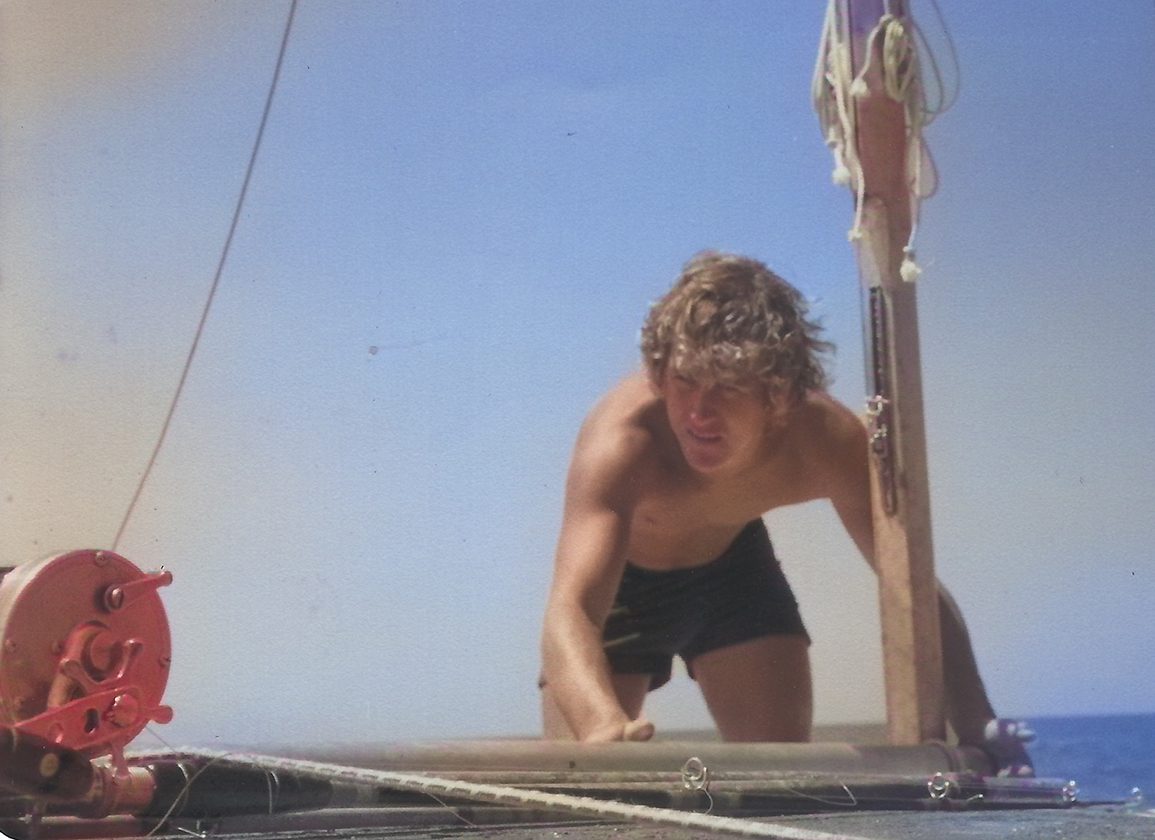
After staying there for a few months, de Meric traveled down to Perth where he was hired to work on Koolan Island, climbing giddy poles with a line-belt and handing kit to the electricians working on the power cables. But none of these hard-drinking men around him seemed to notice that they were surrounded by a dazzling marine environment. The one exception was a chef from New Zealand.

Courtesy Nick de Meric

“So we found this old catamaran, and spent three months fixing it up,” de Meric explains. “What was cool is that everybody on the island got a bit interested in what we were doing. So on night shift, the welders would make us a little bracket for the motor, the mechanics overhauled the motor, the carpenters helped fabricate new rudders. And then we took off, up the coast. Our grand plan was to cross the Timor Sea and island hop up the Indonesian chain to Thailand.”

At the time, it wasn't even charted: just countless little islands and reefs, with 35-foot tides rushing in between and 20-knot currents. They put in at a tiny settlement on stilts, where Japanese merchants hired Thursday Islanders to dive for pearls. Three days out from this last outpost of civilization, they anchored off one of these tiny islands.

“And in the middle of the night we got hit by what they call a cockeyed bob, like a mini-hurricane,” de Meric says. “We fought this thing for three hours and finally drove the boat onto the reef. And when the tide went out, here we are high and dry. It's the right way up, but it's got holes all through the bottom.”

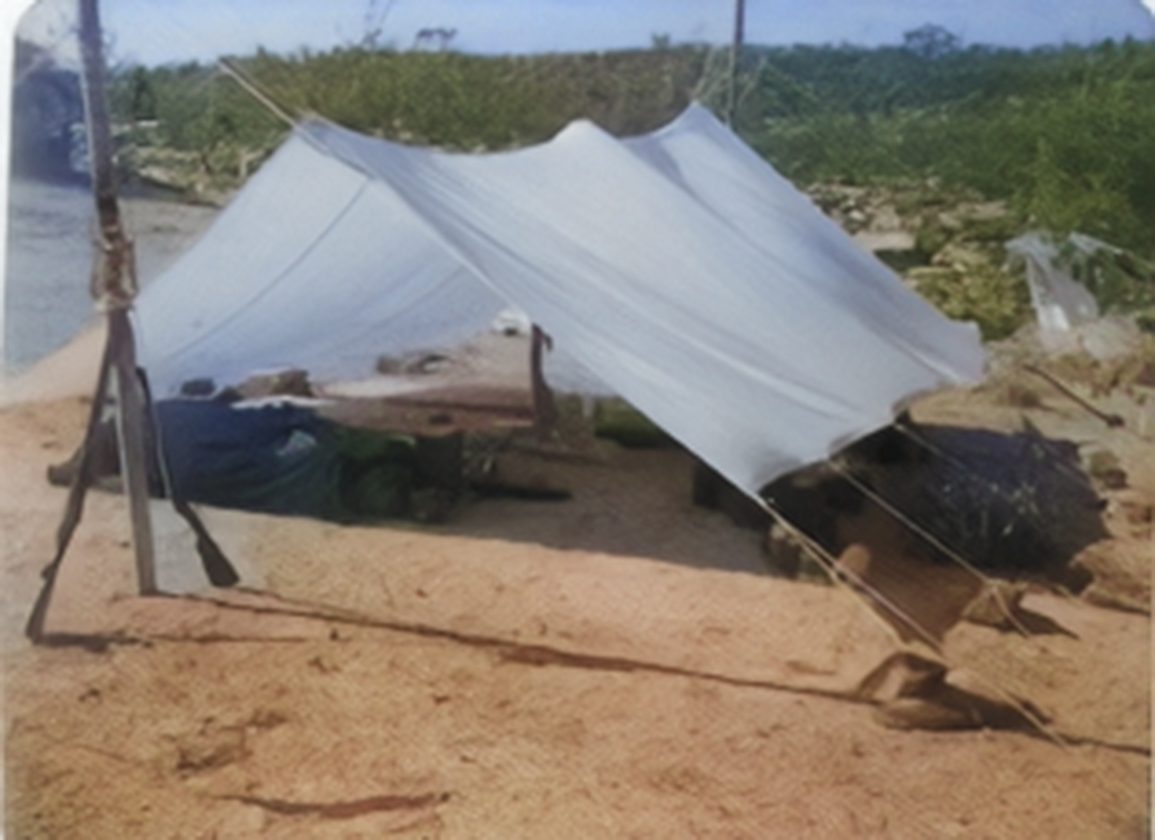
At least they had plenty to salvage: rice, flour, firearms, fishing tackle, not to mention plenty of wine and whiskey. They dragged it all up the beach, made a tent fly of the sail, and made camp. His buddy, remember, was a chef. So that was something, and they fished every night. When sharks started hauling off fish and fishing tackle combined, they switched to a meat hook and caught shark instead.

De Meric's island 'home' | Courtesy Nick de Meric

“Just barely edible, but Graham was good,” de Meric recalls. “The problem we did have was water. There was no fresh water, and our supply was diminishing. We made a bunch of solar distilleries: you make a little depression in the ground, fill it with leaves and brush, put a garbage bag over the top with a pebble in it and a cup underneath. And you get condensation and it drips. But that was nothing like enough.”

They had a radio, but the distances were hopeless. In certain conditions they could get onto the “Skip” frequency but only managed to raise a taxi driver somewhere in Japan. There was nothing else for it: de Meric would try to row the catamaran's dinghy back through the three days' sail to the pearl-diving hamlet. He'd go from island to island, riding each tide, resting in between. But if he could get there, then he could organize Graham's rescue as well.

The initial leg went to plan: de Meric made it to the first island, rested, then took off with the tide for the next one. But half a mile or so out, the tide turned and started rushing him back the way he came. “A depressing moment,” he says wryly.

So he must have thought he was more or less done for?

“We were kind of thinking that before I left, actually,” de Meric admits. “Leaving Graham behind was a very hard thing to do. But he was a chef and I was the seaman, son of a naval officer. Anyway there I am, scanning the horizon, and suddenly I glimpse this little bow wave just caught by the sunset. We hadn't seen a vessel of any description in 13 days out there. So I'm standing up in the dinghy, waving my arms, yelling, but it just keep going. And then, miraculously, it turns round and this boat is coming towards me.”

It turned out to be Australian coastguards, exceptionally patrolling that remote stretch because “Boat People,” as Vietnamese refugees of the time were known, had been washing up along there. They hadn't seen him, of course, but picked up a ping on the radar–and only because the dinghy was aluminum. Otherwise, well, maybe two piles of bones on two different islets might yet remain undiscovered. And nor would dozens of stakes and graded stakes winners (including a Horse of the Year) have benefited from de Meric's eventual discovery, after all these peregrinations, of a vocation that could keep him settled in one place.

And how did that happen? Usual story: Cherchez la femme! Next time he went traveling, de Meric tried the States, got a job with Lee Eaton. Met a girl on Eaton's fall yearling crew of 1981; independently they both got hired by the same Louisiana farm to prep yearlings for the 2-year-old sales; and wound up in the same staff house. “Rancho Malaria, we called it affectionately,” de Meric says. “It was right by the bayou.”

Here, they yielded to two lasting enchantments: one professional, one personal. The first yearling they pinhooked together, a filly by Nearly on Time, cost $15,000: de Meric himself had scraped together five grand, and his parents and then his uncle put in the same. Nick and Jaqui would come home from their work as freelance gallopers, and tend their filly with manic attention. They cooked bran mash on the kitchen stove and rushed it over to her hot. She made $30,000 at OBS March in 1983, and that summer they married.

“Although that may seem a paltry profit, today, at the time it felt like we'd won the lottery,” de Meric recalls. “If that filly had sold for $3,500, or gone lame, my life could have been very different. But the fact that we were able to show even a modest profit inspired us to keep going, to see whether we could make a career of this.”

So they leased a plot outside Ocala, found a couple of believers to send them a horse or two: Moreton Binn, Gerry Nielsen. Then they bought a first, 40-acre parcel, and expanded in gradual accretions until acquiring the 230 acres in 1997 that became the Eclipse Training Center.

“It had been let go, was a bit run down, but basically a really nice piece of land, with a really good track,” de Meric recalls. “So we spent time fixing it up, built two more barns, leased out some stalls. That allowed us enough cashflow to pay the mortgage, until I got rid of that about eight or nine years later, by selling some adjacent tracts with track rights.”

With Tristan at OBS | Photos By Z

They had started their own program even as the 2-year-old game was itself still in its infancy. In fact, de Meric reckons that Ocala Stud must be the only outfit then selling juveniles that's still doing so today. The changes in this sector, after all, have been wild.

“And I think that's why there's been quite a high attrition rate, among those of us playing that game,” de Meric says. “Because if you don't adapt to the changing mores of buyers, and the changing dynamics of the market, you're left behind. Yes, some aspects of the business have maybe evolved in a slightly unhealthy direction. But you either quit playing, or you play by the new rules in order to survive.

“We used to 'two-minute lick' them in pairs, on the bridle. Bow neck, nice strong gallop down the lane, eyeball-to-eyeball, make them look good. And we'd average somewhere between 30 and 70 percent on our money. Never hit one out of the park, but made a decent living. And then Luke McKathan started breezing his horses singly. He was a pioneer in his own way, and very good at what he did. He had this little quarter horse rider that could make them go fast, would whip them all the way down the lane. And then one could hear Luke in the barn saying, 'Yeah, did it real easy.' That was before videos, electronic timers, any of that!”

Nowadays, of course, time is money with these bullet breezers. But surely the old ways sufficed for the better horsemen, who didn't need the crutch of the stopwatch?

“Well, people were quite good at covering up a mediocre horse!” de Meric cautions with a smile. “But yes, the better horsemen could certainly identify the better horses, and plenty of good ones came out of those sales. But it gradually became apparent that you were putting a cap on your upside, doing it the way we were. So, little by little, I started out breezing in pairs and then singly.”

In the process Darrin Miller, who now operates a public stable, proved a real asset. “Riding a horse, he was a master at making it look like he had three more gears, when in fact he was all out,” de Meric says. “One isn't completely comfortable with every facet of the way it has evolved, with speed becoming more and more the thing. But my feeling is that there's a lot you can do to make it easier on your horses.”

And apart from anything else, that starts with selecting the right stock. “We're quite conservative, by comparison to some of our peers,” de Meric says. “But our horses usually show up when it's time to push the button. We aren't famous for bullet works. We don't complain if we get one, but we never demand them. We focus on good movers, and if they're a tick slower than some, that hasn't really hurt us that badly. We just shop carefully and, when we get them home, treat them the best we possibly can.”

A cornerstone of which philosophy is a “resistance-free” education. In fact, de Meric dislikes the very word “breaking,” with its connotations of confrontation. The celebrated Idaho horseman Martin Black worked with their program for three seasons, teaching his methods, and Jaqui has become especially adept at tutoring the young horses.

But while they duly prioritize mentality, physique remains central to their shortlisting.

“I think that's what we start with because, to be honest, everything else follows,” de Meric reasons. “We're looking for horses with a little more to come, but also for that element of precocity. And we like to see that in the pedigree also. But, yes: athletic, balanced, good-moving individuals. If they're athletes, first and foremost, then we'll handicap pedigree and value.”

And how hard is it to gauge competence for such a specific role, if you only get a fleeting glimpse of these yearlings glossed for the sale ring?

“Well, there's an element of guesswork, and also an element of judgment based on experience,” de Meric says. “You're watching for little clues. I got past the point where I look for what you might call 'projects,' or 'fixer-uppers.' Some people make a good living doing that. But I'm looking for horses that will appeal to higher-end buyers, if possible.”

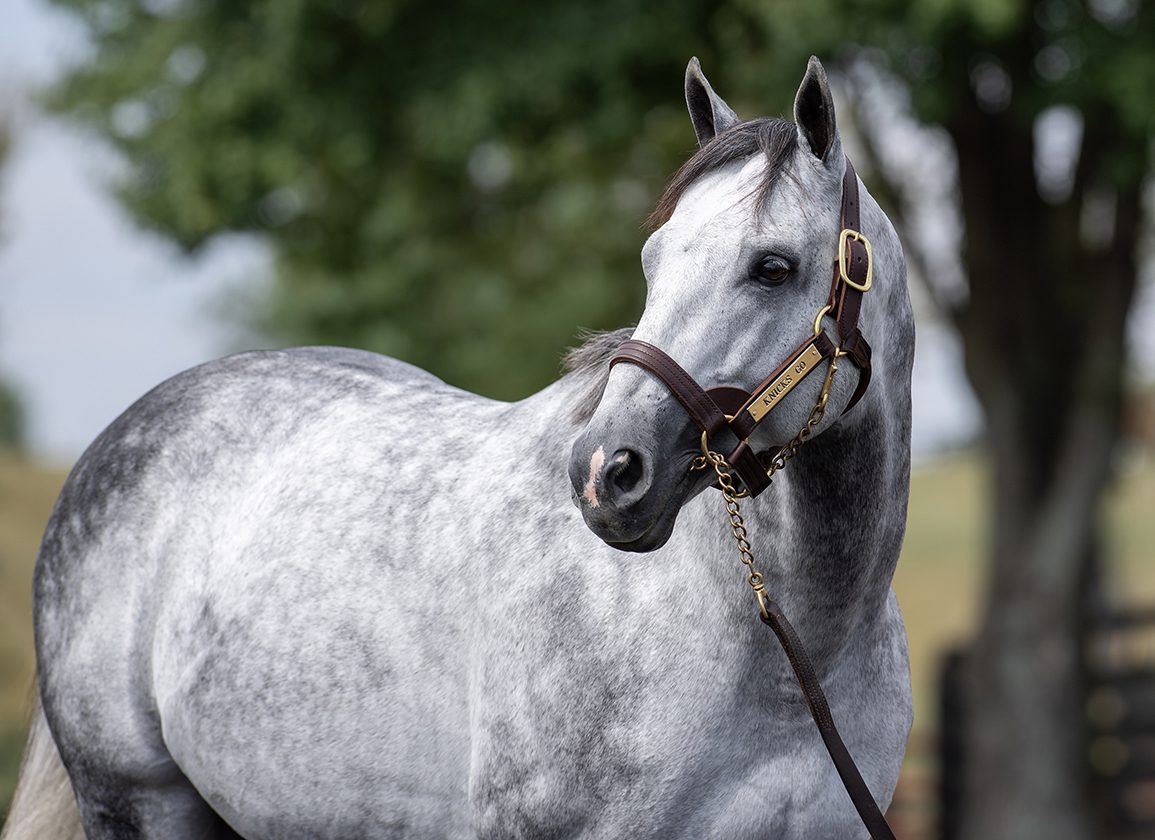
Which is another reason why a horse needs to do more than merely flash precocity. It was this program, remember, that honed Knicks Go. In fact, de Meric says that it was at his urging that the KRA, who had five in the sale, changed their minds and retained the future Horse of the Year to race. He wasn't fashionably bred, of course, nor very big–but he had shown de Meric unusual grit.

Knicks Go at Taylor Made | Sarah Andrew

“We're asking them to do a lot,” de Meric remarks. “These days, as we've said, people want to see these horses work fast. But they also want horses that will possibly have Classic potential, train on as 3- and 4-year-olds. So they need to have it all, and to vet well at the end of it. When you actually stop and add it all up, you think, 'What the heck are we doing? This is madness.' Because the odds are stacked against you from the minute you set foot on the sales ground. But it's what we do. It's the bed we've made. And it's been good to us over the years.”

As you can read in tomorrow's TDN, in de Meric's contribution to our “Succession” series, he's as proud of the parallel program developed by his son Tristan (and daughter-in-law Valerie) as he is concerned by the kind of future that may await the next generation. The way things are going for our sport's reputation in Main Street, it must almost feel like watching that bow wave diminishing into the sunset, all those years ago. But maybe this boat can also turn round.

“There's a lot of momentum in the wrong direction right now,” de Meric acknowledges. “We keep running into these unexpected headwinds, into challenge after challenge. As a generation, I don't think we've done a spectacular job as stewards of our sport. At the same time, I feel we have to stay positive.

“There's enough of us, collectively, that are passionate about this game, that would almost die rather than see it go under. People talk about greyhounds, about harness racing. Ours is a different world. When it gets under your skin, there's no fighting it. That's why billionaires become millionaires playing this game. Because there's no feeling like it.

“It's all those lows that make the highs even more exciting. It doesn't matter if you're racing, pinhooking, breeding, selling: those highs, it's a euphoric feeling. I think all of us, by definition, tend not to be the kind who like the middle ground. Because this is not that kind of business. It's a rollercoaster. And it's not for the faint of heart. When it's good, it's great; and when it sucks, it really sucks. But at the end of the day, we're working with the animals we love. And in that we are truly blessed.”

The post De Meric’s Odyssey Brings Him ‘Home’ To Horses appeared first on TDN | Thoroughbred Daily News | Horse Racing News, Results and Video | Thoroughbred Breeding and Auctions.
Source of original post

Verified by MonsterInsights
