A good 10 years ago in the Santa Anita paddock garden, former trainer Matt Chew was leading a stately old schoolmaster named Fred through and around an afternoon gathering of children with developmental issues when a diminutive figure from the crowd locked eyes with the horse.
“I walked over and handed him the shank and said, 'here, take him. He's yours,'” says Chew about the curious soul, a 10-year-old named Austin, onto whom he foisted the docile Fred.
“He starts walking around with the horse and he starts talking to him, 'oh, you're a beautiful horse. This is wonderful. You're so great. Dah, dah, dah. My name is Austin, I'm 10 years old,'” Chew recounts.
Several observers that day, however, appeared shocked. “Their jaws dropped,” says Chew. “They looked horrified.”
Anticipating a few feathers needing unruffling, Chew's wife Candie Coder-Chew marched over to the thunderstruck group—some of them in tears—lavishing apologies and assurances about the horse's temperament.
“One of the women goes, 'no, it's that Austin doesn't talk. He had experienced a trauma a few years earlier that had shut him down verbally.' So, he was nonverbal, autistic, and this horse brought him out of it,” says Chew. “And to this day, he is still speaking.”
This anecdote has been worn smooth by Chew's retelling over the intervening years, with good reason, for it encapsulates the sense of purpose that has driven the Chews the nearly 1,400 miles from Los Angeles, California, where Matt had trained for decades, to Hayden, Idaho, where they now run a racehorse aftercare facility and equine therapy program for local foster kids, Champions Retreat.
A sense of purpose propelled by the knowledge that within the 1,000 pounds of thundering horseflesh seemingly a hair's breadth away from careening dangerously out of control is an intuitive mind capable of plunging the deepest reserves of empathy.
“These horses are amazing. They seem to understand from the energy coming off of these kids that there's a need for one another,” says Chew of his stable of eight retirees, all of them from California–horses like Silken Prince, a useful claimer under Chew's tutelage before the trainer's retirement in 2020.
Matt Chew | Courtesy of Candie Coder-Chew
“The horses really do interact with these foster kids in a different way than when they act with normal people,” he says. “And I can't explain it. I don't fully understand it, but I've witnessed that dozens of times. There's just a connection that's formed.”
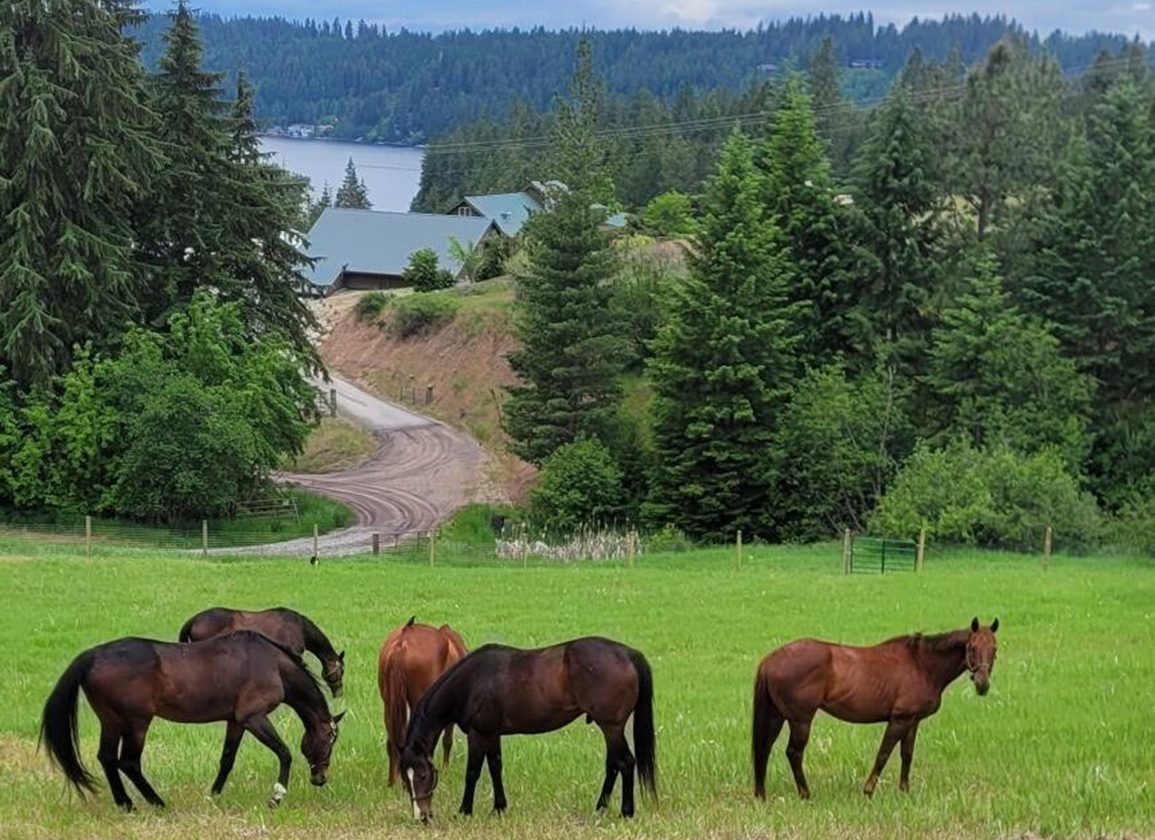
Their 18-acre Idaho ranch is the sort of place that would set Grizzly Adams's heart aflutter.
Eight acres of green pasture. A large barn with 10-feet by 20-feet stalls. An indoor arena. An outdoor arena. And all of this abutting a vast leafy wilderness.
“This is National Forest. We walk out our back fence and we have 350 acres of trails which we've erected on some of the old logging roads. We built a cross country course back there for jumping, and it makes for some lovely riding,” says Chew. “And we have a view of a lake.”
The Chews set up shop some three years ago, unsure quite what kind of program they would offer to whom.
It started with the children of a few local friends with autism or anxiety issues. Some adults that had physical or mental challenges. A few military veterans. Domestic violence survivors.
That's when they were approached by Fostering Idaho, a nearby program that links foster kids and families.
“They asked if we'd be interested in working with them. At that point, they asked us, 'how many kids do you want?' They basically filled up our dance card for us,” says Chew. “We had 42 kids total last year.”
While some kids approach the whole endeavor with all the reticence of an avalanche, “other kids, they're definitely afraid of horses, period,” says Chew. “And they're very intimidated. So, if we can get a kid to feed a carrot and pet a nose, that's a good day.”
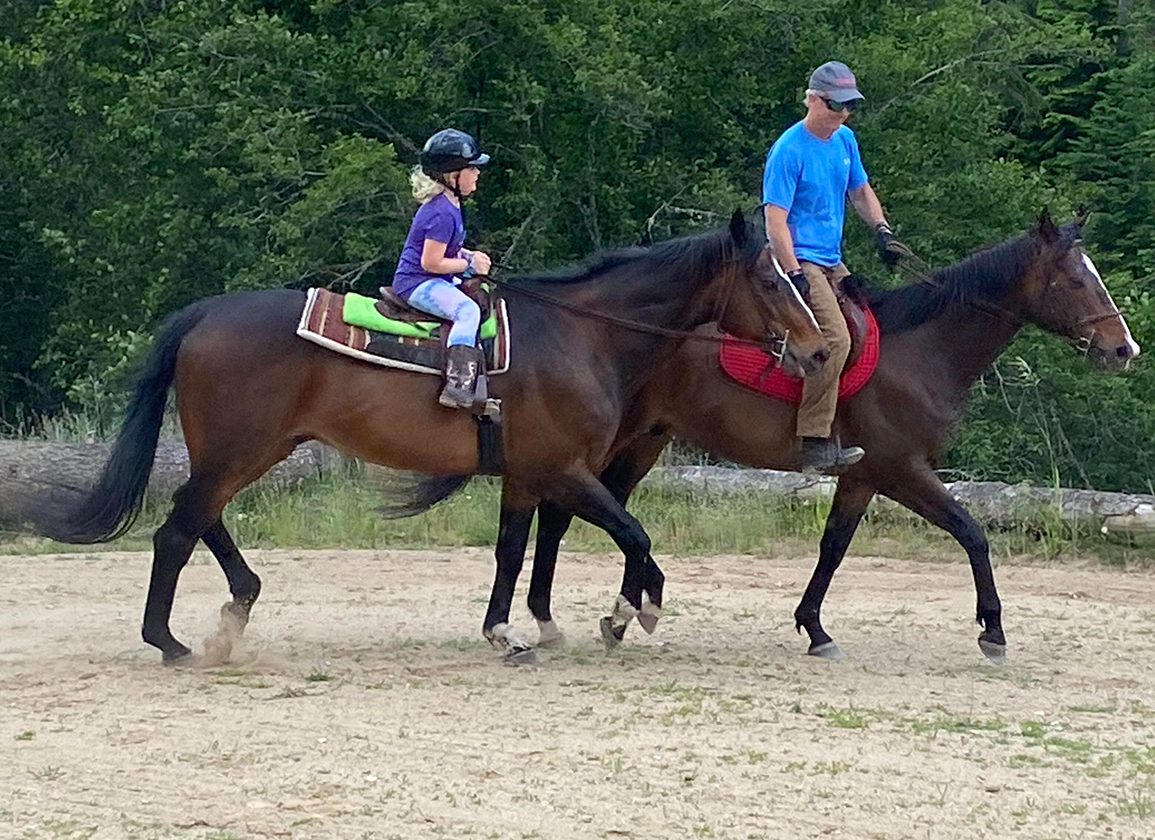
“We have the type of horses where we can put somebody that's never ridden before on a horse and have it be a safe experience,” Chew says. “And then as they progress, we take them from the barn to our outside arena, and then when they get to a certain level, we're able to go on a trail ride.”
Some of the foster children have turned into repeat visitors. “They're welcome any time,” Chew says. But they have to earn their bacon.
“The kids that come back time after time, we do put them to work. We want them to understand that they have to, at some point, earn the right to ride these horses,” he says.
Coder-Chew remembers the first group of foster kids that came their way. “We weren't a hundred percent sure what to expect, so we were kind of winging it a little bit,” she says.
This first reconnaissance mission included two foster brothers, both around six or seven years of age. “One had been adopted by the foster family that brought these kids out. The other one had not,” she says.
The adoptee was a little chatterbox who took to horseback like a young Steve Cauthen. The other brother was more reserved, tentative. As the young boy hit the saddle, he took a sharp intake of breath, and held onto it as though diving for the sea floor.
“So, I asked him to take a deep breath and try to relax a little bit,” says Coder-Chew. “It took about three minutes, I think, and he took some deep breaths and sort of relaxed and petted the horse.”
After a few minutes of slow plodding, the young boy spotted his speedier brother, leaned down with a smile and whispered to Coder-Chew, “'can we go faster? I want to beat my brother,'” she remembers. “So went a little faster. And he was just having a great time and was very engaged by the end—not talking a lot but talking.”
Afterwards, the children and the horses were taken to a small area behind the barn for refreshments.
“This little kid, he walked very purposefully over to the horse, threw his arms around the horse's chest and leg. He was so small. And the horse, of course, bent over to kind of hug him back. I don't think there was a dry eye in the place. It was just pretty incredible, the connection this kid felt with this horse.”
Chew trained for nearly 40 years, during which time he sent out 400 winners from just over 4,000 runners. The majority of these wins came at the lower levels of the game.
“When you're training horses, you're consumed by it 24/7 from the minute you wake up to the time you go to bed,” said Chew. “I mean, it's all encompassing. And that's your entire world. And believe me, to work in racing is a privilege. It's hard. It's demanding. It sometimes sucks the life out of you. But it also gives you a feeling of elation when a horse runs well that you can't get in any other aspect of your life,” he says.
“I fully understand that what working with these kids has done for me is give me a lot more balance in my life. You don't get the extreme high of winning a race, but you also don't get the extreme lows that came with it.
“After you'd win a race, there'd be a time when you'd be walking back to the barn where it was a feeling of contentment. When the world is okay, everything's right, everything's good, and you just would have an overall feeling of well-being. Working with these kids, that feeling lasts for days, not just moments,” Chew says.
Champions Retreat | Courtesy Candie Coder-Chew
A self-described city-slicker, Chew's life-lessons have been both philosophical and practical over three years in a part of the country where the deep winters can wear as long and unrepentant as the summers are short.
A flick through one of their newsletters gives a glimpse into these seasonal toils:
“Winter is near and we feel the pressure of the seasonal changes to get prepared for the cold weather. Matt has been cutting down trees, splitting wood, repairing fences and structures. We have all of our hay in the barn to last through June and have seeded the pasture for spring grass,” they wrote in fall of last year.
“I thought I could I never build anything in my life,” admits Chew. “And I've built shelters and feed sheds, for God's sake. I have two chain saws now. If you'd have told me 10 years ago that I'm going to be in a position where I'm going to need two chainsaws, I'd have said you're nuts.”
Ask Chew who should take credit for much of the heavy lifting and he barely takes a breath.
“My wife,” he replies. “She found the property. She knew it was my vision to work with kids but it was her vision to provide a place for retired race horses. And she made it happen. Without her, this dream would not have materialized.”
Eight horses are a lot to care for. Nor are they cheap. Appetites are huge. Upkeep is near constant. And Champions Retreat is a free service.
“We like to say we have donations and grants, but we also self-fund about 25% of this operation. So, it takes a special commitment to do it,” Coder-Chew says, adding how several of Chew's former owners have supported them financially.
“I think the one thing I would absolutely mention is how supportive the racing industry is of aftercare programs for retired thoroughbreds,” says Coder-Chew, former California Retirement Management Account (CARMA) board president.
“That's something that we're so grateful for because we wouldn't be able to do what we do if we didn't have the support of the Thoroughbred Aftercare Alliance, TCA [Thoroughbred Charities of America] and CARMA. That's huge,” she says.
Given the departure from their old life, do the Chews have any regrets or misgivings?
“None,” says Chew, empathically. “In the racing environment, in order for me to prosper, somebody has to lose. That's just the way it is in any sport. We've tried to create an environment where when you walk onto our property, whether you had four legs or two legs, you're going to be better off when you leave. And we feel like we've accomplished that.”

The post From Training to Equine Therapy, Chews Finding New Balance in Idaho appeared first on TDN | Thoroughbred Daily News | Horse Racing News, Results and Video | Thoroughbred Breeding and Auctions.
Source of original post
