The way California Horse Racing Board (CHRB) chair Greg Ferraro describes it, the now infamous letter in which 1/ST Racing and Gaming appeared to threaten the sale of Santa Anita should the board grant the North its desired 2024 race dates was “a very big mistake” on their part–one that helped sway the board's unanimous decision to side with interests in the Northern half of the state.
“It really put a bad taste in the mouths of board members,” Ferraro said.
Beforehand, Ferraro had anticipated punting a decision on the North's race dates to the following meeting, he said, adding how Belinda Stronach, chairwoman, CEO and president of 1/ST, had called him the day before to “lobby” her position.
Ultimately, however, “the two things that came out to me [from the meeting] was just how much animosity there is towards The Stronach Group in California,” Ferraro said. “And that the letter was the thing that really killed them.”
The granting to the North a 10-week meet–to run at Pleasanton from Oct. 10 to Dec. 15 at the conclusion of this summer's fair meets–heralds quite the dramatic reordering of the operational and political furniture in California racing.
“It might be the most momentous decision the board has made in its history,” said Ferraro. But now the dust has settled somewhat on last week's board's decision, what's next?
“What we have to do now is get the racetrack operators in one room, sit down with them and say, 'okay look, this is the direction we need to go. You can either go voluntarily or the board will force you.' Remember, we control the dates,” said Ferraro.
“Let's sit down and see what we can work out with the calendar for the next year or two, three, to transition to a one circuit,” Ferraro added (more on that single circuit in a bit).
When asked to discuss the situation with a 1/ST representative, company spokesperson Tiffani Steer wrote in an email, “Craig Fravel's comments at the CHRB meeting stand.”
Thoroughbred Owners of California (TOC) president and CEO Bill Nader said for him, the key takeaway from the meeting was the concretizing of important details.
“We all have something now we can measure–I think that's good for the North and it's good for the South,” said Nader. “Trying to define viability or sustainability is difficult when some of it's based on speculation.”
With the vote in, “now [the CARF] have got to go back and address the outstanding points that were raised in the meeting,” said Nader. “We're moving forward, but there's still pieces of the puzzle that need to come together.”
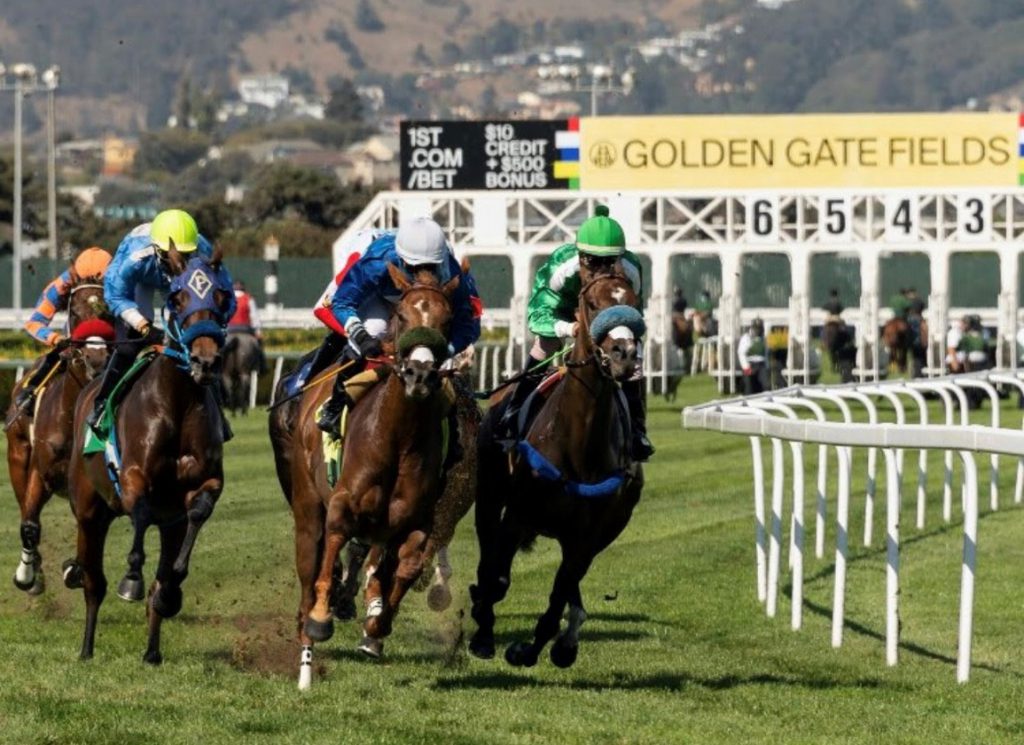
Golden Gate | Vassar Photography
PLANS FOR PLEASANTON
The ambitious plan outlined by the California Association of Racing Fairs (CARF) for its 26-day, 208-race season at Pleasanton presents stakeholders in the North with a set of logistical and bureaucratic hurdles to overcome between now and then, pending CHRB approval of the track's license application at its Aug. 15 meeting.
Upon such approval, the meet is scheduled to run under the auspices of Golden State Racing, a moniker given to differentiate it from CARF's stable of summer fair meets. All told, there will be eight stakes worth a combined $550,000, with some $3.6 million designated for overnight purses. CARF executive director Larry Swartzlander said that these are “not firm numbers yet.”
Among some of the undertakings at Pleasanton these next few months is the installation of some 284 additional auxiliary stalls at a projected maximum cost of $1.5 million, said Swartzlander, with the aim of facilitating around 840 horses.
There are ongoing negotiations with the operators of the golf course situated within Pleasanton's infield to determine how the two entities will coexist. CARF's plan is for no golfing during racing, to limit public use during training hours, and to allow the First Tee community program–a youth golf program–limited access to the infield.
State regulators will likely require a “Notice of Intent” for coverage under an industrial stormwater permit, to be filed before June 2, along with other environmental compliance issues to contend with.
When it comes to discretionary spending number crunching, CARF has stated it has $900,000 in cash reserves, access to a line of credit of up to $4 million from Alameda County Fairgrounds, and that it will arrange for further “lending, grants and donations” as the cost of capital requirements become clearer.
Swartzlander said that an engineer is scheduled to visit Pleasanton in July to assess the facility for a proposed turf course and to provide a cost estimate. At the board meeting, Swartzlander pinned a rough $7 million price tag to that venture.
Currently, once Golden Gate Fields closes its doors on June 9, Santa Rosa will be the only Northern California track with a turf course.
According to Ferraro, several key questions surrounding the issues of everyday operations–“who's running the show”–the agreement with the golf course operators, and that of financial viability remain unanswered, despite the additional details offered up by CARF last Thursday.
“The horse racing board is preparing them a list of questions that we want answered when they come back in August,” said Ferraro. “Staff is working on them right now.”
According to Jerome Hoban, CEO at Alameda County Fairgrounds, the next steps for Pleasanton and CARF concern installing the auxiliary stabling, negotiating a “purse schedule” with the TOC, and developing a licensing agreement “so that it's satisfactory with the CHRB.”
“We're also developing a marketing plan for this meet and beyond,” said Hoban, calling their approach “more robust” than that in place at Golden Gate Fields. “This is not a one-meet endeavour. The confidence that has to be given to the horsemen is that we have found them a home for good.”
A key obstacle that CARF must negotiate is Pleasanton's lesser name recognition compared to Golden Gate. As an example, the DRF recently reported how the New York Racing Association anticipates a 20% decline in betting revenues due to the temporary closure of Belmont Park and the comparative weakness of the Aqueduct “brand.”
It will take time for the simulcasting handle to “pick up on who Golden State Racing is,” admitted Hoban. “I do think we could have a dip in handle because of brand recognition,” he added. “But if there's any team that could turn that around, it's going to be us.”
One of the areas that the board zeroed in on for scrutiny were the possible financial costs and logistical hurdles of complying with state environmental regulations.
“We're always concerned about environmental compliance, but we're a 265-acre property that is used to dealing with these things. This is not new business to us,” said Hoban.
“I think that some of the things that Del Mar, Santa Anita and Golden Gate Fields have had to deal with, they are in a different situation with their manure management programs, with their proximity to the ocean and the bay. I think our facility is already well ahead of those facilities in regards these topics,” said Hoban.
According to owner-breeder Justin Oldfield, part of a working group that drafted CARF's plan, the most pressing thing for all California stakeholders, North and South, is to nail down an outside source of income for purses, which would take a Herculean lift in California's tough political environment.
“There are things we haven't explored thoroughly before, like historical horse racing machines,” said Oldfield. But if realizing outside purse revenues “truly is our number one challenge,” that would require a unified industry front, he added.
“I don't know of a single person on our horsemen's working group or anywhere else that would disagree with that,” Oldfield said.
As for horsemen and women in the North, the mood at Golden Gate Fields since the vote has equated to one big “sigh of relief,” said trainer Blaine Wright.
“I think people are really going to do their darndest to make this a go, keep the horses supplied and make this a reality for us,” said Wright. “I've already had some phone calls from [former owners] who haven't been supporting Golden Gate saying that, 'hey, we're planning on claiming a horse or two for you up there, help make a go of it.' And that's awesome.”
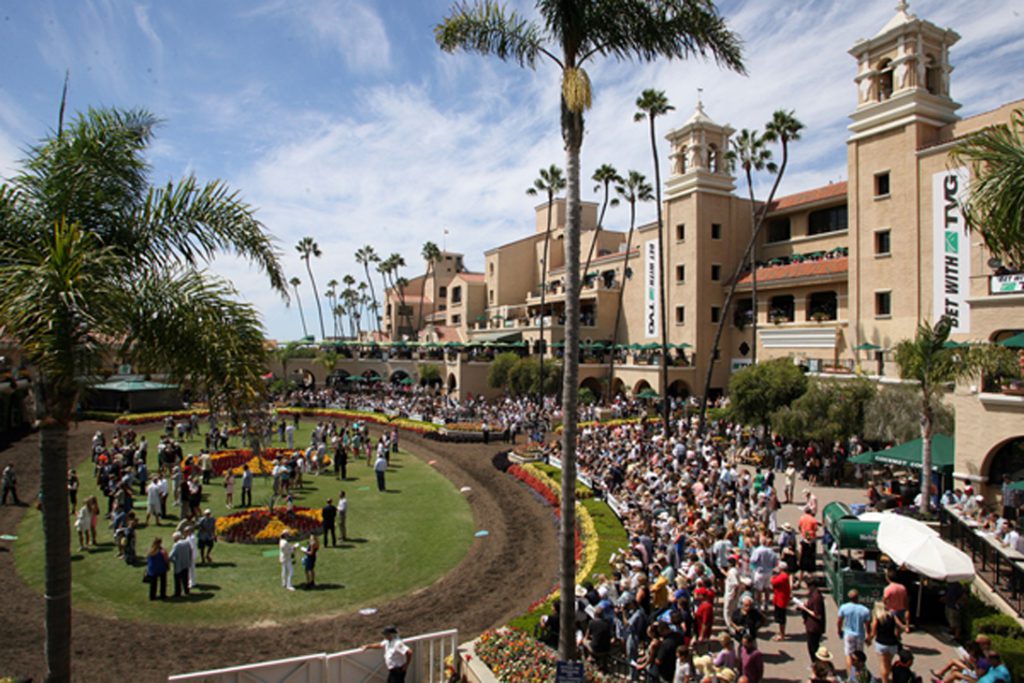
Del Mar | Horsephotos
PURSE CUTS
What the CHRB's decision last Thursday doesn't do is remove the tough economics, especially in the South.
Multi-million purse deficits are fed by shrinking handle totals–wagering on California racing was down by around 5% in the first two months of 2024. At the heart of these equations are field sizes.
During the first 35 days of racing during Santa Anita's current meet (317 races), field sizes averaged out to 7.02 runners. At a comparable stage last year (after 31 days of racing and 282 individual races), the average field size was 7.54 runners. That said, the average field size at a comparable stage in 2022 (after 37 days racing and 328 races) was 6.90.
Interestingly, the 25% purse cuts at Golden Gate appear to have helped claw back a substantial amount of the track's $3.1 million purse deficit. According to data reviewed by the TDN, Golden Gate had recouped over $1.2 million of its purse account over-payment by the middle of March.
Nader said the next step is to come to a decision about purses for Santa Anita's remaining Spring meet by the beginning of April, in time for the next condition book.
A decision about Del Mar's purses will come out “shortly thereafter,” said Nader. “They're anxious to put out their schedule for the summer,” he added.
One notable impact from Golden Gate's closure is the schism that has opened up between interests in the North and South. Earlier this year, three Northern TOC members resigned in protest to what they saw as the organization's Southern-centric approach to the problem. These feelings clearly persist.
“What's the future of the TOC? I think they've lost some credibility,” said Tom Clark, the owner and manager of Rancho San Miguel, a mainstay of the state's breeding industry. “I think we need to strongly examine how the organization's currently structured, and what their mandate is.”
“We're doing all we can to give them comfort that we're here, that we're a resource, and that we accept and hear their views,” said Nader, when asked about the organization's approach to mending bridges.
“That doesn't mean we always agree,” said Nader. “But in the end, we have to land on what's best for California going forward. And we can't isolate this to a specific region, whether it's North or South. It's got to be a big-picture outlook of longer-term vision.
“And that's why getting actual data to accurately assess the benchmarks CARF put forward in its draft license application could be a good thing in the end,” Nader added. “Northern California is asking for a chance and the TOC is saying any business plan needs to be viable and sustainable. This is where we can find alignment.”
However, “if the numbers come out [at Pleasanton's meet] and it's far below expectations or below expectations, you'd need to find a way to pivot to meet the backup model,” Nader said.
What would that back-up model look like? “The backup would be to use the different assets in Southern California, meaning Los Alamitos, Santa Anita and Del Mar,” said Nader.
While stakeholders have raised questions over the years about 1/ST's financial commitment to its Californian assets–in particular, deferred maintenance at Santa Anita and Golden Gate's backsides–the company has still made and promised several costly investments in recent years.
This includes a new Tapeta training track, new turf chute at Santa Anita, and in state-of-the-art diagnostic imaging technologies. Earlier this year, 1/ST announced the California Crown at Santa Anita, revamping the card on G1 Awesome Again S. day, in homage to the Pegasus World Cup.
With that in mind, how seriously does Nader take Fravel's threat to sell Santa Anita?
“The key thing I think was when Fravel said Belinda is still very keen to continue racing there, and she's turned down many offers before,” said Nader.
“The one thing you'd say, the transparency of putting the industry on notice, in some regard, that's a good thing,” Nader added. “I'd rather have them say it than not say it and sell it in the middle of the night.”
THE BREEDERS
Conspicuous in their absence at the last CHRB meeting was a representative from Los Alamitos.
When asked if 1/ST's letter had any bearing on his nonattendance, Los Alamitos vice president Jack Liebau said, “at the board, I think there was a perception that a threat was being made, and I don't think it was well received. Los Alamitos and 'Doc' [Ed] Allred [Los Alamitos owner] perceived of that threat and decided it would not be a party to it.”
In recent months as discussions circulated on a consolidated circuit in the South, Liebau has discussed a possible legislative fix to expand the menu of Thoroughbred races offered at Los Alamitos. Currently outside of their scheduled Thoroughbred meets, Los Alamitos is limited to staging Thoroughbred races capped at 4 1/2 furlongs and at a $5,000 claiming price.
This proposal had followed the passing of key legislation last September, which means that when Golden Gate Fields no longer operates after June this year, proceeds from simulcast wagering in the Northern half of the state will be funneled south when the North doesn't conduct any live racing.
The idea of a legislative fix to expand the menu of Thoroughbred races on offer at Los Alamitos has been put on the “back-burner,” said Liebau. But he also stressed how Los Alamitos was never an active advocate but rather a “passive observer” of efforts like the proposed legislation.
“Doctor Allred has always said that Los Al would do whatever it can do to improve racing and to accommodate all the different interests. But when you get down to it, Los Al is really something of a bystander. It's happy to help, but certainly doesn't view itself as pushing that legislation,” said Liebau.
In discussions with various California stakeholders, the firm stance the CHRB took on Northern dates prompted several breeders holding off on breeding plans until the last moment to press the trigger.
“It was very important that we had something positive to announce to basically keep giving people a reason to breed,” said California Thoroughbred Breeders Association president, Doug Burge, who added that total reports of mares bred won't arrive until the fall.
Clark said he was unaware of such a trend. “It's not like people called me up, saying 'oh boy, with the vote last week, I guess I'm going ahead to breed,'” he said.
However, “one breeder I know, his mare had just foaled and he had to make a decision. He said, 'Yeah, now I feel a lot better about going ahead and breeding again,'” Clark added.
And what of Ferraro's idea for a single circuit in the state? That would look like year-round racing with meets North and South, but no over-lap with one-other, he said.
“Long-term, I think it's the only way California racing can survive,” said Ferraro. “We simply don't have enough horses or enough fan support to continue with this two-circuit racing.”
When asked about this proposition, Liebau voiced his reservations. “It's very difficult to react to a comment made by the chairman of the board, but I think the time passed on that long ago,” said Liebau.
The finances involved with keeping facilities operational in today's economic climate are massive, said Liebau. Indeed, Santa Anita has apparently incurred operating losses of more than $31 million over the last five years. Interestingly, during the latest CHRB meeting, Fravel offered up the company's books for the state regulator to examine.
“Frank Stronach always thought you needed to run year-round and every day because it's very difficult to keep a track like Santa Anita going if it's shut down half the year,” said Liebau.
As for Pleasanton, Liebau pointed to a couple potential positives.
One is that large purses don't necessarily correlate to larger fields. That, “and I suspect the horses in the North have more starts than horses in the South,” Liebau said, adding however that he hasn't crunched those numbers.
“The people in the North deserve to be given the chance to succeed or fail,” said Liebau. “But they have a long difficult road ahead of them.”

The post Following CHRB Race Dates Decision, What’s Next For California? appeared first on TDN | Thoroughbred Daily News | Horse Racing News, Results and Video | Thoroughbred Breeding and Auctions.
Source of original post
