Claiming Crown: Just Getting A Horse Here Can Be A Victory In Itself

Many of the trainers and owners running horses in Saturday's eight Claiming Crown races already won a critical competition before the starting gate even opens at the Fair Grounds Race Course & Slots: They got the horse at the claim box.

With shrinking foal crops and enhanced purses in areas such as Kentucky, New York and Arkansas, there has never been more demand for a competitive claiming horse, the backbone of American racing. The Claiming Crown was created 25 years ago by the National Horsemen's Benevolent & Protective Association (NHBPA) and the Thoroughbred Owners & Breeders of America (TOBA) to spotlight those horses with their own big-money day.

The 25th Claiming Crown — this year worth a total of $1 million and staged with support from the Louisiana HBPA — clearly has encouraged some owners to seek out horses with this day in mind.

“A lot of guys gear up for this day,” said trainer Robertino Diodoro, whose seven Claiming Crown entrants include three contenders for the $200,000 Jewel in Flying P Stable's Saqeel and Frosted Grace and Ken Ramsey's King's Ovation. “Two of my bigger guys, Flying P and Ken Ramsey, have had success at the Claiming Crown and just love it. Jason Provenzano has mentioned it to me at least once a week for four months about having Frosted Grace for the Claiming Crown. Flying P last winter would say, 'How about this horse (to claim)? He'd be eligible for the Claiming Crown next year.' It was nine or 11 months away, but it shows you how excited some of the owners are and how much pride they take in running in it.”

“It's a big day and very important to a lot of owners. The blue-collar horses get to be the spotlight of the day and run for good money. You have to have blue-collar horses in this game, for sure, for spectators, owners and trainers. They're a big part of our game.”

Claiming a horse is one of the quickest and most effective ways to get new owners into the game – or to bring lapsed owners back. Claim a horse, and you could see it run back in your silks in a matter of weeks.

The concept is relatively straightforward: Claiming races have, as a race condition, a set price tag on the horses to encourage running horses of approximately the same value/ability against each other. If an owner (usually represented by his or her trainer) decides they want one of the horses in the field, they fill out a form – and make sure they have the money to pay for it in their horsemen's account — before the race goes off.

The original owner gets any purse money the horse accrues in the race. But afterward, horses that had valid claims submitted walk back to a new barn. If multiple people drop a claim on the same horse, there's a “shake” – akin to drawing straws – to see who wins.

For example, owner Paul Parker and trainer/co-owner Jeff Hiles needed to win a 13-way shake to get Time for Trouble, the favorite in Saturday's $75,000 Ready's Rocket Express, for $8,000 on June 18, 2021 at Churchill Downs. He was one of five horses claimed out of the race. Time for Trouble has not run in another race since where he could be claimed, that includes winning last year's Ready's Rocket Express at Churchill Downs.

Starter-allowance races such as the Claiming Crown are restricted to horses that have started for a certain claiming price or cheaper in a specified time frame. But there is no claiming involved, making starter races attractive to those who don't want to risk losing their horse.

The complexities of the claiming game increase when horses' eligibility for starter races expires. If they're put in another claiming race to make them re-eligible for starter competition, there's a good chance they'll be claimed. On the other hand, horsemen need to run in spots where they can make money to stay in business. Running a horse over its head repeatedly just to hang on to it doesn't do the owner, trainer or the horse any good.

So it's one thing to claim a horse with the Claiming Crown in mind and another to still have it come Claiming Crown day.

Mike Maker, the all-time leading Claiming Crown trainer with 21 victories, and his fellow horsemen Diodoro, Chris Hartman and Joe Sharp are all over Saturday's Claiming Crown entries. Maker and Diodoro entered seven apiece, Sharp six and Hartman four.

Then there are all the horses racing Saturday that those guys used to train. Take Invaluable — and a lot of people did just that.

Now 6, Invaluable won last year's Claiming Crown Glass Slipper for Maker but will start this year for Sharp, who claimed her two races ago. The Claiming Crown was only Invaluable's second start for Maker, who took the mare off Diodoro for $32,000 at Saratoga in a race where all four horses were claimed. The prior winter, Diodoro had taken Invaluable off Hartman for $30,000 at Oaklawn, a race in which five of eight starters changed hands.

“That one hurts,” Diodoro said of losing Invaluable, the 2022 National HBPA Claiming Horse of the Year. “I loved that mare. I didn't want to lose her. She's as honest as they come. We could have tried to hold her out for the Claiming Crown. But you get to Saratoga, the owners want to win, the purses are big. You can't just 'protect' these horses. You've got to run them where they can win – and there's a pretty good chance you're going to lose them at the claim box.”

The home run is getting a horse that improves to where it can run well in allowance and stakes races. That's the case with Frosted Grace, a $32,000 claim a year ago who has made $382,860 for Flying P in 2023, including winning Lone Star Park's Grade 3 Steve Sexton Mile.

Three other Diodoro-trained horses will make their first start for the barn Saturday, having been claimed specifically for the Claiming Crown. One, Pens Street in the Glass Slipper, has been claimed in three of her last four races.

The $75,000 Iron Horse Kent Stirling Memorial will be the second start for Diodoro with $40,000 claim On a Spree, who changed hands six times in his prior seven starts, including spending one race apiece for Hartman and Sharp.

“The claiming game gives everyone a chance,” said Eric Hamelback, CEO of the National HBPA. “There's often not a lot that separates blue blood from blue collar. Horses every day outrun their pedigrees. High price tags bring high expectations, but sometimes those horses simply aren't good enough for top-level company. That doesn't mean they aren't still good, productive horses. And sometimes horses' form goes off to where they're put in a claiming race to get them back on track. Like Emerald favorite Therapist.”

That New York-bred gelding, an eight-time stakes-winner at the time, was claimed for $25,000 and then for $50,000 in his next start by Maker in January. Therapist now has won three races for new owner Michael Dubb, including the Grade 1 United Nations.

Hamelback noted that Glass Slipper favorite Samarita was a $1,000 yearling who has won her past six races and that Claiming Crown Jewel favorite Money Supply cost $400,000 as a yearling but clearly didn't fit into his original owner's program geared toward the classic races.

“The same mare, Tokyo Time, produced $3 million-earner Olympiad a year after she foaled Iron Horse contender Mau Mau,” Hamelback said. “He lost his first six starts, was put in a $30,000 claiming race, won that day and was claimed and has since raced successfully at his level for several different trainers. There are a lot more Mau Maus than Olympiads. They are good racehorses at their level and bring a lot of joy to their owners and barns. We celebrate them all with the Claiming Crown.”

The post Claiming Crown: Just Getting A Horse Here Can Be A Victory In Itself appeared first on Horse Racing News | Paulick Report.

Source of original post

Desert Debuters: Pricy World of Trouble Colt On Debut

In this series, we will have a look at American-bred first-time juvenile starters (through the end of 2023) and debuting 3-year-olds in maiden races at the tracks of the Emirates Racing Authority–predominantly Meydan and occasionally Jebel Ali–with a specific focus on pedigree and/or performance in a sales ring in the meetings leading up to the Dubai World Cup program Saturday, Mar. 30, 2024. Meydan will host racing mainly on Fridays, with the exception of Super Saturday Mar. 2 and Dubai World Cup night. Here are the horses of interest for the Saturday program at Jebel Ali:

3rd-JEB, AED72,000 ($19,606), Maiden, NH2yo/SH3yo, 1200m
PRINCIDENT (World of Trouble), a $75,000 Keeneland September acquisition by Powerstown Stud, caught the eye during the under-tack preview for this year's Arqana May Breeze-Up Sale (see below) and was knocked down to Rabbah Bloodstock for €210,000, the second-priciest of 30 juveniles reported as sold from the first crop of his sire (by Kantharos). Racing in the colors of Sheikh Hamdan bin Mohammed al Maktoum, the Feb. 12 produce is out of the MSP Truth in the Lies (Hold Me Back), a half-sister to five-time New Jersey-bred stakes winner Trueamericanspirit (Is It True).


Fayadh (Liam's Map) is the latest foal to make the races out of Class Included (Include), whose 11 career stakes successes includes the GIII Ballerina S. at Hastings Park. A $100,000 KEESEP purchase by former jockey turned bloodstock agent Ted Durcan/Longways, the chestnut colt fetched €148,148 from owner Ali Haddad at the Goffs Dubai Breeze-Up at Meydan this past March (see below). Bhupat Seemar handles training duties.


The post Desert Debuters: Pricy World of Trouble Colt On Debut appeared first on TDN | Thoroughbred Daily News | Horse Racing News, Results and Video | Thoroughbred Breeding and Auctions.

Source of original post

Weekend Lineup Presented By Del Mar: Turf Festival Draws Shippers Out West, Cigar Mile Card Lights Up East

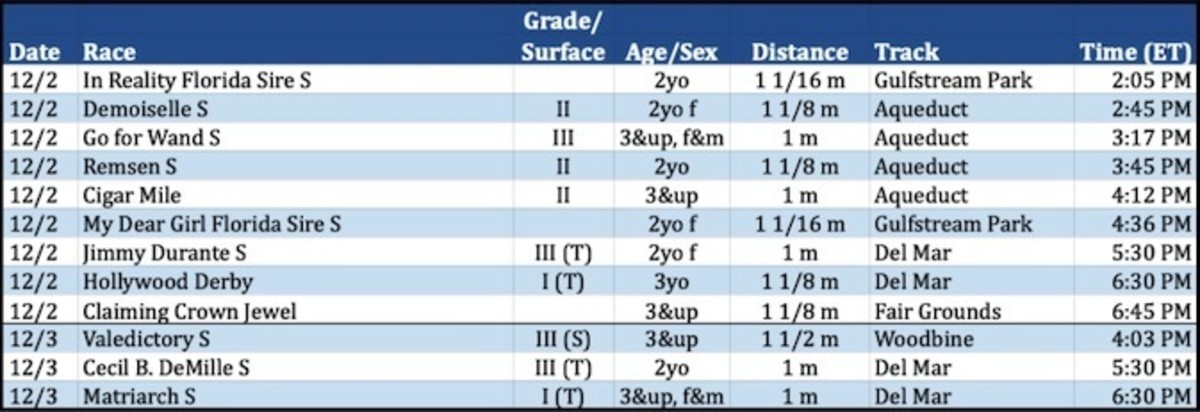
East Coast shippers are prominent in this weekend's stakes action at Del Mar, featuring the Grade 1 Hollywood Derby on Saturday and the G1 Matriarch on Sunday as the track's Turf Festival wraps up the fall meeting. Nine are entered in the 3-year-old-restricted Hollywood Derby, while the Matriarch drew a field of 12.

Those stakes are supported by a pair of G3 turf races for 2-year-olds, the Jimmy Durante on Saturday and the Cecil Demille on Sunday.

On Saturday at Aqueduct, a quartet of graded stakes races are the highlight of a solid Cigar Mile (G2) card. Todd Fincher trainee Senor Buscador has shipped East to be the slight Cigar Mile favorite over 11 rivals. Included on the afternoon's card are two races on the Road to the Kentucky Derby and Kentucky Oaks: the Remsen and the Demoiselle, respectively.

Also on Saturday is the $1 million Claiming Crown, a series of races for former claiming horses which will be held at the Fair Grounds this year, as well as a pair of Florida Sires Stakes races at Gulfstream Park.

Saturday

3:45 p.m. – Grade 2 Remsen Stakes at Aqueduct

The Remsen, carded as Race 9, awards the top-five finishers with 10-5-3-2-1 qualifying points, respectively, towards the Grade 1 Kentucky Derby in May at Churchill Downs.

Dornoch, full brother to Kentucky Derby winner Mage, will attempt to give trainer Danny Gargan a repeat victory in Saturday's Grade 2, $250,000 Remsen, a nine-furlong route for juveniles, at Aqueduct Racetrack. Dornoch arrives from a dominant 6 1/2-length victory at third asking with a gate-to-wire performance on October 14 at Keeneland, garnering an 87 Beyer Speed Figure. His graduation came on the heels of a close runner-up effort to Noted in the one-mile Sapling in August at Monmouth Park where he raced wide and was jostled near the seven-eighths mark.

Copper Tax [post 9, Kendrick Carmouche] streaks in off five consecutive victories for conditioner Gary Capuano, most recently shipping out of Delaware Park for the first time to capture the six-furlong James F. Lewis, III on November 11 at Laurel Park. The son of Copper Bullet was bumped at the start and trailed farther off the pace than he had ever been in his six lifetime outings, but overcame the challenge to rally late and notch the neck score over Inveigled.

Four-time Eclipse Award-winning trainer Chad Brown will send out two contenders in the regally-bred debut winner Sierra Leone [post 7, Jose Ortiz] and second-out maiden-winner Domestic Product [post 2, Manny Franco].

Sierra Leone made his highly anticipated debut on November 4 with a rallying 1 1/4-length score after bobbling at the start and racing five-wide in the stretch to sweep past Change of Command and complete the mile in 1:36.94. The son of Gun Runner was a $2.3 million purchase at last year's Fasig-Tipton Saratoga Select Yearling Sale and is out of the Grade 1-winning Malibu Moon mare Heavenly Love. This third dam, the multiple graded stakes-winner Roamin Rachel, also produced 2004 Japanese Horse of the Year Zenno Rob Roy.

Domestic Product was a winner at second asking on October 27 at Belmont at the Big A, taking a nine-furlong maiden tilt by 4 1/2 lengths with a prominent trip under Manny Franco. The son of Practical Joke improved greatly with a stretch-out after finishing fifth in a six-furlong sprint on debut in August at Saratoga.

Hall of Fame trainer Todd Pletcher will also be represented by a pair of contenders as Moonlight [post 4, Irad Ortiz, Jr.] and Private Desire [post 10, Jose Lezcano] each vie for their first stakes victory.

Moonlight enters from a closing runner-up effort over sloppy and sealed going in the 1 1/16-mile Grade 3 Street Sense on October 29 at Churchill Downs where he made a bid from fourth down the stretch and came up 2 3/4 lengths shy of Liberal Arts. The son of Audible was making his stakes debut off a dominant second-out maiden conquest on September 28 at Belmont at the Big A when annexing a one-mile off-the-turf maiden by eight lengths and garnering a 90 Beyer Speed Figure.

Private Desire looks to rebound from an even fourth-place effort last out in the one-mile Nashua on November 5 where he raced greenly at the seven-eighths and was wide into the stretch. The son of Constitution boasts a field-best 94 Beyer for a second-out graduation sprinting 6 1/2 furlongs on September 16 over the Big A main track. He finished fourth in a July 29 maiden at Saratoga where Dornoch also debuted and finished second.

Where's Chris [post 8, Isaac Castillo] will look to double up on stakes scores for trainer Rick Dutrow, Jr. after winning the one-mile Nashua by three-quarter lengths on November 5 here. The son of Twirling Candy stalked a half-length off pacesetting post-time favorite Book'em Danno in second before coming to even terms with his foe at the top of the lane. The pair drew off and dueled strongly down the stretch with Where's Chris coming out on top in a final time of 1:36.75.

Completing the field are Nashua third-place finisher Billal [post 6, Junior Alvarado], who races with blinkers off for Hall of Fame trainer Bill Mott; and maiden winners Drum Roll Please [post 5, Javier Castellano] for trainer Brad Cox and Le Dom Bro [post 1, Jose Gomez] for conditioner Eniel Cordero.

Remsen Entries

4:12 p.m. – Grade 2 Cigar Mile at Aqueduct

Senor Buscador will cut back sharply in distance as he headlines a talented 12-horse field in the $500,000 Cigar Mile Handicap. Trained by Todd Fincher, Senor Buscador enters from a seventh-place effort in the 10-furlong Grade 1 Breeders' Cup Classic on November 4 at Santa Anita Park. With Geovanni Franco up from post 8, Senor Buscador rallied from last-of-12 and well off the pace to finish 5 1/4-lengths back of the victorious White Abarrio.

Hoist the Gold [post 11, John Velazquez, 121 pounds] also arrives from an off-the-board effort at the Breeders' Cup where he finished sixth in the Grade 1 Sprint. Trained by Dallas Stewart, the 4-year-old Mineshaft colt left post 3-of-8 under Hall of Famer John Velazquez in the six-furlong sprint as Speed Boat Beach rocketed through splits of 21.99 seconds and 44.35, setting it up for the late kick of Elite Power to win by 1 1/2-lengths in a final time of 1:08.34.

Everso Mischievous [post 2, Cristian Torres, 119 pounds] boasts a perfect in-the-money record of 6-4-2-0 for purse earnings of $524,640, including an impressive score last out over returning rivals Dr Ardito and Accretive in the one-mile Grade 2 Forty Niner on October 28 for trainer Brad Cox.

Four-time Eclipse Award-winning trainer Chad Brown will have three chances to secure his third Cigar Mile win when sending out multiple graded stakes-placed Accretive [post 10, Irad Ortiz, Jr., 121 pounds], graded stakes-placed New York-bred Dr Ardito [post 5, Manny Franco, 119 pounds] and maiden winner Cascais [post 4, Jose Ortiz, 114 pounds].

West Virginia-homebred Coastal Mission [post 1, Arnaldo Bocachica, 119 pounds] enters on a six-race win streak, all at Charles Town, for trainer Jeff Runco. The 4-year-old Great Notion gelding has won 11-of-16 starts, including a trio of stakes wins at his Charles Town base led by an open-company score two starts back in the two-turn seven-furlong Russell Road on August 25 and the state-bred West Virgina Breeders' Classic going nine furlongs last out on October 14.

Breeders' Cup alumni Three Technique [post 7, Javier Castellano, 120 pounds] will look to get back to winning ways following an eighth-place finish in the Sprint for trainer Jason Cook.

Rounding out a talented field are graded stakes-winner High Oak [post 6, Luis Saez, 118 pounds] for Hall of Fame trainer Bill Mott; the multiple graded stakes-placed Pipeline [post 12, Jose Lezcano, 117 pounds] for conditioner Cherie DeVaux; stakes-winner Offaly Cool [post 8, Abner Adorno, 117 pounds] for trainer Jacinto Solis; and allowance winner Castle Chaos [post 9, Dylan Davis, 116 pounds] for trainer Robert Falcone, Jr.

Cigar Mile Entries

6:30 p.m. – Grade 1 Hollywood Derby at Del Mar

The Hollywood Derby is the first of two Grade 1 races scheduled for this weekend at Del Mar and Brown has brought the G1 Saratoga Derby winner, Program Trading, out west. The English-bred colt won the first three races of his career before running second in the G3 Virginia Derby at Colonial Downs in September.

Brown also will send out Redistricting, another English-bred, this one by Kingman. His lone venture into Grade I company ended in a forgettable seventh-place finish in the Belmont Derby in July. He rebounded with a win in an entry level allowance race three months later.

Charles Appleby will send out Silver Knott, a heartbreaking second in the 2022 Breeders' Cup Juvenile Turf when he was nosed out by Victoria Rose. Appleby took the English-bred home for the winter and, following his 2023 debut in May, brought him back to the states.

Silver Knott has run four times since his return, but has yet to get back to the winner's circle. In his last, the G2 Twilight Agenda at Santa Anita, he finished second, a half a length behind the winner.

Webslinger comes out of the Mark Casse barn. He is an ultra-consistent son of Constitution who finished a nose behind Silver Knott in the Twilight Agenda. Of his 12 lifetime starts, he has won four wins, including the G2 American Turf on Derby Day at Churchill Downs. He finished in-the-money five other times, never more than two lengths behind the winner.

The local contingent is led by Seal Team, the impressive winner of the Twilight Agenda last out at Santa Anita on the Breeders' Cup undercard.

Others of note are Maltese Falcon, winner of the G3 La Jolla during the summer meet at Del Mar, and Reiquist, another nose back of Webslinger in fourth in the Twilight Agenda.

Hollywood Derby Entries

Sunday

6:30 p.m. – Grade 1 Matriarch Stakes at Del Mar

A dozen fillies and mares have signed on for the one-mile Matriarch on Del Mar's turf course, with trainer Chad Brown shipping in four for the race, including favorite Whitebeam. The winner of the G1 Diana two starts back, Whitebeam most recently finished fourth in the G1 First Lady at Keeneland.

Brown's other three entrants are multiple G2 winner Fluffy Socks, stakes winner Beaute Chachee, and multiple G3 winner Surge Capacity.

Second choice on the morning line is Michael McCarthy-trained Queen Goddess, winner of January's Pegasus World Cup Filly & Mare Turf and most recently second in the G2 Goldikova on the Breeders' Cup undercard.

Other top locally-trained entrants are Carla Gaines' Closing Remarks and Richard Mandella's Ruby Nell.

Matriarch Entries

The post Weekend Lineup Presented By Del Mar: Turf Festival Draws Shippers Out West, Cigar Mile Card Lights Up East appeared first on Horse Racing News | Paulick Report.

Source of original post

You Are Going To Die; What Happens To Your Horse When You Do?

Horse owners are, some might argue, an exceptionally practical, sometimes-morbid group of people. Caring for an animal who is 1,000 pounds with a gastrointestinal system designed by committee walking around on questionable feet and ankles has a way of making the people around them realistic about life and death.

But how many of us spend more time thinking about our horses' mortality than our own?

Joshua Beam is an attorney with Dinsmore and Shohl in Lexington, Ky., and recently gave a presentation about estate planning with horses in mind at a November meeting of the Kentucky Horse Council.

Beam said that when it comes to estate planning, the first step for horse owners – or anyone – is to develop an idea of what they want upon their death and come to a lawyer to help them put that plan into legal terms. The lawyer can't make decisions for you about who should get what, or who knows horses well enough to deal with yours when you're gone.

“Every one of us is going to die. It's inevitable. We're going to leave people, we're going to leave money, we're going to leave dirt, and we're going to leave animals that we love,” said Beam. “Being proactive, being ready is the best thing to do.”

Beam's presentation cannot substitute for legal advice, and focused on Kentucky law, but the presentation can give horse owners a few starting points to think about as they make their own estate plan.

Here are some basic considerations:

–If you don't have a will, be aware of what that can mean in your state. In Kentucky, the assets belonging to a married person who dies without a will are divided in half. Half is directed to the spouse, and the other half is directed to the person's children, then grandchildren, then parents, then siblings, then nieces or nephews before their spouse. So, for Kentucky residents, it's not safe to assume your spouse would legally be entitled to own your horse (or anything else) unless you have put that into a will or don't have family in the aforementioned categories.


–For the purposes of estate planning, horses and other animals are considered “assets” even though some of them have more liquidation value than others, and some have none at all.


–You can use your will to designate anyone you choose to inherit your horse after your death. You can include a list of back-up designees also, if desired. No one is required to accept any asset that's willed to them, however, so someone can turn down your expensive posthumous gift of a horse.

If you name someone to inherit your horse, Beam strongly recommends discussing this with the person in advance, and checking in with them periodically to make sure they remember and are still comfortable with being the designated receiver of the horse.


–You should also make sure the executor of your estate knows who the designated receiver of your horse is, and that the executor knows who they can call to make sure the horse is cared for while your estate is in probate. These may be different people, because probate takes considerable time.


–Beam points out that many people may not realize how much of a lag there is between a person's death and their assets being distributed as they've requested. In Kentucky's Fayette County, where Beam practices, it's typically two or three weeks after a person's death before their survivors reach out to anyone about the probate process. Then it can take two weeks (or longer) for an attorney to get the paperwork around and file it in probate court. Fayette County District Court is about four weeks behind on these types of cases, so it's often another month before the executor can begin acting on the deceased person's will.

After that, there is a six-month waiting period during which creditors may make claims against the estate for any debts. Beam said he doesn't advise executors liquidate or transfer assets during this time, because they become legally liable for debts if creditors emerge in that waiting period and there isn't enough in the estate to pay them. The exception to this would be if the deceased person's spouse inherits everything and is the executor, because they will be liable for the debts anyway.

In all that waiting time, the horse will need to be cared for and fed. It is acceptable for the executor to spend estate money maintaining the deceased's assets, so it's possible for the horse to continue receiving care in this time, but if that horse has economic value, it shouldn't be dispersed to anyone else. The person caring for the horse (a boarding farm operator, etc.) and the executor also need to be in touch with each other, to make sure the care continues during this waiting period.

If the horse has no economic value, it's unlikely a creditor would seek to seize it and, like family pets, horses in this category may be transferred to new homes a little more easily but this can be a gray area legally.


–Beam said he has written wills for people that instruct their animals be euthanized upon the owners' deaths – and that's okay. There are situations where some horses are old, frail, or difficult to manage for people other than their owners, and owners have decided they don't want to risk that horse suffering ill effects from being moved off a property they've lived on for a long time, or falling into the wrong hands.

If you go this route, you need to make sure the person (whether they're the executor or someone else) you leave responsible for coordinating the euthanasia is prepared, financially and emotionally, to carry out your wishes.


–You can and should specify in your will whether you're comfortable with the person who inherits the horse disposing of it via sale or lease. If you expect the person to maintain the horse for the rest of its natural life, it would make sense to leave the person money to do that adequately.


–One way to do this is by establishing a trust that contains the horse in question and whatever money you want to leave the designated person to care for the horse. The executor of the trust, who is charged with overseeing its management, does not need to be the same person performing day-to-day care of the horse. You can outline terms of the trust, which can include details about the standards of care for the horse and what process you want the executor to use to ensure the caretaker is maintaining those standards. But keep in mind the money you're leaving with the horse needs to be sufficient to maintain those standards.

You'll also need to name a residual beneficiary – which can be a person or an organization – who would get any money left over after the horse's death or dispersal.

A revocable trust, which is the most common form of trust used for this purpose, terminates with the death of the last surviving animal in the trust. Only animals that are alive at the date of the owner's death can be included in the trust, which can prove challenging for people with pregnant mares.

If you establish a trust, be sure to fully and completely identify animals contained therein, with registration information or microchip numbers.


–Keep things up-to-date. Beam reminds people to check in periodically not just with their executor, but to also read their will and make sure everything is current. This can often get missed as new family members are added or as friends and family members die.


There's no way to guarantee that things will unfold exactly as you're hoping after you're gone, but by providing a clear set of guidelines for what you want can be helpful – for your human loved ones, and for your horses, too.

The post You Are Going To Die; What Happens To Your Horse When You Do? appeared first on Horse Racing News | Paulick Report.

Source of original post

Verified by MonsterInsights