It is very clear how important the Melbourne Cup is within Australia. Observers at Tattersalls last week were left in no doubt of that. A large proportion of the most expensive lots were bought to head Down Under, with the Melbourne Cup repeatedly mentioned as the ultimate target. It is now, though, a major race both within Australasia and internationally, its global appeal having increased dramatically 30 years ago in the 3 minutes 23.43 seconds which it took Vintage Crop (Ire) to take the prize on the first Tuesday in November 1993.
That triumphant breakthrough represented the moment when the Cup became a truly global event, but it had been a major landmark both domestically and internationally since the 19th century. The respect which the two words 'Melbourne Cup' generated in the Victorian era was shown by the purchase in 1895 of Carbine (NZ), the highlight of whose 33 wins had been when he had won the Cup in 1890, carrying 10 stone 5lb and giving 53lb to the runner-up. By 1895 Carbine had made a promising start to his stud career and his fame was enough to persuade the Duke of Portland to recruit him, at a price of 13,000 guineas, to stand in England alongside reigning champion sire St. Simon (GB) at Welbeck Abbey Stud in Nottinghamshire. He was a great success there, most notably spawning a three-generation sequence of Derby winners, starting with his son Spearmint (GB) in 1906.

The iconic Melbourne Cup | Racingfotos.com
A second Melbourne Cup winner followed hot on Carbine's heels when the 1896 winner Newhaven (Aus) headed north after that season's Sydney Autumn Carnival. His part-owner Mr Cooper had bought a seat on the London Stock Exchange so he arranged that Newhaven would come to England with him.
The highlight of Newhaven's career in England came when he won the City And Suburban H. at Epsom in 1899, reportedly winning connections £50,000 in bets. Unfortunately, though, he could not follow Carbine into the ranks of British-based stallions as he was not accepted into the (British) General Stud Book because of doubts supposedly held about the identity of his fourth dam. Consequently, he had to return to Australia to begin his stud career.
Remarkably, Newhaven was not the greatest Australian horse racing in England during the final years of the 19th century. That honour was held by Merman (Aus). Having ended the Spring Carnival in Melbourne in 1896 by winning the Williamstown Cup, Merman was brought to England, where he was bought by the famous actress Lillie Langtry for 1,600 guineas.
Merman became a remarkable trouper in his adopted homeland, ensuring that Australian stayers would be revered worldwide for decades. The highlight of his three wins in his first season in England, 1897, came when he won the Cesarewitch H. at Newmarket. At the same meeting the following season he won the Jockey Club Cup, having run well in the Cambridgeshire H. the previous day and in the Cesarewitch H. the day before that. His toughness and class were also in evidence at Glorious Goodwood the following summer, when he won both the Goodwood Plate and the Goodwood Cup. Age and exertion did not weary him because it turned out that he was saving the best 'til last: in 1900, aged eight, he won the greatest staying prize of them all, the Gold Cup at Ascot.
One race which particularly illustrated the strength in depth of Australian horses racing in England at the time was the Epsom Gold Cup (now G1 Coronation Cup) at the Derby Meeting in 1898 when Merman was one of three antipodean imports in the field, alongside Newhaven and the 1896 VRC Newmarket H. winner Maluma (Aus). Furthermore, when Merman contested the Cambridgeshire that autumn, he finished behind the imported winner Georgic (Aus), previously successful in the AJC All-Aged S. at Randwick in 1895.
Two-Way Traffic for Top Stayers

Red Cadeaux, with Robin Trevor Jones and rider Steven Nicholson, was second in three Cups | Emma Berry
It was not all one-way traffic, of course. The Australian Stud Book was built on imports, with such horses differentiated from the colonial-breds by an asterisk printed alongside their names. It was the norm for the Melbourne Cup to be won by a horse with at least one imported parent, but the first winner of the race bred in Europe was Comedy King (GB) (Persimmon {GB}), successful in 1910.
Leading Melbourne-based bookmaker Sol Green had gone to England on holiday in 1906 and bought some horses there. One was the Gallinule mare Tragedy Queen (GB), purchased from the Royal Studs, in foal Persimmon. Green left the mare in England but once the resultant foal, Comedy King, had been weaned he was exported to Australia (forging a path subsequently trodden by the Somerset-born three-time Melbourne Cup heroine Makybe Diva).
Just as Comedy King took Makybe Diva's route to Melbourne Cup glory nearly a century before the great mare won her three Cups, so did the 1924 winner Backwood (GB) foreshadow the legion of Australian owners, trainers and agents who nowadays shop at Tattersalls with future Melbourne Cups in mind. A dual winner at a mile and a half in England, Backwood was bought by Australian owners E. L. Baillieu and W. Clark for 2,500 guineas in the hope that he would win the Cup in 1923. He disappointed badly that year won 12 months later, trained at Flemington by Richard Bradfield.
Hopes were high during the war that the Royal Studs would yield another Melbourne Cup winner, following Comedy King. After three unplaced runs in England for King George VI, the Hyperion horse Helios (GB) was sold to race in Australia. He was shaping up nicely until misadventure struck: he injured himself by over-reaching when pulling up from a track gallop at Flemington, fracturing his near-fore pastern, and had to be retired. The story had a happy ending though, as he became champion sire in 1948/'49 and overall sired the winners of over 1,000 races, with one of his best sons being the 1954 Melbourne Cup winner Wodalla (Aus).
The Melbourne Cup naturally began to feature on the international radar more and more as time passed. By the 1980s, improved air-travel and improved communications were making the world a smaller place.
Sangster Backs the Cup
Robert Sangster's love for Australia meant that the Melbourne Cup came to join the Derby on his list of most coveted prizes. One of the first horses transferred by him from England to Colin Hayes in South Australia was Beldale Ball, whom he had bought out of Michael Jarvis's Newmarket stable in 1979. Beldale Ball thrived under Hayes's care to the extent that he recorded a glorious triumph in the Melbourne Cup in 1980.
Sheikh Hamdan Al Maktoum too began to focus on Australian racing, the flames of his enthusiasm fanned by the passion of his manager Angus Gold. At Talaq (Roberto) had carried the Shadwell silks into fourth place in the Derby in 1984 at 250/1 when trained in Newmarket by Harry Thomson Jones; two years later, prepared by Colin Hayes, he won the Melbourne Cup. (The same team would win a second Melbourne Cup in 1994 with Jeune (GB), a Royal Ascot winner bought out of Geoff Wragg's stable specifically to try to win the great race).
Within Australia, Lloyd Williams's Melbourne Cup ambitions were continuing to grow. Prominent in the syndicates which raced the Tommy Smith-trained 1981 Cup winner Just A Dash (Aus) and the John Meagher-trained 1985 Cup winner What A Nuisance (NZ), Williams learned the lessons provided by Beldale Ball and At Talaq. Another horse who caught his attention was Natski (Ire), a maiden race winner at Redcar for Luca Cumani in 1987 who, sold to Australia, was trained by Jack Denham to fail by only inches behind Empire Rose (NZ) in the Melbourne Cup the following year. Also in the field that day was Authaal (Ire), trained by Colin Hayes for Sheikh Mohammed. The son of Shergar had previously won the G1 Irish St Leger in 1986 when trained by David O'Brien.
Williams sent John Meagher, accompanied by Pat Carey, to England to find some suitable prospects and they nearly hit the jackpot straightaway when they selected the Aga Khan's Naiyrizi (Ire), bought out of Luca Cumani's stable after winning at Ascot, Windsor and Doncaster in 1988. During the Melbourne Spring Carnival in 1989 Nayrizi won the VATC Herbert Power H. before finishing a close second to Cole Diesel (Aus) in the VATC Caulfield Cup a week later. Williams has, of course, bought many European horses since then and during the current century has won four Cups with European-bred horses, trained either in Australia or Ireland.
Ireland's Breakthrough
 The momentum of interest and competition building, it was only a matter of time before European-trained horses began to contest the Cup. The breakthrough of British-trained horses running in Australasia had come in the late '80s when the G1 Tancred S. in Sydney and the G1 Air New Zealand S. in New Zealand were being promoted as international races. England's two most pioneering trainers, John Dunlop and Clive Brittain, rose to the challenge. The Melbourne Cup had to come next, particularly as it was sponsored by Carlton & United Brewery, which had recently broken into the European market in a major way with the booming worldwide popularity of Foster's Lager. That is exactly what came to pass thirty years ago, on the first Tuesday of November 1993.
Two European trainers each sent a horse to Flemington in 1993. From England, Lord Huntingdon (who had trained at Warwick Farm in Sydney for a couple of years in the late '70s) sent the Ascot Gold Cup winner Drum Taps, the mount of Frankie Dettori. From Ireland, Dermot Weld sent the previous year's Cesarewitch H. winner Vintage Crop, ridden by Mick Kinane. This bold challenge was meat and drink for Weld, who had already become the first European trainer to saddle the winner of a US Triple Crown race (Go And Go (Ire) in the 1990 Belmont S.) and the first to win a race at the Hong Kong International Meeting (Additional Risk (Ire) in the 1991 HK Bowl).
Drum Taps, ridden by Frankie Dettori, found it hard under top weight of 58.5kg, finishing ninth. But Vintage Crop, carrying 3kg less and feeling at home in the rain which lashed Flemington that afternoon, was sublime. Bearing the colours of Dr Michael Smurfit, Vintage Crop came home three lengths in front of Te Akau Nick (NZ), who had recently become the first Group 1 winner trained by Gai Waterhouse by winning the G1 AJC Metropolitan H. at Randwick. As Mick Kinane brought Vintage Crop back to scale, an emotional Weld delighted the local press corps by reciting lines from A. B. 'Banjo' Paterson's 'A Bush Christening' in the winner's enclosure. It was a very special way for the international racing landscape to be changed forever.
European Success Grows
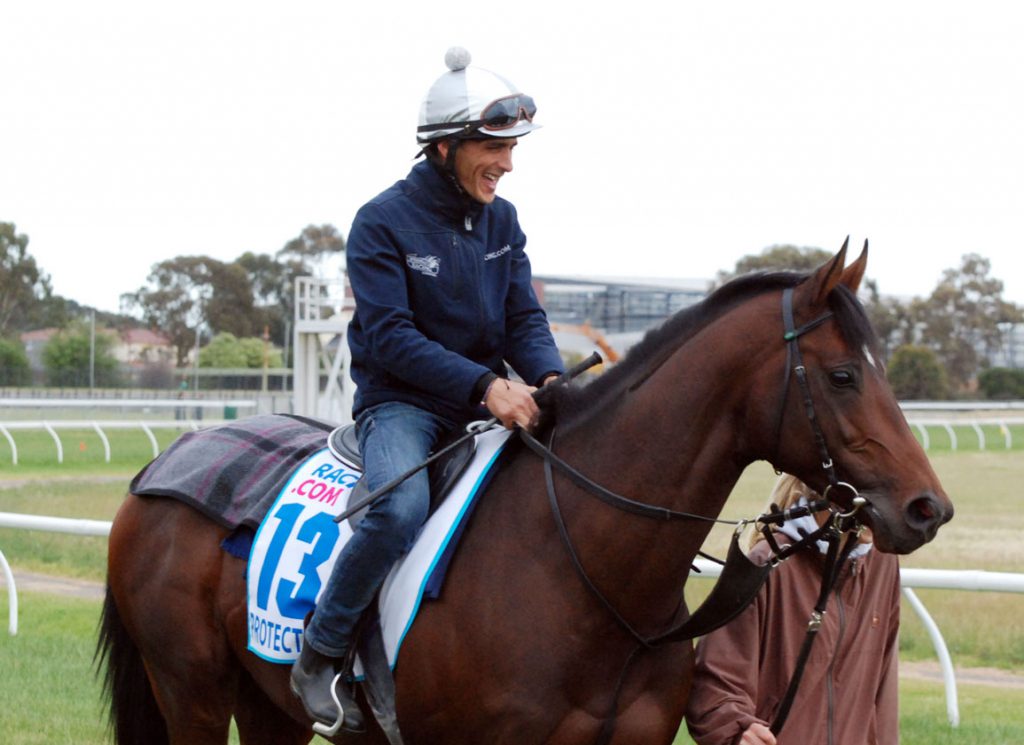
Protectionist, the sole German-trained winner of the Melbourne Cup | Emma Berry
Since then, raiders from Europe for the Melbourne Cup have become the norm. The first leg of Melbourne's 'Cups Double' has also become a regular target, with Europe's breakthrough in that race coming in 1998 when Ray Cochrane brought the Lady Herries-trained Taufan's Melody (Ire) home in front.
Weld and Dr Smurfit won the Melbourne Cup again in 2002 with Media Puzzle. Since then, four other countries have claimed the prize. Japan won it in 2006 with the Katsuhiko Sumii-trained Delta Blues (Jpn). Alain de Royer-Dupre and Mikel Delzangles won it for France in 2010 and '11, courtesy of Americain and Dunaden (Fr). German trainer Andreas Wohler supplied the hero in 2014, Protectionist (Ger). Godolphin won in 2018 with Cross Counter (GB), trained in England by Charlie Appleby. Furthermore, Weld's feat of supplying two winners has been matched by his compatriot Joseph O'Brien, courtesy of Rekindling (Ire) and Twilight Payment (Ire) in 2017 and 2020 respectively, both horses owned by Lloyd Williams..
Any overview of European achievers in the Melbourne Cup wouldn't be complete without mentioning Luca Cumani in dispatches, thanks to a run of narrow defeats, none closer than the pixel or two by which Bauer (GB) was edged out by the Bart Cummings-trained Viewed (Aus) in 2008. Another Newmarket-based trainer to have played a chief supporting role has been Ed Dunlop, whose ultra-genuine charge Red Cadeaux (GB) wrote his name into Cup history as the only horse to finish second in the race three times (in 2011, '13 and '14).
Nowadays, Australian owners and trainers seem intent on buying nearly all of the most likely European Cup prospects. Many were in action at Tattersalls last week and the recent domination of major Australian staying races by European-breds does not seem likely to end any time soon.
The internationalisation of the Melbourne Cup has been a gradual process with many heroes playing their part. Comedy King and Backwood both made special contributions, but none stand taller than Vintage Crop, Dermot Weld, Mick Kinane and Dr Smurfit. The significance of their breakthrough triumph 30 years ago will live forever as the day on which 'the race which stops a nation' became a race which the world watches.

The post The World Now Watches the Race That Stops a Nation appeared first on TDN | Thoroughbred Daily News | Horse Racing News, Results and Video | Thoroughbred Breeding and Auctions.
Source of original post
