Classic Notes: Japanese Pair May Have ‘Blowout’ Breeze On Wednesday

Horse: Arabian Knight  

Trainer: Bob Baffert 
Jockey: Flavien Prat
Morning Activity: Walked at the barn following final preparatory workout Monday.
Planned Activity: Will jog Tuesday, then gallop for the balance of the week. Will likely also school in the paddock on date TBD.
The Quote: “He came out of his workout well and is doing good.  We won't need to do much more with him before the race other than some light gallops.” – Bob Baffert     

Horse: Arcangelo

Trainer: Jena Antonucci
Morning Activity: Did not go to track and his connections said he would be withdrawn from the Longines Breeders' Cup Classic (G1).
The Quote: “We are going to be scratching. We, at this time, need more time. As we have said since Day 1, it is horse first. The journey that he brings us on is exciting and we are grateful for, but we are not going to get clouded by white noise and the excitement of it all. I need to fully figure out where he is and what is going on and I need time to do that. We have such great options out here, resources at our fingertips, so I need to lean into that to make sure that he is well. He is coming out of his skin right now and he looks phenomenal, but I'm not comfortable. The left hind foot is resolving, but we're still not 100 percent there and I want to know what it is. In order to figure out what it is, medications, those kinds of things, take racing out of the conversation. So we have run out of time in that regard.” – Jena Antonucci

Horse: Bright Future

Trainer: Todd Pletcher
Jockey: John Velazquez
Morning Activity: Galloped approximately 1 1/4 miles under exercise rider Hector Ramos.
Planned Activity: Will gallop approximately 1 1/4 miles Wednesday morning and visit starting gate. Time TBD.

The Quote: (Thoughts about the post positions of your Classic horses, Dreamlike and Bright Future?) “It was OK. What was it? 10 and 11? Now we dropped down (with the Arcangelo scratch) Vino Rosso I think it was 10 when we won (2019). You've got a good run to the first turn. Honestly, I wasn't too concerned about it either way.” – Todd Pletcher.

Horse: Clapton

Trainer: Chad Summers
Jockey: Tyler Gaffalione
Morning Activity: Backed up to the wire and galloped 11/2m under Rikki Ramdial.
Planned Activity: Same as Tuesday, but will also stand in the starting gate and school in the paddock.
The Quote: “The way the race is supposed to set up on paper, it could not be a better post (7). Arabian Knight has to work to get over, which is a dream scenario for us. We should be able to save a little ground early on in the race which is important when you are going 1 1/4 miles.” – Chad Summers 

Horse: Derma Sotogake (JPN)

Trainer: Hidetaka Otonashi
Morning Activity: For the first time, he was alone when he went to the track. Entering on the three-eighths-pole gap, he jogged back to the chute, warmed up in the chute and then switched riders from Masa Segawa to jockey Christophe Lemaire. He then had the easiest of breezes (a glorified strong gallop), untimed, coming down the stretch with good energy and galloping out evenly around the bend.
Planned Activity: Possible blowout breeze on Wednesday.
The Quote: “He went very well. He was grabbing the ground well and feels strong. I liked how he felt.” – Christophe Lemaire, jockey

Horse: Dreamlike

Trainer: Todd Pletcher
Jockey: Jose Ortiz
Morning Activity: Galloped approximately 1 1/4 miles with exercise rider Humberto Zamora
Planned Activity:  Will gallop approximately 1 1/4 miles and will visit starting gate. Time TBD.
The Quote: (Thoughts about the post positions of your Classic horses, Dreamlike and Bright Future?) “It was OK. What was it? 10 and 11? Now we dropped down (with the Arcangelo scratch) Vino Rosso I think it was 10 when we won (2019). You've got a good run to the first turn. Honestly, I wasn't too concerned about it either way.” – Todd Pletcher

Horse: Missed the Cut

Trainer: John Sadler
Jockey: Luis Saez
Morning Activity: Galloped 1 1/2 m on main track with Juan Leyva up.
Planned Activity: Similar to Tuesday.
The Quote: “I like the post (4). He will be coming from off the pace and he won't be wide.” – John Sadler

Horse: Proxy

Trainer: Mike Stidham
Morning Activity: Had an easy morning, his first since arriving at Santa Anita on Monday from Kentucky. Jogged a circuit and promptly returned. Trainer Stidham expected to be on the grounds Wednesday.
Planned Activity: Expected to jog and gallop routinely on Wednesday.

Horse: Saudi Crown
Trainer: Brad Cox
Set: N/A
Morning Activity: Jogged at Santa Anita after arriving Monday from Kentucky.
Planned Activity: Will gallop Wednesday.

Closer Look: Aguilar a Key to Secret Weapon's Success

Ever since his rise from Breeders' Cup newbie in 2016 to entering the event in 2023 as one of the most successful trainers in Breeders' Cup history, trainer Brad Cox has been quick to recognize his entire team and their importance to his operation. One of those key team members and one could even call him the “secret weapon” is groom Darwin Aguilar.

Aguilar has been working for Cox for eight years and said he got the job because one of his sisters was a hot walker for the barn and told him how much she liked it.

When asked what he liked most about working with horses, Aguilar said, “looking at my horses in their stalls and seeing that they look good. And, then taking them to the paddock and looking at them. I like seeing they are doing and looking good.”

Cox has entrusted Aguilar with many of his top horses, including two-time Breeders' Cup Distaff (G1) winner and champion Monomoy Girl and 2020 Breeders' Cup Juvenile (G1) winner Essential Quality. This year, his horses include Saudi Crown and Wet Paint.

“Monomoy Girl is still one of my favorite horses,” Aguilar said. “I sometimes go visit her and her new colt. And, watching her win the 2018 Breeders' Cup Distaff is one of my favorite racing memories.”

“He's a good horseman, and he's just a good person period,” Cox said. “But, he's a very, good horsemen. He's very aware of what's going on with his horses and, always if there's an issue, he not only brings it to my attention or the assistant's attention, but he's also knowledgeable and knows what to do. When there is an issue whether it be a puffy ankle or a bruised food or skin irritation or whatever it may be, he's very aware of what's going on. He loves horses, he dedicated, loyal, a top class employee. They don't get any better. He's one of the best.”

As for Aguilar, he's very modest about his role in Cox's success. His best advice for keeping the horses looking so good is “when you see them poop, go in with a muck basket and take it out.”

Horse: Senor Buscador

Trainer: Todd Fincher
Jockey: Geovanni Franco
Morning Activity: Galloped 1 1/2 miles under exercise rider Dennis Means.
Planned Activity: Similar to Tuesday. Trainer arrives Wednesday night.
The Quote: “I like the post (9). – Jockey Geovanni Franco.
“The post is good and the horse is good too, so we are happy at the moment.” – Todd Fincher

Horse: Ushba Tesoro (JPN)

Trainer: Takagi Noboru
Set: 6:45 a.m.
Morning Activity: Entered from the three-eighths-pole gap, jogged back to the chute, galloped about 1 3/4 miles and then schooled in the paddock for about 20 minutes before returning to the barn.
Planned Activity: Expected to have a blowout breeze on Wednesday and school at the gate.

Horse: White Abarrio

Trainer: Richard Dutrow Jr.
Jockey: Irad Ortiz, Jr.
Morning Activity: Galloped 1 1/2 miles under exercise rider Emily Ellingwood.
Planned Activity: Will go to the track between 6:30 and 6:45 to gallop 1 1/2 miles, then visit the starting gate.

The Quote: “My brother wanted an outside post. That's what he would have liked. I haven't talked to him about the post position (2 with the scratch of Arcangelo) yet. It's not the outside but I just feel like that, it's my opinion, that him and Irad are going to have to work that out. He's so durable that wherever he's at he's fine. Wherever his early position is he'll be able to work things out. He's got such a turn of foot that I just don't think that it's going to be a problem. Some horses can't regroup. He can regroup.” – Chip Dutrow, Richard's brother and assistant.

Horse: Zandon

Trainer: Chad Brown
Morning Activity:  Galloped a mile and a half.
Planned Activity: Will gallop a mile and a half.
Closer Look: “He looked super. He seemed to like the track. He worked a couple days ago and just had a walk day when he shipped and just trotted a bit yesterday, once around. It was his first day back out of a work, so he just grabbed the bit a little bit. Not bad, but he'll settle down tomorrow and he always seems to settle well as he gallops through the week.” – Chad Brown

The post Classic Notes: Japanese Pair May Have ‘Blowout’ Breeze On Wednesday appeared first on Horse Racing News | Paulick Report.
Source of original post

2024 Kentucky Race Dates Set

The Kentucky Horse Racing Commission (KHRC) on Tuesday approved a Thoroughbred racing calendar for 2024 that largely mirrors the template that has been in place for the past three seasons.

The board's unanimous approval included a conditional “optional dates” placeholder for Ellis Park's July and August calendar that has to be solidified into a three-dates-per-week commitment before the end of this year.

The gaming company Churchill Downs, Inc. (CDI), which owns Ellis, Churchill Downs Racetrack, and Turfway Park, had requested additional time to figure out if swapping Fridays for Mondays will be feasible for 2024.

So Ellis got awarded 18 mandatory dates (which will be run on Saturdays and Sundays) and 30 optional dates. Waqas Ahmed, the KHRC's executive deputy director, told commissioners that he expected Ellis would eventually end up picking up seven more mandatory dates from that optional allotment of 30.

“The obvious goal at Ellis is to run three days a week,” Gary Palmisano, Jr., CDI's  executive director of racing, said during the KHRC meeting. “As we approached the race dates application deadline, the idea was tossed around of potentially running Saturday, Sunday, Monday rather than [this season's] Friday, Saturday, Sunday.”

Leaving that placeholder for now, Palmisano said, “is going to allow our team a little bit more time to conduct some due diligence [and] make sure the horsemen are on board; make sure test barn workers can get there; make sure we can actually cover potential Monday racing.”

CDI must notify the KHRC by Dec. 31 as to how it will satisfy the commission's condition that calls for “at least” three days of racing per week at Ellis in 2024.

Assuming Ellis ends up with 25 mandatory dates, the total number of race dates in Kentucky will rise slightly in 2024 compared to the assigned dates for 2023, up from 211 to 215. The total mandatory dates for the other tracks are Churchill (83), Turfway (67), Keeneland (33) and Kentucky Downs (7).

Here's a chronological look at the state's 2024 Thoroughbred schedule:

Turfway: Jan. 3-Mar. 30 on a Wednesday-Saturday evening schedule.

Keeneland: Apr. 5-26 on a Wednesday-Sunday schedule.

Churchill Downs: Apr. 27-June 30 on a Wednesday-Sunday schedule, with exceptions on GI Kentucky Derby week and the Memorial Day holiday week.

Ellis Park: July 4-Aug. 27 with Saturdays and Sundays anchoring the schedule, plus additional dates to be announced and an opening-day Thursday card on Independence Day.

Kentucky Downs: Aug. 29-Sept. 11 for seven dates with three “optional” dates in case of rainouts.

Churchill: Sep. 12-29 on a Wednesday-Sunday schedule.

Keeneland: Oct. 4-26 on a Wednesday-Sunday schedule.

Churchill: Oct. 27-Dec. 1 on a Wednesday-Sunday schedule.

Turfway: Dec. 4-28  on a Wednesday-Saturday evening schedule with a Christmas Day  exception.


The post 2024 Kentucky Race Dates Set appeared first on TDN | Thoroughbred Daily News | Horse Racing News, Results and Video | Thoroughbred Breeding and Auctions.

Source of original post

Dave Johnson: What a Performance!

Maybe our sport is still capable of bringing together four such people round a dinner table. But you have to doubt it.

“They were comparing the theaters that they had played on the Vaudeville circuit,” Dave Johnson recalls. “Which had the best backstage dressing rooms? Which had the best eating places, that you could walk to still with your costume and makeup on?”

These memories were being shared between Johnson's mother and Fred Astaire. Moreover, both of those who were listening on, fascinated, had remarkable stories of their own: Astaire's wife, the former jockey Robyn Smith, and Johnson himself-the man whose call, for those present at the 1973 Belmont S., will forever be synonymous with one of the greatest performances in the story of the breed.

Whether or not the world has moved on, it has certainly turned plenty since. Next Saturday, indeed, is the 50th anniversary of Secretariat's final start. And this dinner itself took place over 40 years ago, in Los Angeles, during Johnson's tenure as the caller at Santa Anita.

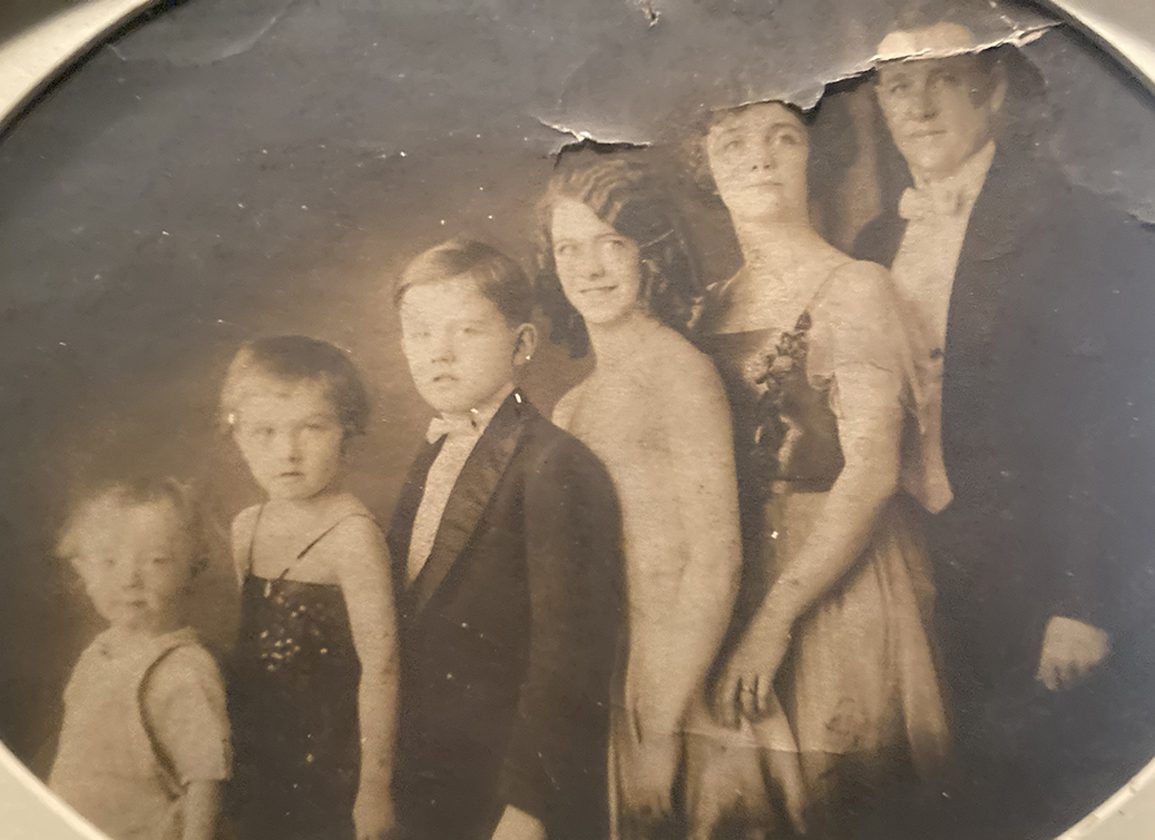
“Afterwards Fred sent my mother an autographed picture,” Johnson recalls. “I think things like that helped keep her alive. My dad died early, he was only 52. But my mother passed away at 93. I have a picture of her as a dancer in 1930, when she was nine or so, with the whole McLeod Troupe on the Orpheum Circuit: my grandfather, my grandmother, their oldest son who was an attorney, then a daughter who was in the chorus, and then my mother, and then baby Jackie, who was about four or five.”

It was a different world, clearly. His grandparents, indeed, were blackface comedians. But the timeless dividend, for Johnson, was to be raised on the stories of a nomadic community, full of incident and character; and, moreover, with a genetic flair of his own. Because it was performance, of course, that united all four of those gathered round the table at the Palm that night.

McLeod Troupe on the Orpheum Circuit: Johnson's mother is second from the left next to brother Jackie | Dave Johnson

“Robyn was much younger than Fred, but each was equally dependent on the other,” Johnson recalls. “Robyn's a wonder. She was a terrific rider, but a great person. Still is. And of course Fred was just a hell of a guy. Loved the game. He would get emotional about his horses. If one got claimed, just like Burt Bacharach, he would buy it back.

“At one point during that dinner Fred leaned across the table to me, just so serious, and I thought, 'Oh gosh, what's coming now?' And he said, 'Dave, I really have an important question to ask you.'” Johnson pauses and chuckles. “'Dave,' he said. 'How do you win the Pick Six?'”

Now here we are, on the opposite coast, in the Manhattan apartment that Johnson even then called home. (He bought it 51 years ago.) And we're wondering what has happened to our game since; how to retrieve the glamor of those days, when the golden age of the silver screen retained at least a copper glow; when Marje Everett ran Hollywood Park and made sure that friends like Elizabeth Taylor would show up for the inaugural Breeders' Cup.

Johnson knows that horseracing today is a very different world from when his mother taught him, aged just four or five, how to read the Racing Form: they were on the train from St. Louis to New Orleans, in the last months of the war, visiting his father's military posting.

“The arc of what has happened, in racing, seems so evident to me,” Johnson says. “I first started to go to the races as a very young guy. My family was never in the game as owners, trainers, anything. But we all loved to go to Fairmount Park, over the river from St. Louis, and it was always a wonderful holiday.

“In 2023, racing is a television production. There's no longer people at the track, or only very few. For the Derby, Oaks, the Breeders' Cup, Royal Ascot, a destination like Saratoga or Keeneland: yes. But on a day-to-day basis, year round, it's a television production. So what we have now, with some racing executives, is people making decisions about television without knowing anything about broadcasting. Of course, some are terrific. I've worked for good and bad; and it's no different on the TV side, some know their racing, some don't.”

At 82, naturally enough, Johnson doesn't find it quite so easy to get around. But he remains fully engaged, and feels due gratitude for precisely the reach of all the broadcasting platforms that are available today. Shortly before welcoming TDN, indeed, he had already been watching British racing on his phone over a morning coffee. But breadth of access does not equate to breadth of engagement.

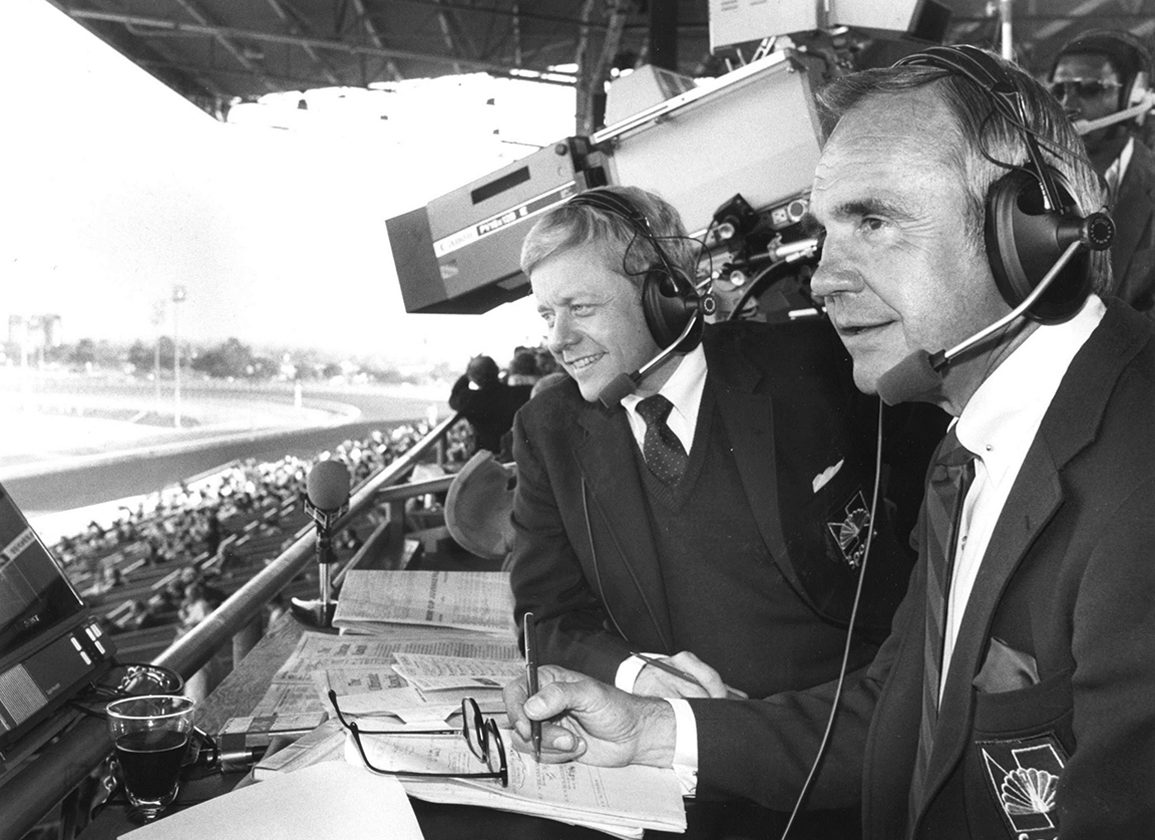
Dick Enberg and Dave Johnson at the 1984 Breeders' Cup | NBC Sports

One of the things that sustained the sport's popular heyday, he feels, was simply the way horses were bred or trained (or both). Johnson wonders whether longer intervals between races have partly become standard because of medication levels; less speculatively, he deplores the sensitivity of trainers to their win percentages, above all now that so many potential runners are concentrated in so few hands. Johnson remembers when even someone like Woody Stephens would have no more than 40 horses.

“I knew Woody very well, and his assistants Sandy Bruno and David Donk,” Johnson recalls. “I knew that whole barn. Wonderful people. And Lucille, Woody's wife. That was before  the age of flying horses around, which was really started by Wayne Lukas. I mean, how would you begin to know 200 horses? I don't know how they do it.

“Woody was very funny. And very self-centered! 'Let's see what time it is. Oh, by the way, did I tell you that Laurel gave me this watch for winning five Selimas?' But he was a hell of a horse trainer, wasn't he? I mean, a real hardboot. Hardworking, old school. A throwback. Owners had some input, too, but the trainers ran their horses where they thought. I mean, Woody is a perfect example: winning the Met Mile with Conquistador Cielo Monday, and winning the Belmont on Saturday. I think there are some traditions which should stay, including the Triple Crown. To move the Met Mile to the Belmont undercard, that hurt me. Maybe I'm old school too.”

But maybe that's just what we're missing-the sense of participation that spreads down from the barns to the public. Horses weren't just financial or career devices, whether for breeders or trainers: they put on a show.

After all, Johnson himself would never have got started without an innate sense of theater.

“I called my first race in '65 at Cahokia Downs,” he recalls. “And it's like the script of a B movie. I was 24, working for a law firm. I'd do wills, I'd go out and take pictures of where an accident happened, I'd go and talk to a guy in prison. Anyway we had a box at the track, for the clients, and that evening I'd gone over there to wheel a horse in the double. And the announcer, Todd Creed, became ill. A stretcher went by, behind the box, and an announcement was made: 'Ladies and gentlemen, there'll be no more announcing tonight. Please watch the tote board. Thank you, and good night.'

“Now, I knew the general manager, Ann Detchemendy. She was an Ethel Merman type: a brash, wonderful lady. She'd say to me, 'Hey sweetheart, you want to split a double with me?' 'Oh yes, Miss Ann, I'd love to.' Her office was right behind, so I went in and said, 'Miss Ann, I could call the races for you. I can memorize the 10 points of the Yalta Agreement, so I can certainly manage the seven horses in this race.'”

Miss Ann picked up the phone, there was some back and forth, and she hung up. “Thanks, Dave, but the announcer's son is going to fill in.”

“That was Todd's son, Mike,” Johnson recalls. “So he's in there with the engineer, and the 'musician' who would put the stylus on the record to play the bugle. (They had to have a member of the Music Union do that for every race!) And so the three of them stood there as the horses broke out of the gate.”

“That's number five going to the lead,” says Mike.

“I don't think it's the five,” interjects the engineer.

Then a third voice: “I think it's Blue Boy.”

“And you heard the three of them argue for five furlongs,” Johnson says. “It was hilarious. Immediately after the race, Miss Ann came into the box. 'You're next!'” Johnson pauses and smiles. “I'd told my friend Tony Marino that I was going over to the track, but he was going to have some dinner first and drive over later. So he parks his car, and as he's coming through the parking lot he hears the fourth or fifth race being called. And he said, 'Geez, that sounds like Dave.'” Johnson shakes his head and chuckles. “And that was it. And here we are, almost 60 years later.”

Johnson did other stuff around the track, too: booked group parties, wrote stories, did selections for both the local newspapers. (They had to be different!) He carried on working during the day and called races at night. Meanwhile he was still reading history at Southern Illinois University, albeit graduation had to be squeezed in between the fourth and fifth races one night. “And the people, I loved the people,” he stresses. “That's what is so wonderful about working at the track. They're like family. Because you spend more time with them than you do at home.”

Calling a race just came naturally: that performance gene coming through. Having provided cover on other, less extempore occasions, Johnson took over at Cahokia and Fairmount when Creed went to Ak-Sar-Ben. Then, in 1970, he got the NYRA gig on the retirement of Fred Capossela. Secretariat was foaled that year, and so the wheel of destiny turned.

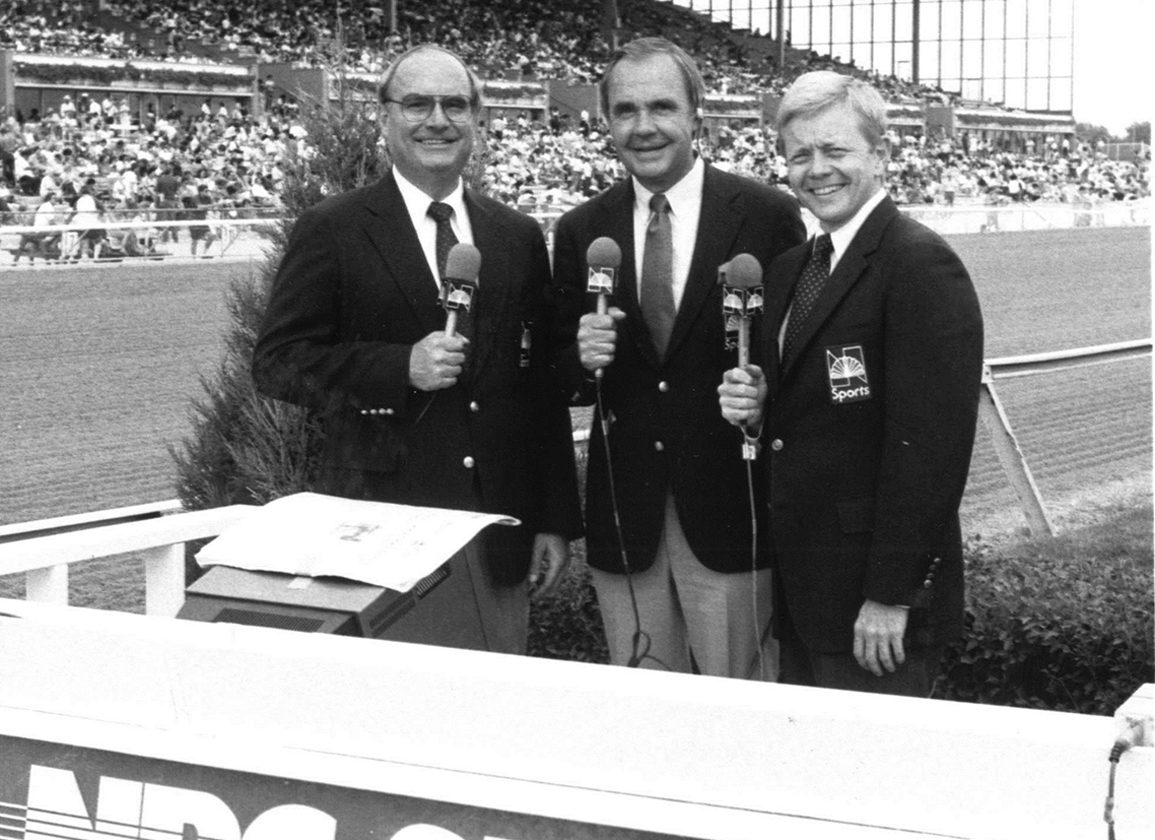
Pete Axthelm, Dick Enberg and Dave Johnson in 1984   | NBC Sports

With time, Johnson's trademark call (“And down the stretch they come…”) became literally that: he was able to charge its unauthorized use to charity. But however entertaining his style, he always felt that his first priority was to inform.

“Say what you see,” he says. “That was my only job. All the extraneous B.S. of the announcer coming on, and telling who they like, that's somebody else's job.”

That said, even the informing was constrained in the old days. “At the track, you had to shut the microphone off at the 16th pole,” he recalls. “That was because of a federal law called the Wire Act. They didn't want the result to get outside the confines of the racetrack, for fear that illegal bookmakers would churn the money. Prior to the first race, the string of payphones at Belmont Park would be locked up-and they'd only unlocked after the ninth.”

There was one time, admittedly, when Johnson finished the call too early even for the strictures of the Wire Act-in a race at Cahokia that he called as a sprint when it was really a route. (“I saw these jocks with the brakes on,” he recalls. “And I thought, 'Oh my God, it's a fixed race!' They went around the clubhouse turn, I hung up the microphone off, and the engineer said to me, 'Dave, they go around again!'”)

Not all change is for the worse, plainly.

“No, that's true,” Johnson acknowledges. “One time Angel Cordero was going for his fourth win of the day. And early in the stretch I said, 'And Cordero moves to the front.' And then at the 16th pole I said who was in front, who was second, shut it off. [Next day] my boss Pat Lynch called me in and said, 'I got a memorandum. From a board member. “Please inform Mr. Johnson, it's horse racing-not jockey racing!” The mentality… I mean, see how much it's changed?

“But if you listen to Fred Capossela-a  wonderful man, just a great human being-his calls were never jockey-, or trainer-related. But it was all very good. And that's our job: to identify, and give the margins, and who's moving. And from the top of the stretch, maybe only concentrate on the horses in contention.”

One way or another, however, Johnson showed that inherited flair for performance. And, in time, that actually extended as far

as playing roles on stage and screen.

Back in St. Louis, for instance, he performed in musicals like My Fair Lady, Can-Can and Unsinkable Molly Brown in front of 12,000 at the outdoor theater in Forest Park. Above all, however, Johnson has adapted his racetrack nose for a wager to investment in Broadway productions.

“That also came from a St. Louis connection,” he says. “Rocco Landesman, who I knew from the racetrack 20, 25 years ago. Owned six theaters here in New York, called the Jujamcyn Theaters. We had always talked about The Producers, which was one of my favorite films, with Zero Mostel. So when he said there was a chance he might do it as a stage play, I said, 'Count me in.'”

Johnson had already backed a theatrical winner in London, a city he would get to know very well through attending 24 consecutive Royal Ascots. In 1983 he saw the West End debut of Michael Frayn's Noises Off, and virtually camped on the producers' doorstep.

“I begged them to take my money!” he says. “And it was a big success, mainly because they sold the film rights for $5 million. But I didn't invest in another show until The Producers, nearly 20 years later. Rocco came up to me at the memorial service for David Merrick and said, 'I think we've got Matthew Broderick.' And that was it. Biggest bet I ever made. But it paid very well.”

The show opened at the St. James Theater on 19 April 2001, and ran for 2,502 performances, harvesting a record 12 Tony Awards. And Johnson remains immersed in that cosmopolitan community, still telephoning and corresponding with folks from behind and in front of the footlights. Asked what draws him to their world, his answer is succinct and emphatic.

“Talent, and honesty,” Johnson declares. “I have a lot of friends whose talent I really admire. They give it all. But it's not just the performing, it's everything that goes into making any of these things: a television show, a commercial, a stage show, a movie. Because, really, can't you see through people that are phony? I can, at least I think I can. So it's not just talent, it's also the honesty: people, like Rocco, who always do the right thing. I don't want anything to do with anybody who isn't above board, who's shady, who cuts corners.”

But come on, Dave, how does that account for where you spent the rest of your time? You must have seen a few phonies on the racetrack.

“Oh, yeah!” he says with a chuckle. “And in the management of racetracks, too.”

This, in fact, is one of his pet vexations: track executives who didn't come up through the game; people who would never go to the races on their day off. But the beauty of Johnson's own story is the way he has straddled the margins between these two cosmopolitan, theatrical worlds: the stage and the Turf.

“There's only one job at the racetrack that is a performer,” he reflects. “As announcers, we are performers. If you're doing it on television, you're not doing it for the crowd. Yeah. Isn't that funny? Only one job.

“And it's a once-in-a-lifetime thing. In anything, like a movie, that's going to be on videotape or film, you can change it. You can do take two, whatever. At the racetrack, you get one shot, and it'll never be the same. Ever. Run the same horses, your call is never going to be the same.”

What luck, then, that he took his cue that night back in 1965: an unscheduled audition for the rest of his life.

“There's a little article in The New York Times called Tiny Love Stories,” Johnson says. “It has to be 100 words or less. And so many times it's about people who met their mate in a cab, or on a corner, or in a rainstorm. I love those stories. It's the same kind of thing. What if I hadn't gone to the track that evening? Who knows? How lucky was I? And then I get to see Secretariat, Ruffian, Affirmed. I really have been lucky. I have no regrets. I've had a great career, and a wonderful life. I love the line in the movie Braveheart, where Mel Gibson says: 'Every man dies. But not every man lives.' And boy, have I lived.”

The post Dave Johnson: What a Performance! appeared first on TDN | Thoroughbred Daily News | Horse Racing News, Results and Video | Thoroughbred Breeding and Auctions.

Source of original post

Get Smokin To Be Scratched From Turf, Point For 2024 Campaign

Mark Casse-trained Get Smokin, a multiple graded stakes-winning 6-year-old gelding by Get Stormy, will be scratched from Saturday's Grade 1, $4 million Longines Breeders' Cup Turf. Ironhorse Racing Stable, who has campaigned Get Smokin in partnership with BlackRidge Stables, Saratoga Seven Racing Partners, and T-N-T Equine Holdings, posted on the X social media site the following:

“Unfortunately, Get Smokin had a very minor setback in his preparation for the Breeders' Cup Turf and Mark Casse and the owners have made the decision to scratch him. We will let him have a winter break and prepare for a 2024 campaign.”

Get Smokin was coming off a front-running victory in the G2, $1.7 million FanDuel Turf Cup Stakes at Kentucky Downs on Sept. 9. The win was his sixth from 27 lifetime starts. He previously won the G2 Hill Prince in 2020 and the G3 Tampa Bay  Stakes in 2021.

A 30-1 longshot on the morning line for the star-studded Turf, Get Smokin was to be ridden by Fernando De La Cruz.

Get Smokin was bred in Kentucky by Hurstland Farm and James Greene Jr.

The post Get Smokin To Be Scratched From Turf, Point For 2024 Campaign appeared first on Horse Racing News | Paulick Report.
Source of original post

Verified by MonsterInsights
