What The L Is Lymphangitis?

There are still so many things that baffle veterinarians and researchers, including how to manage chronic leg swelling called lymphedema that can lead to many more problems for the horse's health and comfort.

Lymphedema is a painful condition that occurs when the soft tissues retain fluid left behind after the cardiovascular system sends blood to the tissues and organs. Normally, the lymphatic system collects lymph (the remaining fluid) and returns it to the heart via a network of lymph vessels and lymph nodes. When something disrupts the lymphatic system's process, lymph collects in the appendages, thus causing swelling.

There are many causes of lymphedema in people, but the most common causes are surgical removal of the lymph nodes to treat cancer and infection. In horses, infection is by far the most common cause of lymphedema and is typically referred to as lymphangitis.

So, what is lymphangitis?
Lymph fluids are important to remove waste and toxins from the body's tissues.

Lymphangitis is often called different things: vasculitis, cellulitis, a staph infection or “big leg disease.” This horse disease is actually a recurrent bacterial infection. While it is identified by swollen legs, it is very different from a horse that is “stocked up.”

Stocking Up – non-painful swelling of the lower leg in two or more legs (typically the hind legs). Seen more as a minor issue, found in horses that have experienced a drastic decrease in exercise, perhaps due to an illness, weather or injury. It typically is resolved with light wrapping and upon return to exercise, even if it's just hand walking.

Lymphangitis – abrupt and intensely painful swelling of an entire single leg (again, typically a hind leg), accompanied by an elevated temperature (102-105 degrees F). The horse will exhibit more signs of discomfort and pain: depression, trembling, reluctance to move, rapid breathing, and sweating.

Lymphangitis is still a bit of a mystery in terms of how and why it occurs and ways to prevent it. The cause most often found is due to bacteria getting into the leg from a slight cut or abrasion. According to the AAEP, the bacteria then race to multiply:

“The bacteria reproduce quickly, causing inflammatory reactions of heat and swelling as the body attacks its invaders. The lymphatic system drains fluid from the leg, filtering it through lymph nodes that try to remove foreign pathogens (disease-causing organisms). The lymph nodes are overwhelmed and can, themselves, become infected. Lymph ducts and blood vessels become damaged and swollen and lose elasticity, with blood and lymph pooling on top of the one-way valves. The heart continues to pump fluid in, but the exits are blocked.”

[Story Continues Below]

The skin around the leg, which already lacks musculature, becomes tightly stretched as the leg swells, thus causing fluid seepage. That fluid can then burn the skin.

“Anything that can introduce bacteria under the skin and any sort of infection can lead to cellulitis and lymphangitis,” said Dr. Lauren Schnabel, professor of equine orthopedic surgery at North Carolina State University. “Wounds and insect bites can occur any time of the year in any climate, but moist humid environments are particularly a challenge. If there's any break in the normal skin barrier like happens with scratches, they'll be more likely to develop cellulitis and lymphangitis.”

Treatment for lymphangitis
Veterinarians will prescribe aggressive antibiotics and anti-inflammatories to combat the infection while also administering medication such as phenylbutazone and flunixin meglumine for the pain and swelling. While most swelling is tended to by cold therapy and bandaging, these treatments are often ineffective or only work for a short time before the swelling returns.

The biggest tool for treating lymphangitis is movement, which is difficult when the leg is so painful. So, what can be done?

In humans, the only way to encourage drainage for the lymphatic system is by lymphatic drainage massage. This type of gentle massage encourages the drainage of the lymph nodes and movement of the lymph fluids around the body. Humans can utilize lymphatic drainage massage, either manually or with a device, to move the fluid to be excreted from the arms and/or legs.

So how does this apply to horses?

Tune in next week to learn how a new treatment for lymphangitis might be the start of a revolution in horse healthcare.

The post What The L Is Lymphangitis? appeared first on Horse Racing News | Paulick Report.

Source of original post

Kirkpatrick & Co. Presents In Their Care: Cristina Bonilla’s Dream To Ride Lives On

Dreams die hard. So it is with Cristina Bonilla.

She did not grow up around horses. She came to the racing game late, at 24. She is 37 now. She estimates she has suffered at least four concussions, including one in a horrific accident at Arlington Park in 2021, and tells of significant memory loss.

And yet Bonilla, a 5-2, 109-pound exercise rider for trainer Domenick Schettino at Belmont Park, never loses sight of her dream. She yearns to be a jockey again.

“It's the only sport where men and women compete at the same level. I love that,” she said. “It makes you work harder. It makes you work way harder.”

Bonilla earned a bachelor of fine arts degree from the School of the Art Institute in her hometown of Chicago. She was working in marketing when she read that no female jockey had ever won the Kentucky Derby. She kept turning over that fact in her mind until it became life-changing.

She called her older sister, Crystal. “What do you think if I become a jockey?”

Crystal answered the question with a question. “What?”

Calls were made and Bonilla gave up everything to leave Chicago for New York, where she met trainer Gary Gullo at the Belmont stable gate.

“Are you homeless?” he asked.

“Yeah, pretty much,” Bonilla responded.

He called fellow trainer Dominic Galluscio, who hired her as a hotwalker and allowed her to stay in a room at his house with the provision that she work hard. She fulfilled her pledge for six months but was determined to start her riding career.

Galluscio contacted Jimmy Miranda and arrangements were made for Bonilla to work for the retired jockey in Orlando. Bonilla learned the basics by riding Quantum, a retired Thoroughbred, in a round pen for two months. Although it was a slow process, she worked her way up to galloping horses.

Cristina Bonilla's painting of Randy Romero brought the two together

Bonilla also sold artwork online, including a portrait of Randy Romero that attracted Romero's attention and inadvertently brought the two of them together. He asked her to send videos of her on horseback. He was sufficiently impressed that he agreed to become her agent and they went to work at Evangeline Downs in Louisiana in 2017. She was 31.

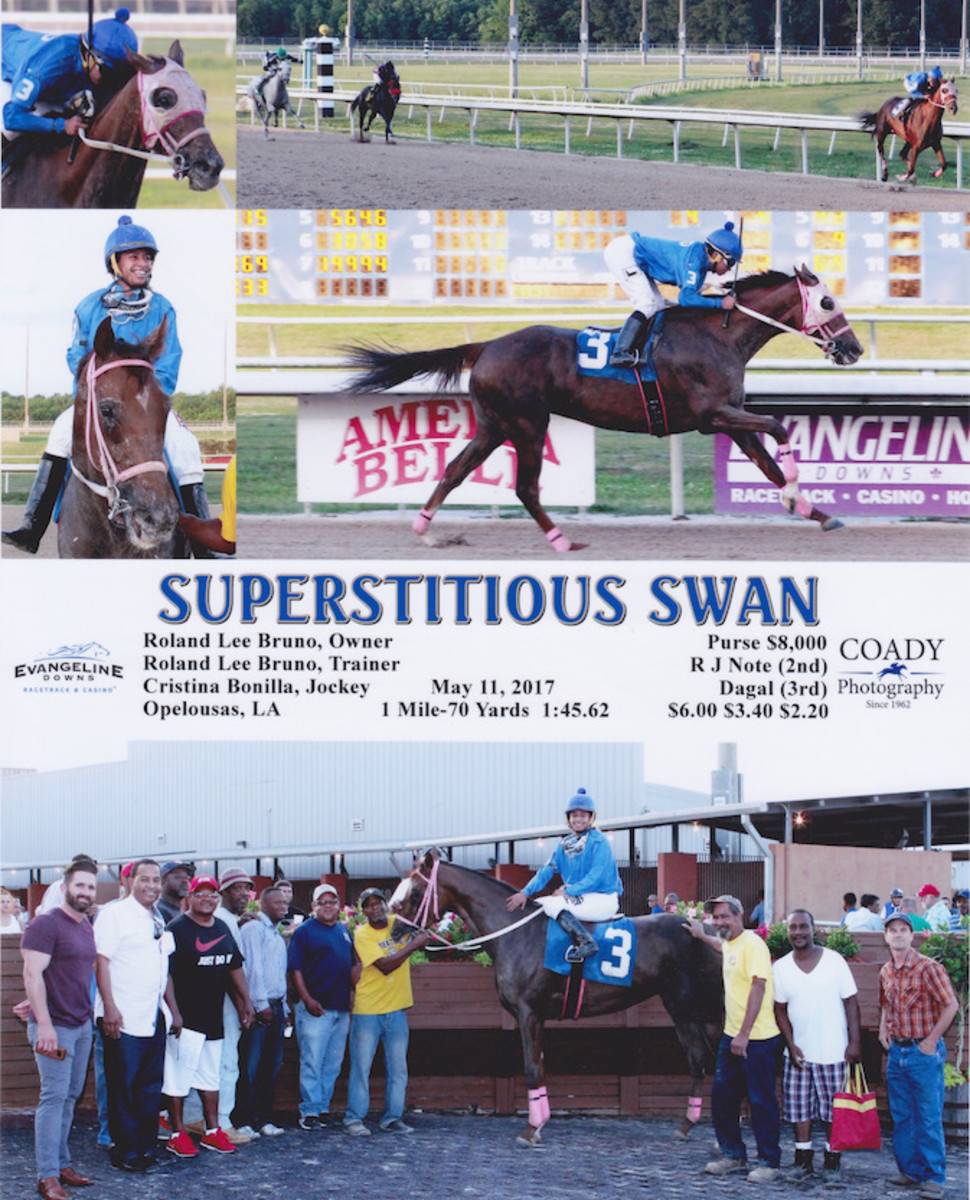
That led to one of the best days of Bonilla's life. She won with her sixth mount, a runaway 11-length victory at a mile and 70 yards aboard Superstitious Swan. “I remember dropping my reins mid-stretch because I was so excited,” she said.

Her return to the jockeys' room was equally memorable. In keeping with tradition, she was pelted with eggs, powder, you name it. “They got me really good,” she said, “and they put it on TVG.”

Romero died two years later at the age of 61 after battling numerous health issues.

Cristina Bonilla and the late Randy Romero

After Evangeline, it was on to Fair Grounds and eventually Arlington Park with its Polytrack surface. She believes the Polytrack contributed to one of the worst days of her life. It was the summer of 2021 and she was aboard an ill-fated horse named Charlie's Heir that suffered a heart attack as they approached the wire.

“When they have a heart attack, they give you no warning, no sounds, not even slowing down,” Bonilla said. “It's just like bam, out of nowhere. He goes to the left, I go to the right.”

She landed head first on a track she described as unforgiving. “I love riding on the Poly,” she said, “but it's not fun to fall on.”

She woke up in the hospital three days later, not recalling how she got there. Five weeks later, she was galloping for trainer Wayne Catalano and soon won a race for him. She has been with Schettino for most of the last three years and believes she has made great progress there.

“I feel great,” she said. “The only thing is remembering stuff. I feel like it's a lot less than before.”

She has developed a strong relationship with Schettino and spends holidays with his family. He values her ability to read horses, to elaborate on what she is feeling beneath her each morning and to calm nervous fillies.

“She's trustworthy and to me that's a lot,” the trainer said. “That's my number one thing I think about is trust. I know that they're looking out for these horses. She loves the horses and loves what she does.”

Bonilla also has gained experience as a veterinary assistant. “It's something to fall back on,” she said, “because you never know what your next injury is.”

According to Equibase, she has ridden competitively just once this year, finishing last of six aboard 41-1 Bear's Correct in a one-mile maiden claiming race at Aqueduct on March 3. In 392 lifetime starts, her record stands at 17-30-31 with earnings of $346,183.

Bonilla is doing everything possible to hire an agent who can create opportunities for her in New York. She said she is willing to pay 40 percent of her earnings to that person for the first year. As much as Schettino cares about Bonilla, he is skeptical about that plan.

“For her to ride again and stay in New York, hopefully she'll get a chance. But New York is a tough place for her to fulfill her dream. That's just my opinion,” Schettino said. “New York is a tough place for a lot of people to fulfill their dreams. You're in the top place with the best of the best.”

And yet, through it all, Bonilla is undeterred.

Tom Pedulla, 2022 recipient of the Walter Haight Award from the National Turf Writers and Broadcasters, wrote for USA Today from 1995-2012 and has been a contributor to the New York Times, Los Angeles Times, Blood-Horse, America's Best Racing and other publications.


If you wish to suggest someone as a potential subject for In Their Care, please send an email to info @ paulickreport.com that includes the person's name and contact information in addition to a brief description of the individual's background.

The post Kirkpatrick & Co. Presents In Their Care: Cristina Bonilla’s Dream To Ride Lives On appeared first on Horse Racing News | Paulick Report.

Source of original post

Dubai Racing Carnival to Offer Free Stabling To Overseas Runners

Stabling for runners in the International Quarantine Stables traveling from overseas for the upcoming season of the Dubai Racing Carnival will be free, the Dubai Racing Club announced on Tuesday. The season kicks off on Friday, Nov. 10, with the first of 14 meetings at Meydan Racecourse.

Further incentives, including travel, will be decided by a special committee on a horse-by-horse basis. Stable staff staying in the quarantine facilities can do so for a fee of AED1000 per month (US$272).

These incentives are in addition to the new Dubai World Cup Bonus Race Scheme–nine races guaranteeing starting places at the Dubai World Cup meeting, with bonuses of more than $4million. The bonus, 10% of the prize-money for the corresponding race on the Dubai World Cup card, will be paid if the horse wins both races.

“We're really excited about our new-look season. The new programme is aimed at encouraging owners and trainers to base their horses here throughout the winter, allowing them to make use of our five star facilities and wonderful climate,” Major General Dr. Mohammed Essa Al Adhab, Executive Director of Dubai Racing Club, commented.

The Dubai Racing Carnival precedes the $30.5million Dubai World Cup meeting, which takes place on Saturday, Mar. 3, 2024.

The post Dubai Racing Carnival to Offer Free Stabling To Overseas Runners appeared first on TDN | Thoroughbred Daily News | Horse Racing News, Results and Video | Thoroughbred Breeding and Auctions.

Source of original post

Equine Industry Survey Overload – What You Need To Know

In recent months, several surveys have been circulated regarding the U.S. horse industry.  The American Horse Council (AHC) wishes to clarify these to avoid confusion and misunderstanding of the data collection methodologies, audiences, and findings. While all the surveys collect and publish data regarding the U.S. horse industry, each survey has different target audiences and different definitions.

AHC Equine Economic Impact Survey
The most comprehensive survey comes from the National Economic Impact of the U.S. Horse Industry conducted by the AHC Foundation which surveys all horse owners and stakeholders in the industry. Typically, this study occurs every five years, and is currently underway through September 29, 2023. The data from this survey is completely anonymous. Conducting an economic impact study creates an awareness of and an interest in the equine industry, helps provide positive relationships, including congressional and media relations, identifies local partners and supporters and offers an opportunity to recognize those relationships, identifies the industry as a player in the local, state & national economy and allows the industry to advertise itself by first identifying its contributions. This survey differs from the USDA-sponsored National Agriculture Statistic Service census because of the limitations placed on the USDA census.

Specialty entities that are being collected through this survey include: carriage operators, equine-assisted therapy groups, equines in academia, racetracks and commissions, and more.

You can find the AHC Equine Economic Impact Survey here: https://horsecouncil.org/economic-impact-study/

USDA, National Animal Health Monitoring System
The USDA, National Animal Health Monitoring System (NAHMS) periodically conducts an Equine Needs Assessment Survey to identify key issues and information gaps related to herd health. Currently, NAHMS is doing is in the development stage of the next study and is surveying the equine industry to help shape the study's objectives. This survey is currently active through October 1, 2023. The full survey will take pace in 2026.

USDA, National Agriculture Statistic Service
The USDA, National Agriculture Statistic Service (NASS) conducts an agriculture census every five years. This census counts only horses that are on working farms. This definition excludes boarding, training, and riding facilities; as well as any other operation that fails to generate a minimum of $1,000 in sales of equine products, defined as “breeding fees, stud fees, semen or other”.  This census misses the majority of the horse population in the United States as well as a majority of the impact horses have on their communities.

PetSource
The American Veterinary Medical Association (AVMA) publishes a report on pets called “PetSource”. While horses are defined as “livestock”, the AVMA study does ask owners about all types of animals in their care and thus publishes the number of horses reported and health/veterinary care issues.

AAEP, Equine Network
The American Association of Equine Practitioners (AAEP) in conjunction with Equine Network publications EquiManagement, The Horse, EQUUS and Horse & Rider just completed a survey of horse owners relating to their experiences with veterinary services and care.

University of Kentucky
Most recently the University of Kentucky has announced an equine health survey for horse owners in the state of Kentucky.

While the number of surveys can seem like overload, it's important that horse owners and horse-related business owners take the time to complete as many as they can, as each survey can have a positive impact on the equine industry. Having accurate numbers can help support legislation, fund local events and support horses and their owners in a variety of ways.

For more information on the AHC Equine Economic Impact Survey, contact AHC President Julie Broadway: jbroadway@horsecouncil.org.

The post Equine Industry Survey Overload – What You Need To Know appeared first on Horse Racing News | Paulick Report.
Source of original post

Verified by MonsterInsights
