The second annual Horse Racing Women's Summit will feature Reagan Cannon as the event's keynote speaker. An international leadership speaker and coach, Cannon brings more than 20 years of experience from Fortune 15 companies like Amazon and AT&T. Passionate about women's advancement, she's the author of “The Cure for Career Quicksand” and presented a TEDx talk titled, “The Real Reason Women Aren't Promoted.” The following Q&A details Cannon’s insights on advancing in male-dominated industries and how her career knowledge lends itself to the world of horse racing.
Month: August 2023
Research In Action: Grayson-Jockey Club Findings Have Changed Our Reaction To EHV
Possibly the only thing more unsettling than being a horse owner experiencing an infectious disease outbreak on their farm is to be a veterinarian who experiences one.
That was the case for Dr. Trisha Dowling, professor of veterinary clinical pharmacology at the Western College of Veterinary Medicine in Saskatchewan, Canada. In 2008, Dowling took a horse and a pony off her farm and trailered them to a local lesson barn to use their indoor arena. Neither the horse nor pony encountered any other horses while they were there.
A week later, one of Dowling's horses colicked with unusual symptoms; then the pony fell ill. At first, Dowling thought the pony had contracted rabies and tried to manage the disease unsuccessfully. Two weeks after that, another horse fell ill and this time, she tested the horse for equine herpesvirus (EHV).
“Eventually, six of my horses developed neurological signs,” recalled Dowling. “All survived but one mare remained slightly ataxic for the rest of her life. My youngest horse only developed a fever and a unilateral uveitis. One of my neurological horses developed bilateral uveitis.”
There are a few different strains of EHV, but the most common is EHV-1. It often presents with mild respiratory symptoms and fever, but in some horses it can progress into equine herpes myeloencephalopathy (EHM), which is characterized by neurological symptoms and can quickly turn intense. If a horse develops advanced neurological signs, the disease can prove fatal.
EHV can easily be spread through nasal secretions, and it's unknown how long it can live on shared surfaces or hands.
EHV-1 is a major concern at large events where horses from different populations may be stabled together. Experts believe that most horses have been exposed to the virus at some point in their lives and may spontaneously begin shedding it through their nasal secretions if they're under stress. It may also be true that a small percent of the population could be “super spreaders” who can carry and shed huge amounts of the virus, sometimes without appearing to be ill themselves. This makes the virus very hard to control.
[Story Continues Below]
Dowling contacted Dr. Lara Maxwell, professor of physiological sciences at Oklahoma State University. Maxwell has made a study of pharmacology of many equine drugs, as well as their effectiveness against specific diseases. Part of Maxwell's research has dealt with the use of the antiviral valaciclovir against EHV-1, and she suggested Dowling give it a try.
Valaciclovir is the second generation in a closely-related group of drugs that have been tried for EHV-1; acyclovir was its predecessor but had poor bioavailability and had to be given by injection. The oral valaciclovir is easier for laypeople to give, and much more of the drug got to the horse.
“One of my endurance horses was highly rated and I was hoping to make the Canadian Equestrian team for the 2010 World Equestrian Games,” said Dowling. “Dr. Maxwell recommended the treatment with valacyclovir as soon as possible. Basically, I bought all the available supply of the drug in Saskatoon ($4,000 worth) and treated her. She was the only one of my horses that did not develop any signs of EHV even though she tested positive. We did end up as alternates for the team in 2010 – oh, well. But it was worth the cost to me to protect the most valuable of my horses against the clinical signs of EHV.”
Dr. Nicola Pusterla, professor of medicine and epidemiology at the University of California-Davis, said that we now know valaciclovir can be a great weapon against an EHV-1 outbreak like Dowling's – if it's given in the right context. Studies have since shown that if you give it to a horse who's already exhibiting the neurological signs classic of EHM, you probably won't do much to change the outcome of the case. It's also a good protective option if it's given to a horse before they're exposed to EHV-1, but most of the time, horse owners don't know they're taking their horse into a facility where another animal is shedding the virus.
Where it is useful, according to Pusterla, is treating horses who may be showing the earliest signs of illness but for whom neurological symptoms haven't shown up yet – those with fevers and mild lethargy.
“We know that valaciclovir is very potent and repeatedly shown to work best in the early stages of disease,” said Pusterla.
He also thinks it's a good way to slow an outbreak.
“Experimental studies have shown that by the time a horse has a neurological deficit, the use of valaciclovir will not alter the outcome,” he said. “Where I see one of the huge benefits in treating an EHM horse with valaciclovir is the rapid decline of viral shedding and viremia … putting them on a drug which rapidly, in 24 or 48 hours, will significantly reduce the amount of viral shedding and nasal secretion is a tremendous benefit in reducing or preventing environmental contamination or transmission to other horses.”
Support our journalism
If you appreciate our work, you can support us by subscribing to our Patreon stream. Learn more.Pusterla does have concerns that valaciclovir and the third generation of the drug, ganiciclovir, can be overused by panicked horsemen who want to give it to outwardly healthy horses as a way of protecting them. It works for this, for as long as the drug is being actively given, but Pusterla worries it will ultimately create viral resistance to the drug, similarly to the way scientists have noted concerns about a growing bacterial resistance to antimicrobials.
The evolution of veterinary understanding of valaciclovir's use against EHV-1 wouldn't have been possible without years of academic research from Maxwell and her colleagues. Some of those key studies were funded by the Grayson-Jockey Club Research Foundation, which funds research that benefits horses of all breeds. Since its foundation in 1940, the organization has given more than $40 million to underwrite over 426 projects at 45 universities. Grayson-supported research has changed the way owners, farm managers, trainers, and riders of all disciplines manage horses in times of wellness, illness, or injury. Find out more about its current projects here.
In Dowling's case, the drug functioned as it was supposed to – and despite having horses who had lasting deficits from EHM, she hasn't had any more problems on her farm.
“I tested my horses after 'stressful events' such as a colic surgery and after 100-mile endurance rides,” she said. “I was never able to demonstrate any shedding in any of my horses. I brought in naïve horses and they did not become infected. The mare who remained ataxic gave me two nice fillies in the next couple of year.
“We have not had an outbreak around here like the 2008 one (over 100 horses at the [index] barn tested positive and three were euthanized),” Dowling said. “The cost of the drug is what would stop most of the horse owners around here. But if the horse is valuable enough, it seems like a good idea to try to protect them from what can be devastating consequences of EHV infection.”
The post Research In Action: Grayson-Jockey Club Findings Have Changed Our Reaction To EHV appeared first on Horse Racing News | Paulick Report.
Letter To The Editor: Industry Reactions To New York Thunder Ring Hollow
When a national tragedy happens in the United States, in the moments after we are often met with a common phrase, “Now is not the time for politics. It is the time for thoughts and prayers.” Fast forward to a couple months to the next tragedy and the same utterance can be heard from the same folks in power. Cue the cycle and nothing ever feels like it gets done.
On Travers Day, I had a front row view of racing's most recent tragedy. New York Thunder, about to win his first Grade 1 as a sophomore, went down about a furlong from the finish line. It all at once went from a glorious coronation to a ghastly funeral. Metaphoric? Maybe. Tragic? 100%
But what will stick with me the most is the sound. It was like the crack of a bat at a baseball game. It was deafening. I looked to my father next to me. He wailed, he was in tears almost immediately. Others screamed. I walked up the steps. Pain was everywhere in the stands. Tears; moms being consoled by their own children. I'm not being hyperbolic.
Half an hour later, cue the quotes. “We have to do better. Condolences to the connections. We don't have the answers.”
An hour after that, a blanket of flowers was draped over a deserving Travers Champion in the winner's circle. The show goes on.
I think many will hear my sentiments and think, “This guy just wants to end racing! PETA plant!” The opposite is true. I want it to be my life. I want it to succeed. I want it to be as beautiful as I know it can be. And like many others in my generation whom I'll affectionately call Millennials, what we want is to be heard and what we want is actionable change. For we are in fact the future stakeholders in the sport. So where are the solutions from the current industry leaders?
I'm tired of the empty quotes. It feels as though I'm being handed the keys to a car that's about to break down and it's my problem now.
I am outspoken on Twitter (X? lol) about my need for changes and often highlight some of my ideas. Please feel free to read them and even critique them. In my opinion, I believe it starts with breeding horses who have proven themselves on the racetrack and ends with taking care of them to the fullest extent of which our technology allows.
StrideSafe is actionable change.
On-site PET Scans is actionable change.
Research money for cures for laminitis and other deadly diseases is actionable change.
Running longer, safer distances is actionable change.
Slowing breeze sales so 2-year-olds that are often not even really two years old aren't asked to go under 10 seconds for a crazy sale price is actionable change.
Testing race surfaces weekly is actionable change.
Not putting horses who had career ending injuries on the racetrack into the gene pool is actionable change.
What are some solutions you have? Where are the industry leaders' solutions? And why do I feel like there are some who want no change at all? Enough with the lip service and fear of backlash.
“You have to do better.”
–Ryan Metzger
Owner, breeder, member of NYTHA and NYTB
New York
*************************************
If you would like to submit a letter to the editor, please write to info at paulickreport.com and include contact information where you may be reached if editorial staff have any questions.
The post Letter To The Editor: Industry Reactions To New York Thunder Ring Hollow appeared first on Horse Racing News | Paulick Report.
Practical Joke Colt Tops Texas Yearling Sale
GRAND PRAIRIE, TX – A colt by Practical Joke brought $110,000 to top Monday's single-session Texas Thoroughbred Association (TTA) Summer Yearling Sale at Lone Star Park.
By the numbers, a total of 175 yearlings sold for $3,240,000. The figures represented a decrease from 2022 when 161 sold for a record $3,416,000 in gross receipts. This term, the average was $18,542, while the median was $11,000 and 77 horses reported not sold.
Foster Bridewell, Director of Horse Sales for the TTA, said of the auction, “Three of our top five offerings were Texas-breds, so that was good to see,” he said. “This was one of our largest catalogs in the history of this sale and we had buyers from several key quadrants–Kentucky, Ocala, California and across the Lone Star State.”
A Practical Topper For Al Pike
Offered as hip 122, the dark bay was purchased by Al Pike, acting as agent. The Apr. 30 foal is out of SW Jan's Perfect Star (Imperialism), dam of UAE Jebel Ali Sprint hero Road Bloc (Street Sense). The native Texan from Palestine, and his wife Salley, relocated this past summer to Highlander Training Center, outside of Dallas. A regular on the pinhooking scene, Pike frequents a bevy of juvenile sales, including OBS March, Fasig-Tipton Midlantic and the Texas 2-Year-Old In-Training Sale.

Practical Joke colt (hip 122) | Olivia Friesen/TTA Sale
Pike said he saw this yearling as an opportunity.
“This one is for me and partners,” said Pike. “I thought he was a stunning Practical Joke, beautiful horse, and I think he's going to grow to be really special. It's just the Practical Joke that sold it and he had some pedigree too. I just thought he was a beautiful colt. This will be one to pinhook for the spring and we'll probably look to go to OBS March.”
Bred by Michael and Linda Mazoch of Texas, the colt was consigned by Scott Mallory, agent.
“He came from Buena Madera and they always do an excellent job in preparing the horses for the sale,” Mallory said. “And it makes it a whole lot easier when you get to the sale because they are well presented. With the recent success of Practical Joke, we kind of thought he'd be fairly popular with the sale. He vetted good, handled himself well up there. And with Texas coming up with the $40,000 maiden special weights, we knew that would add an extra bid or two. I didn't quite think he'd bring $110,000, but I'm happy about it. We thought he'd sell well–I thought he'd sell for $70,000 or $80,000, but $110,000 is excellent.”
Vekoma Colt Takes Home Silver
Late in the session, hip 260, a chestnut colt by Vekoma, brought $90,000 from pinhooker David Scanlon. Out of Winning Saga (Tale of the Cat), the May 12 foal was raised and prepped at Elm Tree Farm in Kentucky and consigned by agent Scott Mallory, who also consigned the topper.
“This colt just showed well the whole time, he had a great disposition, he just looks like he is going to turn into a really beautiful 2-year-old and he was bred by Dr. Fred Willis from Louisiana,” said Mallory.
Competitive Edge Colt Reminds Asmussen of Ryvit
The third highest-priced yearling of the session was taken home by Steve Asmussen's KDE Equine for $85,000. Hip 24, consigned by Highlander Training, was bred by Valor Farm in Pilot Point, Texas.
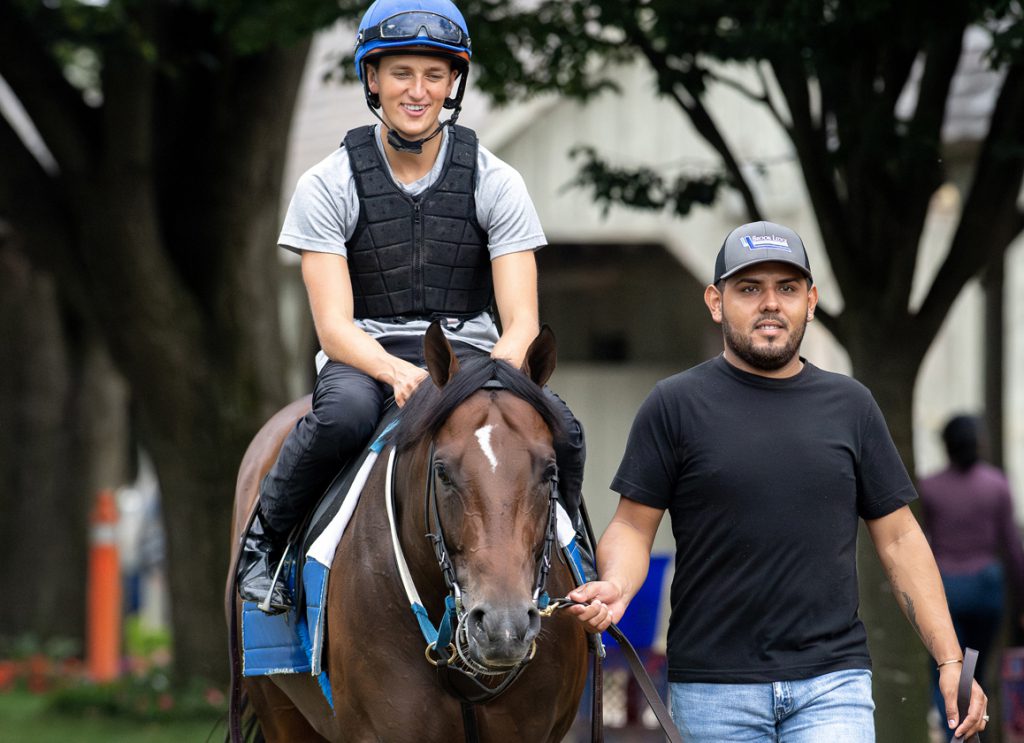
Ryvit schooling at Saratoga with Erik Asmussen up | Sarah Andrew
The Feb. 16 foal is the first foal out of unraced Better Than Mo (Uncle Mo), who counts MSW More Than Most (Indygo Mountain), MSW Worldventurer (Wimbledon) and GIII Miss Preakness S. scorer Red Ghost (Ghostzapper) as half-siblings. His third dam MGISP Alysbelle (Alydar) is a full-sister to Horse of the Year Alysheba.
Asmussen indicated Monday's purchase was prompted by another Texas sale graduate, GIII Chick Lang S. victor Ryvit (Competitive Edge).
“A couple of years ago, I got Ryvit out of this sale,” explained the Hall of Famer. “I think that there are blue collar horses and they have to earn their keep. And it had everything to do that he reminded me of Ryvit. Just a very sturdy and athletic-looking horse and, hopefully, we can create a similar circumstance.”
On behalf of his client Whispering Oaks, Asmussen also purchased hip 110, a Louisiana-bred colt by Spun to Run out of SP Hilarious Brown (Big Brown) for $80,000, in addition to a dark bay filly by Competitive Edge out of Conquest Bebop (Scat Daddy) (hip 51), who also brought $80,000.
Complete sales results can be found here.
The post Practical Joke Colt Tops Texas Yearling Sale appeared first on TDN | Thoroughbred Daily News | Horse Racing News, Results and Video | Thoroughbred Breeding and Auctions.
