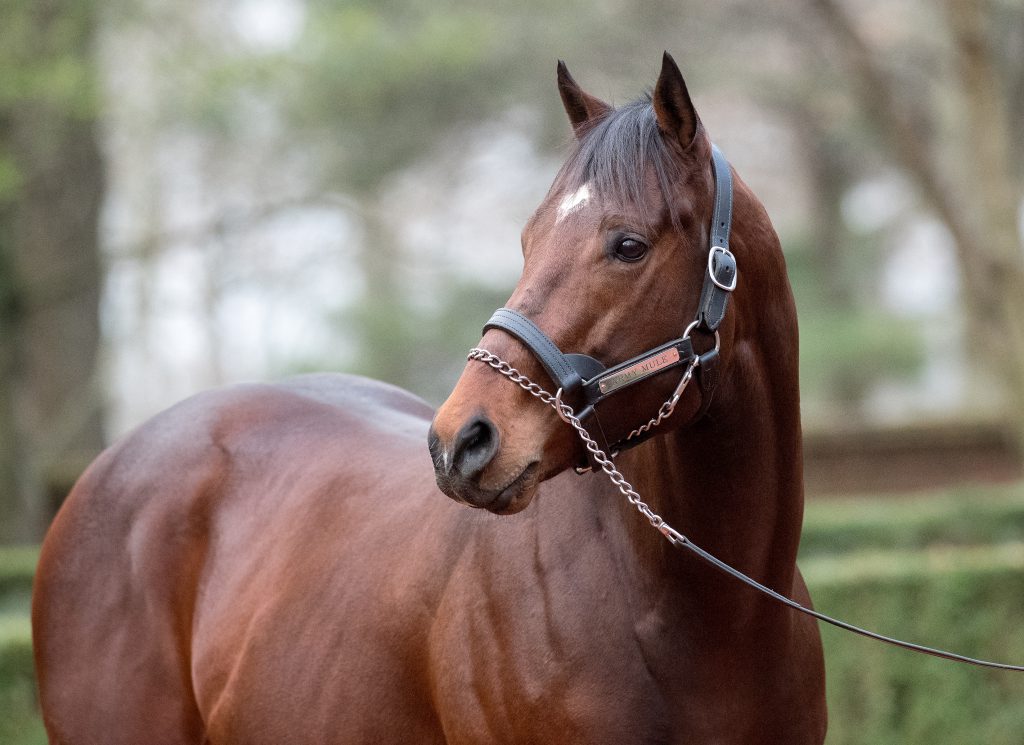
Trading in horsepower is second nature to Nathan McCauley. For many years his father Ron owned a big Toyota franchise in Lexington, and McCauley showed a precocious flair for the same game when opening his own dealerships in Tennessee. And since quitting automobiles for Thoroughbreds, McCauley has discovered a couple of niches largely unexplored by those horsemen whose own transitions, from one generation to the next, tend merely to consolidate familiar commercial conventions.
In fact, since opening River Oak Farm for business in 2019, he reckons to have bought and sold as many as 250 horses. That's a pretty staggering turnover, when you consider that the resident population tends not to exceed 50. A lot of these trades have been broodmare pinhooks, driven not so much by the long game of building a family as by alert identification of up-and-coming stallions.
So does this imaginative, adventurous program reflect a marketplace felicity learned in his first career?
The question prompts a chuckle. “I think so,” he says. “And I'm smiling, just because I'm thinking of Lindsay Laroche, my business partner. I think I do trade a lot more horses, especially mares, than is typical. And sometimes it must be uncomfortable for Lindsay, that we do so much. But I'm kind of wired that way: comfortable doing multiple deals in a week, keeping track of it all, maintaining a comfortable exit strategy. Saying that, I'm now at the stage where I think the most challenging thing that you can do is also the most satisfying. And that's to breed.”
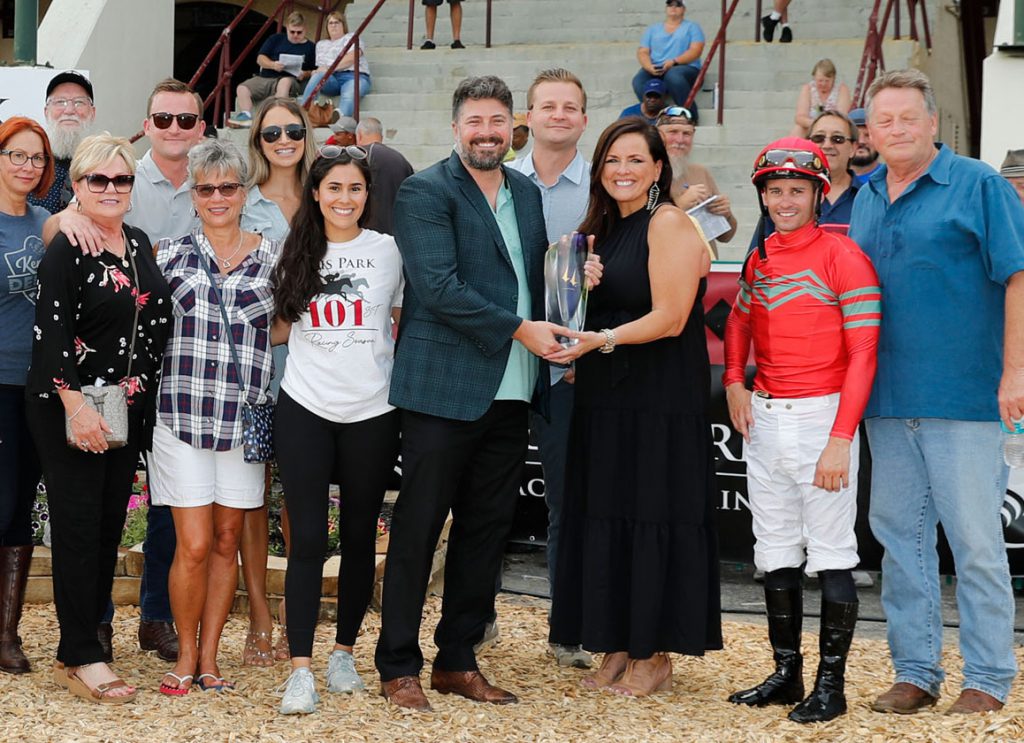
McCauley (center) in the winner's circle after Stitched wins the GII Wise Dan S. | Coady Photography
Sure enough, he has lately shown aptitude in every department. He bred Eda (Munnings), unbeaten in her last six and a graded stakes winner in each of her three seasons; he pinhooked the dam of Arabian Knight (Uncle Mo); and he not only bred but co-owns Stitched (Mizzen Mast), winner of the GII Wise Dan S. earlier this summer.
“I love breeding and raising horses,” he stresses. “It's just that there's a lot more risk involved, and it's a lot more expensive. So if you're going to take those chances, you have to pay for it some way. I don't have the car dealerships anymore, we just have River Oak, so we need to sell good horses. And we do. We sell our best mares every year.”
That was why Show Me (Lemon Drop Kid) was cashed out to Camas Park Stud for $535,000 even as her daughter Eda was emerging as one of the best juvenile fillies in California in 2021-and actually before she won the GI Starlet S.-having been purchased for just $24,000 three years previously. In an typical snapshot of McCauley's program, she had been acquired to support one of his stallion picks.
“We bought her to breed to Munnings,” he explains. “I really believed in him, and felt that I needed to put the focus of my operation behind Munnings while he offered this tremendous value. In her case, Lemon Drop Kid was an incredible broodmare sire; she'd been an expensive 2-year-old, and a debut winner for Mark Casse at Gulfstream Park; and she was a half-sister to a graded stakes-winning 2-year-old. So she had a great resume, and I thought she'd really fit Munnings physically too. I felt very lucky to get her for that.”
Eda herself realized $240,000 at the Keeneland September Sale (before doubling her value for Eddie Woods the following spring). And McCauley, having meanwhile sent Show Me back to Munnings, was able to offer her carrying a sibling to a recent stakes winner/head runner-up in the GII Sorrento S.
“That was a life-changing day for me,” McCauley admits. “The price was well over reserve. And I was still very happy to see Eda then go on and win her Grade I, so that her dam turned out to be a great buy for those connections.”
McCauley had first struck the Munnings seam with the home-bred Free Rose, who proved a revelation when switched to turf. After he melted the clock in a Keeneland allowance, “Bing” Bush came in for a piece with Abbondanza Racing in California. “Wonderful guys,” McCauley says. “We sent Free Rose out to Richard Baltas, and he ended up winning the [GIII] La Jolla H. and the [GII] Del Mar Derby. And I'm sitting there at Del Mar, having the time of my life. And the team at my car dealership are calling me every day to solve problems, and all I want is to be at the track. So I thought, 'Man, I've got to find a way to do horses full-time.' Within a year or so, I sold out of my dealerships, and was 'all in'.”
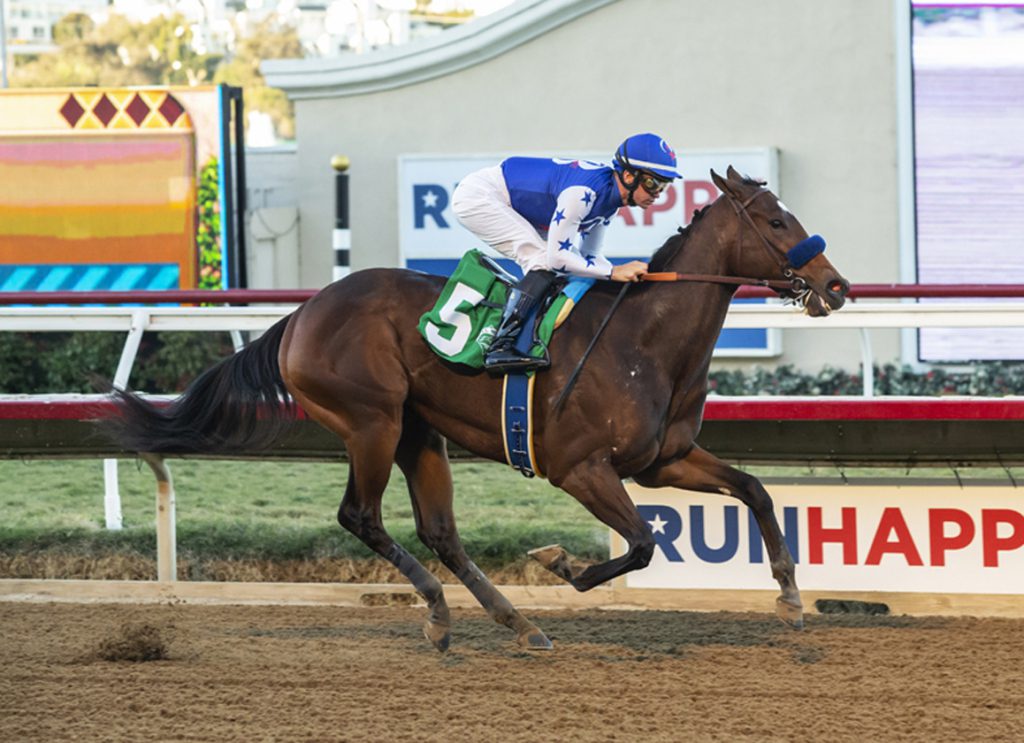
Eda | Benoit
The whole Turf adventure had started with his father, who had worked his way up from car salesman to manager to owner. Ron had all five of his sons selling cars right out of high school, but there was one other bond that they all shared.
“We got very lucky, we sold right before the [2008] recession,” McCauley says. “And we had always gone to Keeneland, and to the Derby, and for years we were saying, 'Dad, we should buy a horse.' We twisted his arm, and finally talked him into it.”
Ron bought a yearling, and then went into overdrive. He bought half a dozen mares at the November Sale, and started building a farm.
“So he really caught the bug, as did we all as a family,” McCauley says. “And actually we were very lucky: Eugenio Colombo introduced us to Madeline Auerbach and Barry Abrams who owned the great California stallion, Unusual Heat. And they sold us his daughter Golden Doc A.”
That filly made them think the game was easy, winning the GI Las Virgenes S. and running fourth in the GI Kentucky Oaks. Moreover the McCauleys bought into a couple of other Grade I fillies by Unusual Heat, Bel Air Sizzle and Lethal Heat. Of course, there were also bumps in the road; but the family had discovered a captivating new world.
And apart from anything else, it turned out that the boys shared an innate horsemanship.
“Well, we grew up in the country, in the middle of the woods, and had a couple of $100 horses,” McCauley says. “So we had a love for horses as a young age. But none of us were experienced horsemen, and we all got a baptism of fire when my dad started the farm.”
McCauley's late brother Alex proved to be “just a natural,” breaking the horses, while Tyson built much of the farm infrastructure. Then one Thanksgiving dinner their dad introduced a casual thunderbolt.
“You know,” he said. “I think Tevis could maybe train our horses for us.”
McCauley remembers exclaiming: “Dad, Tevis isn't crazy enough to think that he could do that!”
“And the following week they had applied for stalls,” McCauley remembers with a grin. “I don't think there's anything Tevis has ever put his mind to that he couldn't do. He was a 20 percent lifetime trainer, and won many stakes.”
Tevis quit the racetrack when starting a family-he now has a successful hunting lodge-and soon afterwards their parents dispersed the stable. Yet it was precisely then that the middle son sold his Nashville dealerships and decided on full immersion.
“I had been fortunate to have so many good people around me,” McCauley emphasizes. “Eugenio Colombo, Hubert Guy, Lesley Campion, the Taylor brothers. I picked their brains nonstop, and obsessed over the TDN every day. I didn't have a lot of money, but about 15 years ago started pinhooking some mares.
“The very first one, I called Lesley and said that I'd seen this well-bred mare in for $16,000. I didn't even have the five or six grand to put up my third, so just suggested her as one they could do themselves. But they put up the money for me, and we resold her and doubled our money. Then I could play a little on another, and it just grew from there. I started finding stuff that worked; started thinking that maybe I could see one or two things that other people don't.”
One especially useful intuition, as we've seen with Munnings, was for emerging sires. For instance, from his parents' dispersal he salvaged an unraced filly from one of the first crops of Into Mischief.
“She'd been bred on a $7,500 stud fee,” McCauley recalls. “Her name is Walking Miracle. She had a paddock accident, and we were told to put her down. But she was in such good spirits, my mom insisted that we give her a chance, and she had a miraculous recovery. She had been such a gorgeous foal that it made a big impression on me, about what Into Mischief could get you physically.”
McCauley doubled down on Into Mischief for as long as he could afford the fee. But Walking Miracle was always special in her own right, having been home-bred from an Aldebaran mare claimed for just $12,500 as a half-sister to GI Hollywood Gold Cup winner Mast Track.
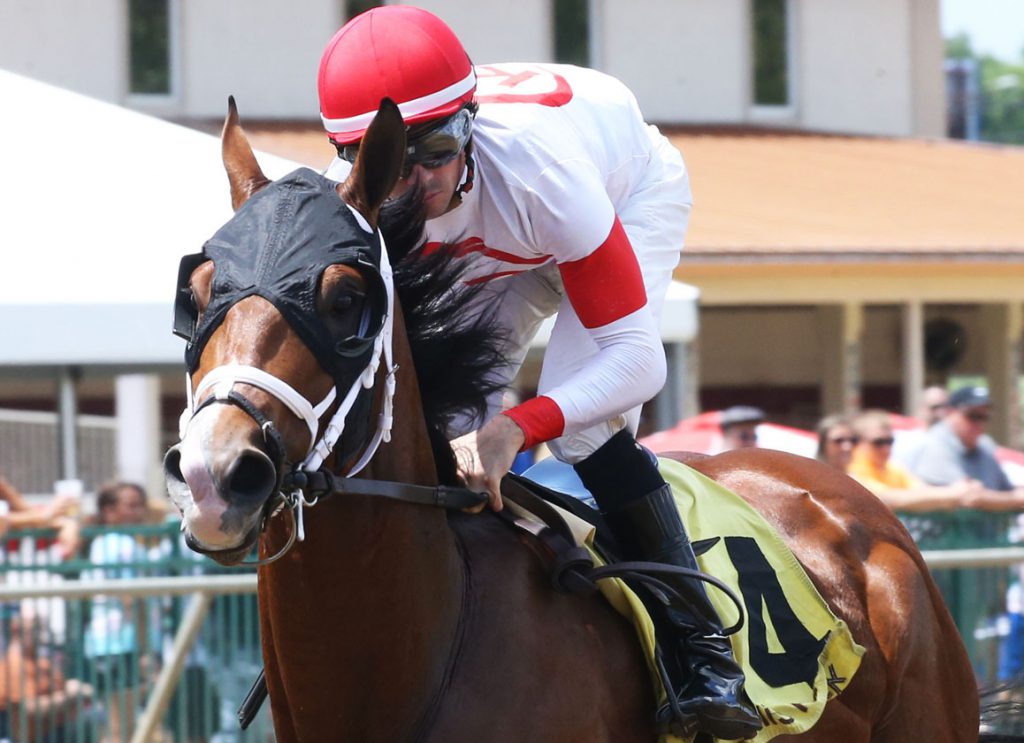
Swill | Coady Photography
“At that time I needed mares to breed to Scat Daddy,” McCauley explains. “He was another one I was just crazy about. They don't always work out like that, by the way! But I think he'd had three graded stakes winning 2-year-olds that year, and he was affordable, $17,500. That's been my niche, finding stallions early that are on the upswing. Not This Time would be our most recent example, my dad was an original shareholder.”
But reviving the family's Mizzen Mast link (he was sire of Mast Track) with Walking Miracle has given McCauley a different kind of kick, as the result was Stitched-rather an exception in his program, having been retained after failing to make his reserve at $50,000 at the Keeneland September Sale of 2020. Stitched's shock success at Ellis Park took him past $500,000 in earnings and he's been a great ride for McCauley with “the O.G.s”.
“So the term is the 'original gangsters', as they're the original partners that were involved in Free Rose,” McCauley explains. “There are five of us, and they're so supportive. They really encourage me with the risks I take-and we just have a blast, win, lose or draw.”
Walking Miracle's first foal, Swill (Munnings), broke his maiden shortly after Stitched went under the hammer.
“I knew that [Swill] was a promising horse, I loved what I was seeing from the mare, and I thought a lot of Stitched as a yearling,” McCauley explains. “He was a beautiful moving horse, had great mechanics. And Mizzen Mast was terribly underrated. The only question was, could I afford to race him? So when my buddies asked if they could do that with me, that was all I needed.”
There's no mistaking the extra fulfilment that McCauley, still only 40, derives from teaming up with others on his wavelength. He loves the work of trainer Greg Foley and his sons Travis and Alex; and then there's Laroche, with whom he has “struck up a wonderful friendship.” Unfortunately McCauley wasn't able to go to Royal Ascot to root for one of his partner's European projects, Snellen (Ire) (Expert Eye {GB}), winner of the Chesham S.
Needless to say, there will be a wide spectrum of outcomes when you're trading in such volume. (Around 30 mares will go to the sales every winter, many off the track carrying a first foal; while the average foal crop would be 15 to 20.) Even a successful mare pinhook like Borealis Night (Astrology)–picked up for $50,000 in February 2019 before sold at Keeneland that same November for $285,000–was a bit of a mixed result, in that her upgrade cover by Uncle Mo would ultimately produce Arabian Knight.
“Borealis Night was by Astrology, but sister to a couple of good horses, and just a beautiful physical specimen,” McCauley says. “By then Uncle Mo was starting to show an affinity for A.P. Indy, and we just thought we'd breed the best physical that we could to one of the best stallions around. We sold her, we made a profit, and that was good. That served River Oak Farm's business model. And we always take a lot of satisfaction when people that buy mares from us have that type of luck.”
Much the same thing happened with a Smart Strike mare claimed for $30,000 back in 2012. McCauley sent her to Hard Spun and processed her through Keeneland November for $130,000. The resulting foal sold well before winning two Grade II prizes as Rocketry.
“Those early mares taught me a lot,” McCauley argues. “To this day, that mare was one of the nicest physicals we ever bought. And then you'd get some that had the pedigree, but you wouldn't necessarily want them in your broodmare band. And so those mares have a slot, and we would take them to market, and it taught me a lot about how I make my living today.
“There's certain mares we have a strong feeling about, that wouldn't be expensive, and those are the type that we're breeding on the farm, and trying to raise good horses out of. But that's a long game, and very challenging. Show Me wasn't worth a lot, for instance, until Eda came along.”
Right now, the emerging stallion that intrigues McCauley is Army Mule, whose early ratios have been so conspicuous.
“I ended up bringing a lot of mares to him at the end of the season,” he says. “If he can come up with a Grade I winner in the next little bit, he's going to explode. And one part of the River Oak program that I'm terribly excited about is that we bought into Uncle Chuck. He went to Journeyman Stud in Florida last year, and covered 135 mares. I've got seven Uncle Chucks on the farm that are just unbelievable. I just have a strong feeling about him. He was a beautiful-moving horse, unexposed, had a ton of talent. And that family [Uncle Mo half-brother to Maclean's Music] is just incredible.”
As for the mares, it looks like McCauley may have done it again with Lookintogeteven (Ghostzapper), claimed for $40,000 at Santa Anita last fall. In the meantime, her half-brother Drew's Gold (Violence) has emerged as one of the fastest 3-year-olds around. Lookintogeteven will be going to the November Sale with an Epicenter cover.
“When I started, back around the time of the recession, nobody was really buying mares,” McCauley reflects. “But then I started really paying attention, and understanding the claiming game. I picked up on the value of horses pretty fast, started to study stats and pedigrees. You never really know what they're worth. But I was a car guy! I'd been at auctions every day. I started a spreadsheet many years ago, and began to see outliers.
“Maybe you see something that was born to be a good horse but just ended up in the wrong program. You're going to have some gut feel, but I let the data drive it: opportunities, performance, the pipeline. And if you can catch onto that kind of stuff, and make a bet based on it, sometimes it works out.”

The post River Oak Moving Through The Gears appeared first on TDN | Thoroughbred Daily News | Horse Racing News, Results and Video | Thoroughbred Breeding and Auctions.
Source of original post