Nunn’s Attorney Charges HISA With Hypocrisy In Dealing With Intra-Articular Injections

Attorney Drew Mollica understands that his client trainer Doug Nunn violated Horseracing Integrity and Safety Authority (HISA) Rule 3313, which prohibits trainers from running a horse within 14 days of an intra-articular joint injection or working them within seven days of the injection. What he doesn't understand is why his client has been suspended while at least 15 other trainers have been let off the hook for the same violation.

“This is the height of hypocrisy,” Mollica said. “He has been victimized by a system that is flawed.”

On June 26, HISA announced that it had temporarily suspended full enforcement of its intra-articular joint infection rules and that the rule covering workouts would not go into effect until July 15. According to HISA Chief Executive Lisa Lazarus, between 15 and 20 trainers had breached the rule surrounding intra-articular joint injections prior to a workout. Lazarus said the delay in implementing the rule was needed because there was confusion among trainers regarding the specifics of the rule.

“On the workout side, while it was mentioned in the education process, it seems that a lot of trainers just really didn't understand it, and most of the violations we saw were only off by one day,” she said. She added that the temporary modification of enforcement of the rules was deemed the most “fair and equitable” way to proceed “given the number of violations.”

Alexa Ravit, the director of communications and outreach for the Horseracing Integrity and Welfare Unit (HIWU), confirmed in an email to the TDN that Nunn's penalty was not excused because the injection was too close to a race while the other offenders were too close to a workout.
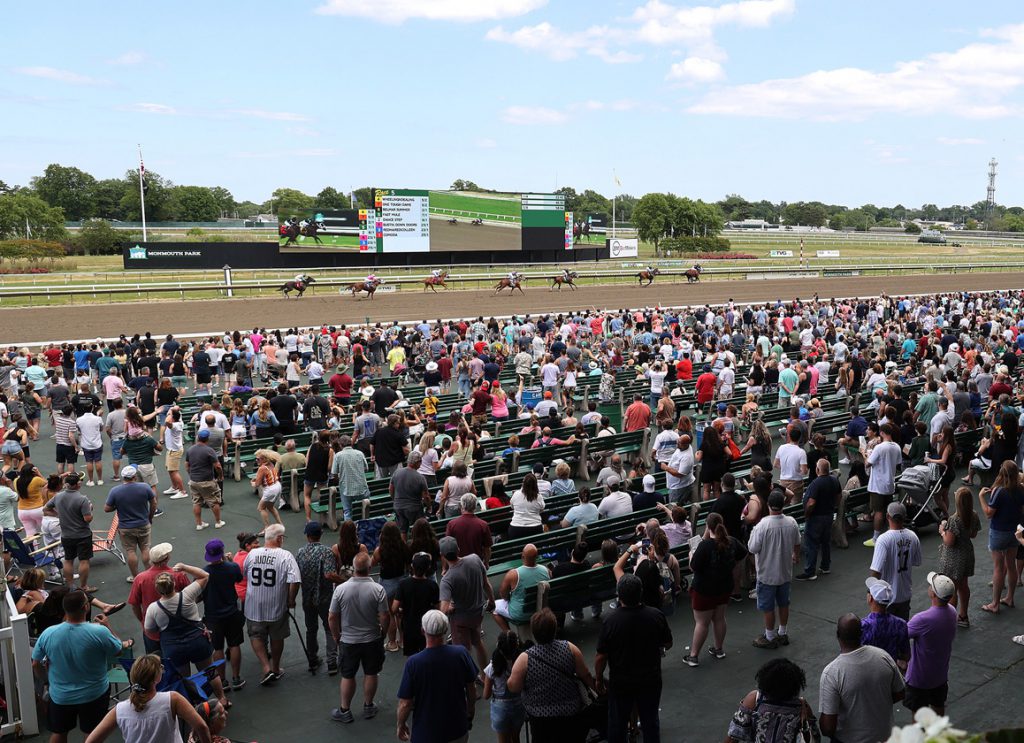
Monmouth Park Racetrack | Bill Denver/EQUI-PHOTO

According to Mollica, the horse in question, Smithwick's Spice (Frost Giant), was injected 12 days before racing on June 9 in an allowance race at Delaware Park, which the gelding won by three-quarters of a length. That, he argued, is less egregious than working a horse within seven days of an injection.

“The people who made the mistake of working within seven days put more stress on their horses than he did in the 12 days between the injection and racing,” he said. “The racing-versus-the-work argument is not logical because his horse had more time to recover.”

Mollica also said that if HISA had been doing its job the entry of the horse would not have been allowed.

“Doug Nunn's horse had an injection and it was reported on the horse's portal on May 31,” he said. “Everyone knew about it. HISA was supposed to now flag his entry. The horse was supposed to be ineligible to race. But they, maybe because of confusion, didn't do it. Doug Nunn was confused about the rules and didn't talk to his vet and didn't coordinate things properly. He entered the horse. The overnight was out eight days before the race. HISA never said 'Wait a minute, Doug, your horse isn't eligible.' They let him run on June 9. He wins on June 9. There was confusion as to what he was supposed to do. But Doug Nunn, as opposed to, fill in the blanks, the trainers who they let off, was treated differently. Those guys got a pass. That's not America to me.”

Mollica said that if possible confusion about the rules was the reason why trainers who violated the workout provision of the rule weren't suspended then there's no reason why the same argument shouldn't apply to racing a horse in violation of the rule.

“In this situation, there obviously was confusion,” he said. “How do I know? Because HISA themselves dropped the ball. Delaware Park was confused. HISA was confused. Doug was confused. Why is his any confusion any different than their confusion?”

Mollica also wants to know what trainers violated the workout rule. Although any possible suspensions were waived, their horses were ineligible to race within 30 days of the injection, which Mollica, argues, should make the names of those horses a matter of public record. He pointed to the June 29 story in the TDN in which Lazarus implied that the names of those horses would be released.

“When horses are suspended, you'll be able to figure that out,” Lazarus said at the time, pointing to HIWU's “public disclosures” webpage.

However, the names have not been disclosed and a request to HIWU by the TDN to release the names of the horses involved was denied.
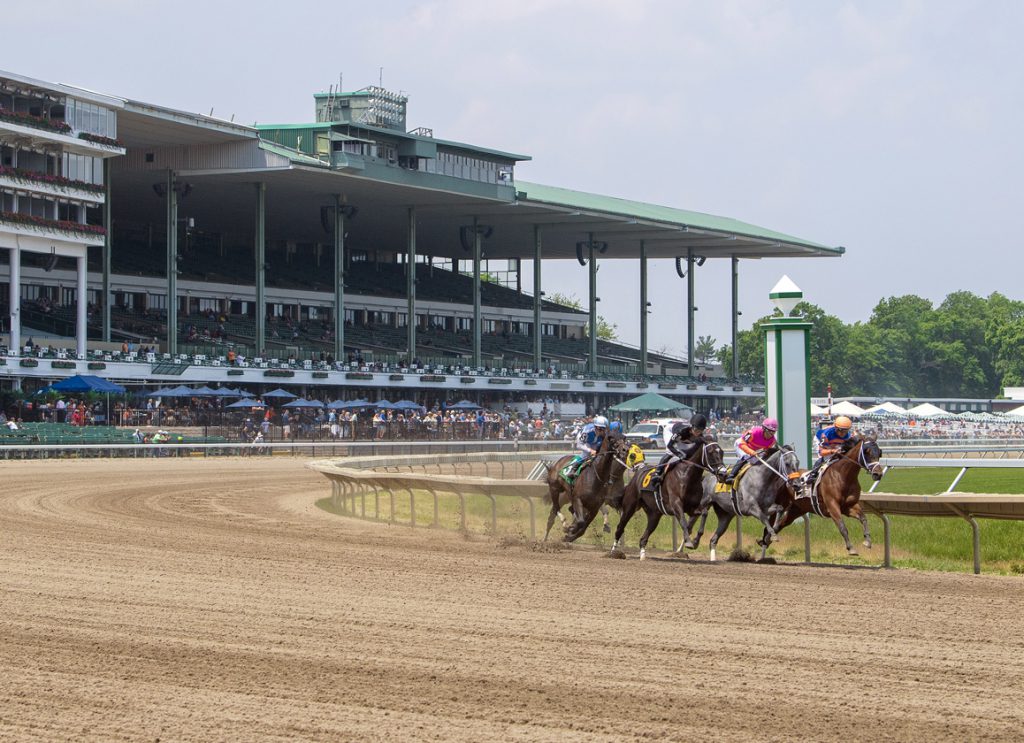
Monmouth Park First Turn | Sarah Andrew

“Since the trainers were not Provisionally Suspended and Charge Letters were not issued to them because they only received a warning (as per HISA's notice), HIWU will not be publishing the names of the horses currently facing a 30-day period of Ineligibility due to breezing too soon after an IA injection,” Ravit wrote to the TDN in an e-mail. “For IA-related matters after July 15, the names of both the trainers and the horses will be published once a Charge Letter is issued to the trainer.”

But HISA's own rule 3620 makes it clear that public disclosure is required. It reads: Rule 3620. Public Disclosure
(a) The Agency shall Publicly Disclose the resolution of an alleged violation of the Protocol no later than 20 calendar days after:
(1) the final decision;
(2) a resolution between the Agency and the Covered Person; or
(3) the withdrawal of a charge or a final decision finding of no violation

Why won't HISA/HIWU release the names of the horses that worked within the seven-day period, even though their own rules say they must? Mollica said he didn't want to speculate but he was quick to fault them for a lack of transparency.

“My problem is the lack of transparency and the lack of fairness,” he said. “What's good for the rich and famous trainers should be good for Doug Nunn. The lack of transparency shows because Lisa Lazarus said you'll know the names of those trainers when we publish the names of the suspended horses. Now we understand they are not going to release the names of those horses. Meanwhile, Doug was publicly villainized with his ruling up there on their website, yet we don't even know who these people who were given a pass are. So tell us. Transparency is the greatest disinfectant. We obviously have an infection. Why are we not disinfecting it?”

Nunn's violation can yield a suspension of up to 60 days but Mollica said he has reached an agreement with HISA and HIWU and that his client will receive a 30-day suspension. The situation has left him asking a lot of questions and he doesn't have all the answers, but he believes that Nunn was treated differently because he's a small-time trainer. Based at Monmouth Park, he's won six races this year from 59 starters and has 305 career victories.

“If you are going to start opening up loopholes, you can't open up loopholes for some and not for others,” Mollica said. “Doug Nunn is a victim of being a small guy in a big world. I do think he's being treated differently, like a lot of little guys are. This is stacked against the little guy. They excoriated Nunn and let others off and they won't even tell us who they are.”

The post Nunn’s Attorney Charges HISA With Hypocrisy In Dealing With Intra-Articular Injections appeared first on TDN | Thoroughbred Daily News | Horse Racing News, Results and Video | Thoroughbred Breeding and Auctions.

Source of original post

After Two-Year Layoff, 2021 Preakness Winner Rombauer On Comeback Trail With Saffie Joseph, Jr.

When last seen on the racetrack, John and Diane Fradkin's Rombauer followed up his sharp score in the 2021 Preakness Stakes (G1) with an even third-place finish in the Belmont Stakes (G1) three weeks later.

Sidelined for approximately two years, the now 5-year-old son of Twirling Candy has surfaced at Gulfstream Park, where he breezed three furlongs Sunday morning.

Trainer Saffie Joseph Jr. now trains the returning Rombauer, a homebred who was formerly trained by Michael McCarthy on the West Coast.

“He was given time off for an issue he had,” Joseph said. “I train horses for [the Fradkins], and they decided to send him to me.”

Joseph has trained two younger half-siblings to Rombauer for the Fradkins – Republique, a daughter of Strong Mandate who won three of six starts last year, including back-to-back wins at Gulfstream to kick off her career; and Alexander Helios, a 3-year-old son of Cairo Prince who finished third in a Gulfstream Park maiden special weight race June 25 after going 0-fo-4 on the in Southern California Coast last year.

Joseph was pleased with Rombauer's first official workout since being sidelined.

“He had a couple works at the farm and this was his first work over the surface,” Joseph said. “He went nice and easy. So far so good.”

Rombauer debuted with a victory on turf at Del Mar before finishing second on dirt in the American Pharoah (G1) two starts later at Santa Anita. After concluding his juvenile campaign with a fifth-place finish in the Breeders' Cup Juvenile (G1) at Keeneland, he launched his 3-year-old campaign with a victory in the El Camino Real Derby, a 'Win & In' Preakness qualifier, at Golden Gate Fields. He went on to finish third behind Essential Quality in the Blue Grass (G1) at Keeneland before bypassing the Kentucky Derby (G1) and going directly to the Preakness at Pimlico. Rombauer rated off the early pace before rallying in the stretch to win going away by 3 ½ lengths under Flavien Prat. He raced evenly to finish third behind Essential Quality in the Belmont before going to the sideline.

“He's a proven horse. He was the Preakness winner. He's a classic winner. Michael McCarthy did a great job with him,” Joseph said. “Hopefully, he stays happy and healthy and comes back to what made him what he was.”

Joseph said Rombauer could return to the races in August, under ideal circumstances.

The post After Two-Year Layoff, 2021 Preakness Winner Rombauer On Comeback Trail With Saffie Joseph, Jr. appeared first on Horse Racing News | Paulick Report.

Source of original post

Charle Oliveros Celebrates 1,000th Winner At Mountaineer

Jockey Charle Oliveros, a perennial top rider at Mountaineer in New Cumberland, WV, achieved the 1,000th victory of his career on Wednesday evening when Wild Wine won the card opener by a length.

The Venezuelan-born Oliveros has been among the top 100 riders in the United States by wins each year since 2017, finishing among the top three riders at Mountaineer from 2018-2020 and capturing the leading jockey title in 2021. Last year Oliveros finished second in the standings, and this year he is currently ranked third.

Oliveros began riding in 2011, but did not achieve his first victory until 2013. He first passed the 100-win mark for a year in 2017, riding at Mountaineer and Mahoning Valley in Ohio, and has maintained that momentum (excluding 2020, in which he won 97 races during a season truncated by the pandemic) each year since.

The rider's career win rate stands at 14 percent, with 1,000 winners from 7,001 starters and career earnings of $11,858,359.

The post Charle Oliveros Celebrates 1,000th Winner At Mountaineer appeared first on Horse Racing News | Paulick Report.

Source of original post

HBPA On HISA: This Court’s Job Is To Again Tell Congress ‘No’

With oral arguments tentatively scheduled for the first week in October, the National Horsemen's Benevolent and Protective Association (NHBPA) and 12 of its affiliates told the United States Court of Appeals for the Fifth Circuit on Wednesday that the rewritten version of the Horseracing Integrity and Safety Act (HISA) remains “patently unconstitutional,” and that the Authority overseeing the sport “is basically a private police department” whose sweeping powers equate to “oligarchic tyranny.”

As the appellants in a lawsuit that has persisted in the federal court system for more than 27 months, the HBPA plaintiffs were allowed to file the first briefing in a landmark case for the Thoroughbred industry that has been put on an expedited schedule by the Fifth Circuit.

The defendants, who are personnel from the Federal Trade Commission (FTC) and the HISA Authority, have 30 days to craft a reply. They will make their filing knowing that a lower court in Texas has already ruled that an amended version of HISA is constitutionally compliant because it fixed defects that the Fifth Circuit had previously identified. The HISA law has also been upheld as constitutional in a separate lawsuit initiated by different plaintiffs that got validated on appeal to the Sixth Circuit.

In a 72-page brief filed July 5, the HBPA appellants laid out an argument based on the premise that the rewritten HISA statute that got signed into law late in 2022 still doesn't pass the constitutional sniff test.

“This Court has already struck down HISA once before,” the HBPA filing stated. “Then Congress tweaked the law in one respect, giving the FTC a modicum of additional power over the original design. Though it is understandable to desire to applaud 'a productive dialogue' between the branches, this Court's job is not to reward Congress for passing a marginally less unconstitutional law by declaring it constitutional. Laws do not get passing grades for improved effort. Nor is constitutional analysis like horseshoes or hand grenades, where close–or even just slightly closer–is good enough.”

The HBPA filing continued: “This Court's job is to again tell Congress–'No.'”

Central to the HBPA's case is the principle in administrative law that Congress cannot delegate its legislative powers to other entities. In their brief, the horsemen argue that the HISA Authority is a private entity subject to that “private nondelegation” doctrine, and that it is wrong to intentionally grant it powers that evade the safeguards of constitutional design.

“An alternative way to think about private nondelegation is not to ask about the quantity of supervision authorized, but the quality of the powers delegated. This question is not how much surveillance and authority the FTC has, but what type of power the Authority wields,” the HBPA filing stated.

“HISA is directly contrary to the historical understanding of private delegation. Ultimately the corporation is named the Horseracing Integrity and Safety Authority, and not Advisors or Administrators, because its purpose is not to advise the FTC or perform ministerial tasks. Its purpose is to exercise sovereign national authority [and] giving such governmental authority to a private corporation was and remains 'delegation in its most obnoxious form.'”

The HBPA filing put it this way: “The Authority establishes the programs, drafts the rules, makes policy decisions, exercises enforcement discretion, investigates individuals, seizes evidence, prosecutes industry participants, sits in judgment on them, issues sanctions, decides how much it wants to spend, and then decides how much it will take in taxes to fund that spending.

“It does all of this without appointment of its board members by the president, confirmation of those board members by the Senate, appropriation of its funds or authorization of its fees by Congress, review of its investigatory requests by a federal magistrate, or transparency to the industry and the public through accountability laws like the Freedom of Information Act, Federal Advisory Committees Act, or Government in the Sunshine Act.”

The first time the HBPA plaintiffs attempted to challenge the original 2020 version of the HISA statute in federal court, on Mar. 15, 2021, the suit was dismissed more than a year later, on March 31, 2022.

The HBPA plaintiffs then appealed, leading to a Fifth Circuit Court reversal on Nov. 18, 2022, that remanded the case back to the lower court. In the interim, an amended version of HISA got signed into law on Dec. 29, 2022.

On May 4, 2023, the lower court deemed that the new version of HISA was constitutional. The HBPA plaintiffs swiftly filed another appeal back to the Fifth Circuit, which is where the case stands now.

The HBPA filing stated that, “this Court should approach the amended statute with a clean slate and hold it up to the high bar set for a delegation of government power to a private actor, as enunciated in its prior opinion. If this Court does so, it will see that the act again fails. Even as amended, the statute does not give the FTC pervasive surveillance and control over the HISA Authority.”

At a different point in the filing, the HBPA took umbrage with HISA's funding mechanisms.

“The powers to set taxes and spend tax funds are legislative powers. The Authority has the power to tax–it is empowered by HISA to set a mandatory assessment that either states pay, or if states decline to pay, then covered persons must pay directly. This is a tax….These funds are not voluntary or charitable contributions from covered persons and states–these are mandatory, obligatory fees levied by law. Failure to pay them can result in fines and suspension from racing. Once these funds are collected, HISA allows the Authority to spend them without any FTC oversight.”

Enforcement is also constitutionally problematic for the HBPA.

“The Authority has the power to search and inspect 'offices, racetrack facilities, other places of business, books, records, and personal property of covered persons that are used in the care, treatment, training, and racing of covered horses,' to issue subpoenas, to compel truthful and complete answers to inquiries, to undertake urine and blood tests without advance notice, and to exercise 'other investigatory powers of the nature and scope exercised by State racing commissions,' which the Authority has apparently defined to include the power to seize evidence….

“By contrast,” the filing continued, “if the FTC wanted to conduct a search or seize evidence, it would need a warrant from a magistrate. For the Authority to conduct a search or seize evidence, it doesn't even have to let the FTC know, little less secure the advance approval of a federal magistrate. This is an unconstitutional mutation of executive power. The Authority also has the power to hold administrative hearings, weigh evidence, decide guilt, and issue sanctions. These are also executive powers…

“As a result, under the terms of the statute, horsemen are investigated and subpoenaed and their property is seized with zero pre-clearance from a federal official, little less an independent magistrate,” the filing stated.

The HISA and FTC defendants now have the opportunity to file their own brief with the Fifth Circuit Court by Aug. 4.

The post HBPA On HISA: This Court’s Job Is To Again Tell Congress ‘No’ appeared first on TDN | Thoroughbred Daily News | Horse Racing News, Results and Video | Thoroughbred Breeding and Auctions.

Source of original post

Verified by MonsterInsights