As a junior he wound up in the same fraternity as a guy named Bob Baffert, who was already riding winners, already conspicuous. Eric Kruljac, for his part, had transferred to University of Arizona from Arizona State, where he had been on a football scholarship only to blow a knee. Then, when Baffert proceeded to stardom at the racetrack, Kruljac literally went undercover. He worked for a buddy as a private investigator until, having learned the ropes, starting an agency of his own. For several years you'd find him tailing suspects, switching over every few miles with colleagues in different cars.
On Monday, nearly half a century after the pair first crossed paths, Kruljac saddled one of the handful of horses in his care to finish third behind Baffert's latest Grade I winner at Santa Anita. That was a gratifying sequel to what had happened the previous day, when the star of Kruljac's small team confirmed himself a winning machine that would stand out even in the Baffert barn—whether by talent or charisma or, above all, sheer consistency. Because with The Chosen Vron (Vronsky), it's not just every Cal-bred that needs to be checking its rearview mirror.
The Chosen Vron has now won his last seven straight, all stakes, taking him to 12-for-16 overall and $792,678 in earnings. On Sunday, he finally had a showdown with another Californian fan favorite, Brickyard Ride (Clubhouse Ride), in the Thor's Echo S. His rival, who last month retained the GIII Kona Gold S., may not have shown his best as he faded into third of four; but the fact is that very few state-breds of recent times could have matched The Chosen Vron in his current vein.
“I think it was his best race ever,” Kruljac says. “They went fast, and he was four or five lengths behind, stalking. Then the rider just threw the reins at him couple of times, and he just swallowed them. It was awesome. Just, wow.”
The 5-year-old won by five and a half lengths, and it feels like time to return to open company. He won a couple of graded stakes as a sophomore, beating Monday's big winner Defunded (Dialed In) in one and Laurel River (Into Mischief) in the other. When the latter went on to win the GII Pat O'Brien S. at Del Mar last summer, The Chosen Vron finished only fifth. But that race probably came too soon after what had been his first start in nine months—in which, incidentally, he had only been beaten in a three-way photo over an extended mile of turf. (Sunday's race was over six furlongs of dirt: this is one versatile horse.) And he's unbeaten since.
“He developed a few problems [at three] and we had to turn him out and do a little surgery,” Kruljac explains of the gelding, co-owned with Sondereker Racing, Robert S. Fetkin and Richard Thornburgh. “But he's come back gangbusters. I learned, I think, that if I give him six weeks or more, he seems to relish the extra couple weeks. So, we've changed strategy a little bit, to give him more time between races, and will probably keep him on that line as we go forward. He seems to have come out of the race in fabulous shape and we might have to jump in with open company next time.”
Kruljac bought The Chosen Vron's dam, Tiz Molly (Tiz Wonderful), as a yearling for just $25,000 at the Keeneland September Sale of 2011 and also raced her in partnership.
“She showed lots of ability, won her first two races impressively,” he recalls. “We turned down a pretty sizeable sum for her. Then she hurt herself, and it was a career-ending injury. Three of us four partners stayed in and decided to use her as a broodmare, and it's been a good decision.”
So, too, was her retention (at just $1,200!) when offered for sale after The Chosen Vron was weaned. The mare is now at Legacy Ranch where she has recently delivered a second consecutive filly by Clubhouse Ride.
Vronsky himself died two years ago, and The Chosen Vron is unfortunately not equipped to continue the line having been castrated soon after entering training.
“He would go off behind intermittently,” explains Kruljac. “And we found out that he had a testicle hanging over a ligament in there, and causing him discomfort. Once we took that out, he traveled like a Bentley. Until we figured out what was going on, he would show his stuff, work really great—and then the next time, you might be a little disappointed. Gelding changed him more than any horse I've ever trained. Though I wish we'd left one in there! Anyway, he's been fabulous ever since. Just a great horse to be around in the barn. My boys have done a wonderful job with him.”
Kruljac traces his flair for horses to maternal grandfather Walter Markham, who raised pedigree cattle and Thoroughbreds on his ranch in Carmel Valley—along with nine grandchildren. Markham's trainer was Buster Millerick, who reached the Hall of Fame via the long career of Native Diver.
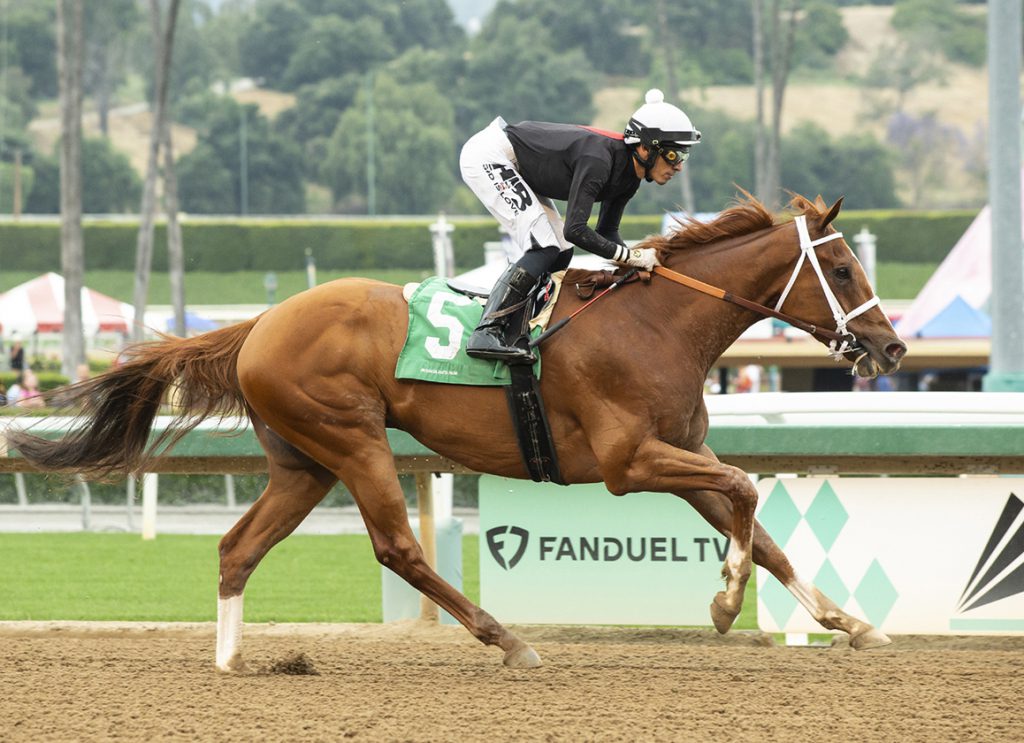
The Chosen Vron | Benoit Photo
“Buster loved my grandfather because he was an animal man,” Kruljac says. “My grandfather was a purebred Hereford stock breeder. They spoke the same language. Buster was a legend, but he'd run off all his clients, he was so mean. He had this little dog and when the owners came in the shedrow, he'd stick that dog on them!”
Kruljac himself was breeding his first horses by his early 20s.
“I had a little farm in Phoenix, Arizona,” he recalls. “I was just starting to train a few, and had a client who had an Alydar son that didn't make the races. Then I bought a couple of my own mares, and bred them to him. That didn't turn out so well! But I pretty much stayed with it. That's how I entered the game, breeding, which is crazy.”
But we do meanwhile need to ask about that left-field parallel career, as private detective. Kruljac says it wasn't as colorful as it sounds, his principal focus being compensation fraud. But he accepts with a chuckle that he must have been one of the few who ever came to the racetrack and found himself dealing with somewhat straighter people than previously.
“It takes all kinds, I'll tell you,” he acknowledges. “I ran my agency for about eight years. It's all pretty boring, until everything opens up. Mostly we were investigating people that the claims adjusters thought were faking injuries. We'd go out early in the morning and sit a quarter of a mile down the road, and then follow them and gather evidence that showed that they were malingerers.”
There was one memorable liability claim, concerning a couple and their three young boys.
“They'd already had two accidents where they'd be going up the ramp onto the freeway, and slam their brakes on until they get someone to run into them,” Kruljac recalls. “Anyway, we film them going into the doctor's office, all five with neck collars. Out they come, still with neck collars. And they drive off. All of a sudden, they pull into a grammar school. There's a jungle gym, swings and all this stuff, and these kids come running out of the car, one of them throws his neck brace up in the air, and they're jumping eight feet off this thing. We got this all on film.”
All the time, however, Kruljac was maintaining an interest in horses: a little breeding, a little trading, a few in training with a brother. When the latter quit, Kruljac shut down his agency and started training them himself, going full time at Turf Paradise at the age of 38. He has meanwhile accumulated as many as 1,240 winners, including seven individual graded stakes scorers.
These were memorably crowned by Leave Me Alone (Bold Badgett), who shipped over to win the GI Test S. by just under eight lengths in 2005. After she won a valuable sprint at Calder under Kent Desormeaux, his agent rang and implored Kruljac to look at her numbers and think about Saratoga.

Trainer J. Eric Kruljac (right) celebrates with jockey Hector Berrios | Benoit
“And she was training just incredibly, so we decided to take a shot,” Kruljac recalls. “I don't think I saw a filly run that fast until Gamine (Into Mischief) 20 years later. It was really incredible.”
Kruljac had bought her for just $35,000 as a yearling. “I saw her at an auction at an equestrian center outside of Del Mar,” he recalls. “Other than being totally crazy, while they were showing her, she was just incredibly athletic.”
He was originally intending to buy her for himself and bring in a couple of partners, but in the event secured her for a new client at the time, Steven Mitchell.
“And that worked out to be a great experience,” Kruljac says. “We flew in his jet to Saratoga, stayed in this house right across from the entrance. There were eight or nine of us, including his kids. So, the night before the race we tried to get dinner at [a noted Saratoga restaurant]. We went in there, and the guy says, 'Absolutely not. Sorry. We're totally booked.' Even though Mr. Mitchell tried to give him $500! Next day, after the race, we went back to the same place. The owner's boy was holding the saddle towel. This time the guy said, 'Sure, Mr. Mitchell. We'll make room for you.' Then as we're walking to the table, he says, 'And Mr. Mitchell, I will take that $500.'”
As it happens, The Chosen Vron reminds their trainer of Leave Me Alone: another tall and angular chestnut, with a great shoulder. That year, however, she was one of 86 winners from 383 starters for the barn. For Del Mar this summer, in contrast, Kruljac expects to have eight head; with four or five 2-year-olds to come through.
To be fair, the emphasis has meanwhile tilted towards the barn of his son Ian—whom he famously launched, when still his assistant, with a City Zip yearling he'd found for a client at $85,000. This turned out to be none other than Finest City, who won the GI Breeders' Cup Filly & Mare Sprint before selling to Katsumi Yoshida for $1.5 million.
“I'm more interested in helping Ian out these days,” Kruljac concedes. “He's up there in Arcadia along with the people that have worked for me over 30 years. At 70, I'm slowing down a notch. I've pretty much made Del Mar my residence, so I've been commuting a lot for the last three or four months.”
Though still enchanted by his working environment, Kruljac recognizes the ongoing difficulties of the industry in his home state.
“And I'm still very concerned, because we've got a long way to go to get it anywhere close to what it was,” he reflects. “With these incredibly beautiful tracks, we've been spoiled. Now, with all the restrictions, the media, the finger-pointing, it's made it tough, for sure. The simulcast money is the only thing keeping our purses at the level that they are. But it appeared to be a really good weekend, as far as attendance and families coming out again, so that was encouraging. For me, anyway, it's heaven on earth.”
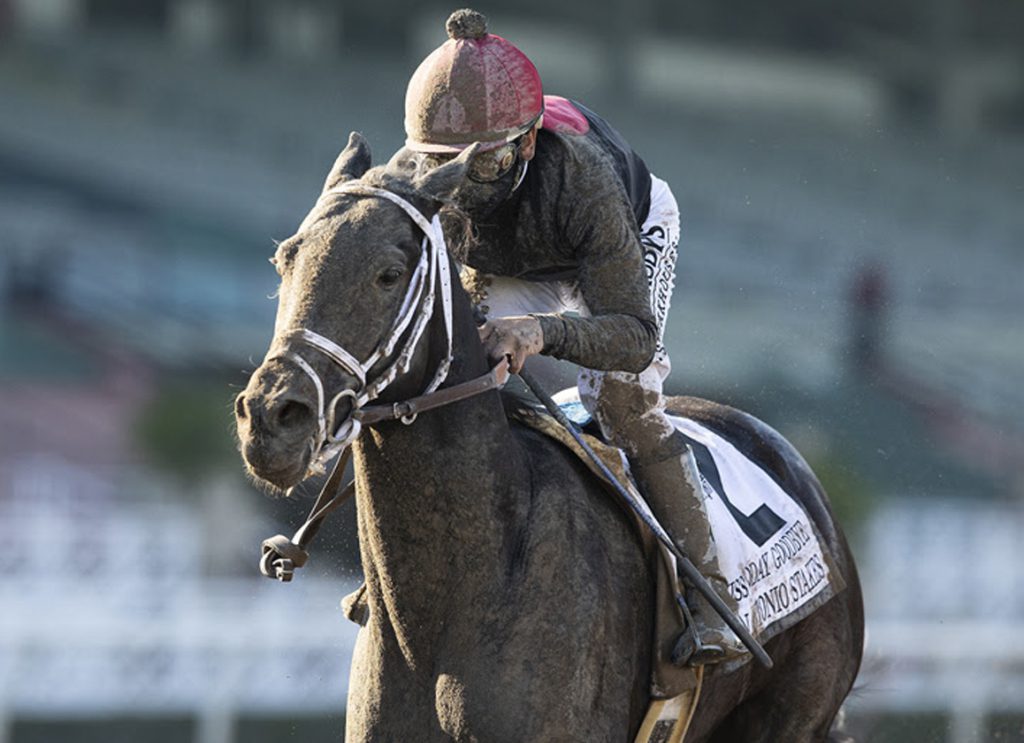
Kiss Today Goodbye | Benoit Photo
In the era of the super trainer, then, here is a barn that maintains the old lifeblood of the sport: a multi-generation horseman at the helm, with loyal and experienced help, all patiently devoted to the horses that could hardly warrant the same attention and perseverance in more industrial operations. It has been a labor of love, for instance, to coax Kiss Today Goodbye (Cairo Prince) back to form at the age of six for that third place in the GI Hollywood Gold Cup on Monday.
“Very difficult horse to train,” Kruljac admits. “My crew has done a fabulous job with him. It's taken us a long time to take his negative energy and make him a happy horse. It was worth the five or six months, though, so let's hope he keeps going forward now.”
And whisper it, but with a Breeders' Cup in his backyard this fall, perhaps we might even see the horse test the water this summer.
“We'll play it by ear,” Kruljac says. “See how he's training at that time. If he's as on fire as for the last few races, we might try the [GI] Bing Crosby, which would tell us whether he's good enough to think about that.
“It's been a long time since I've had a really good horse. But I've been blessed for the money I've been able to muster. Even for a couple of Vron's losses, there were things that went wrong in the race; and like I said, maybe I was running him back a little too quickly. But once we gave him the time, worked with him, brought him back slow, just handled him with kid gloves… I feel he's better than ever.
“To have this horse, at this point, I feel so fortunate and privileged. I'm fired up because of Vron, he gives you a little more energy to get up and get at it. So we're just living large right now, and thanking our lucky stars. Hopefully we can just keep this horse running for another year or two, keep him going onward and upward.”
The post Vron Couldn’t Have Chosen A Better Barn appeared first on TDN | Thoroughbred Daily News | Horse Racing News, Results and Video | Thoroughbred Breeding and Auctions.
