With Extra Veterinary Help And StrideSafe Sensors, Arizona’s Rillito Park Was Much Safer In 2023

Last year's meet at Rillito Park generated the kinds of headlines no racetrack wants. The track saw seven deaths from 63 races in the first four weeks of its meet, several of which came on opening weekend.

This year's season was a different story.

The Arizona Department of Gaming has the track's 2023 record officially as showing two fatalities during the meet, but Rillito management considers that the meet was free of any racing-related deaths. Dr. Ed Ackerly, president of the Rillito Park Foundation, points out that neither fataility was related to musculoskeletal injury sustained during racing. One was a Quarter Horse who died in the gate; a subsequent necropsy showed the horse died of natural causes. The other was a Thoroughbred who was overcome with heat exhaustion and died after being vanned back to the barn.

Either way, the improvement is significant from the prior season.

It corresponds to additional veterinary resources Arizona tracks have had so far this year.

“If I had to try to attribute that to anything, I think that again, I did have a second veterinarian working alongside me with pre-race exams during the months of March, April, and May,” said Dr. Sue Gale, equine medical director for Arizona at a meeting of the Arizona Racing Commission in May. “All the horses were getting complete exams.”

Between March and May, there were 41 horses scratched from races for lameness and added to the veterinarian's list.

[Story Continues Below]

Although statewide racing fatalities in Arizona are still higher than the national average recorded by the Equine Injury Database, Gale points out that the state is trending lower than in past years. For the fiscal year 2023, overall Thoroughbred fatalities are at 2.24 per 1,000 starts compared to 2.59 last year. (The national average for 2022 was 1.25.) Turf Paradise is down to 2.14 versus 2.31 last year; Arizona Downs showed an increase from 0.97 last year to 2.17 this year but that was prompted by one additional death in its very short meet.

Since Arizona resumed cooperation with the Horseracing Integrity and Safety Authority, it has adopted a void claim policy, which historically it did not maintain. From March until May, the state recorded 100 claims at Turf Paradise, nine of which were voided, and 14 claims at Rillito, none of which were voided.

Rillito's figure was down to 1.64 fatalities per 1,000 starts (if the two non-musculoskeletal deaths are included) this year compared to over 10 last year in what Gale called a “tremendous improvement from one year to the next.”

Rillito Park general manager Mike Weiss said that a trial use of the StrideSafe sensor helped veterinarians provide additional screening for horses who may be at risk of injury. StrideSafe relies on motion sensors to detect changes in a horse's motion and provides a green, amber, or red rating for a performance demonstrating how much deviation the horse's movement showed from normal.

Complete data can't be released publicly since the use of the sensors was part of an academic study, but Weiss said the trial, which cost $45,000 for 18 race days, was an encouraging first experience from the track's perspective.

“Because this was an experiment and it wasn't official, we didn't take the red ratings and put it straight onto a veterinarian's list,” said Weiss. “However, we contacted the trainer and said, 'Your horse red-lighted; we'd like you to have a vet look at the horse prior to re-entry.' If or when the horse did enter, whether it was weeks or whatever later, we had our own equine wellness program in place where we had vet students and vets pre-check every single horse. They went through every horse anyways, with the direction, 'Do not be afraid to scratch. This is about safety. This is about equine wellness.'”

Support our journalism

If you appreciate our work, you can support us by subscribing to our Patreon stream. Learn more.

For StrideSafe CEO Dr. David Lambert, the trial at Rillito demonstrated a useful shift in culture for the trainers and veterinarians who received the data. He's hopeful that the system, which provides better readings the more times an individual horse is monitored, will ultimately create a mentality of collaboration between regulatory vets, private vets, and trainers to get horses the diagnostics they may need and avoid many musculoskeletal fatalities.

“I think the thing that was most rewarding about it was the way in which the culture changed, right in front of my eyes,” he said. “When we showed up, there was a lot of resistance. But when we started giving the information to the veterinarians and they'd talk to the trainers, explaining the kinds of things we'd seen. Instead of pushing back, they started absorbing things and taking a look at their horses in greater detail.

“It only took one or two of them to find things and it spread a little bit like wildfire around the place that this was revealing stuff.”

Lambert said the sensor picked up on one abnormal run from a horse who ended up having a chip in a fetlock. Another horse got an unusual rating while moving through a turn, and was later found to have a broken tooth which had cut into the horse's cheek on one side, inhibiting steering.

“These little unique anecdotes got the ball rolling a little bit and people were interested,” said Lambert. “Trainers were very curious to learn more. I think they were pleased when they learned we weren't scratching horses. This isn't a technique to scratch a horse. What it is really, how I want them to look at it, this is a post-race welfare and soundness assessment. If trainers and owners can see it in that way, and see it as an early warning system that something just shook loose, that changes the feeling behind it. If the trainers start looking at it as one more hoop to jump through, that scares them, but it's not for that. If we just get the information to go to the trainer, that's it. It doesn't need to go anywhere else.”

The post With Extra Veterinary Help And StrideSafe Sensors, Arizona’s Rillito Park Was Much Safer In 2023 appeared first on Horse Racing News | Paulick Report.

Source of original post

HISA `In Communications’ With Parx Over Standing Water on Track

After heavy rains forced Parx to abandon the last race on Tuesday, the Horseracing Integrity and Safety Authority (HISA) said it was “in communication” with the racetrack after race replays showed that Wednesday's races were conducted with a large pool of standing water on the inside rail in the stretch.

“HISA has been made aware of the concerning video of the standing water on the track surface at PARX and is gathering more information about the current surface testing metrics at the track,” a HISA spokesman said. “We are in communication with racetrack management to better understand how the surface could have been deemed safe for training and racing today.”

A smaller puddle was visible on the backstretch, with a far larger one in the homestretch. The races were conducted without incident.

The post HISA `In Communications’ With Parx Over Standing Water on Track appeared first on TDN | Thoroughbred Daily News | Horse Racing News, Results and Video | Thoroughbred Breeding and Auctions.

Source of original post

$500,000 Kantharos Filly Leads ‘A Productive Exercise’ at Inaugural Midlantic June Sale

TIMONIUM, MD – The inaugural Fasig-Tipton Midlantic June Sale of 2-Year-Olds in Training drew a fairly limited catalogue of 99 juveniles that had some consignors worrying about a lack of buyers, but the auction ultimately proved a good first step in remaking the juvenile sales calendar. A filly by Kantharos brought the auction's top price of $500,000 when selling to bloodstock agent Steve Young. The juvenile was one of four to bring six figures Wednesday in Timonium.

“I would be less than honest if I said we weren't a little disappointed with the number of horses that we received,” Fasig-Tipton President Boyd Browning said at the conclusion of Wednesday's auction. “But I would also be less than honest if I didn't say we were very surprised at the strength of some of the results. I think it clearly demonstrated that there was a legitimate marketplace here for quality horses. There was significant demand and bidding well above reserves on the top-priced offerings.”

From a catalogue of 99 head, 79 juveniles went through the sales ring Wednesday with 59 selling for a gross of $2,541,000. The average was $43,068 and the median was $26,000. With 20 horses reported not sold, the buy-back rate was 25.3%.

“I thought it was a productive exercise,” Browning said of the final results. “I think the folks who came were generally rewarded, but it's like everything else in the marketplace, there is still fragmentation and segmentation. All in all, I would say it was a successful effort, but not an overwhelming, 'Oh, my god, it was fantastic' and there are going to be 400 horses here next year.”

Clovis Crane admitted the day before the auction that he expected a buyer's market at the first June sale in Timonium, but after selling the sale-topper Wednesday, the Pennsylvania-based horseman said he was pleasantly surprised by the market.

“In all honesty, I got fair market value for my horses,” Crane said. “Maybe there was a hole or two here or there, but the way the sales have been trending, it was pretty much business as usual. I was extremely tepid coming in here, but at the end of the day, after the smoke settled, I think the market was fair. I am saying that and I walked out with the sale topper, but I had a lot of other horses in here that I think they moved along plenty fair.”

Consignor Cary Frommer had the session's second-highest priced offering when she sold a daughter of Arrogate for $225,000. She admitted it was a tough market, but she has hopes that the June sale will gain traction once these graduates hit the track.

“It's very, very tough to get over about $30,000,” Frommer said. “I think there is a mindset with the buyers that this is just the last sale of the year type thing. When, in fact, we have all commented that there are some really nice horses in the sale. I think they are getting missed a little bit, but maybe it will get stronger by next year when these horses come out running.”

Although slim on numbers, the catalogue did attract plenty of attention from buyers off-site, who were active bidding over the internet and over the phone.

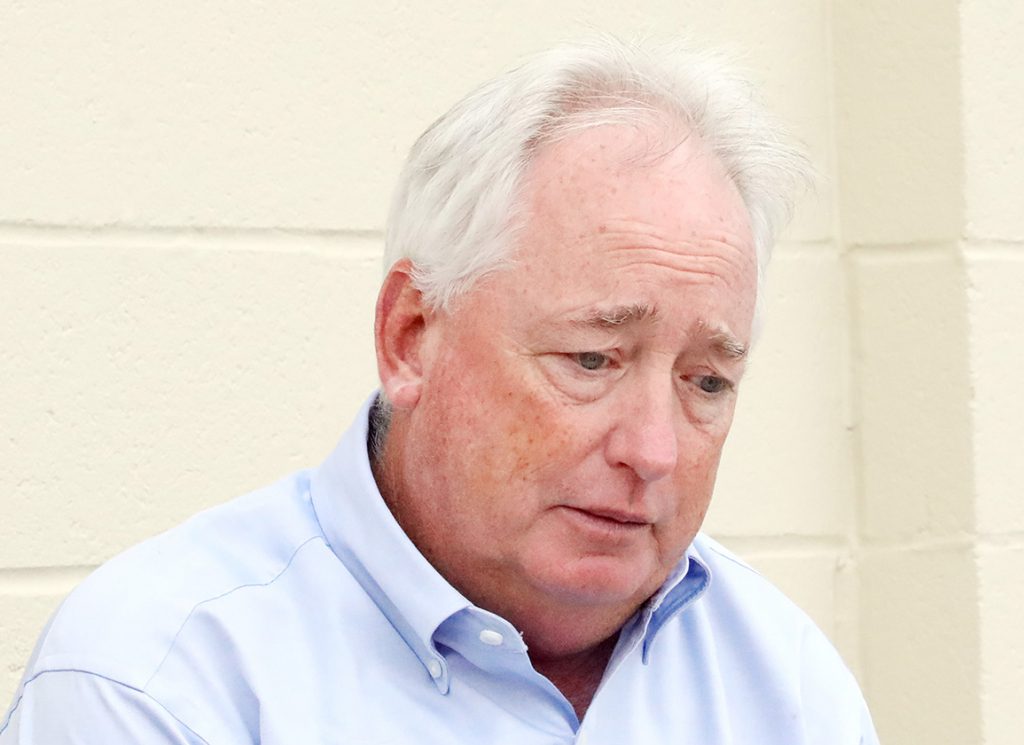
Boyd Browning | Fasig-Tipton

“There was a lot of internet activity,” Browning confirmed. “We are seeing an increasing comfort level of buyers to watch horses on the internet and to evaluate breezes. The most interesting thing from a technology standpoint was the amount of vetting that was done off-site. I am going to bet you that 90% of the vetting was probably done by veterinarians who weren't on the sales grounds who were able to access the repository and evaluate those X-rays. And maybe that's something that we look to grow and be strategic with–how do we increase the technology. That might be an angle that we look to in the future as well.”

One of those off-site buyers was Dennis O'Neill, who bid on three horses and walked away with a filly by Practical Joke (hip 46), who was purchased for $79,000. Consigned by Tom McCrocklin, the juvenile had RNA'd for $70,000 at the OBS March sale.

“I went through all the breezes and there were three of them that I really liked,” O'Neill said of his process in going through the June catalogue. “This filly was in the March sale. I had seen her there and I really liked her. She had some physical issues; I think shins and something else. I really liked her, I just couldn't get anyone to buy her with the physical issues. And then when I saw she showed up here, I thought her breeze was fantastic. And then she vetted perfect. Everything was good on her today.”

O'Neill admitted that seeing the horses he was bidding on at previous sales gave him confidence to move forward with them.

“This filly I knew. I had seen her before,” O'Neill said. “There were two others that I bid on and I had seen them before. They were both in the Maryland sale in May. It is a little stressful if there is something in there that I haven't seen. And then you kind of have to trust the vet. For me, I do like to put my eyes on them.”

O'Neill said he thinks the Midlantic June sale does have a spot on the calendar going forward.

“This sale almost took the place of the California sale,” O'Neill said. “There were always a couple of good horses out there at that sale. But my opinion, for 40 years, is that a good horse can come from anywhere. I bought Goldencents from the supplement of the [OBS] June sale and at the time they said no good horse could come out of the June sale. I am convinced that a good horse can come from anywhere.”

Asked about the prospect of returning to Timonium in June of 2024, Browning said, “I would think so. I never want to make any guarantees or promises until we go through and evaluate and see what happens through the yearling sales and make plans. But I think when you sell a horse for $500,000 and several others for over $100,000, there was good trade. My gut reaction is yes. But we don't make too many bold proclamations the day of the sale or the day after the sale. A lot of times you are better off catching your breath and evaluating and try to make an intelligent decision on how to best serve the marketplace. If we can serve the marketplace, it makes sense. If there isn't a need in the marketplace, we won't do it. If you are serving the marketplace, it will grow and it will prosper.”

After making the inaugural sale's top bid, Young admitted he hopes to be back again next year.

“This is a great place to buy 2-year-olds, it always has been,” Young said. “I hope [the sale returns next year] because Fasig-Tipton deserves it.”

Kantharos Filly Stands Out

Hip 47 | Fasig-Tipton

A filly by Kantharos (hip 47) stood out on the track with a bullet quarter-mile breeze in :20 4/5 and duly delivered in the sales ring when selling for $500,000 to the bid of bloodstock agent Steve Young Wednesday in Timonium. Young, who was bidding on behalf of an undisclosed client, said the filly will be joining the barn of trainer Todd Pletcher.

“She is a tremendous physical,” Young said. “When you buy horses at that number, they have to be able to stack up to the horses that were sold at other sales. And she does that. She had a terrific work and she is a very talented filly.”

The chestnut is out of La Titina (Distorted Humor), a daughter of multiple Grade I winner Ask the Moon (Malibu Moon). She was consigned by Crane Thoroughbred Services and was purchased by Clovis Crane for $125,000 at last year's Keeneland September Yearling Sale. She RNA'd for $110,000 following a :10 1/5 work at the OBS April sale.

After praising her breeze over the dirt this week, Young admitted, “I saw her breeze [at OBS], but I didn't see her up close.”

Following her bullet breeze Tuesday over the dirt surface at the Maryland State Fairgrounds, Crane said the filly had not liked the synthetic surface in Ocala and had only a handful of views before the April auction.

“The instant I stepped onto the synthetic with her, I knew I was in trouble,” Crane said Wednesday. “She just didn't like it at all. The extra month and a half gave me time to tighten her up and get her ready to go farther and prove that she could run. I had seen it several times at home, but when you can actually prove it in front of everybody, that's what matters.”

In addition to her bullet breeze this week, the filly also has a pair of published works at Penn National, most recently going four furlongs in :47.20 (1/21).

“We are going to send her to Todd at Saratoga and we like her enough that she'll tell us when to run her,” Young said. “The foot traffic here is light–if she was in a sale where she would have been looked at by 50-100 people, then we always like to give them some break. But she appears to be doing very good mentally and I think she can go straight on to the races.”

Charles Takes Home Arrogate Filly

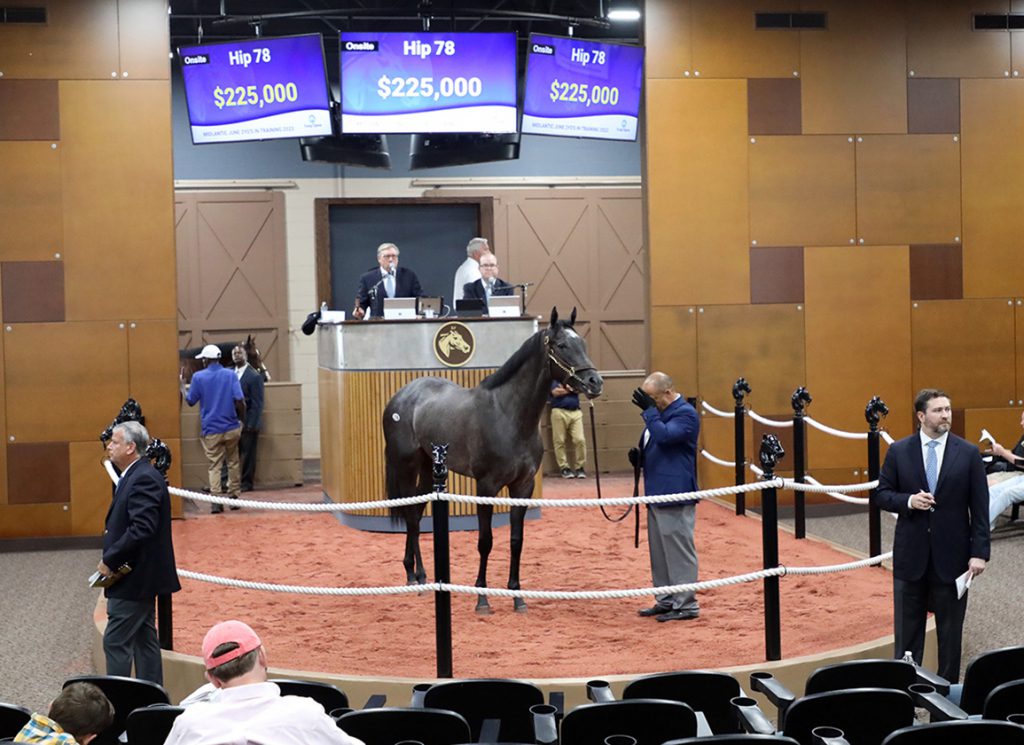
Hip 78 | Fasig-Tipton

Ellen Charles of Hillwood Stables bought out her pinhooking partners to secure a filly by Arrogate (hip 78) for $225,000 during the Fasig-Tipton Midlantic sale Wednesday. Barry Berkelhammer signed the ticket on the juvenile, who was consigned by Cary Frommer. Frommer had purchased the gray filly for $170,000 at last year's Fasig-Tipton New York-bred Yearling Sale. Following a :10 1/5 work at the OBS March sale, the filly was purchased by agent Mike Ryan, but was ultimately returned and came into the Midlantic sale with a :10 3/5 work.

“Mike bought her for $250,000 and there was a problem with the owner who decided not to keep her,” Frommer explained. “We took her back. She had a chip in an ankle, we took it out. We haven't done too much with her until this sale. She was back here for sale.”

The filly, the final juvenile by the late champion to sell at auction, is out of Summer Shade (Stephen Got Even) and is a half-sister to stakes-placed Harmon (Cairo Prince). The mare is a half-sister to multiple graded winner Hot Summer (Malibu Moon).

“I think she is destined to be a really nice horse,” Frommer said. “Mrs. Charles, who I deal with and who also pinhooks a little bit herself, she decided to stay in on her and just go ahead and buy us out. She probably got the nicest horse in the sale.”

The post $500,000 Kantharos Filly Leads ‘A Productive Exercise’ at Inaugural Midlantic June Sale appeared first on TDN | Thoroughbred Daily News | Horse Racing News, Results and Video | Thoroughbred Breeding and Auctions.

Source of original post

Verified by MonsterInsights