Few decades resonate still in the consciousness of sports, yet many of the names and faces of the 1930s remain well known to this day.
Month: June 2023
Six Takeaways From Day One Of The Track Superintendent Field Day
The 22nd annual Track Superintendent Field Day took place this week at Horseshoe Indianapolis, with an agenda that ranged from soil science to HISA to Canada Geese.
With recent media coverage focusing on racing safety, it has become more important than ever to understand everything that goes into making surfaces safe and consistent.
Here are a few of the things we learned from Monday's sessions:
–When it comes to dirt surfaces, ideal condition doesn't depend just on the proportion of ingredients – it also depends on the sourcing of ingredients used. Clay, sand, and silt all have different particle sizes and chemical properties, which means they interact with water and machinery differently. Michael DePew, a social scientist who works regularly with Horseshoe Indianapolis, said that for him, the idea equine surface would be 70 to 85 percent properly-sized sand with the remaining material 15 to 30 percent silt/clay.
DePew said track supers often end up blending sand from two or three sources to get the amount they need. There's a significant range in particle sand particle sizes, which makes the composition more complicated. Natural sand is preferred because manufactured sand particles have jagged edges to them and continue to break down further as they're worked. Natural sand remains more consistent under machinery but it can be difficult to source, and tracks sometimes have to switch suppliers to keep surfaces refreshed.
–Chemistry of the soil matters. The water used to irrigate dirt surfaces is often richer in sodium than rainwater. That means a lot of positive ions are being poured into the surface, which can weaken the bond between some types of surface particles, causing them to break apart more easily when worked by machines.
–DePew was asked about his preferred machinery for rock removal. Rocks do appear in shipments of new dirt surface materials, and DePew likes to use beach cleaner devices because they handle moisture in the surface pretty well. There is another type of device which he described as being similar to a tiller with fingers on the back. This hit rocks in the surface and push them down through the cushion, but for DePew, that doesn't result in removing the problem so much as burying it.
–There is no single set of track conditions that's going to be ideal for all tracks and climates. As such, there's no single standard for maintenance measurements that's considered the safest option for everyone to use. Ann McGovern, who oversees the Horseracing Integrity and Safety Authority's Racetrack Safety Program, discussed the Authority's requirements for racetracks to report specific condition measurements. The Authority is asking for a small number of measurements at the quarter poles of each racetrack. Many track maintenance programs are taking measurements in many more spots around their ovals than what's required by the Authority. McGovern let superintendents know that the primary goal of this reporting requirement is data collection so the Authority can develop a sense of ideal ranges for a given region.
–Geese on racetracks are no joke – just ask jockey Chantal Sutherland, who suffered serious injuries in a fall she said happened after her horse spooked at a goose. Jessica Merkling, urban wildlife biologist for Indiana's Department of Natural Resources, outlined a few strategies for discouraging Canada geese from settling in racetrack infields. While some tracks may allowed limited hunting or trapping and relocation or euthanasia, Merlking said these may not be ideal solutions for a racetrack. It is legal to harass geese as long as you don't physically harm them, but you have to be persistent, sometimes chasing them away daily for weeks at a time, and many times they will come back. Also, during June and July, goslings are molting and physically unable to fly away when chased, so shooing them at certain times of the year is ineffective.
–The best strategy, Merkling said, is to make infields less inviting for them. Canada geese like areas of open, fertilized grass that comes to the edge of a body of water and will seek out those environments as their natural habitat disappears from urban development. Adding a buffer of native vegetation such as wildflowers at the edge of waterways – at least 30 feet wide and 30 inches tall – makes the area less appealing to ground-nesting geese.
The post Six Takeaways From Day One Of The Track Superintendent Field Day appeared first on Horse Racing News | Paulick Report.
Letter to the Editor: Bill Casner
Editor's note: Bill Casner, a long-time participant in many facets of racing, is probably best known for founding WinStar Farm with Kenny Troutt and winning the 2010 GI Kentucky Derby with Super Saver. Among Casner's many roles in the sport have been founding director of the Race for Education and Kentucky Equine Education Program (KEEP). He has sold his interest in WinStar to Troutt and currently operates as Casner Racing.
Horse racing is in a firestorm. We are at survival tipping point. The decisions that are made in the short term will determine whether horseracing can endure as we know it. The American public has no tolerance for what they perceive as a sport that is immersed in carnage. I commend Churchill Downs for suspending racing to take a hard look at their future and to explore solutions that will be significant in mitigating breakdowns and restoring confidence to our fans.
The one decision that would be a major game changer is to convert the racing surface at Churchill Downs to synthetic. In the released 2022 The Jockey Club (TJC) Equine Injury Database (EID) for the year 2021, injuries on dirt were 1.44 per 1,000 horse starts. Turf injuries were 0.99 per 1,000. Injuries on synthetic were vastly diminished with 0.41 per 1,000. This data shows that synthetic surfaces are 3.5 times safer than dirt and 2.2 times safer than turf. These stats are compelling in showing the exponential safety of today's synthetic surfaces over dirt and turf.
The data is compelling but it doesn't tell “WHY” synthetic tracks are safer. Back in 2006, I chaired the shoeing committee for TJC Welfare and Safety Summit. We were tasked to examine the safety of toe grabs which Dr. Sue Stover at UC Davis had shown to significantly contribute to breakdowns. We employed sophisticated high-speed cameras with a closed group of nine horses provided by Chris McCarron's jockey school to understand why toe grabs were contributing to breakdowns. We filmed the hoof's contact with the racing surface using a variety of shoes with varying toe grab lengths on both dirt surfaces and Keeneland's synthetic track.
The results were dramatic. What we learned was the effect of “slide” on the lower limb of the horse. With Queen's Plates, the front foot has an average slide on dirt of 3 1/2 to 5 inches. The average slide on synthetic was 1 1/2 inches. Slide is important to understand. It's the “give” in a horse's stride. The increased length of slide on dirt causes two things to happen. First, it magnifies torque on a horse's lower limb. If a horse “toes in” the limb incurs torque medially because of the increased forces on the outside of the hoof. If they toe out, then the torque is lateral with the increased forces on the inside of the foot. And when horses step in holes on a dirt track, the torque can go either way. This doesn't happen on synthetic tracks because of the shorter slide which greatly diminishes torque. Also, a horse's foot is always landing flat on a synthetic surface as opposed to the cuppy holes that cover a dirt track. Synthetic also provides a much higher energy absorption than dirt with a higher energy return.
The second important factor that we were able to measure was the magnified load on the pastern that was presented on dirt. Because of the exaggerated slide and delayed break over on dirt, the pastern continues to load through the stride, increasing its drop by as much as an inch over synthetic. We were also able to see this increased load when horses landed in the “holes” created on dirt tracks.
As you can visualize, the increased load or drop of the pastern creates excessive strains on the suspensory apparatus of the horse's lower limbs magnifying the opportunity for a catastrophic failure. When a horse blows out its suspensory apparatus in a race it leads to a broken leg in the next few strides.
Suspensory and tendon injuries are extremely rare on synthetic but occur way more frequently on dirt because of these magnified strains.
The videos also exposed how lethal toe grabs were on all surfaces. They were especially detrimental on synthetic because they abruptly stopped the foot not allowing any slide. This is why trainers were experiencing rear-end injuries early on because they were continuing to use toe grabs on the rear feet.
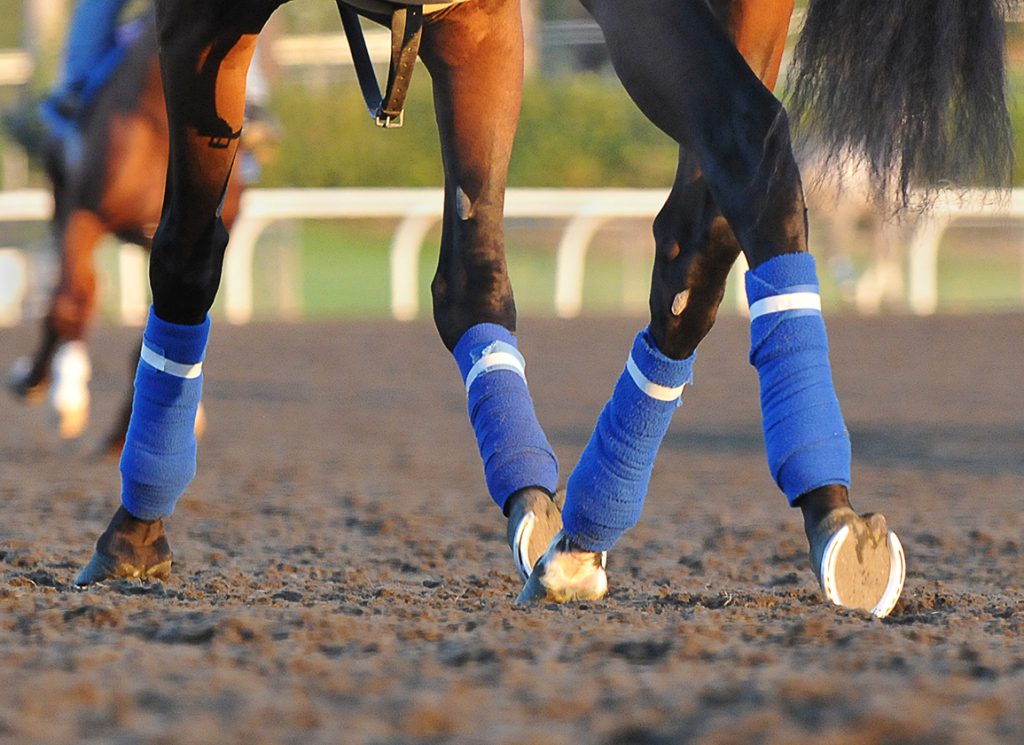
Sarah Andrew
Catastrophic break downs are rarely caused by one bad step although this is more likely on dirt. As most orthopedic surgeons will testify, they are the result of cumulative microscopic injuries that accrue with the thousands of steps a horse accumulates in training and racing. It's the laws of physics. Excessive torque and loads on a horse's legs will eventually take its toll. With a synthetic surface these strains are greatly diminished and a horse's natural ability to remodel its bone will repair and strengthen it at a cellular level.
We not only have the irrefutable data over hundreds of thousands of horse starts on synthetic but we have the notable success of several major tracks that have employed them.
The first is Keeneland. The last meet they ran on synthetic in 2014 was the most successful meet in Keeneland's history at that point. All-time attendance and handle records were set. There were record field sizes, minimal scratches with inclement weather when races were taken off turf. And most importantly, there were zero breakdowns!
The second is Santa Anita. The last meet run at Santa Anita in 2009 had an injury rate of 0.57 per 1,000 horse starts compared to their pre-synthetic era on dirt of 2.78 per 1,000. That computes to a 4.8 times higher safety record. This is in spite of a poor-quality installation that would not properly drain, eventually having a subsurface membrane failure allowing aggregate to float to the surface.
Here are some compelling stats from three tracks currently running on synthetic surfaces: Golden Gate, Presque Isle, and Gulfstream.
Golden Gate had an injury rate of .38 per 1,000 with 12,986 horse starts in 2021 and 2022 on their Tapeta surfaces.
Presque Isle race meets in 2021/2022 had 0.24 injuries per 1,000 with 8,178 horse starts.
Gulfstream with its newly installed Tapeta track had the best record of all with only one injury out of 7,085 horse starts with 0.14/1,000. This translates to a 9.7 times safer surface than their dirt track.
Belmont has recognized the advantages of having a synthetic surface with its scheduled completion in the spring of 2024.
Injuries on a national basis have dropped significantly at certain tracks since the implementation of intensified pre-race veterinary examinations of our horses and have the promise of continuing to diminish injuries with mandated requirements by HISA. This high-level scrutiny of starters combined with the safest possible racing surface will dramatically reduce injuries and show the world that we care.
Horseracing is a sport with a rich history of tradition. The thought of changing the racing surface of the Kentucky Derby to a synthetic surface will not appeal to those that value tradition above the safety of our horses and the survival of our beautiful sport. If we do not take drastic proven steps to significantly eliminate breakdowns we are destined for the fate of Greyhound racing.
Today's public has no stomach or tolerance for what they perceive as abuse of our horses. The “writing is on the wall” or in our case the New York Times, CNN and the 6 o'clock news. We either embrace innovative change supported by the data to maximize safety for our horses and riders or we are destined to experience a slow painful death.
The post Letter to the Editor: Bill Casner appeared first on TDN | Thoroughbred Daily News | Horse Racing News, Results and Video | Thoroughbred Breeding and Auctions.
Robin Goodfellow’s racing tips: Best bets for Tuesday, June 13
Mail Sport's racing expert Robin Goodfellow delivers his tips for Tuesday's racing from Ayr, Brighton, Salisbury, Southwell and Wetherby.
