They know perfectly well, by this stage, that the apostrophe shouldn't be there. They've been asked, and told, about it often enough. But you know what? They're fine with that. They have come round to the view that it fits the horse, that quirky outlying touch; fits their whole story. Because really there's no way they should be here, either.
“Every year, 20,000 foals are born,” reflects Anthony Sagan. “And only 20 make it to the Derby. But not only did we make it, we were a length off winning it. We almost pulled it off, almost shocked the world.”
Sagan's father Phillip is one of the two octogenarian namesakes in the entourage who prompted the naming of Two Phil's (Hard Spun), that consoling sunbeam through the black clouds that had gathered over our sport last Saturday.
Even the 20 who drew a gate for the GI Kentucky Derby had not yet finally confounded the odds. No fewer than five were withdrawn between declaration and post time, three substitutes completing a field of 18. But Two Phil's, bred from the only Thoroughbred the Sagan family ever bought and ignored by every expert in the first session of the Keeneland September Sale, not only showed that he belonged. He actually took command turning into the stretch, and saw off every challenger bar Mage (Good Magic).
Second place, so near and yet so far, notoriously invites mixed feelings. But the Two Phil's team are still buzzing from an unforgettable day, even if it's only human to dwell on the bittersweet sense that Two Phil's touched, but could not quite grasp, the hem of turf history.
“Yes, we were happy and sad all in the same moment,” Sagan admits. “We were so proud of the horse and what he's accomplished. And we were sad because we just almost did it-and the odds of us getting ever back to there are… Well, it's like winning the lottery, will be in the billions. So many people try to get to the Derby every year, so many big-time owners and sheikhs and billionaires. And a little guy like us, we almost pulled it off.”
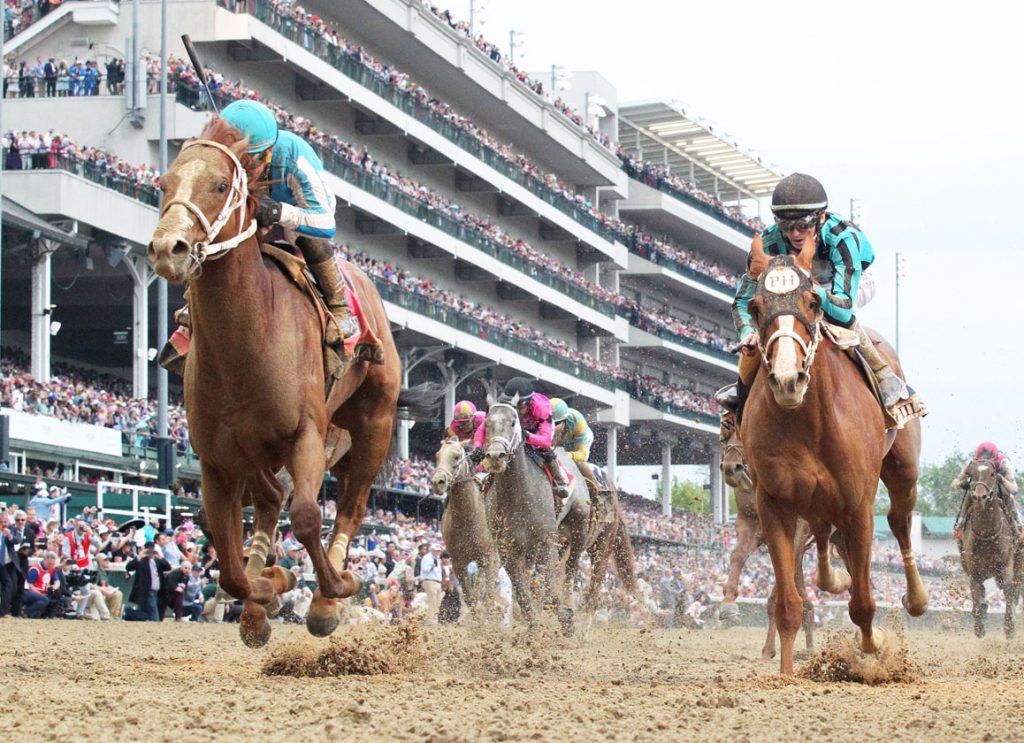
Mage and Two Phil's | Coady Photography
There had been corresponding support for the team all week, on the backside, and above all during the coveted “walkover” with Two Phil's, and the 17 others elected by fate, from the barns to the paddock. Being relative novices–the Sagans had previously only dabbled in a few Standardbreds–they were taken aback by the emotional intensity of that ritual.
“We didn't even realize that it was such a big deal, and what it entailed,” Sagan acknowledges. “It was an incredible experience; I can't even describe it. People along the rail, yelling and cheering and high-fiving us, screaming for Two Phil's: 'Let's go!' I'd never seen anything like this in my life. We didn't know how many fans the horse had out there. I think he'd kind of become a fan favorite, kind of the hard-working, blue-collar horse.”
He was also a Chicago horse, in spirit at least. His trainer Larry Rivelli won every Arlington training title from 2014 until the track's heartbreaking closure in 2021 by the same corporation that now provided the stage for this fairytale. Co-owner Vince Foglia of Patricia's Hope LLC, meanwhile, had been leading owner there since 2015. And Jareth Loveberry, who started out round a “five-eighths bull-ring” at Great Lakes Downs 18 years ago, had won its last two riding titles. Cast adrift from Arlington, here they were coming ashore with a horse that asked no favors and gave no quarter.
Poignantly, the Sagan family had spent their harness days at another doomed Illinois circuit, Maywood Park. In dipping their toe into the Thoroughbred world, however, they gave $40,000 for an unraced 3-year-old filly by a failed stallion, General Quarters. She had been recommended by two seasoned horsemen, Jerry La Sala and Gene Lotti, and their judgement was vindicated when Mia Torri became a dual stakes winner and twice finished second in graded stakes.
At this point they reached the first of many junctions, many roads not taken, on the winding road that ultimately led to last Saturday.
“The smart move would have been to sell her,” Sagan concedes. “At one point, we were being offered $300,000–plus for Mia Torri as a broodmare prospect. But she always had a special meaning to us. We'd named her after my grandma. And I always had a gut instinct, even when she got hurt and had to retire, that she could be something more. Horses like this don't come around very often. If you take the money, and then go out and buy some others, what are the chances you'll find one as good as this? The odds are way against you.”
It didn't look as though the gamble would pay off after Mia Torri lost her first foal, but she went back to Hard Spun for her second cover. This priceless conduit to the great Danzig had been picked out for the Thoroughbred rookies by Steve Leving, another stalwart of the Chicago racing scene. (Indeed, he would eventually re-enter the saga as Loveberry's agent.) Hard Spun was tough, classy, versatile, and fairly priced-and he also complemented the mare physically.
“Fortunately, the foal got the father's body and frame,” Sagan recalls. “Mia Torri's well put together, but she's not a really big, powerful-looking mare. But right from when he was born, he also got his mom's head: her demeanor, her attitude, her mental fortitude.”
The colt was foaled, raised and broken by Elise Handler at Spruceton Farm, Kentucky: yet another instance, in this story, of someone seizing a rare opportunity and reaching the highest standards. Handler got him through some of the usual baby issues and by the time the Keeneland inspectors came, they wanted to put him into Book I of the September Sale. But here was another twist in the road.
“Because with his pedigree he probably didn't probably belong in that first book,” Sagan says. “These people were experts, they knew what they were doing, and obviously saw something they liked in him. But placing him where they did probably kept us involved in the horse. Because if he'd been in Book III, we would probably have sold for $100,000.”
As it was, Hip 62 didn't meet his reserve at $150,000. They tried again, at OBS the following spring, and Jimmy Gladwell has since told Sagan that the colt had outworked all his other charges that winter. But he didn't sparkle in his breeze and it was clear that he would fall through the market cracks.
“You know what?” Gladwell said. “He's better than this. Take him home.”
With the fathers of Sagan and La Sala both sharing the same name, the colt was registered as Two Phil's and entered training with Rivelli, whose main patron Foglia also bought into the horse. (Latterly, the horse having put himself in the Derby picture, Madaket Stables came in for a piece too.) And the rest is history: Two Phil's emulated Hard Spun by winning the race now known as the GIII Jeff Ruby S., before finishing second in the big one.
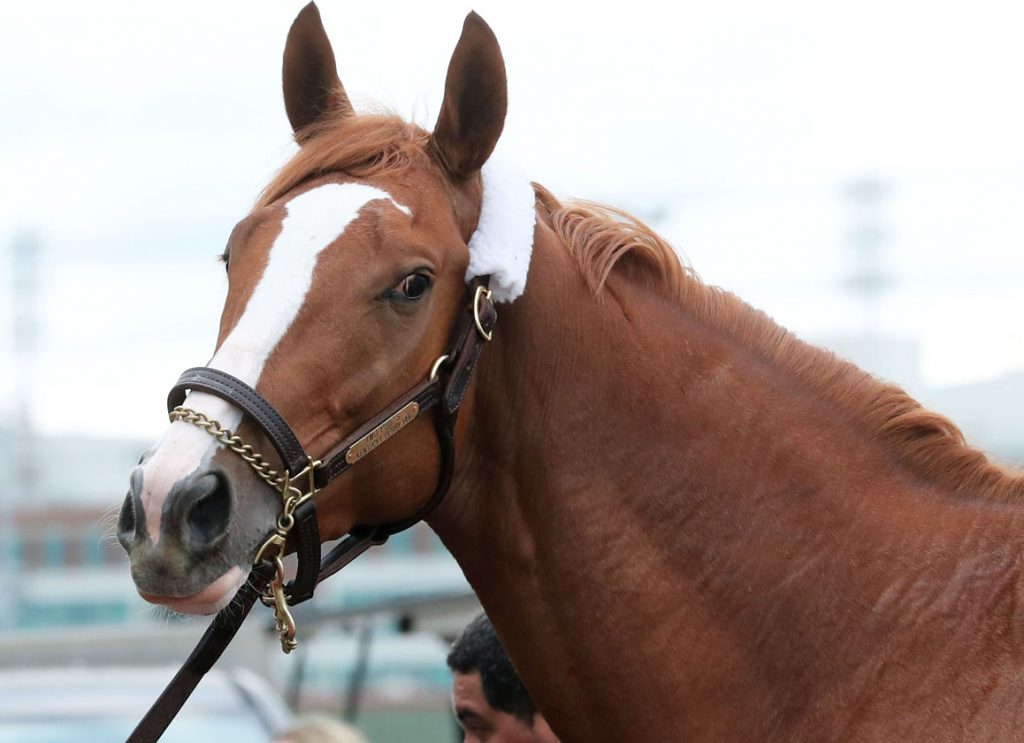
Two Phil's | Coady Photography
The Turfway race also produced Rich Strike (Keen Ice) to stun everyone in the Derby last year, but Two Phil's arrived with far wider belief behind him–not least after taking to the track so well in the GIII Street Sense S. last fall. So, while the whole team was cognizant of their privilege simply in securing a Derby gate, they weren't just in town for the ride.
“Just qualifying for the race, yes, that was a major accomplishment for this horse,” Sagan says. “But we believed that we had a real chance to win. I got there on Monday, because I knew that this was a once-in-a-lifetime shot and wanted to take it all in. And every morning on the backstretch people came up, wanted to take pictures and talk.”
A big Chicago crew assembled on raceday: Sagan's sisters, his nieces and nephews, a bunch of cousins and friends. And of course, Foglia had a lot of people with him, too, as did Rivelli. It felt like they had a long afternoon ahead, hanging out, walking around, soaking it up. The two Phils, characters both, did a spot on NBC. And before they knew it, it was time for the walkover.
Then a media group not only trained a camera on Sagan but hooked him up with a microphone and even a heart monitor.
“They said they wanted to share the experience of an owner watching the Derby,” Sagan recalls. “I said, 'Guys, I might swear a little bit!' They said not to worry, they'd get rid of that. But if we won, this would be all over the world news. My dad was down on the rail, but he couldn't even pick his head up. He was so nervous, he wouldn't watch it. He wanted to win for my mom. She just passed in December, she loved the horse, and would have been so proud to be a part of this. So, it was emotional for all of us.”
That heart monitor must have melted when Loveberry pounced from his stalking position.
“When he took the lead in the stretch, it really felt like we were going to win the Derby,” Sagan says. “I knew this horse has a huge heart, how hard he tries every time. Every other horse that had been near the front, they all finished 14, 25, 50 lengths back. But Two Phil's kicked on and got beat a length. The race he ran wins the Derby, like, nine out of 10 years. He ran a phenomenal race but hats off to Mage, we just came up short.”
Though Rivelli has decided to sit out the GI Preakness S., Two Phil's has put himself firmly in the elite of the crop and promises all kinds of excitement in the second half of the campaign. Meanwhile he has also brightened the future for his dam, who was bred back to Omaha Beach this spring. The Spendthrift stallion is already sire of her 2-year-old colt, apparently very handsome but just held up by a minor issue as a $32,000 RNA at Fasig-Tipton's Kentucky October Sale. He is in pre-training with Gladwell, while a yearling colt by McKinzie is being prepared for a likely appearance at the September Sale.
Sagan pays warm tribute to the way everyone involved, from farm to racetrack, has contributed to the development of Two Phil's.
“We're family-oriented people,” he says. “We try to stay with family businesses, and we're loyal. Everyone did a great job and we're happy that they got on the radar with Two Phil's. These horses don't come around too often, so it's pretty special for all of us. Jareth gave him a great ride. He saw the hole, he went for it, and almost pulled off an amazing upset. And with Larry, the horse always comes first. He gets them the best treatments, the best vitamins, the best feed. And he's got a great team.”

Team Two Phil's at Derby Draw | Coady Photography
After a fairly harrowing week for our community, this horse can help to keep the faith in the game's redemptive potential-if only we can do our bit right.
“Listen, I know there's a lot of black eyes around Thoroughbred racing right now,” Sagan accepts. “And these big tracks like Churchill make so much money, they should be doing everything they can to make conditions as safe as possible.
“But yes, horse racing needs these stories to keep the game going. How about Cody's Wish? That's another feel-good story. Some of these horses have a lot of meaning to people. We need to put that out there, make people realize that this game is not just about money and fame. Guys like us are a perfect example. This was sport, a hobby, something we love. Sure, it's awesome to succeed. But it wasn't our goal to make money. That's almost impossible to do. We managed to pull it off, but the horse did it, not us. He does all the work, and he deserves all the credit.”
Sagan is little too modest here. He's a poker player, after all, and has always been a gambler. And it took a risk-taker's instinct to keep his family aboard for this thrilling adventure. It would have been a more prudent option, no doubt, to take the money for Mia Torri; and not to persevere with her son when repeatedly rejected at market.
“But if you've got a good product, you stick with it, and that's what we did,” Sagan says. “We did feel this mare was going to be special. But yes, it's like a fairy story. You have one horse, you breed her, and you almost win the Derby. I remember the day he was born. Elise sent me a picture. It was an awesome thing, like, wow. But never in our wildest dreams could we imagine that any of this could happen.”
Hence the connection people demonstrated with the horse, making that Derby walkover: here was living, breathing, hard-running proof that everybody has some kind of chance.
“In the betting line, he was not a longshot,” Sagan notes. “He was 9-1, actually the fourth choice. But the story of this horse is what makes him a longshot. How he was bred, where he came from, and all the things that happened to him along the way. He was the underdog.
“Everyone on the backside was saying how good it was to see a new face get to this spot in the game. Mostly it's Pletcher, Cox, Baffert, the same guys with three or four horses every year, and the same ownership groups. Nothing against any of them. They put a lot of money into the game, and deserve any success they get. But it's good that a small-time guy with one horse can get to the Derby. It gives hope to other people that play this game. It shows that anything's possible.”

The post ‘We Almost Shocked The World’ appeared first on TDN | Thoroughbred Daily News | Horse Racing News, Results and Video | Thoroughbred Breeding and Auctions.
Source of original post
