FWD Champions Day will be held this coming Sunday, April 30, at Sha Tin Racecourse in Hong Kong (late Saturday night Pacific Time or early Sunday morning Eastern Time). The three feature races are the G1 Chairman's Sprint Prize for HK$20 million (US$2.5 million) going 1200m, the G1 FWD Champions Mile for HK$20 million (US$2.5 million) going 1600m and the G1 FWD QEII Cup for HK$ 25 million (US$3.0 million) going 2000m.
Four of the world's highest rated turf horses will be representing the home Hong Kong home team and it is very possible, if not likely, that the home team will occupy the top spot on the podium in all three races. At the minimum, they will be favored in all three races.
The G1 Chairman's Sprint Prize features Lucky Sweynesse, who has emerged as the dominant sprinter in Hong Kong. Last season, he was a progressive horse that won five of his first seven starts including his first three at Happy Valley. This season, he came out with an easy win in a Class 1 then he held on for second in the G2 Premier Bowl Handicap when he was run down by Wellington.
Next time out in the G2 Jockey Club Sprint, he sat off the pace and rallied to win by a nose in 1:07.55 seconds while getting five pounds from Wellington. Wellington got his revenge in the G1 Longines Hong Kong Sprint when Lucky Sweynesse had all sorts of traffic problems in the stretch.
But since then, Lucky Sweynesse won two straight Group 1 stakes races and a Group 2 to prep for this. Left in his wake two starts back was California Spangle in the G1 Queen's Silver Jubilee Cup going 1400m in 1:21.12 seconds as much the best. Only aged four, Lucky Sweynesse is the fastest of the fast and looks to have the sprint division at his mercy for the foreseeable future.
Lucky Sweynesse
With four superstar local runners and three Group 1 stakes races, something had to give and the G1 FWD Champions Mile is the beneficiary. Horse of the Year Golden Sixty has won this race the past two years and beat California Spangle in last year's renewal. California Spangle is fast enough to try the Sprint but I think Lucky Sweynesse might have changed his connections' mind.
Instead, he will take on Golden Sixty at a distance where he was able to beat him in December's G1 Longines Hong Kong Mile. Golden Sixty reversed that decision in the G1 Stewards' Cup going Sunday's distance and then came back to beat Romantic Warrior in the G1 City Hong Kong Cup going 2000m. He is an amazing 12 for 14 going a mile and even at the age of seven he shows no signs of slowing down. No matter the circumstances, Vincent Ho is able to find a gear that gets him home; something they have done 24 times.
It will be fascinating to see what tactics Zac Purton employs aboard California Spangle. Yes, he did set a dawdling pace in the Hong Kong Mile to hold off Golden Sixty's late surge but I still feel that his best chance is to use his brilliant speed to open up as big a lead as possible turning for home. The third 400m split will be the key, not the fourth one in my humble opinion.
That said, I'm going with California Spangle to grimly hold on in the stretch duel that we are all hoping for.
California Spangle holds off two-time Horse of the Year Golden Sixty in the Hong Kong Mile
The G1 FWD QEII Cup at 2000m has the strongest international field of the three races and as good as Romantic Warrior is going this distance (4 out 5), he could get beat. Dubai Honour is a world traveler from William Haggas that won the G1 Queen Elizabeth Stakes in Australia last start going this distance on soft ground.
Danon the Kid was a distant second here in December in the G1 Hong Kong Cup and ran well last out in Hanshin going this distance in super time. Prognosis is a lightly raced son of the immortal Deep Impact that has a wicked finish and is still improving in only ninth career start. Geraldina is a daughter of the immortal seven-time G1 winner Gentildonna that was third to Equinox two starts back to finish last year and had an easy prep for this last out.
If there is going to be an upset in the Champions Day G1 trio, it will come in this race and I think Geraldina can fly the flag for Japan as they continue to thrive on the international stage.
OCALA, FL – For the third straight day, the team of Bob Baffert and Donato Lanni, acting on behalf of Saudi businessman Amr Zedan, made the highest bid of the session, this time going to $2.2 million–top price of the Ocala Breeders' Sales Company's Spring Sale of 2-Year-Olds in Training sale so far–to acquire a colt by Gun Runner from the de Meric Sales consignment as the Spring sale continued to produce figures largely in line with its record-setting 2022 renewal.
Through three of four sessions, OBS has sold 519 juveniles for a total of $67,661,000. The cumulative average of $130,368 is down 3.7% from the corresponding end-of-day figure from 2022 and is down just 1.8% from the average of $132,821, which includes post-sale transactions from a year ago. The median of $65,000 is down 7.1% from a year ago.
“We were very pleased with the March sale and it seems like that momentum has carried on through April,” said OBS Director of Sales Tod Wojciechowski. “We set records last year and here we are bumping up against those records this year. It feels good and it is a testament to the strength in the marketplace.”
Zedan topped the sale's opening session with a $1.45-million son of Arrogate and added a $900,000 son of Frosted Wednesday.
“He's come with a big budget and that's helpful to the consignors,” Wojciechowski said of Zedan. “It probably pushes horses that he gets and hopefully, it moves buyers to other horses and they look for other top prospects that they can settle on as well.”
With 128 juveniles reported not sold after the final horse went through the ring Thursday, the buy-back rate was 19.8%. it was 16.5% at the same point a year ago.
While the figures remained stronger, consignors continued to see a polarization in the marketplace.
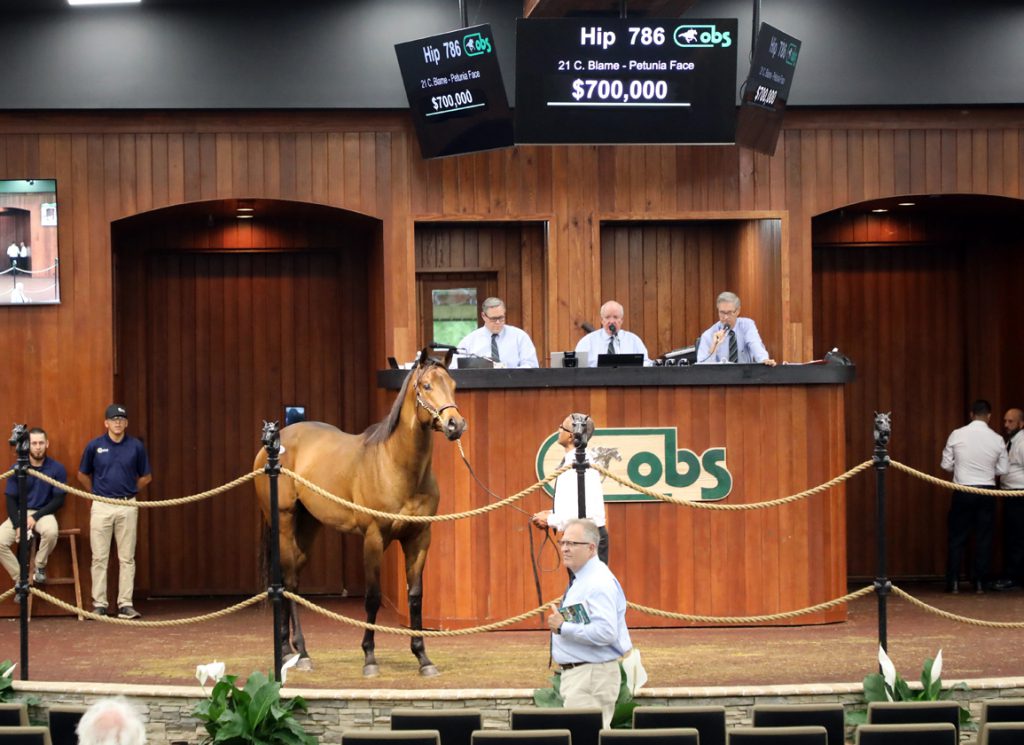
“I had so many people on that horse who just had to have him,” Jesse Hoppel of Coastal Equine said after selling a colt by Blame for $700,000. “But if you don't have the flavor of the week, they don't want to have anything to do with you.”
Hoppel said the absence of a select sale like the Fasig-Tipton Gulfstream Sale has buyers scrambling to make sense of the new sales landscape.
“I think the buyers are confused,” he said. “They don't know where to go. The 2-year-old sales market now lacks a select sale. It doesn't give you direction–where are these middle market horses going to be, where are the expensive horses going to be. Right now, they are scattered. The public doesn't have an idea of where to go for the right horses.”
Still buyers found plenty of competition for the top lots.
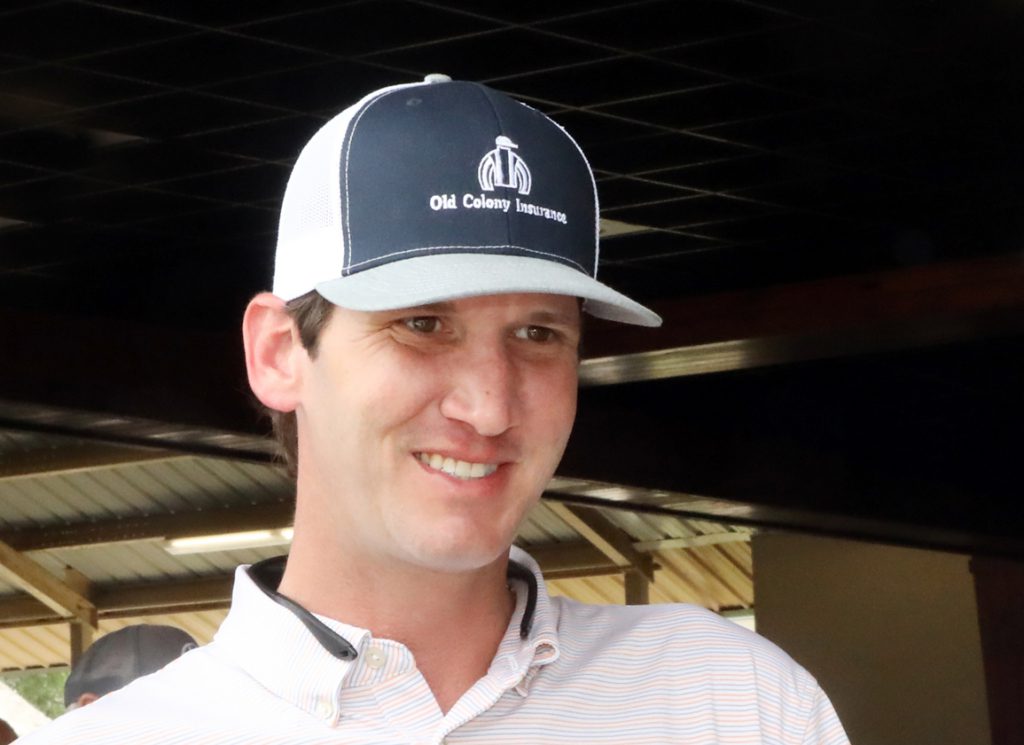
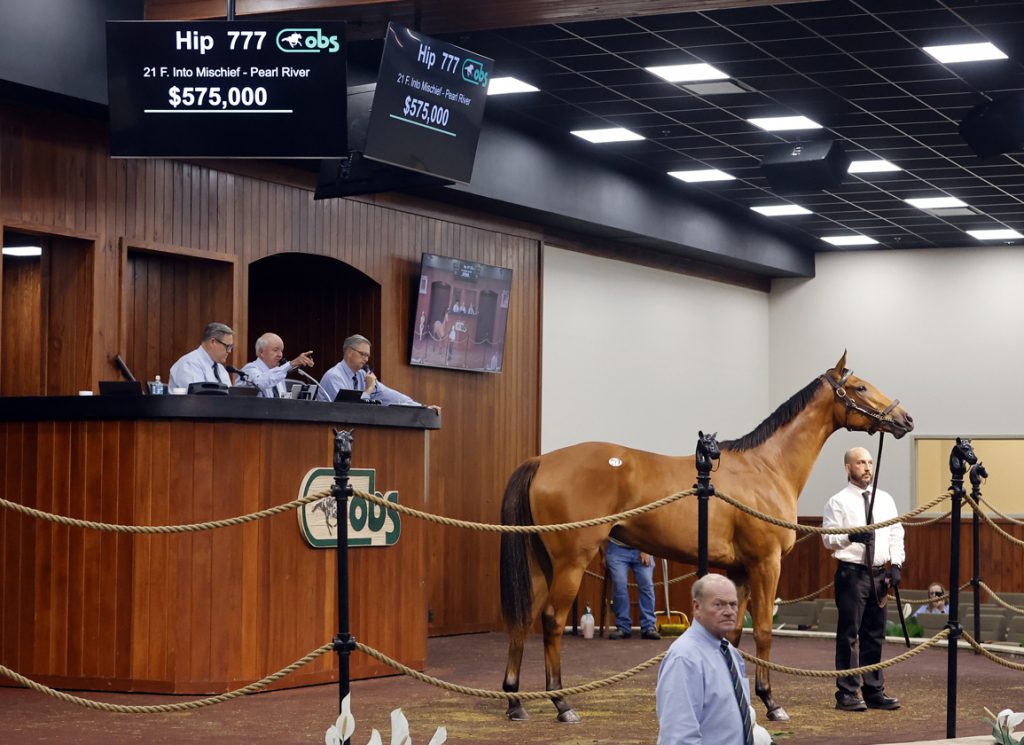
“People are saying it's a little bit spotty, but at the same time anything we followed up seemed like it's made plenty of money,” said Hunter Valley's Fergus Galvin after signing for a $575,000 daughter of Into Mischief. “I don't think it's overly strong.”
Donato Lanni | Photos by Z
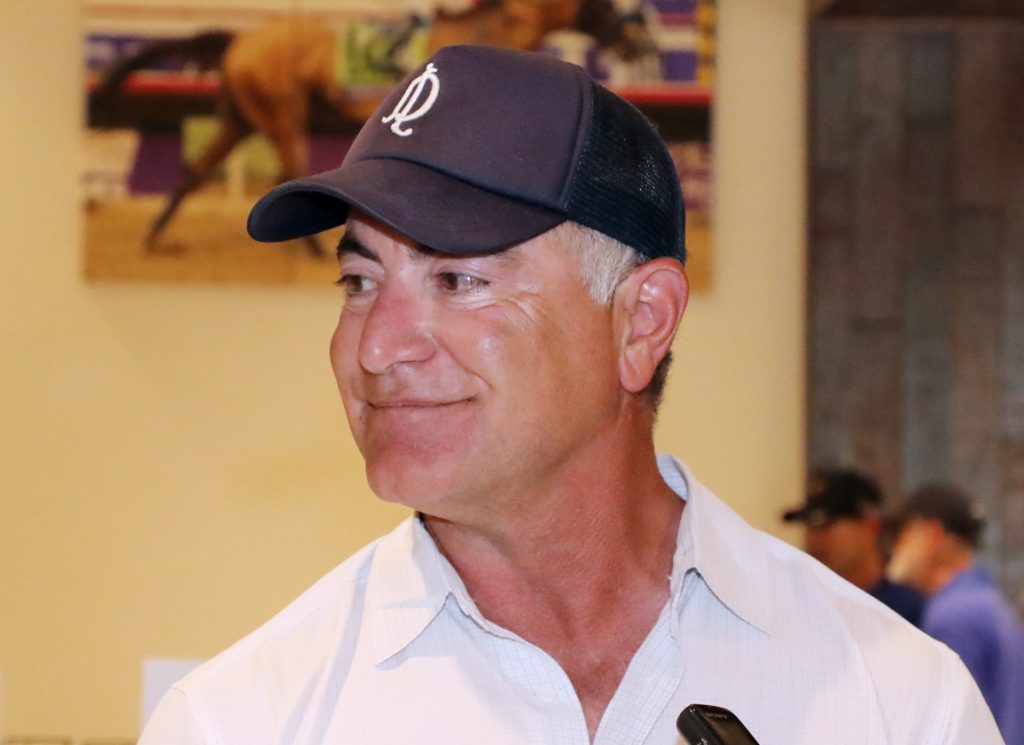
Bloodstock agent Donato Lanni, who has made the highest bid of each of the sale's first three days, said, “It's really strong for the top, top horses. The middle market looks like it is holding pretty strong. Everyone is here, so it's very strong for the top-end horses. The market was very strong here last year and we're seeing that again this year. Hopefully it continues that way.”
The OBS Spring sale concludes with a final session Friday. Bidding begins at 10:30 a.m.
Guns Blazing at OBS Day 3
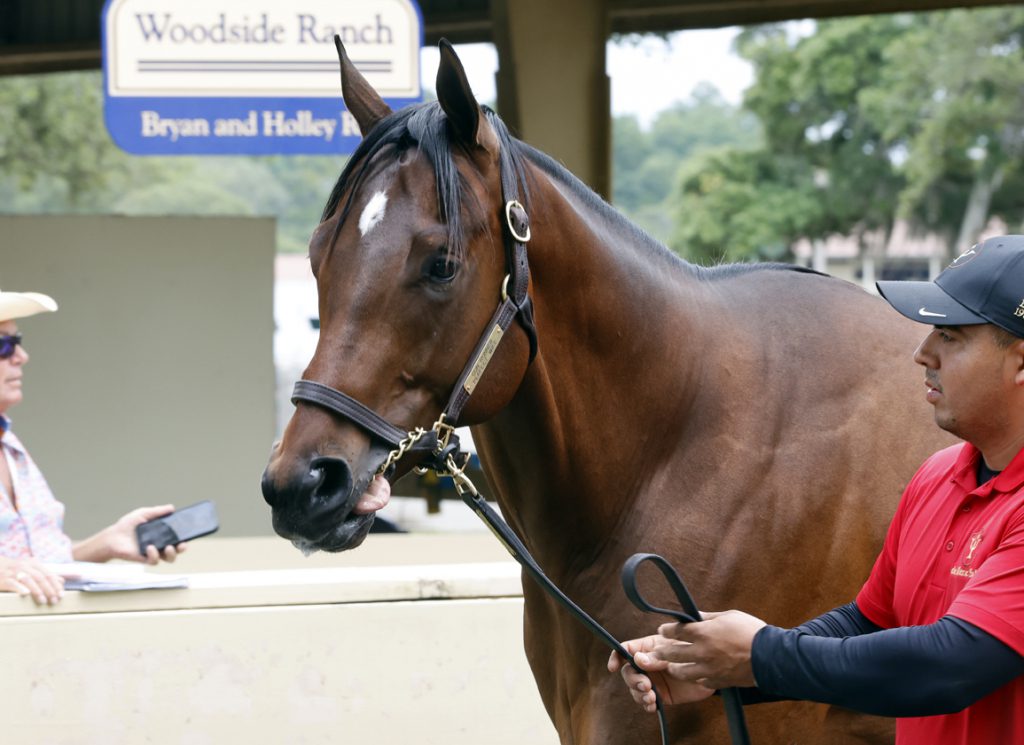
The storms that barreled through the Ocala area Wednesday night seemed like a mere breeze compared to the gale force that swept through the OBS sale's ring midway through Thursday's session. In the moments leading up to the entrance of Hip 782 into the ring, several of racing's biggest names lined up to duke it out for a juvenile colt by Horse of the Year Gun Runner. With several separate interests clashing, including agent Donato Lanni–accompanied by trainer Bob Baffert in their customary perch in the media box–and fellow Hall of Famer Steve Asmussen, who trained Gun Runner during his illustrious campaign, it was Amr Zedan's potent team that outlasted the rest to land the colt for a cool $2.2 million.
Hip 782 | Photos by Z
“That was 'wow',” said Lanni. “Amr Zedan absolutely loved him and he really wanted the horse. He was not going to go home without that horse…Bob really loved him too. The whole team did.”
Outlining some of the factors that led to the team extending to the sale-topping price through three sessions, Lanni offered, “He performed very well and had a great gallop out. He was really fast for a such a large-sized horse. He looks like he wants to go a Classic distance and has gears.”
“It's nice to see a horse with that much size by Gun Runner who looks like a two-turn horse but also has the speed. He showed it here.”
The Mar. 20 foal is out of Perfect Wife (Majesticperfection), the dam of the colt's full-sibling GSP Runaway Wife.
“Every day when you have one like that in the barn, you're kind of sweating bullets and you're worried you'll walk into the barn and find him with his legs up in the air or colicking,” said Nick de Meric. “But he's been a wonderful horse for us. Tristan and Val [de Meric] take the credit for producing him like they have.”
Bred by Fern Circle Stables, the bay brought $430,000 at Fasig-Tipton last July. Consigned by de Meric sales at OBS, the colt breezed in :10.1 last week.
“It was a ton of pressure,” continued de Meric. “Frankly, that [yearling price] was out of our comfort zone. We just all felt so strongly about him and we had a couple of partners on him, so we didn't have to shoulder the whole load.
“He affected all of us [when we first saw him] and we thought he could be something special.”
Tristan de Meric was equally enthused with the colt.
“The way this horse moved, his balance and the way he just kept it up all day long [stood out],” he said. “He always did everything right. He's a horse with a great mind and did everything right from the get-go.”
Reflecting on the colt's purchase last term, he continued,
“We definitely stretched well beyond our comfort zone, but when we were signing the ticket on him, it felt right. I am happy it all worked out. We were just lucky to have him.”
In regard to the colt's illustrious sire, who led all second-crop sires and ranked sixth on the General Sires list in 2022, the junior de Meric explained, “We started out just trying to find some nice Gun Runners because we believed in him and he had a nice run with his first crop. It was amazing what he did with his first crop.”
With the relief evident after hitting it out of the park following months of intense preparation, the elder de Meric could breath a sigh of relief now that the colt was going to get every chance under the care of the Hall of Fame trainer.
“All of us in this business know it doesn't work out like that every time. You need one of those every once in a while and that was outstanding. We couldn't be happier.”–@CBossTDN
When Jacob West signed the ticket at $700,000 to obtain a colt by Blame (hip 786) on behalf of Repole Stable Thursday at OBS, it marked an impressive pinhooking score for consignor Jesse Hoppel, who purchased the youngster for $70,000 at last year's OBS October sale.
Hip 786 | Photos by Z
“He was a very sleek horse that looked like he needed to grow up a lot,” Hoppel said of his early impressions of the colt. “I still think he has growing up to do. There is no telling how good he will be when he is finally there because he's not there yet. He's going to keep coming.”
The colt is out of the unraced Petunia Face (Congrats) and is a half to graded winner Jalen Journey (With Distinction). He worked a quarter-mile last week in :21 flat.
Of the colt's final price Thursday, Hoppel said, “I was thinking in the $400,000 to $500,000 range, but this market is really polarized. I had so many people on that horse who just had to have him. If you don't have the flavor of the week, they don't want to have anything to do with you.” @JessMartiniTDN
After a filly by Uncle Mo brought a $675,000 final bid during the first day of selling at the OBS Spring sale, a colt by the Coolmore sire (Hip 682) realized the same amount Thursday afternoon. Consigned by agent Gene Recio, trainer Keith Desormeaux signed the ticket on behalf of Dallas, Texas-based Benjamin Gase, founder and CEO of the shipping technology company R2 Logistics.
“He didn't have as much as a quick cadence as most of these eighth-of-a-mile breezers but his movement was fluid, and he still went in :10.1,” said Desormeaux. “That's what we're looking for, a horse with speed but most importantly the distance.
“I hate to use the same old cliche but he ticks every box.”
Echoing the sentiment, Recio added, “He showed himself well and just has a lot of class. He didn't turn a hair the whole time. He did all the right things.”
The colt was offered at Keeneland last September, bringing $250,000 from Lynnwood Stable. The Apr. 26 colt was offered by a partnership that included the breeder, Breed First.
Gene Recio | Photos by Z
“I fell in love with him when I saw him at the yearling sales,” explained Recio. “I didn't really think I was going to be able to buy him, I thought he was going to bring more than that.”
The juvenile is out of the unraced Bodemeister mare Mezinka, a half-sister to dual Grade I-winning Pioneerof the Nile, who also finished runner-up in the GI Kentucky Derby.
“The breeder is a good friend of mine, so I am happy for them. They stayed in for a piece. I'm happy when it all works out like that.”
The Desormeaux and Gase axis has already produced results, highlighted by a win in this winter's GII Rebel S. with Confidence Game (Candy Ride {Arg}), who was unearthed for a mere $25,000 at Keeneland last September. Confidence Game currently stands 12th on the Kentucky Derby leaderboard with 57 points.
Clearly looking to mine another Classic-bred jewel with a long-term view on next season, Desormeaux enthusiastically outlined the colt's list of attributes.
“The horse has Classic pedigree, great lines, awesome conformation and a good foot,” he said. “He was as good as you get from head to toe.”
He continued, “One of the added values is that he has great sire value, being by Uncle Mo and with Pioneerof the Nile [under the second dam]. We know he's got speed and Classic distance on the bottom.”
With the Classics still a year away, Desormeaux's ambitions in the shorter term appeared to be no less lofty.
“He's going to go to California and prepare for the GI Breeders' Cup Juvenile.”–@CBossTDN
Into Mischief Filly to Qatar Racing
Sheikh Fahad's Qatar Racing, which enjoyed top-level success along with partners with Caravel (Mizzen Mast) in last year's GI Breeders' Cup Turf Sprint, continued to build its U.S.-based string with the purchase of a filly by Into Mischief (hip 777) at OBS Thursday. Fergus Galvin of Hunter Valley Farm made the winning bid to acquire the filly for $575,000 from the Wavertree Stables consignment.
Hip 777 | Photos by Z
“We actually haven't come up with a trainer for her yet, to be honest,” Galvin said. “She will definitely stay in the U.S. She is a lovely, big filly. Ciaran [Dunne of Wavertree] recommended her well and we are very happy to get her.”
The bay filly is out of the unraced Pearl River (Quality Road) and from the family of champion Sweet Catomine and multiple Grade I winner Life Is Sweet. She was bred by Pam and Martin Wygod.
Marc Tacher purchased the 7-year-old Pearl River, in foal to Nyquist, for $50,000 at last year's Keeneland November sale.
In addition to Caravel, Qatar Racing was also partners on Shedaresthedevil (Daredevil), who was purchased for $5 million at the 2021 Fasig-Tipton November and whose 2022 campaign included a win in the GII Fleur de Lis S. The partners returned the mare to the sales ring at Fasig-Tipton last November where she sold again for $5 million.
Caravel has already started 2023 a winner, recently winning the GIII Shakertown S. at Keeneland.
“We just have to keep our run going,” Galvin said. “Sheikh Fahad is keen to establish a string here in the U.S. We've had a lot of success with turf horses and now we are trying to aim a little bit more on the dirt side.” @JessMartiniTDN
Goffs Group Chief Executive Henry Beeby had one word for Thursday's record-breaking Goffs Punchestown Sale–“Sensational.”
Taking top billing at a new record price for the auction was the Milestone Stables-consigned Qualimita (Fr) (Muhtathir {GB}), who attracted a final bid of €500,000 from Mags O'Toole. The 4-year-old debut point-to-point winner (lot 14) is from a classy German family featuring G1 Deutsches Derby hero Waldpark (Ger) (Dubawi {Ire}) and Masked Marvel (GB) (Montjeu {Ire}).
The clearance rate improved 1% on 2022's edition as 20 horses sold from 22 offered (91%) for a gross of €3,940,000 at Punchestown after racing yesterday. The average rose to €197,000 (+23%) and the median improved to €170,000 (+26%). Nine lots made €200,000 or more.
Tom Malone and Paul Nicholls picked up the 4-year-old winning pointer Histrionic (Ire) (Walk In The Park {Ire}) (lot 19) for €450,000, the second-dearest lot of the day. Consigned by Ballyboy Stables, the gelding is kin to graded-winning chasers Alfie Sherrin (GB) (Kayf Tara {GB}), Kimberlite Candy (Ire) (Flemensfirth) and Hawkes Point (GB) (Kayf Tara {GB}).
“The Original Festival Sale returned a trade that can only be described in the richest of superlatives with huge increases in every statistic and a magnificent new record top price of €500,000,” Beeby continued.
“As ever we are indebted to the vendors who put their trust in the Goffs service and sent such quality to the Punchestown Sale. They are a mighty bunch as they truly put their money where their mouth is year after year and it is fantastic to see results like these today.
“We now look ahead to the Goffs Arkle Sale in June as we put the finishing touches on an outstanding catalogue. Irish Point-to-Point handlers are the backbone of the store sale market and we were delighted to see so many of them well rewarded here at the Punchestown Sale. Last year's Arkle Sale, formerly the Land Rover, has produced more 4-year-old Point-to-Point winners this season than all other store sales combined, and there is plenty more quality awaiting buyers at the Arkle Sale from 13–15 June.”
Looking back with clear eyes, Jareth Loveberry probably shouldn't have ridden in that race.
His mount was jigging as soon as he got the leg up, and before he could leave the perpetual dusk of the Great Lakes Downs paddock, the horse swung his head back and clocked the rider right between the eyes with the back of his skull. You could tell it rocked the jockey a bit.
At that point, a rider with less constitution might have slumped out of the saddle and hit the wood chips, or at least pulled up his reins for a moment to figure out which way was up. Before he had time to process the certain headache he'd have later, an unsympathetic voice from inside the paddock cried out, “Shake it off and go get that money!”
Given the state of things at Great Lakes Downs at the time, “that money” was his share of a purse that couldn't have been more than $10,000.
His horse never broke stride after the outburst, they continued on to the track, and if there was any fog under Loveberry's helmet, it cleared in time for him to enter the starting gate, finish the race, and ride the rest of the card.
It's no surprise then, that Loveberry, 35, later mounted up for the biggest race of his life on a barely-healed fibula fracture. That time, he got the money, guiding Two Phil's to a blowout victory in the Grade 3 Jeff Ruby Steaks on March 25 at Turfway Park, and clinching a mount for his first Kentucky Derby – a new target for the biggest race of his life.
In the Derby, Loveberry will be riding for more than just the connections of Two Phil's, and the people that back him at the betting windows. He'll ride for his wife and two kids, who have endured the often-challenging life of a jockey. He'll also ride for the memory of the formative people and places no longer on this mortal coil, and in support of those he feared might join them.
That's a lot to carry under the Derby's 126-pound weight allowance, but he proved at Turfway Park that steady hands can strengthen a healing leg.
The First Rung
Loveberry grew up around horses, but not racing, in Mount Pleasant, Mich. His mother had an elderly Arabian named Chance who guided him through his earliest equine experiences, but the horse's role didn't expand much further than being a pasture decoration.
Rural Central Michigan is hardly known as a hotbed for Thoroughbred activity on the national scene, but it's there if you know where to look and who to ask.
Randy Russell was a regular presence near the top of the trainer standings at Great Lakes Downs in Muskegon. (Don't bother looking for it; it's not there anymore.) He kept a full barn at the track, two stallions at his farm servicing his broodmare band, and crops of foals waiting to go to the racetrack.
The “help wanted” sign was always out at his property, across the road from the Loveberrys' house.
“We didn't have a whole lot, so we had to earn anything that we had, so I worked over there for a summer job to make a little money,” Loveberry said. “I started working when I was 12, and when my younger brother who was two years younger than me turned 12, he started working there, and then my youngest brother started working there when he was 12.”
Loveberry quickly earned a reputation as a young horseman able to convince his charge to match his own level-headed energy. Within a year at the farm, he was breaking horses under saddle.
“From day one, he never got excited about anything,” Russell said. “Some kids, you lead them to the walker or have them cleaning stalls or this and that, and they'd be kind of nervous, but he never was.”
While his younger brothers followed Loveberry to the farm, his older brother Justin Ellsworth joined the Marine Corps. Loveberry viewed Ellsworth as a trusted protector as he navigated his early youth, which made the older brother's career in the service a natural decision, and his promotion to Lance Corporal unsurprising.
On Nov. 11, 2004, Ellsworth was killed by an improvised explosive device while on a reconnaissance patrol in the Anbar province of Iraq. His actions to clear his fellow Marines from the area before the remote device detonated earned him a posthumous Bronze Star medal for heroic service in a combat zone.
Loveberry was cleaning stalls at Russell's farm when he was called home to receive the news from his father.
The horses were only supposed to be a temporary part of the story. Loveberry wanted to attend college to become an architect, and a six-inch growth spurt between his junior and senior years of high school had him hovering around 5'8”.
At 16, he asked Russell for a reference to aid in his search for a college job. Instead, the trainer offered him a spot in his rotation of jockeys, which included Terry “T.D.” Houghton and Federico Mata, arguably the top two riders on the state's haggard racing circuit.
As a five-furlong bullring, Great Lakes Downs was a paradox for a rider, requiring early speed to get out of the gate and secure position for a one-turn half-mile race, while also having enough horse to carry that momentum out of the tight turn. Houghton and Mata were two of the best at solving that puzzle, and they took the fledgling rider under their guidance.
“He was really interested in what we could teach him, and asked a lot of questions,” Houghton said. “He had a good seat on a horse, and he was patient. He would pay attention to where he was out on the racetrack, and noticed where the horses are that are in the race with him, where he'd make his move, and where he'd position himself. He picked up on that real quick.”
Loveberry took his first professional mount on June 16, 2005 – what would have been his brother's 21st birthday.
“He went in the Marine Corps before I ever had a license,” Loveberry said. “He knew I worked at the farm, but I don't remember if he knew I was going to be a jockey or not.”
From the perspectives of pedigree and purse size, the caliber of horses Loveberry was getting on at Great Lakes Downs was about as cheap as they come. Four-furlong races for $4,000 claiming tags were the norm, and the platoon of runners was largely limited to humble state-breds and horses that tumbled down the ladder from other circuits. Some of them were pretty gnarly to deal with.
On those gnarly horses, Loveberry perfected that early-developed specialty of projecting his calmness to his mount, or at least keeping their head screwed on long enough to get through the race. Sometimes, it led to a one-way trip toward the sandy loam while the horse darted away. More often, though, it led to the winner's circle.
“We'd go to a barn, someone would say, 'This one's kind of crazy,' and then I get on him, and that horse was alright,” Loveberry said. “I just grew up around it, so it wasn't different to me. It was just normal.”
“On the bullring, position is a lot,” he continued. “I had to learn when you get to the turn, you're either in or you're out. Sometimes, I'd try to hang in there and went down a couple times. You learn your position more on a bullring than starting on a mile track, and I think that helped me a lot for positioning a horse for the turn and knowing you'd better get in, or you'd better get out.”
When autumn came, Loveberry juggled riding with his formal education, attending Baker College near the track. With Great Lakes Downs typically running night cards during the weekdays, a balanced schedule could be found if regularly scheduled sleep wasn't a priority. By his second year at the track, he was in the top 10 by wins in the jockey standings.
“I could only work horses before the break on Tuesdays and Thursdays because I had math class,” he said. “It was early mornings at the track, back to school in the afternoon, back for the races, back to the dorms to do homework. It was a lot. It was hard to manage both. Being 18 years old and getting a paycheck from the track, I'm like, 'Wow, I'll keep doing this.'”
Making His Own Name
Great Lakes Downs hosted a long meet, running from May to November, but the lake effect snow that rolls off Lake Michigan and pummels the state's west coast are too harsh for winter racing. Loveberry moved his tack to Beulah Park in central Ohio for the winter. (Don't bother looking for it; it's not there anymore.)
He didn't win a lot of races that first season, but that's not why the winters at Beulah Park mattered.
During one afternoon card, Stacie Moore visited the track to deliver a phone charge cord to her mother, a mutuel teller, and she stopped in the paddock to chat with her father, a valet, on her way out. She wasn't a regular sight at the track, occupied instead with school and holding down multiple jobs, so Loveberry had questions for the valet after she left.
“One day she was there, and I saw her and said, 'Oh my gosh, who is that blonde?'” Loveberry said. “They said, 'Oh, that's our daughter.' I was not invited to the house, but I was friends with people at the track, and their house was the hangout house.”
“They brought him around,” Stacie said. “I told them not to bring him back.”
Being in the same social circle over the course of the Beulah meet eventually made Loveberry a more welcome presence. They kept in touch when Loveberry went back to Great Lakes Downs in the spring, and in time, they began dating.
Loveberry became Russell's first-call rider during his second meet in Michigan, and he graduated from being a lanky apprentice to a lanky journeyman with relative ease. His confidence in the saddle improved dramatically, and his win percentage reflected those pieces being put together.
Jareth Loveberry in the paddock at Great Lakes Downs.
When Loveberry returned to Beulah in the winter of 2007, he and Stacie moved into a small apartment together. He came to Grove City, Ohio, with some pain in his shoulder, and he toughed it out through the end of the season at Beulah while Stacie balanced low-paying jobs at a couple restaurants and a hair salon.
At the end of the meet, the pain became too much to stand, and a doctor's examination bore worse news than expected. He'd torn a tendon, and the shoulder surgery to repair it would not only put him on the shelf for six months, but immobilize his arm to the point where he could barely care for himself during recovery.
For a young couple, this was a daunting test.
“We didn't have a whole lot,” Stacie said. “We were struggling, but we would go without ourselves before we'll owe somebody something if we can help it. All of our bills were paid. We weren't behind on anything, but I would go to the store with no money. We would buy canned vegetables because they were 59 cents, and then the little Yoplait yogurts were super cheap, and ramen noodles, and that's what we'd eat. I don't think I bought meat for months because we couldn't afford it.
“We were in Grove City, where all of my family is, and they would have fed us,” she continued. “My parents don't have a lot either, but we always had what we needed. Any of my family would have helped us, but I was 18 and he was 19 or 20, and we were just too proud, because to us, that would be failure, so we were just going to figure it out.”
Jareth and Stacie Loveberry, early in their relationship.
Every jockey colony has its share of lifers who never leave their circuit, whether the reasons are practical or talent-based, and Loveberry could have easily settled in as one of them. When he returned from his surgery, the years that followed were defined by identifying his comfort zones, and choosing which ones to move beyond.
When Great Lakes Downs shuttered in 2007, Loveberry could have followed his familiar home state connections to the recently-built Pinnacle Race Course outside Detroit (Don't bother looking for it; it's not there anymore.) and won plenty of races. Instead, he decided that true career growth meant taking his game on the road.
“I love Michigan,” he said. “Great Lakes was great. It's home, and it's hard to leave home. I was at a point where I needed to get out on my own, get out from the shadow of, 'You just ride for Randy.' I don't know if I would have stayed there or not (if Great Lakes Downs hadn't closed). I don't think so.”
Loveberry ended up at Mountaineer Racetrack, where agent John Costanzo picked up his book. Costanzo was close to Chicago-based trainer Larry Rivelli, a dominant figure in flyover country who isn't afraid to ship a horse to rack up wins. When Rivelli sent runners to Mountaineer to take advantage of the state's casino-enriched purses and softer competition, Costanzo ensured Loveberry got the mounts.
Mountaineer raced 10 months out of the year, which offered stability that many journeyman jockeys are not afforded. Jareth and Stacie married in November 2011, and if they wanted to, they probably could have stuck close to home, carved out a living, and raised a family going between West Virginia and Ohio until Jareth's riding days were over.
Even more, Loveberry picked up his first riding title during Mountaineer's winter/fall 2012 meet; shortly after he and Stacie welcomed their daughter, Kennedy.
Some might have taken this as a license to gather moss, but fellow jockey Francisco Torres convinced Loveberry there was more to be had after a pair of terse conversations; first in the jock's room, and then the next day around the barns.
“I started winning more and more, and in 2012, I won 200 races and thought, 'Man, I think I can do a little bit better.'” Loveberry said. “Cisco Torres came to Mountaineer, and he yelled at me one day. He said, 'Jock, you need to get out of here. You're wasting your time. You're a much better rider than this.' That stuck. Maybe I could make the next step.
“Whenever I see him, to this day, I thank him for it.”
Support our journalism
If you appreciate our work, you can support us by subscribing to our Patreon stream. Learn more.
Loveberry moved his tack to Oaklawn Park at the beginning of 2013, and while the Mountaineer-to-Oaklawn pipeline isn't one that shares a lot of names or horses, he pulled together a handful of mounts and wins, and made a lot of connections.
He continued to base himself on the Ohio/West Virginia circuit for two more summers between meets at Oaklawn before entering uncharted territory once again when he moved to Remington Park to ride for trainer J.R. Caldwell.
Stacie moved from Ohio to Texas, both to be centrally located to her husband's tracks and to be near Jareth's mother for assistance with the kids (their son, Colton, was born in 2016).
Hours-long weekend road trips were the norm to meet at whatever track he was riding for too-quick visits, before having to turn around to get Kennedy to school on Monday morning.
“We've been all over the place,” Stacie said. “We've spent most of our relationship long-distance. We've had two households.”
Loveberry became a top-10 rider in the competitive Oaklawn jock's room, and a regular in the Remington Park winner's circle, before moving to Canterbury Park, where he topped the standings in his first full season riding first-call for trainer Mac Robertson.
Even with Canterbury being a fairly long meet, it still meant a lot of time apart from a young family still based in Texas. A long-term solution presented itself when the name “Larry Rivelli” appeared on Loveberry's phone.
Jose Valdivia Jr. had won a heap of titles as Rivelli's first-call rider at Arlington Park (don't bother looking for it; it won't be there much longer), but in 2020 he moved his tack to California, and the trainer needed a new top guy.
“I knew early in Jareth's career that he was probably a little bit better rider than the circuit, but the money was so good,” Rivelli said about Loveberry during the Mountaineer days. “I knew he was capable of being a good rider, and he was still under the radar enough that he wasn't (a perennial) leading rider at other tracks, and I was going to provide him an opportunity to be the leading rider, unless he came out and sat on the horses backward. I thought the timing was good.”
The Loveberrys bought a house in the Chicago suburbs and for the first time in a long time, they started to settle down. Jareth was winning races in bunches at Arlington, and Stacie took pictures at the track for Coady Photography. With plenty of work coming from the city's biggest trainer on a nearly year-round circuit, and a promising piece of gaming legislation recently signed into law that looked to boost purses in Illinois, moving tack to the Windy City seemed like it could finally provide some solid footing.
Jareth and Stacie Loveberry with daughter Kennedy and son Colton.
The plan worked just fine for about a year. Loveberry ran away with the riding title at Arlington, and finished second in the standings at Hawthorne Race Course that fall. Then, Churchill Downs Inc. announced in early 2021 that it planned to sell Arlington Park, and the rumored suitors – including the NFL's Chicago Bears, who eventually sealed the deal – had no interest in horse racing.
Loveberry became Arlington's final leading rider in 2021, during a season that also saw him win his first graded stakes race aboard Bizzee Channel in the G3 Arlington Stakes. When the lights went out for the last time at Arlington, the odometer started spinning again.
The Big Horse
Between riding his first meet at the Fair Grounds and moving east to pursue opportunities at Colonial Downs in the summer of 2022, Loveberry spent his spring mornings at Hawthorne galloping a new chestnut Hard Spun colt for Rivelli that showed a bit of promise.
Back at the bullring, there were horses whose winning times for a half-mile race never dipped below :47 seconds. That's gate-to-wire, full effort.
When Two Phil's led at every point of call to break his maiden at Colonial with Loveberry in the saddle, his opening four furlongs went by in :44 3/5 seconds. The jockey had barely shaken the reins when they set that fraction.
From a rider's perspective, Loveberry said the effortless manner in which Two Phil's covered ground was the biggest difference between a Saturday afternoon horse and a Wednesday night plodder.
However, there are some ways that approaching a potential graded stakes horse with the same patience and steady hands he employed to solve a nickel claimer can be beneficial.
“The first couple times I worked him, he was very aggressive, and he worked fast early,” Loveberry said. “He was just very speedy. I worked him a couple more times, and it clicked. I had my hands in a certain position, and I said, 'Larry, I found his shutoff spot.' When you put your hands in that certain spot, he just shuts down and goes into a nice high lope, and he just carries himself smooth. Then, you move your hands a little bit, and he picks it right back up. You need that shutoff in a big race, for him to get to that nice, relaxed high cruise.”
Two Phil's was pointed for a follow-up in the Shakopee Juvenile Stakes in September at Canterbury Park. Before the Loveberrys made the trip north to Chicago from Virginia, they made a detour for Jareth to take a few mounts at Kentucky Downs. While in southern Kentucky, they received the news that Stacie's father — Rob Radak, the Beulah Park valet Jareth chatted up to inquire about his future wife — had been diagnosed with Leukemia AML, a rare, aggressive cancer.
The family agreed to keep the diagnosis under wraps until they knew more about the present and future but the shock was harder to keep contained.
“He had been so emotional riding, even when he decided to ride Kentucky Downs, because a lot of those people know my dad,” Stacie said. “One of the valets said Jareth was just beside himself. He felt like he was lying to people (keeping it a secret) because he's just that kind of person.”
After he wrapped up his duties at Kentucky Downs, Loveberry took a rare week off to spend time with his wife and her family in Erie, Pa., where Radak was receiving treatment. At the time, many of them thought they were there to say goodbye.
It took some convincing to get Jareth on the plane toward Canterbury Park. Rivelli told him he'd have the mount next time if he decided to skip the race, but a racetrack family can be persuasive when there's a stakes horse in the barn, and Radak gave his blessing for Jareth to take the mount.
Two Phil's won the race with ease, but for a moment during the post-race interview, Loveberry's signature steadiness took a backseat.
“After that win, he just bawled and told everybody on the Canterbury feed that my dad was diagnosed with leukemia.” Stacie said. “He dropped the bomb. We all made fun of him. We teased him, 'Of course Jareth, his emotional self, couldn't keep it together.'”
[Story Continues Below]
Loveberry booted Two Phil's to the colt's first graded stakes win two starts later in the G3 Street Sense Stakes at Churchill Downs, and when the jockey settled in for the winter at the Fair Grounds, the horse followed.
Things were going well for both in New Orleans. Loveberry was in contention for the riding title, and Two Phil's kept his name on the Kentucky Derby contender lists with in-the-money efforts in the G3 Lecomte Stakes and the G2 Risen Star Stakes.
Then, Loveberry's ticket to the Derby was nearly pulled from his grasp on a nondescript Wednesday afternoon. Prior to the day's fourth race, his mount Not on Herb reared in the starting gate and left the rider with a hairline fracture to his left fibula on his way down.
Fortunately, the small bone in the leg supports only a fraction of a body's overall weight load. Shortly after the incident, a specialist gave Loveberry a two-week timetable where if the healing was satisfactory, he could ride again.
Two Phil's was set to run in the Jeff Ruby Steaks in three weeks. The margin of error was slim, but he threaded the needle.
The race went about as well as a Derby prep could go. Loveberry kept Two Phil's comfortable about three paths off the rail going through the first turn, the duo sat chilly across the backstretch, and then they locked horns with post time favorite Major Dude at the top of the stretch before effortlessly putting him away by 5 ¼ lengths.
Stacie had made the drive from Chicago to watch the race in-person, with a brief detour in Columbus, Ohio, to visit her dad, who had been relocated ahead of a six-week round of treatments. Two Phil's success had coincided with Radak's battle with cancer, but it also served as one of the family's strongest rallying points.
The tears that flowed from Stacie's post in the winner's circle, and from Radak's hospital room, were a blend of joy, relief, validation, excitement for the future, and a brief distraction from the present.
Jockey Jareth Loveberry embraces his wife, Stacie Loveberry, aboard Two Phil's after winning the G3 Jeff Ruby Steaks at Turfway Park.
But, what does a jockey think about on the solitary gallop back to the grandstand after winning the biggest race of his life?
“My brother.”
Loveberry took a moment to collect himself after he said this. The thought of everything Ellsworth has missed over the past 19 years – growing families, moments of triumph, moments of need, and all the stories from the road – remains heavy on his mind.
Regardless, Ellsworth never stopped being Loveberry's protector.
“In the Jeff Ruby, I told him before the race, 'Justin, help me out if you can,'” he said. “After we won the race, I just put my head down and said, 'Thank you.'”
The First Saturday In May
Loveberry is fortunate. The Kentucky Derby trail is littered with reliable local jockeys who get their horses to the show with good performances in the preps, but are then discarded for a more recognizable name when the classics come around.
It's a natural urge. If someone like Mike Smith or an Ortiz brother wants to ride your horse, it's hard to send that call to voicemail.
Rivelli said the assignment was never in question after the Jeff Ruby.
“Why would you change jockeys?” the trainer said. “The guy's won on the horse, and he's won a million races for me. As far as I'm concerned, if the horse is good enough, he's not going to mess it up.
“Jareth's your guy. You stick with him. That's what you do.”
Jareth Loveberry (left) and Larry Rivelli celebrate following Two Phil's victory in the G3 Jeff Ruby Steaks at Turfway Park.
After winning the Jeff Ruby, Loveberry moved his tack to Kentucky and got an apartment outside Louisville, so he could ride in the mornings at any track or training center within driving distance, then ride the races in the afternoons.
As for the Derby itself, Loveberry has sought guidance from regulars like three-time winner John Velazquez to riders who have only made the big dance once or twice like Channing Hill and Joe Rocco Jr.
“A lot of the best advice is, 'Appreciate it, soak it in,'” he said. “Channing told me, 'I don't think I appreciated it until I hit the eighth pole. I thought I'd be back, and with my injuries, I didn't get back. Just appreciate the whole week, everything.'”
Stacie and the kids remain at their house in Chicago while Jareth rides in Kentucky.
“I try to go home as much as I can,” Loveberry said. “Right now, I go home every week, and it's about 5 ½, six hours (to drive). It's just under five hours from Churchill.”
On Derby day, Stacie will be shooting the races as part of the roughly 30-member Coady Photography team at Churchill Downs.
Last year was her first Derby shooting for Coady, and she knew ahead of time that the electric atmosphere of the race couldn't be replicated by words alone. She was positioned on the roof of the grandstand, and she placed a GoPro camera next to her post so Jareth could hear the race's unique buzz and roar. At the time, Two Phil's was just another rookie in the Rivelli barn, and no one could have known how soon that footage would have a practical use.
Could she have secured a spot in in the grandstand for this year's Derby – perhaps a pretty nice one – if she wanted it? Probably. Honestly, she'd rather be on the roof. If she needs to get to the track surface to move to the other side of the camera, she's got her route planned out.
“For me, I'll do better to have a job and something to focus on that day, and not just be nerves all day long,” she said. “It's a long day when I work it and I have something to do, and it'll be a longer day when I have to sit there with my thoughts.”
Stacie might be several stories above Jareth when he enters the gate for the Derby, but her vantage point for his growth has always been front and center.
The rangy apprentice who took his lumps under the floodlights of Great Lakes Downs is not the same rider that's about to enter the sport's brightest spotlight. Who he rides for and why has evolved over the years, and that progression is a natural part of life. Realizing that to be true is part of what got Loveberry here in the first place.
The steady hands that allowed him to make that progress, though, are the same as they've always been. He'll need them to project that calming influence when he guides Two Phil's into uncharted territory at Churchill Downs.
If only in that sense, there might be no better time for Loveberry to ride like he's back at the bullring.