In this continuing series, we examine the past winners of significant filly/mare races by the lasting influence they've had on the breed. Up today is Keeneland's GI Central Bank Ashland S., the first Grade I of the year for 3-year-old fillies.
First run in 1936–also Keeneland's first year–for 3-year-olds and up, the Ashland was named for the plantation home of Kentucky statesman Henry Clay. It had a predecessor, the Ashland Oaks, which was inaugurated in 1879 at the old Kentucky Association Racetrack and was a very different race.
Perhaps it's the magic of the Ashland running in front of the home crowd, but it has left a truly extraordinary endowment on the breed. Yes, it is the major Kentucky prep for the GI Kentucky Oaks–now just four weeks away–and it counts no fewer than 14 winners who have also taken the Oaks, but it's much more than that. The Ashland has been so rife with extreme quality that it's harder to find winners who haven't become stakes producers than it is to name those who have.
Counting split divisions and a dead heat, 90 fillies have worn the Ashland crown. If we eliminate the past 10 years of winners as young mares haven't necessarily had a chance to prove themselves as broodmares yet and focus on the first 80 winners, a full 56 (70%) became stakes producers. Some of the foals were obviously higher quality than others: a few of the mares may have had one or two black-type performers instead of stakes winners among their foals, while others had champions.
Even those who don't enjoy statistics should be staggered by these numbers; 70% stakes producers on any list–whether a race's winners, a broodmare band, or a top stallion's book of mares–is simply preposterous. When including what their daughters and granddaughters produced, the number jumps up to 67, or 83.75%, of those 80 winners who threw black-type quality. Of the remaining 16.25%, five (6.25%) died before ever producing a foal and only eight (10%) were not responsible for any black-type among their descendants.
So heavily laden with quality are the Ashland winners as producers that we'll only list the particularly phenomenal here. No fewer than 30 would be included here otherwise.
Following are a fraction of the most important Ashland winners by what impact they've had on the sport through their sons and daughters. Unbelievably, producing a champion or even a Grade I winner or two isn't enough to make this list.
Take Charge Lady (1999, Dehere–Felicita, by Rubiano), bred by William Schettine: Named the 2013 Broodmare of the Year, she produced three Grade I winners and is granddam to a champion. She's also probably not done adding to her legacy, as a number of promising prospects are in the pipeline through her daughters as is MGISW and 2023 first-crop sire Omaha Beach.
Prospectors Delite (1989, Mr. Prospector–Up the Flagpole, by Hoist the Flag), bred by W. S. Farish: Broodmare of the Year in 2003, her first foal was MGISW and Grade I producer Tomisue's Delight, while her last was Horse of the Year Mineshaft. All five of her foals were stakes winners.
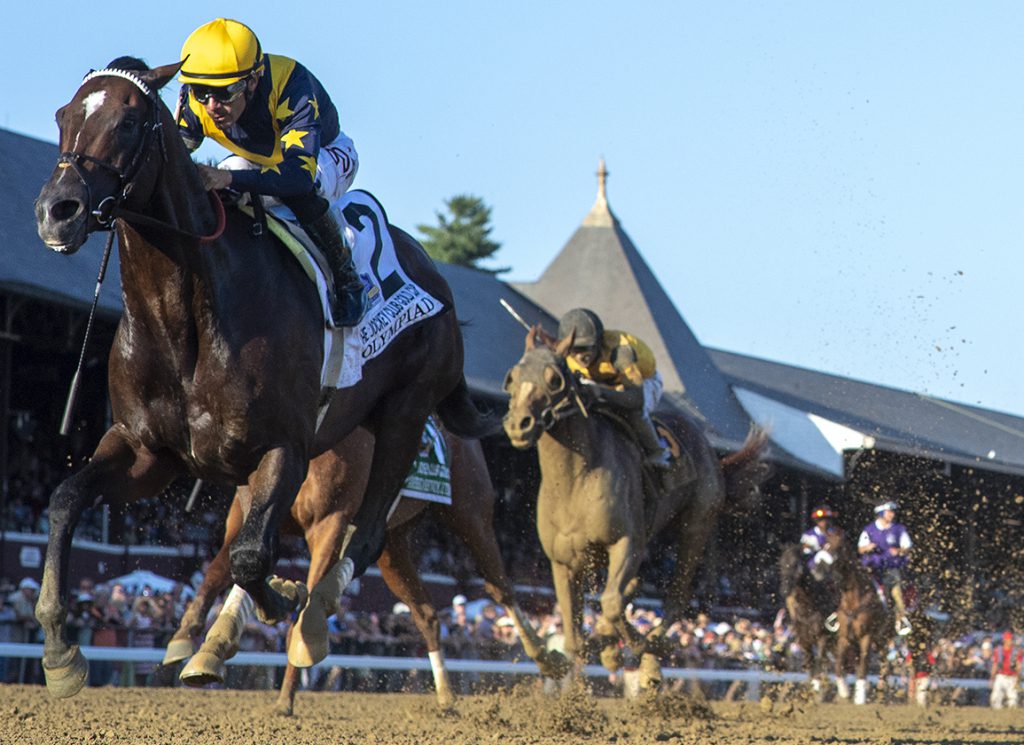
New to the sire ranks for 2023, Olympiad descends from the 1987 Ashland winner | Sarah Andrew
Chic Shirine (1984, Mr. Prospector–Too Chic, by Blushing Groom {Fr}), bred by Emory Alexander: No fewer than 20 graded winners already trace to her, including GISWs Keen Ice, Somali Lemonade, Harmonize, Preservationist, Verrazano, and Olympiad in the last decade alone.
Blush With Pride (1979, Blushing Groom {Fr}–Best in Show, by Traffic Judge), bred by Mr. and Mrs. Darrell Brown: Among her best was her Broodmare of the Year daughter Better Than Honour, who hammered for $14 million at Fasig-Tipton's November sale in 2008, and that one's champion daughter Rags to Riches. The family remains extremely active and continues to rack up graded victories.
Gay Missile (1967, Sir Gaylord–Missy Baba, by My Babu {Fr}), bred by Michael G. Phipps: She produced French champion Gay Mecene among her four stakes winners, but it was Gay Missile's daughter Lassie Dear who cemented her legacy with a number of champions tracing straight to her. Among the extensive list of Gay Missile's breed-shaping descendants are Broodmare of the Year Weekend Surprise and her Horse of the Year and leading sire son A.P. Indy, as well as champion and sire Lemon Drop Kid.
Miss Swapsco (1965, Cohoes–Soaring, by Swaps), bred by Mr. and Mrs. John W. Galbreath: Her first foal, Ballade, produced Canadian Horse of the Year and U.S. champion Glorious Song (who in turn produced champion and multiple-continent Grade I/Group 1 winner Singspiel {Ire}, as well as stellar sire Rahy), champion Devil's Bag, and excellent sire Saint Ballado.
Hidden Talent (1956, Dark Star–Dangerous Dame {GB}, by Nasrullah {GB}), bred by Harry F. Guggenheim: Among her descendants are Broodmare of the Year Too Bald, champion Capote, 11-time Grade I/Group 1 winner Exceller, and MGISW Broad Brush.
Real Delight (1949, Bull Lea–Blue Delight, by Blue Larkspur), bred by Calumet Farm: Her Broodmare of the Year granddaughter Sweet Tooth produced champion Our Mims and six-time GISW and leading sire Alydar. Others tracing to Real Delight include champion Christmas Past and Classic winner Codex.
Myrtlewood (1932, Blue Larkspur–Frizeur {Fr}, by Sweeper {Fr}), bred by Brownell Combs: As the first winner of the Ashland, Myrtlewood set a stunning precedent in her second career as a broodmare. Among her foals were a champion as well as a Kentucky Oaks winner, with several more champions and another Oaks winner among her descendants. Her biggest legacy? Tracing to her through her daughters are breed-modeling sires Mr. Prospector and Seattle Slew.
The post Background Check: Ashland appeared first on TDN | Thoroughbred Daily News | Horse Racing News, Results and Video | Thoroughbred Breeding and Auctions.
