Every week, the TDN publishes a roundup of key official rulings from the primary tracks within the four major racing jurisdictions of California, New York, Florida and Kentucky.
Here's a primer on how each of these jurisdictions adjudicates different offenses, what they make public (or not) and where.
With the Horseracing Integrity and Safety Act (HISA) having gone into effect on July 1, 2022, the TDN will also post a roundup of the relevant HISA-related rulings from the same week.
California
Track: Santa Anita
Date: 04/09/2023
Licensee: Abel Cedillo, jockey
Penalty: Three-day suspension
Violation: Careless riding
Explainer: Having received notice from the California Horse Racing Board that the appeal of LATS Ruling #32 (March 3, 2023) has been withdrawn, the original ruling is reinstated. Jockey Abel Cedillo is suspended for 3 racing days (April 28, 29 & 30, 2023). Pursuant to California Horse Racing Board Rule #1766 (Designated Races), the term of suspension shall not prohibit participation in designated races.
The following rulings were reported on HISA's “rulings” portal, except for the voided claim rulings which were sent to the TDN directly.
One important note: HISA's whip use limit is restricted to six strikes during a race.
Violations of Crop Rule
Aqueduct
Heman Kumar Harkie–violation date April 1; $250 fine and one-day suspension, 7 strikes
Tampa Bay Downs
Angel A Rodriguez–violation date March 31; $250 fine and one-day suspension, 8 strikes
Isaac Manuel Jimenez–violation date April 1; $250 fine and one-day suspension, 7 strikes
Shaun Bridgmohan–violation date April 2; $250 fine and one-day suspension, 9 strikes
Will Rogers Downs
Gustavo Armando Herrera–violation date April 10; $250 fine and one-day suspension, 8 strikes
Travis G Cunningham–violation date April 10; $250 fine and one-day suspension, 7 strikes
An American racehorse owner whose ancestors triumphed in the Grand National in 1923 is bidding to recreate his family's success by winning this Saturday's race exactly 100 years later.
Pierre Manigault and his family will travel more than 4,000 miles from South Carolina to Aintree Racecourse to watch Cape Gentleman, who was bought last year specifically to run in this year's renewal of the race, take on the iconic Aintree fences.
The decision to buy a horse for the race was inspired by the story of Stephen 'Laddie' Sandford, Manigault's great uncle, who became the first American to ever own a Grand National winner when his horse Sergeant Murphy stormed to victory in 1923.
It was such an achievement at the time that Hollywood movie-makers turned it into the 1938 film 'Sergeant Murphy' – starring future president Ronald Reagan.
Speaking from his home in Charleston before setting off for the U.K., Manigault told The [British] Jockey Club, which owns Aintree Racecourse: “There has been a great presence of Sergeant Murphy everywhere in my life for as long as I can remember.
“I had always wanted to go to the 2023 Grand National and had been planning that because I wanted to see the race in person, see Aintree in person and be there for the centennial of Sergeant Murphy and my great uncle – that was a goal I had set.
“Then my trainer over here, Arch Kingsley, suggested that it would be good fun to have a horse in the race and I guess a light just kind of switched. It didn't seem that far-fetched – we had already bought a couple of horses in Ireland and imported them into America and so the thought of buying a horse to race didn't seem crazy as we knew we'd be able to buy one, run the race and then bring him home to America.
“It all kind of just happened and developed. It's exciting but it does make the whole prospect of coming over a little more nerve-wracking.”
When he goes to post in this year's race, Cape Gentleman will be carrying the same purple and gold colors that Captain Tuppy Bennet wore when winning onboard Sergeant Murphy exactly a century ago.
The horse's owner himself is no stranger to the racetrack, having competed in point-to-points and owned horses that have run in races across the U.S. in his family silks for many years.
Manigault, who runs his family-owned media company, used his network of contacts in the U.S. to identify an appropriate trainer based on the other side of the Atlantic Ocean. That was when John “Shark” Hanlon – who became a sensation stateside after training Hewick to victory in the American Grand National back in October – was suggested.
John “Shark” Hanlon with Hewick.
Initially, Hanlon was approached about the prospect of selling his stable star Hewick for the job – something that would not come to fruition – and so the trainer searched for something suitable, finding the answer in Cape Gentleman, who was stabled just a couple of miles down the road from his County Carlow home with last year's Grand National-winning trainer Emmet Mullins.
Hanlon said: “It's very hard to get a horse rated over 150 in England or Ireland that is for sale. There are plenty of them out there, but they're not for sale – Gigginstown own them, J.P. (McManus) owns them. They're in with Willie (Mullins, trainer) or Paul Nicholls – their owners also want to have runners at Aintree and don't want to be selling their horses.
“There was an element of luck in finding Cape Gentleman and his owner who was willing to sell. Only for that I don't think I would have been able to buy them a horse and that would have been a disaster what with them having everything planned to come over to Liverpool.”
Manigault has not even met Cape Gentleman yet but is traveling to the U.K. with a group of friends and family, including his two daughters, who are equally as keen to be a part of family history when the special anniversary is marked.
And while their horse might be one of the outsiders for victory at 100-1, it would not be the first time a horse with those odds has triumphed in the greatest steeplechase in the world, with Mon Mome (2009), Foinavon (1967), Caughoo (1947), Gregalach (1929) and Tipperary Tim (1928) all successful 100-1 winners.
Explaining how excited the family are to be at Aintree this Saturday, Manigault explained: “Last spring on the morning that the hospitality boxes went on sale for the 2023 Grand National, I woke up at around 4 a.m. to immediately place an order, not really knowing what I was getting – I was so afraid of missing out.
“I think this is a legacy that my family has been very proud of for a long time. Laddie was the very first American to win the race and it's a tough race to win – only a handful of Americans have won it. It makes it much more exciting; it's brought some energy to American racing and the heritage of American racing.”
Back in the 1920s Sergeant Murphy was originally bought by Laddie as a hunter for his own use, before he was placed into training in Newmarket with George Blackwell – who remains one of the few people to have ever trained both a winner of The Derby in Rock Sand (1903) and a Grand National winner.
In total, Sergeant Murphy would go on to complete the Grand National course six times and was the oldest horse in the field the year he claimed victory.
Valerie Archibald Embrey, Blackwell's granddaughter, said: “This story really is quite something. Both Sergeant Murphy and Cape Gentleman are chestnuts, they have similar white markings and they both hold their heads very high. I think it's amazing and I have such a great feeling about this.”
In 2013, exactly 90 years after The Aintree Grand National Trophy was won by Laddie and Sergeant Murphy, the silverware was stolen from the National Museum of Racing and Hall of Fame in Saratoga Springs, N.Y.
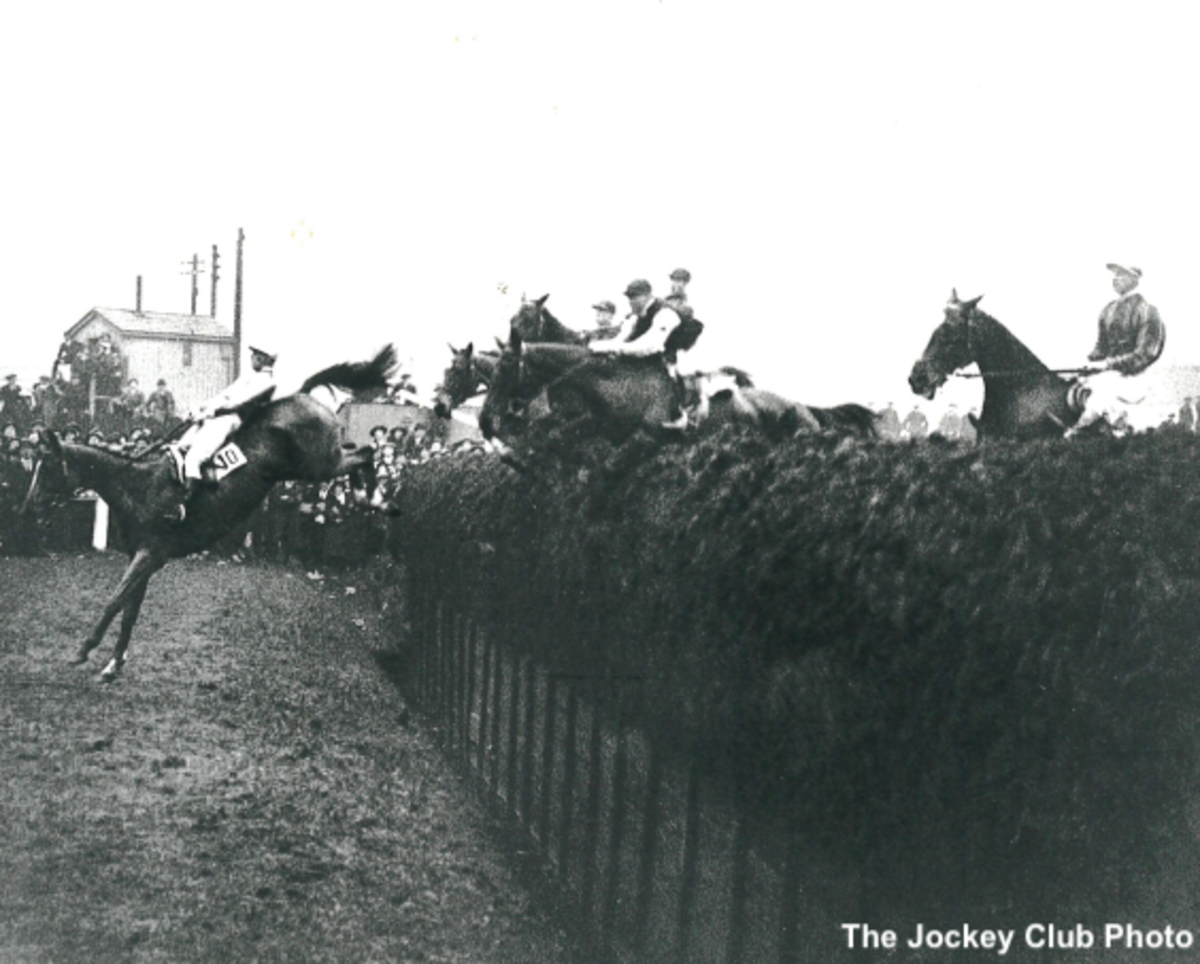
Sergeant Murphy leading at Bechers in the 1923 Grand National
The Grand National's Strong U.S. Links
American owners have long been captivated by the Grand National. Olympic Gold medal-winning polo player Foxhall Keene, one of the founding fathers of Jump racing in the U.S., was represented by Chorus (eighth) and Prophet III (fell) in 1908. The winner that year, Rubio, also boasted trans-Atlantic connections, having been bred at the Rancho del Paso Stud in California.
The first success for an American owner came in 1923. Sergeant Murphy had been bought by John Sanford, a carpet trader, and given to his son, Stephen, who was then at Cambridge University in England.
That victory proved the catalyst for renewed interest in the U.S., and a second triumph followed when Jack Horner prevailed in 1926, having been bought by another U.S. polo player, Charles Schwartz, two weeks before the race for £4,000 from fellow American and amateur rider Morgan Blair.
Kentucky-bred gelding Billy Barton had proved himself to be a champion in both America and Cuba, gracing the cover of Time magazine, but Howard Bruce's chaser fell when leading at the final fence in the 1928 Grand National. Jockey Tommy Cullinan remounted Billy Barton and came home a gallant second as only two horses finished.
Jock Hay Whitney was one of the unluckiest owners in the history of the Grand National. The U.S. Ambassador to the United Kingdom won the Cheltenham Gold Cup with Easter Hero in 1929 and the 9-year-old was a gallant second in that year's Grand National under the mammoth weight of 12st 7lb.
Whitney was responsible for 14 Grand National runners in total between 1929 and 1951, with Sir Lindsay finishing third in 1930 and Thomond II occupying the same position in both 1934 and 1935.
American sewing-machine heir F. Ambrose Clark sold the 7-year-old Kellsboro' Jack to his wife Florence for £1 in 1933 on the advice of trainer Ivor Anthony in the hope that the new owner would bring more luck. Kellsboro' Jack, who started at 25-1, won by three lengths.
Another Grand National win for America came in 1938 via Battleship, owned like Trouble Maker by Marion du Pont Scott, wife of Hollywood star Randolph Scott. The 11-year-old Battleship stood at just 15.2 hands, but had won the American Grand National in 1934 before being sent to England to be trained by Reg Hobbs. He was ridden at Aintree by 17-year-old Bruce Hobbs, the youngest victorious rider.
An American flavor returned in 1963 with the seventh home Owen's Sedge being owned by Gregory Peck, and the Oscar-winning film actor also saw his colors carried in the race by Different Class, who was brought down in 1967 and returned to Aintree 12 months later to take third.
American owners were back in the winner's circle in 1964 with the Fulke Walwyn-trained 18/1 chance Team Spirit, a 12-year-old having his fifth start in the race owned by Ronald B. Woodard and John K. Goodman along with Englishman Gamble North.
There was an even stronger U.S. connection to the 1965 winner as the Pennsylvanian-bred Jay Trump, a dual Maryland Hunt Cup victor for owner Mary Stephenson, was ridden by American amateur Tommy Crompton Smith. Jay Trump was trained by Fred Winter in Lambourn, England.
This North American run of success continued with Highland Wedding in 1969, co-owned by Thomas H. McCoy Jr. and Canadian Charles Burn, while The Beeches, who finished fourth, carried the famous colors of philanthropist Paul Mellon.
American-owned horses continued to make their mark, thanks to Raymond Guest's L'Escargot in 1975, Redmond C. Stewart's dual Maryland Hunt Cup winner Ben Nevis (ridden by American amateur Charlie Fenwick) in 1980, Lois Duffey's Mr Frisk in 1990 and most recently Betty Moran's Papillon in 2000.
With 12 days remaining in the 2022-2023 Oaklawn meeting, the race for leading rider is down to Cristian Torres (a meet-high 80 victories) and last season's co-champion, Francisco Arrieta (73). Eight-time Oaklawn riding champion Ricardo Santana Jr. is a distant third with 48 victories.
Torres is seeking his first career Oaklawn riding title after winning 22 races in 2021 – his debut season in Hot Springs – and 19 during an injury-shortened 2021-22 meeting.
“Francisco's a great guy,” Torres said. “We're really good friends. I'm really happy that both of us are on top and we're doing good. If I win it, I'll be happy. And if he wins, I'll be happy, too.”
Torres enters Friday with 499 career victories, according to Equibase, racing's official data gathering organization. Torres is named on 25 horses this week at Oaklawn – seven Friday, 11 Saturday and seven Sunday.
In addition to overall victories, Torres leads all riders at the 2022-2023 Oaklawn meeting in stakes victories (six) and purse earnings ($4,953,576). Santana set Oaklawn's single-season record for purse earnings by a jockey ($5,643,023) in 2021.
Arrieta rode 50 winners in his Oaklawn debut in 2021 and 62 last season, when he shared the title with David Cabrera. Arrieta, in 2022-23, has also already eclipsed his previous single-season Oaklawn bests with $4,456,624 in purse earnings (ranks second) and five stakes victories (tied for second).
“I'm doing really good and feel confident,” Arrieta said. “I'm enjoying what I'm doing. Thanks to all the people that have supported me.”
Arrieta is named on 21 horses this week at Oaklawn – six Friday, nine Saturday and six Sunday. Arrieta is scheduled to ride Tejano Twist, the 5-2 program favorite, in Saturday's $500,000 Count Fleet Sprint Handicap (G3) for older horses at 6 furlongs. Arrieta notched his first career graded stakes victory at Oaklawn, and second overall in the United States, aboard Tejano Twist in the $200,000 Whitmore (G3) March 18.
Torres and Arrieta both said they will be based in Kentucky after the Oaklawn meeting ends May 6.
Trainer Keith Desormeaux has returned to Oaklawn in search of another stakes victory with a modestly priced Keeneland September Yearling Sale graduate.
On the heels of My Boy Jack ($20,000) and Confidence Game ($25,000) comes former bad boy Surveillance, who is entered in Saturday's $500,000 Count Fleet Sprint Handicap (G3) for older horses at 6 furlongs.
A 6-year-old gelded son of millionaire multiple Grade 1 winner Constitution, Surveillance brought just $25,000 at the 2018 Keeneland September Yearling Sale. Now a multiple stakes winner armed with $470,367 in career earnings, Surveillance is another rags-to-riches story for Desormeaux, the older brother of Hall of Fame jockey Kent Desormeaux.
“That was Constitution's first year and out of a dam that was unproven,” Keith Desormeaux said Wednesday afternoon. “I could never get away with getting that horse for $25,000 now. Keeneland's the source of the champion, but also a source of bargains.”
Illustrating those bargains, My Boy Jack won the $500,000 Southwest Stakes (G3) for 3-year-olds in 2018 at Oaklawn. Confidence Game, in his last start, won the $1 million Rebel Stakes (G2) for 3-year-olds Feb. 25 at Oaklawn. While My Boy Jack and Confidence Game flourished as young horses, Surveillance needed 10 starts to break his maiden.
“He's a good horse, but he was a battle,” Desormeaux said. “He defined the word rogue when he was younger. He would prop and refuse to train and rear up and take the gap at a full gallop. I just tried what I could with him, giving him breaks, trying to be the best horseman as possible. But I had to go to the ultimate equipment change, finally. That seemed to do the trick. He allowed himself to train and when that happened, the talent emerged.”
After being gelded, Surveillance broke his maiden Jan. 1, 2022, at Fair Grounds. He's never been worse than fifth in 13 subsequent starts, highlighted by three sprint stake victories at Fair Grounds – $175,000 Thanksgiving Classic Nov. 24, $100,000 Richard R. Scherer Memorial Dec. 26 and the $100,000 Duncan F. Kenner Jan. 21.
“He's a very talented horse,” Desormeaux said.
Desormeaux, who co-owns Surveillance, is seeking his fourth career Oaklawn stakes victory. His first came with Sonneteer, a Calumet Farm homebred, in the $125,000 Fifth Season for older horses in 2018.
Surveillance, 6-1 on the morning line for the Count Fleet, has a 6-3-5 record from 23 starts overall. James Graham is named to ride.