Last month, a lengthy Financial Times feature detailed the growing share of overall handle generated through Computer Assisted Wagering (CAW)–both in California and nationwide.
CAW players are a small group of high-volume and largely anonymous gamblers with an outsized impact on the betting markets due in no small part to the sophisticated wagering tools at their disposal. Because of their high stakes play, they're offered inducements in the form of rebates and reduced takeout rates largely not available to the average punter.
CAW proponents argue that these deep-pocketed players provide much needed financial ballast to an industry in flux. Critics say the industry has bent over backwards to accommodate their trade, to the point where their influence on betting pools is akin to a run-away train. It's not an easily told story–attention needs to be paid to the numbers behind the numbers.
Using California Horse Racing Board (CHRB) data, the story illustrated the way total California handle has shrunk appreciably between 2007 and 2021, but the share of that handle from CAWs has increased hand over fist during the same window.
When it comes to by far the most influential of these computer syndicates, the Elite Turf Club–a Curacao-based company owned in part by The Stronach Group and NYRA Bets LLC–their share of overall wagering has increased from about 3% to roughly 30% between 2007 and 2021, according to the FT's analysis of CHRB data.
Just two Elite Turf Club accounts account for the majority of all “Elite Turf Club” wagers bet, the FT calculated. Though here it should also be noted that other important betting entities facilitate CAW play, including some key ADW platforms.
Bill Nader, president and CEO of the Thoroughbred Owners of California (TOC), told the TDN that the Elite Turf Club's percentage share of the overall handle during Santa Anita's recently completed “Classic Meet”–which ran Dec. 26 last year through April 9–was 22.89%.
This number is important for one crucial reason: There is a tipping-point when the percentage share from CAW players on overall handle becomes so large that their participation at these levels becomes unsustainable–that it begins, essentially, to cannibalize the market.
“I think everyone would pretty much agree that around 25% is the cap and anything above that might be taking it too far,” said Nader, who presides over the organization given final say over any betting-related contracts inked in the state.
“Even the CAW player would agree that in striking the right balance through their lens–to avoid the CAW player competing against the CAW player which is not what their model wants–they need liquidity in the pools for distribution of investment,” said Nader.
Scott Daruty, president of Elite Turf Club, agrees there's a balance to strike–but he takes a more circumspect route as to what the tipping point is, highlighting different variables factoring into the equation, like the size and location of a racetrack.
“There are very different answers. I can only speak to the tracks that we operate,” said Daruty, pointing to the 1/ST Racing facilities.
“I would think if CAW is 15% of the pool, you're fine. I think if it's 30% or more of the pool, I personally would start to get worried about that,” Daruty said. “Other tracks who have different circumstances may answer that question differently.”
Does the 22.89% CAW play on total handle from the recent Santa Anita Classic Meet strike the right balance?
“I am not overly troubled at 22% if in fact that is the [right] number,” said Daruty, adding how, at the time of the interview, he was not able to verify the figure.
Earlier this week, the Daily Racing Form reported that Santa Anita will cut purse levels for the upcoming Spring meet. This cut was anticipated months in advance, said Nader, but has been influenced by issues like a slate of lost racing days through inclement weather this winter in Southern California.
Not inconsequentially, the purse account is in an operating deficit–a number currently sitting at $554,417 in the red, but expected to shrink to $430,789 through June 18, said Nader. How much of the state's purse account deficit can be attributed to the impacts from CAW play?
“They're volume players and they make a significant contribution,” Nader responded. “That's where I come back to the need to strike the right balance.”
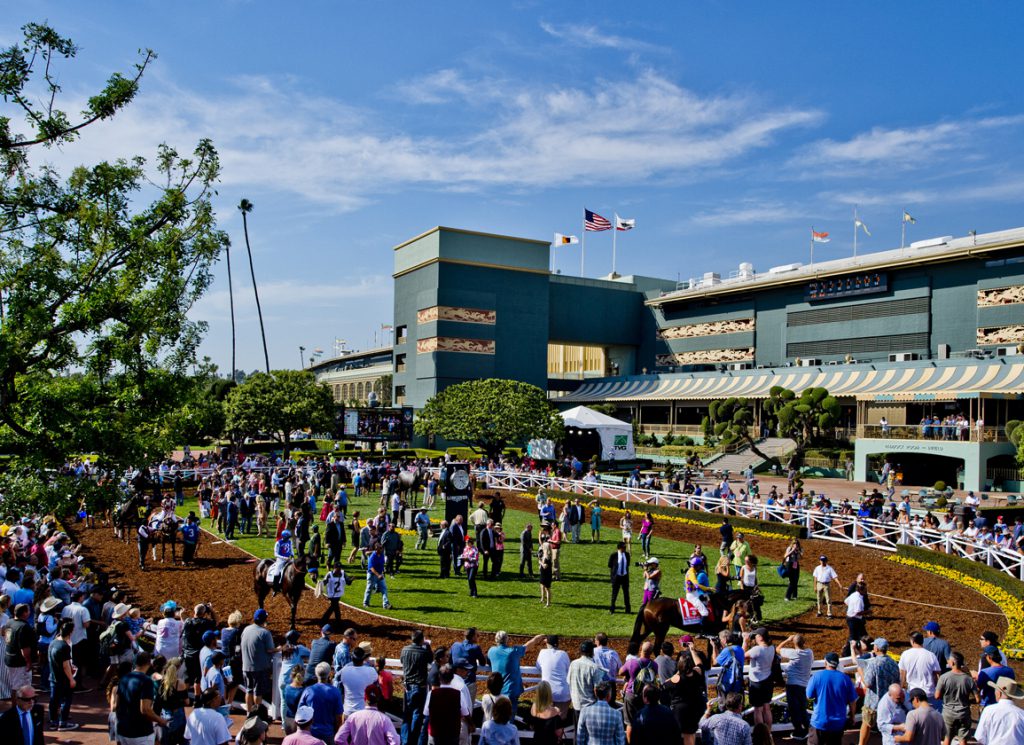
Santa Anita | Benoit
Modifications Already Instituted in California
That said, efforts have already been made at Santa Anita and Golden Gate Fields to control CAW growth in California—the first concerning the Rainbow Pick 6.
Since Santa Anita's fall meet last year, CAW players have been prohibited from taking out the Rainbow Pick 6 jackpot on a non-mandatory payout day.
“CAW players must bet in a 40-cent unit which means they can't take out the jackpot,” Nader said. By rule, the only way the jackpot would be paid is to a single 20-cent unit.
The second concerns a bête noir of CAWs among ordinary gamblers–swinging last-minute odds changes. In response, CAW players must pay a surcharge of around 3.5% on top of their normal rate if they want to bet to the close of the win-pool, said Nader.
These modifications, said Daruty, were made at least partly in response to player feedback.
“There were complaints about late-odds shifts and a lot of focus on CAW players as the cause of that, and we wanted to take steps to try to alleviate the problem if not wholly at least partially,” Daruty said.
Have these modifications rectified the problem of late-odds changes? “We've monitored it carefully and we believe it has had a materially beneficial impact on that issue,” Daruty replied, leaving the door ajar for further possible pricing changes in CAW play.
“I don't know there is ever a perfect answer or a final answer,” Daruty said, adding that anything more specific on possible pricing tweaks would be a hypothetical. “It's an issue we will continue to monitor and if necessary make adjustments.”
Nader took a similar stance to Daruty, saying that the CAW surcharge is so prohibitive, “it effectively prices them out of participating in the win pool.”
But these modifications haven't fully addressed the issue of striking the right balance between CAW and non-CAW play, Nader added, once again saying “it's all about how we control access to the pools and how we price it to ensure fairness.”
As to what additional controls on the betting pools could and should be instituted, Nader also largely steered away from specifics, explaining that contract negotiations are ongoing between the tracks and the TOC with the Del Mar summer meet on the horizon.
Del Mar offers an intriguing case study as to the growing impact from CAWs in California.
According to publicly available CHRB data, the total amount Elite Turf Club wagers at Del Mar annually has increased nearly 56% comparing 2018 data–the year prior to the Santa Anita welfare crisis and a global pandemic–and 2022 numbers.
On a handle-per-race basis, the increase is even more stark. Comparing 2018 numbers to 2022, the Elite Turf Club's per-race handle increased 73.1% at Del Mar.
“I'm not trying to avoid the question, but we still need to have the conversations with the track partners,” Nader said, when asked about specifics concerning these ongoing negotiations. “We have the rights to approve, but I need to respect the position of the tracks. We need to come together.”
Nader pointed, however, towards the higher takeout wagers–like the Pick 4, 5 or 6 bets–as an area for possible pricing modifications.
“The CAW players have gravitated towards the multi-leg wagers which are higher takeout wagers. In many cases, higher takeout wagers can lead to higher rebates. There's where I think there's room for discussion,” said Nader.
For win, place and show or Exacta wagers, the takeout is extracted one time for each race. In the multi-leg wagers, however, the takeout is extracted only one time for a sequence of races.
“So, in terms of payments to tracks through commissions and to owners through purses, those dollars are not working nearly as hard as they would be in the single race pools,” said Nader.
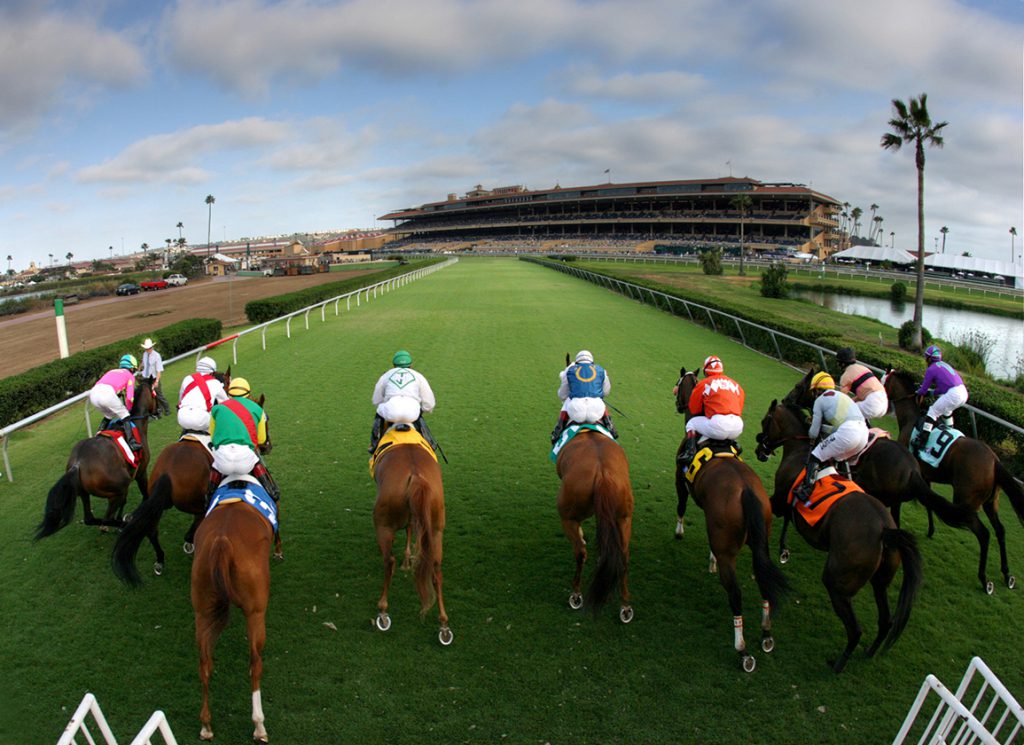
Del Mar | Horsephotos
Concern Over Core Customers
The Thoroughbred Idea Foundation (TIF), an industry think-tank, has been banging the drum about the rise of CAWs, and the implications for the industry, for several years.
Just this March, TIF co-founder Craig Bernick warned that the current trajectory of CAW play risks substantial losses to both mainstream betting customers and to racehorse ownership.
In the same vein, Pat Cummings, TIF executive director and a former executive with the Hong Kong Jockey Club, stressed how vigilant California horsemen should be to the impacts from CAW to the long-term sustainability of the state's racing industry.
“No group should be pushing more for reform in this space–and to date, that has not really happened,” Cummings said, pointing to how California's purses are built solely upon handle, unlike other states which bolster their purse revenues through other sources. “Wagering is the lifeblood of the sport, but in America, nowhere more so than California.”
As such, pricing is key. “The growth of CAW play is proof that the cost we charge bettors via takeout matters,” Cummings said. “If takeout was higher for CAWs, they wouldn't wager or churn as much as they do,” Cummings added. “And while we don't have access to the deals cut to incentivize them, their overall growth is the sign that improving their experience through better pricing has worked.”
Indeed, the lack of public transparency by the industry at large about the impact from CAWs is glaring. Take the CHRB, one of the more transparent commissions when it comes to CAW data.
Until 2021, the CHRB issued detailed annual betting data on individual Elite Turf Club accounts. Last year, the CHRB lumped all Elite Turf Club accounts into one block.
More specifically, the incentives offered these players is another major bugbear of CAWs. According to the FT, the rebates that CAW players receive can be around 10% of whatever they bet.
When asked if these details should be made public, Nader said that any effort at pricing transparency should ideally be done uniformly across the nation. “But I'm not sure there's a willingness to do that,” said Nader, who added that legal obstacles could similarly hinder such endeavors.
When asked the same question, Daruty said that “we believe very strongly that the personal wagering habits of our customers and their personal situations is something that should remain private, so we're not prepared to discuss specific rebates of specific players–that would not be appropriate.”
Individual rebates, Daruty explained, are dependent upon a wide variety of factors.
“Thus far we haven't found a one-size fits all model that we think makes sense for our racetracks, the horsemen who run there, as well as our customers. Until we can come up with such a model, we're going to continue to have a wide variety of rebates available to a wide variety of customers,” Daruty added.
Which leads to a fear among track operators that weakened CAW incentives could drive these price-sensitive players from the game. At the same time, without controls on CAW access to the betting pools, CAW is only going to further sour the average gambler to the game, Nader admitted.
“For the casual bettor, I'm not so sure,” Nader said. “It's the core customers, they're the ones I'm concerned about. I'm talking about the ones at a level just below the CAWs–they're the ones contributing on a day-to-day basis or participating at a higher rate. We want to make sure we're looking after their interests.”
What should that look like? Nader skirted specifics, calling it “a question for the industry at large to look at.” That said, “the key is introducing new people to the sport. Maybe we haven't done a good job at that for the last 10 to 20 years.”

The post When Do CAWs Help And Hurt California Racing? appeared first on TDN | Thoroughbred Daily News | Horse Racing News, Results and Video | Thoroughbred Breeding and Auctions.
Source of original post
