HISA’s Lisa Lazarus Joins TDN Writers’ Room Podcast

On Monday, there will be a seismic shift in horse racing. That's when the Horse Racing Integrity and Safety Authority will launch its Anti-Doping and Medication Control program and, in most states, will take over the responsibilities of drug testing and drug adjudications. With that date right around the corner, the TDN Writers' Room podcast presented by Keeneland brought in HISA's CEO Lisa Lazarus to give an update on what to expect once HISA takes over. Lazarus was this week's Green Group Guest of the Week.

Lazarus made it clear that one of HISA's major goals is to do everything in its power to stop anyone who tries to use performance-enhancing drugs to get an edge. To do so, they will go beyond drug testing and will rely on investigations and intelligence.

“Our test distribution plan is going to be investigations and intelligence led,” she said. “We are not going to be relying primarily on post-race testing in order to discern who actually is breaking the rules. We've got a very robust investigative team headed by Shaun Richards, who is a former FBI agent. He is actually the one who worked up all the evidence in the prosecutions in the Southern District involving Navarro and Servis, et cetera. We really are focusing on the intelligence.”

Lazarus said she knows there are still those in the industry who are anti-HISA and have a lot of trepidation about it taking over when it comes to drug testing. She said one of her main goals for HISA is to change that narrative.

“I would like to have gained the trust of the majority of horsemen and players in the industry,” she said when asked about her goals for the coming year. “You may agree or disagree about a rule here or there, and that's all good. That's all part of the dialogue. But I really hope that and believe that we'll have the majority saying that this is actually needed. That we needed a uniform system. We needed uniform rules. This is good. And this is this actually professionalizes our sport to a different level. I hope that horsemen will feel like there is a level playing field. I hope the public sees racing horse racing in a different way, that it is safer and with more integrity.”

Another change that HISA will usher in is that it will differentiate between drugs that are true performance-enhancers and therapeutic medications that were still in a horse's system when they were tested. They will also have a separate category for positives that appear to be the result of environmental contamination.

“We completely separated the rule book into two categories, the banned substances, which are the doping substances; versus the controlled medications, which are the therapeutics,” she said. “And we take a very different philosophical approach to those two categories. If you have a banned substance in a horse, which is a performance enhancement that should never be in a horse, the penalties are severe. They're severe, they're swift, and they will be game-changing. If you make a mistake or if you have a therapeutic overage, there will be consequences, but they'll be proportionate to the to the violation. We also have a policy called the Atypical Findings Policy, which basically has 27 different substances that, if detected in a horse's system, we know it's almost certain to be result of contamination. Those will go through a different process. If we are satisfied after looking at those a little bit more deeply that it really is contamination, there's no loss of purse, there's no sanction. It's like it never happened.”

Elsewhere on the podcast, which is also sponsored by Coolmorethe Pennsylvania Horse Breeders Association, Woodford Thoroughbreds, The Kentucky Thoroughbred Association, XBTV, 1/st Racing, WinStar Farm and West Point Thoroughbreds, Randy Moss and Bill Finley took a look at the remarkable year 87-year-old trainer Wayne Lukas is having. Lukas won last weekend's biggest race, the GIII Essex H. at Oaklawn Park with Last Samurai (Malibu Moon). There was also a discussion of the promising numbers that came out of the Equine Injury Database for 2022. The 2022 figure of 1.25 fatalities per 1,000 starters was the lowest since The Jockey Club began compiling fatality numbers in 2009. Looking ahead to this weekend's racing, the team gave their thoughts on the major races at the Fair Grounds and Turfway Park, which include key GI Kentucky Derby preps in the GII Louisiana Derby and the GIII Jeff Ruby Steaks S.

Click for the Writers' Room Podcast's Audio or Video.

The post HISA’s Lisa Lazarus Joins TDN Writers’ Room Podcast appeared first on TDN | Thoroughbred Daily News | Horse Racing News, Results and Video | Thoroughbred Breeding and Auctions.

Source of original post

Breeders’ Cup Presents Connections: ‘I Don’t Think Anybody Would Do What He Did’

Fans tuning in to Sunday's Sunland Park Derby card may be surprised by the appearance of jockey Felipe Valdez' name in the program. With a mount in seven of the day's 11 races, the 43-year-old Valdez is in the midst of a comeback he truly never saw coming.

Plagued by injuries throughout his career, including a broken back that initially left him unable to walk and kept him out of the saddle for 3 ½ years, Valdez was finally forced to announce his retirement from the saddle in 2017. He hadn't ridden since March of 2016 at Santa Anita, when a fall broke his collarbone for the second time in five months and left him with damage to his right arm.

“All the pain I have is horrible and is not getting any better,” Valdez said in 2017. “I cannot keep living my life thinking I will be back.”

It took 13 surgeries and nearly seven years away from the racetrack, but Valdez did recover from his injuries. In December of 2022, he reached out to New Mexico-based trainer Todd Fincher with hopes of getting back to working with horses.

“I never thought I was gonna ride again; I was reaching out to gallop or work with horses,” Valdez explained. “He said, 'If you want to work, come down to New Mexico and I'll give you an opportunity.' He started putting me on horses to gallop in the mornings, and then he put me on my first horses in the afternoon. 

“The first day I came back, I won my first race after seven years (a Jan. 1 maiden special weight at Sunland aboard Fincher trainee Still In The Trap). It was very emotional, and I was very happy; I never thought that would happen again in my life.

“I'm gonna be very thankful for the rest of my life to this man, because I don't think anybody would do what he did. To give me the trust to ride good horses, you are just not going to find that with many people.”

Valdez had won a race for Fincher at Del Mar in 2015, so he was familiar with the trainer and was wanting to ride anywhere except California, the site of some of his worst injuries. 

Fincher, a long-time leading trainer in the Southwest region, said he granted Valdez a chance for several reasons.

“Well, everybody deserves an opportunity, don't they?” the trainer mused. “It wasn't just because of him. We kind of have a shortage of jockeys around here, so I thought if it works out, then it does. He's worked hard for it and he's earned it.”

A native of Mexico City, Valdez took out his license as an apprentice in 1997. He captured the riding title at Portland Meadows in 2001 and was among the top jockeys at Hastings Racecourse for several seasons before shifting his tack to Southern California.

The wreck at Hollywood Park that left Valdez with two fractured vertebrae occurred on Dec. 3, 2010. He spent a year between a wheelchair and a walker, wrestling with whether or not to agree to a specialized surgery with a 50 percent success rate. Even with the surgery, doctors warned Valdez he'd never ride again.

With a successful operation to implant pins in his spine, Valdez underwent extensive physical therapy and made it back to the winner's circle in April of 2014 at Emerald Downs. It was an emotional triumph, to be sure, but it came with plenty of warnings from his doctors.

A year and a half later, Valdez suffered a broken collarbone, fractured ribs, and a pinched lung in a fall at Los Alamitos. A second fall just five months later broke the collarbone again and damaged ligaments in his right arm. 

Once more, doctors were unconvinced Valdez would ever return to the races, and Valdez subsequently announced his retirement.

“I had had four or five surgeries then, and it was hell,” Valdez said. “I was in pain 24/7, I was not getting any better, and nothing was working.”

“In one moment of my life, I thought that I was lost,” he admitted. “I lost my health, my job, everything.”

There were several friends who kept Valdez from giving in to his injuries, among them Hector Palma, Luis Acosta, and an attorney named John.

“They supported me all the way, let me borrow money when the insurance wouldn't pay for one of my surgeries, and always gave me good hope that everything was going to get better,” said Valdez. “They showed me that nothing is going to last forever. Horses get injured, but with time, they get better, and humans are the same way.”

Eventually, after 13 surgeries with little improvement, Valdez decided to try something different.

“I stopped taking medications and just let my body heal, just gave it the time,” he said. “Now, I don't even take Tylenol or anything.”

Valdez also credits both his family and his dogs with helping his return to health.

“My daughters, especially my youngest, were always asking me when I was going to go back riding,” he explained. “I also got into the habit of going hiking every day with my dogs. They're like my second kids, and every day they would go to the door and bark and go crazy to go hiking, so every day we'd go four or five miles, even if I had to go slow.”

Valdez began supplementing his physical therapy routines with time on a mechanical exercise horse, and eventually felt strong enough to reach out to Fincher.

With 15 winners since his return to riding, including two stakes races, Valdez has a lot to be proud of. While he doesn't have a mount in the marquee race on Sunday's card, he has been tabbed to ride several morning-line favorites and feels good about his chances. 

Recently Valdez heard the story about New Mexico-based racing analyst Julie Farr's son, Bryce Bordieu, who lost his leg after an injury suffered when a horse flipped over on him during morning training hours at a training center. 

“It caught my eye because I went through something similar when I injured my back,” Valdez said. “I had an issue with one insurance company to cover my surgery, so I know how hard it can be. I don't really know him, but he's so brave, this kid. He's very passionate about life, knowing that he lost his leg but trying to be strong and live a normal life.

“I'm going to donate five percent of my earnings on Sunland Derby day to them so that he can get the prosthetic he needs. Hopefully I can help this guy and his family.”

Long-term, Valdez wants to stay healthy enough to ride a few more years. 

“I wish to be healthy, just to ride until I'm 50,” he said. “And, If I'm lucky, to be the leading rider here once before then!” 

The post Breeders’ Cup Presents Connections: ‘I Don’t Think Anybody Would Do What He Did’ appeared first on Horse Racing News | Paulick Report.

Source of original post

Pegasus Winners Art Collector, Atone Highlight Louisiana Derby Undercard Stakes

Bruce Lunsford's multiple graded stakes winner Art Collector ships in to Fair Grounds Race Course & Slots to headline a field of eight sharp older males in Saturday's 98th running of the $500,000 New Orleans Classic (G2).

The New Orleans Classic will go as Race 9 of 15 with a post time of 4:04 p.m. CT. It will be the first leg of the all-new Bayou Bluegrass 5, which combines five stakes from Fair Grounds' and Turfway Park's big Saturday cards. First post for the Louisiana Derby Day program will be noon (all times Central) and will feature the 110th running of the $1 million Louisiana Derby (G2) and the 56th running of the $400,000 Fair Grounds Oaks (G2). 100-40-30-20-10 Kentucky Derby and Oaks points are on the line for the top five finishers as the Championship Series begins in New Orleans with the 1 3/16 miles Louisiana Derby (Race 12, 5:42 p.m.) and the 1 1/16 miles Fair Grounds Oaks (5:08 p.m.).

Besides the New Orleans Classic, The Louisiana Derby Day stakes-laden card will also feature the $300,000 Muniz Memorial (G2), the $100,000 Tom Benson Stakes, the $100,000 Costa Rising Stakes (LA), the $100,000 Crescent City Derby (LA), and the $100,000 Crescent City Oaks (LA).

Ahead of Olympiad's second-place finish to Flightline in the 2022 Breeders' Cup Classic, trainer Bill Mott sent him to Fair Grounds where he first won the Mineshaft and followed that up with a win in the New Orleans Classic. Mott also won this race with Good Samaritan in 2018. This year he will be represented by the $4 million lifetime earner Art Collector. The 6-year-old's last win at the 1 1/8 miles distance came in January's Pegasus World Cup. In that race he showed a new dimension rating behind the speed, only to draw off, leaving 11 of the division's best 4 1/2 lengths behind him. Four of his Pegasus foes won in their next outing. In his race prior to the Pegasus, the 1 1/18 miles Lukas Classic (G2), Art Collector finished fifth, 6 1/2 lengths behind the winner Hot Rod Charlie.

“In (the Lukas) remember we were in the lead and we got passed,” Lunsford said. “Really that may not be his most comfortable way to run. When he was younger, he wouldn't break. When we put Luis Saez on him, Luis was able to get him to break, get him to go and run on the lead. Now I think (Art Collector) is smarter and runs differently. He had plenty left in the Pegasus, and I think he would have run another half mile if he had to.”

Atypical for modern racing, Art Collector was brought back to race as a 6-year-old by his sporting owner Lunsford.

“Part of the reason I decided to run him back is I like the game,” Lunsford said. “I like to race. I talked with Bill (Mott) about it, and we felt the horse had excuses with his foot and things like that and we could get him back in good order to run. I didn't think it would be fair for him to go out after that one (the Lukas Classic), and it worked out pretty well because he was really healthy (in the Pegasus).”

If not Art Collector, who will take the early lead in the New Orleans Classic? After entering Brad Cox's barn at the beginning of his 5-year-old season, Gary and Mary West's West Will Power soon developed a new running style as he moved up in class. His 5-2-3-0 record with the Cox barn, including a win in the Fayette (G2) at Keeneland, proves the success of the new tactics. He exits two strong on-the-board-finishes in the Clark (G1) behind Proxy and the Razorback (G3) behind Last Samurai, who recently returned to take the Essex (G3).

If West Will Power wants the lead, he will have to duke it out with one of Fair Grounds' fastest early speedsters over the past two meets in Robert Johnson and Britt Haselton's Treasury. The one-dimensional son of Speightstown is as honest as they come. In his races at Fair Grounds, he is 11-for-11 in the money with three wins, including last out in an allowance where he went all out at every call, saying catch me in the end, if you can. Trainer Grant Forster says the same strategy will be employed in Treasury's first stakes run.

“We're going to be in front,” Forster said. “You have to be in front at some point to win the race. He's doing fantastic. He loves it here, it's the perfect time to take our big swing with him and see what happens. He's just a horse that you have to let run. His thing is he can go fast and keep going. Obviously, these are top-class horses, but we're going to go out there and take it to everybody and see what happens.”

Among the other top competitors in the New Orleans Classic is Lothenbach Stable's Happy American. Winner of the Louisiana (G3) and the Tenacious, two of the three preps for the New Orleans Classic, last out in the Mineshaft Happy American finished a disappointing eighth.

“I was hesitant to run last time and I shouldn't have,” Pessin said of the poor performance. “I'm kicking myself for doing that. I wasn't going to run in this one but he is doing exceptionally well, like he was before the Louisiana. After we gave him a couple of weeks off, he's come back doing exceptionally well, bright and energetic, so we're going to see what happens. It's a little tougher race than before. There are a couple horses shipping in that make it pretty tough, but I need to see where he belongs. If he runs his race but gets beat five lengths I know I need to avoid those horses. If he runs his race and is right there, then I'll take them on again. We need to know if he fits in the upper echelon.”

There's no questioning Jon Lapczenski and JIL Stable Mr. Wireless' form. Trained by Bret Calhoun, the 5-year-old has finished second in each of the local preps. In the Mineshaft, it was Sumaya U S Stables' Pioneer of Medina who got the best of Mr. Wireless. However, Pletcher's trainee returns on Saturday, but he is winless in two starts at the New Orleans Classic distance of 1 ⅛ miles.

Here is the complete field for the New Orleans Classic in order of post position (with jockey, trainer and morning line odds):

  1. Treasury (Corey Lanerie, Grant Forster, 20-1);
  2. Art Collector (Junior Alvarado, Bill Mott, 8-5);
  3. West Will Power (Flavien Prat, Brad Cox, 2-1);
  4. Trafalgar (Mitchell Murrill, Chris Hartman, 30-1);
  5. Rattle N Roll (Brian Hernandez Jr., Ken McPeek, 10-1);
  6. Happy American (James Graham, Neil Pessin, 10-1);
  7. Mr. Wireless (Deshawn Parker, Bret Calhoun, 8-1);
  8. Pioneer of Medina (Luis Saez, Todd Pletcher, 9-2).

Looking to back up his win in the Fair Grounds Stakes (G3), Wolfe Racing Hugh Robertson's Two Emmys enters the 31st running of the $300,000 Muniz Memorial Classic (G2) poised to repeat after wiring last year's renewal. Nine other formful older turf males entered to end Two Emmys' reign at Fair Grounds Race Course & Slots, including last-out Pegasus World Cup Turf winner Atone and Two Emmys' nemesis in the 2021 Sycamore, Spooky Channel.

Going 1 1/8 miles over the Stall-Wilson Turf Course, the Muniz is slated as the 10th race on the stakes-laden 15-race program. Post time is 4:36 p.m. CT. The portable rail has been moved inside from 34 to 28 feet for all this weekend's turf races, and with that, field sizes are expanded to ten entries.

A win in the Muniz would put Two Emmys above $1 million in lifetime earnings. Trainer Hugh Robertson has been masterful with his 7-year-old gelded son of English Channel who keeps getting better with age. A multiple-graded stakes winner who often manages to get the lead and slow down the pace, Two Emmys will break from post No. 6 with regular rider James Graham aboard.

Three Diamonds Farm's Atone exits the best performance of his 6-year-old career, scoring in the Pegasus World Cup Turf. The 7-time winner made his first grade-stakes win count in scoring the lion's share of the $1,000,000 purse. Trainer Mike Maker is known for finding the best in his turf horses as they mature, and the 6-year-old Atone is no exception. Drawing post No. 1 and tabbed as the 5-2 favorite in the morning line, Luis Saez will climb aboard Atone for the first time since 2021.

Similar to Two Emmys, NBS Stable's Spooky Channel is an older English Channel seeming to be in career-best form. Trained by Jason Barkley, the 8-year-old missed most of 2022 with a minor setback, but in December of 2022 he reasserted himself winning the $100,000 Diliberto. His next start was over the soft going of Sam Houston Park in the Connally Turf Cup, where he tended to the pace in typical fashion but finished one length behind winner Scarlet Fusion and a neck shy of Muniz-foe Another Mystery.

“Right now, he is a monster,” assistant trainer Shelbi Barkley said. “Since he ran at Texas, he has been tough and on the bridle. Even more than before. He had his little issue last year and we had to give him time. Last year he trained well, but right now he is doing better than ever.”

In Spooky Channel's last race before the setback, he nailed Two Emmys at the wire in the Sycamore (G3) at Keeneland. Joel Rosario will pilot Spooky Channel, who drew immediately inside Two Emmys with post No. 5.

Russell Welch and Ran Leonard's Rising Empire has found new form since being pointed to the turf two races back by trainer Brendan Walsh.

“He's been working very well,” Walsh said. “Sometimes in the past he wasn't the greatest workhorse but recently he's been working great. I think he got a lot of confidence from his few grass starts. He likes it here, he likes this turf course. I don't think he'll be too far away.”

Made 20-1 in the morning line, Rising Empire finished a head shy of winning his first turf run but wheeled back for the open-length score against allowance ranks in February. Florent Geroux is signed on to pilot him from post No. 2.

Here is the complete field for the Muniz Memorial from the rail out (with jockey and trainer):

  1. Atone (Luis Saez, Mike Maker, 5-2);
  2. Rising Empire (Florent Geroux, Brendan Walsh, 20-1);
  3. Gentle Soul (Rey Gutierrez, Bret Calhoun, 5-1);
  4. English Tavern (Deshawn Parker, 12-1, Michelle Lovell);
  5. Spooky Channel (Joel Rosario, Jason Barkley, 9-2);
  6. Two Emmys (James Graham, Hugh Robertson, 3-1);
  7. Another Mystery (Flavien Prat, Chris Block, 6-1);
  8. Tiz the Bomb (Brian Hernandez Jr., Ken McPeek, 10-1);
  9. Risk Manager (Ricardo Santana Jr., Sarah Davidson, 20-1);
  10. Native Thunder (Mitchell Murrill, Dallas Stewart, 30-1).

The post Pegasus Winners Art Collector, Atone Highlight Louisiana Derby Undercard Stakes appeared first on Horse Racing News | Paulick Report.

Source of original post

Sadler Staying On Flight Path

As noted by colleague Bill Finley earlier in the week, we've just passed the 50th anniversary of Secretariat's sophomore debut. Yet even two years ago hardly anyone had heard of an unraced son of Tapit, meanwhile acclaimed by many as the best American Thoroughbred since.

Okay, so he had been a seven-figure yearling; and everyone who had participated in his education knew that he was something special. In fact, John Sadler was so aware of the impending responsibility that he was saying nothing. For one thing, if people had any inkling of the talent he was about to detonate, the races wouldn't have filled. But also because this, like all secrets, was a burden as well as a privilege.

Looking back, Sadler accepts that doing justice to Flightline felt like so intense a duty that it could not come without some personal cost.

“I kind of devoted my time to him to a point where I probably shut some people out,” he admits. “The odd dinner at night, that kind of thing. I really drilled down, I said to myself, 'I'm going to walk this walk with this horse.' I wanted to be right alongside him, every step, because I knew it was going to be so special. So here I am today, light mood, happy as heck, because I always said my time to celebrate would be when it was over. Very early on, I said to myself: 'I'd like to pitch a perfect game.' That's a career goal. And we did.”

But so much of life is about the pursuit, rather than the actual moment of fulfilment. Sadler, tall and bronzed, looks in great shape at 66. But now that he has consummated a generational dream, can he still maintain the same motivation?

“We've been pondering that a lot,” he acknowledges. “But like B. Wayne Hughes of Spendthrift Farm used to say, 'My health insurance is that group of yearlings over there.'”

So, while he knows that he can hardly expect another Flightline, Sadler also feels that the true horseman's appetite, happily enough, can never be finally sated.

“I'm pretty confident I'll have a lot of good horses come my way, because I still want to do it,” he says. “If there's a time to not do it, I'll know when that is. Somebody said I'd retire right after Flightline. But rushing into a decision like that, with horses, is always rash. Time will see where we're at. I've got some really good young people in my operation. They've invigorated me the last several years and really make me excited about the future. My assistant Juan Leyva is just going to be a phenom, and I've a couple of other guys like that. So I'm really not feeling a lot of pressure.”

And, actually, that's just why it's appropriate to catch up with Sadler now, when the dust has settled and Flightline is embarking on a new career at Lane's End. Because the horse himself was such a meteor, burning with almost agonizing brightness as it became clear how fleeting his passage was likely to be, that he almost became a communal possession. As such, we rather lost sight of his more intimate context: of the decades of groundwork that prepared Sadler for the task that would define his career.

That long accretion of experience didn't just make him eligible, but also duly appreciative. Yes, he could feel vindicated–not least after the notorious torments he endured, for much of his career, at the Breeders' Cup–but the true gratification was personal, not public. Because for the great horsemen, it's about the process, the daily and seasonal cycles of engagement. If that ultimately produces a champion, then it all makes sense. And, that being so, then of course you continue with the immersion.

“Totally, a lifestyle,” he replies, when asked how he views his vocation now. “It's the journey that I've always loved: horses coming in, and seeing where they go. You don't want to be like a claiming trainer, slashing around here and there, but to develop horses. I think that's where my strong suit is. And for this to hit at this time, in the latter part of my career, is so special. When I started out, I wanted to be known as a good professional. I know I achieved that. But then to get these great horses is gravy on my career.”

Because don't forget that Sadler started out right at the other end of the scale. With no background in the game, he learned under tough, old-school horsemen, and laid the foundations of his own career with tough, fast Cal-breds.

“I've had to battle stereotypes my whole career,” he muses. “When you're a young trainer, you get locally-bred horses and those happen to be sprinters. And we did well with them. So, as I started getting better horses over the years, and won important races over a distance of ground, that's fun. But every year they'd write how Sadler can't win at the Breeders' Cup. And you'd be beaten a head. Or find yourself running against Miesque. I think I did that three years, and I ran against Goldikova a couple of times, too. And when you do that, it doesn't matter if you have the best turf horse in California.”

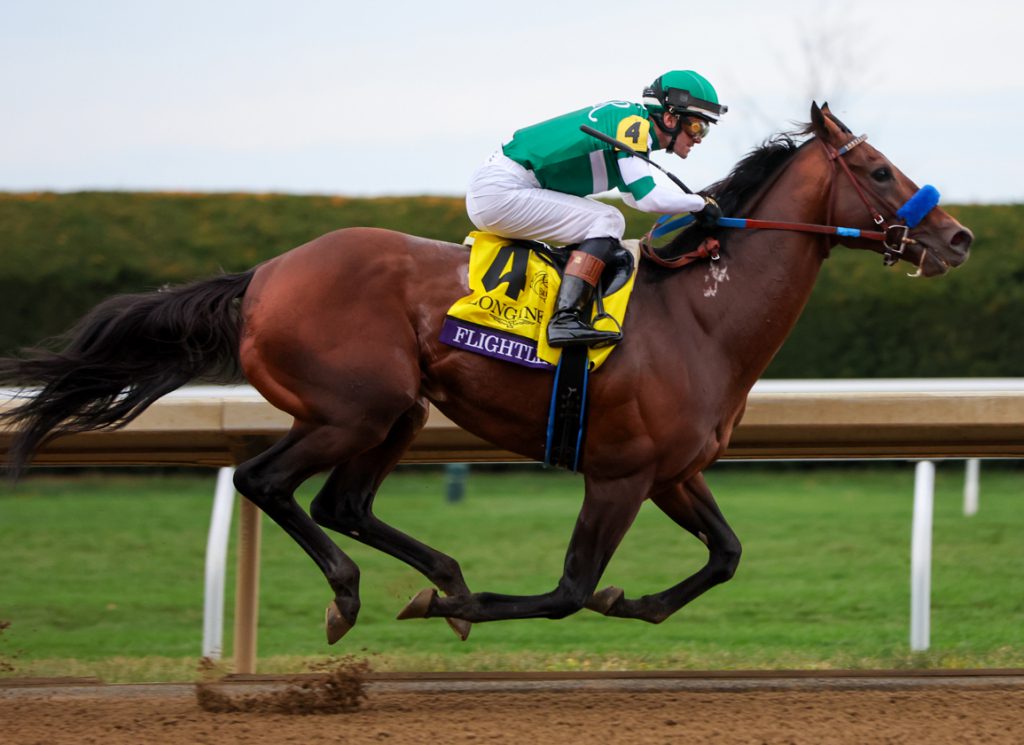
Flightline | Breeders' Cup Eclipse Sportswire

But if Sadler had a long wait for the best materials, in one respect he could not have been more blessed.

“Oh, absolutely!” he exclaims. “I came under a brilliant class of horsemen. They may not have all been perfect human beings. In that era, they might have smoked or drank too much. But they were self-made guys and really knew what they were doing.”

He absorbed priceless insights assisting racetrack vet Dr. Jack Robbins, observing the day-to-day methods of clients like Ron McAnally and Gary Jones.

“It was great practice,” he says. “I loved that we were going in all these different barns: you could take something from every one of them and then build your own program. And Dr. Robbins himself was so smart. A tremendous veterinarian, obviously, but also a successful horse owner, one of the charter members of the Oak Tree Racing Association. Tough guy, opinionated guy, smoker, drinker, but just a great man.”

Robbins could see that his protégé was unusually attentive. Sadler might say, “Oh, Doctor, I went over to such-and-such a barn and suggested a vitamin shot for that horse.” And Robbins would reply, “Oh John, no, that was a terrible idea!” And then he'd wink.

Sadler also learned a great deal as assistant to Dave Hofmans, though his big break came in 1979 when Eddie Gregson had taken on a big client and was looking for someone, he could trust to take four or five to Golden Gate Fields. There were things going on–a pari-mutuel strike, people shipping out–and Sadler quickly learned not to turn down horses. By the end of spring, he was up to 30 or 40.

Gregson's heartbreaking end, by his own hand, still grieves all who knew him. “He was really a bright guy, very sensitive, he knew food and wine and was very cultured,” Sadler recalls. “It caught everybody off guard, nobody saw that coming. But you never know what goes on with people. A great guy and a great trainer also.”

Besides these mentors, Sadler cherishes no less affection for the horses who also assisted his education. He'll never forget the $100,000 match, at Santa Anita in 1991, where his Cal-bred speedball Valiant Pete (The Irish Lord) beat Quarter Horse champion Griswold in a world record dash. And then there was the $50,000 claim Olympic Prospect (Northern Jove).

“He didn't run very well the day we claimed him,” Sadler recalls. “But he became really an important horse for me, early on. You couldn't train him very hard, but he ended up winning every sprint stake in the state. One day Patrick Valenzuela got on him, I can't remember what happened to the usual jock, in a race called the Potrero Grande [now the GIII Kona Gold S.]. He just let him roll, and they went that first half-mile in 42-and-change. And won! I mean, he was tiring at the end. But I've never seen that, before or since.”

With that kind of background, it meant a great deal to Sadler gradually to disclose a mastery with two-turn horses. Whatever pinnacle it might also represent in the story of the breed, let's not forget that Flightline last summer–by a bewildering 19¼ lengths–was his barn's fourth different GI Pacific Classic winner in five years, all owned (part-owned, in this case) by Sadler's cherished patrons at Hronis Racing.

That streak was started by the slow-burning Accelerate (Lookin At Lucky), whose campaign at five would have made him a lock for Horse of the Year but for landing in the same ballot as an unbeaten Triple Crown winner. He remains Sadler's richest runner at $6.7 million. “I just love him to death,” Sadler says. “His foals are going to be like him, they'll be later types, but I've two or three [of his first crop] that I really like and I'm expecting a lot of them to come forward as the year goes on.”

But Flightline was a freak from the outset. “He never hid his talent,” Sadler says. “April Mayberry called me from the farm and said, 'John, this horse gives me goosebumps.' She's been doing it a long time, and the only other to give her that feeling had been Zenyatta. So, we were expecting a lot when he came in. And even after the first, short piece of work, we were all just going, 'Wow.'
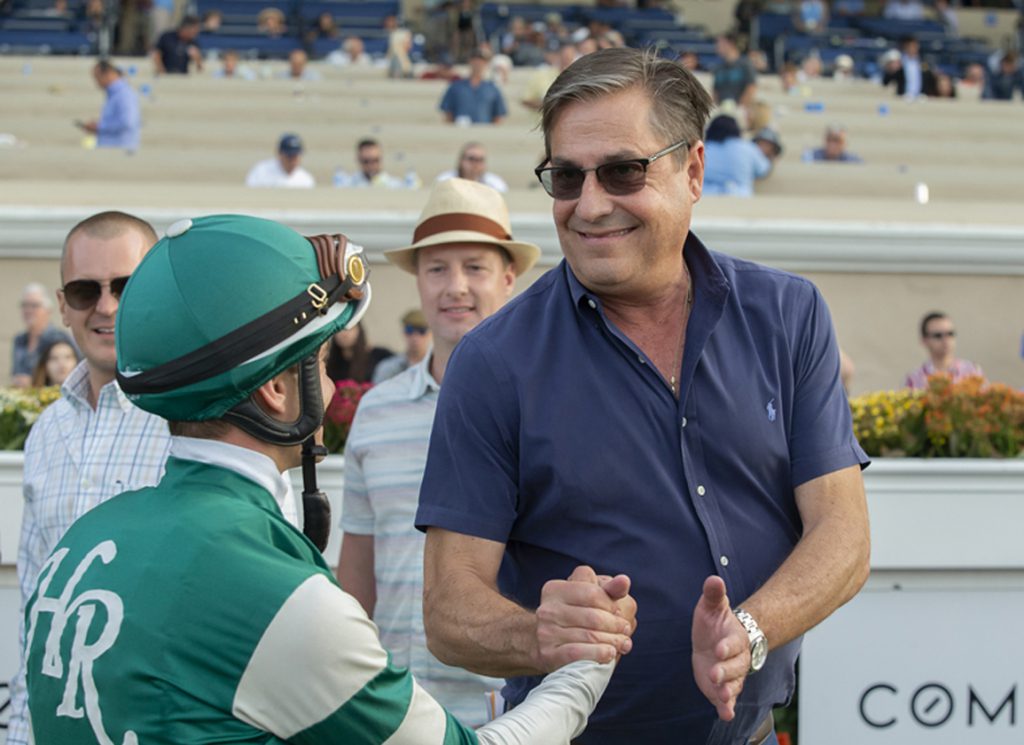
John Sadler with Flavien Prat | Benoit

“I mean, usually, I have to train them up. This horse, it was just a straight line. He's already there. He was so willing, from day one he just wanted to do it. Most of the early training was about getting him to relax and carry his speed. Even when he broke a little slow, he was very keen to charge out there between horses and push them aside. So, it was just about calming him down a little.”

While it was bittersweet only to race Flightline six times, Sadler absolutely understood his retirement. It would have been virtually impossible to find domestic opposition, unless or until a sophomore champion proved willing to take him on, while the insurance of fresh challenges overseas would have been eye-watering.

Whatever life after Flightline may comprise, it's been an incredible odyssey for the stockbroker's son who gazed across a paddock fence one summer vacation and fell in love with the horses grazing there. It should plainly end in the Hall of Fame, for which Sadler has a belated nomination this year. In some ways, perhaps he doesn't stand out from the production line of his profession merely in terms of his craggy six feet and four inches. And he does admit that there have been times when he has sensed a little resistance, notably in East Coast perceptions.

“You get that a little bit,” Sadler concedes with a shrug. “But you know what, when you've been training a long time, I don't really let those things bother me. I love training a stable of horses. I like where I train. I'm very comfortable doing what I'm doing. And, when you've been doing it a long time, you tend to end up with clients that are people you really like. So, I feel I'm in a good place. Like I said, I've hit most of the marks I want to. You can't worry about that kind of stuff. I mean, anything can happen with horses–and that's what's fun.”

That willingness to fight your corner, feisty and independent, was something he always loved about the California circuit.

“I was always trying to model after the guys that might not have had the best horses, but were always very hard to beat,” he remembers. “Even back then, they went out and won everywhere. I loved Tommy Doyle going over to win the Belmont [in 1975, with Avatar]. When California ships out, the results have always been amazing–and continue to be, to this day.

“We don't have gaming or casinos but we have the most beautiful tracks in the world and we always hold our own. Yes, when there's 15 protestors, versus 40,000 on opening day, and I'm signing autographs with Flavien Prat for an hour and a half, it's the 15 protestors that get all the noise. But California's led the way in all sorts of reforms. It's an adjustment, but you either embrace it or get stuck in the past.”

Sure enough, California has now given us one of the all-time greats soon after producing the only Triple Crown winners of modern times; not to mention a mare that arguably reached a wider public than any of them. Zenyatta's trainer, incidentally, is also deservedly nominated for the Hall of Fame–and would certainly join Sadler in stressing their shared debt to David Ingordo, now purchaser of three GI Breeders' Cup Classic winners.

“I was a friend of David's father so I've known him since he was in short pants,” Sadler says with a chuckle. “Actually, I do have a picture of him in short pants! He calls me Uncle John sometimes. So, it's been fun for me, and a source of great pride, to see how his business has developed. He's a tremendous, tireless worker, and obviously brilliant at it.”

Whether on behalf of his closest circle, then, or the entire Turf community, Sadler says he's profoundly grateful for the benediction he shared over the past couple of years.

“Many of the horses Flightline beat were really never the same afterwards,” he remarks. “He was a very dominant colt. At the Breeders' Cup one morning, Juan was coming off the track just as Epicenter was going up and Juan said he could feel Flightline rise up under him, literally making himself bigger like a rooster, as that horse came by.”

And something else happened that week. One morning Sadler's phone rang and there was Ron McAnally, 90 years old and still rooting for that lofty young man who used to follow Dr. Robbins round the barn.

“John,” McAnally said. “Don't let those photographers bother Flightline. I had that once with a horse, they were pestering him every five minutes, and he didn't run any good.”   Sadler hardly needed telling, but was still blown away. “Okay, Ronnie, I really appreciate that.”
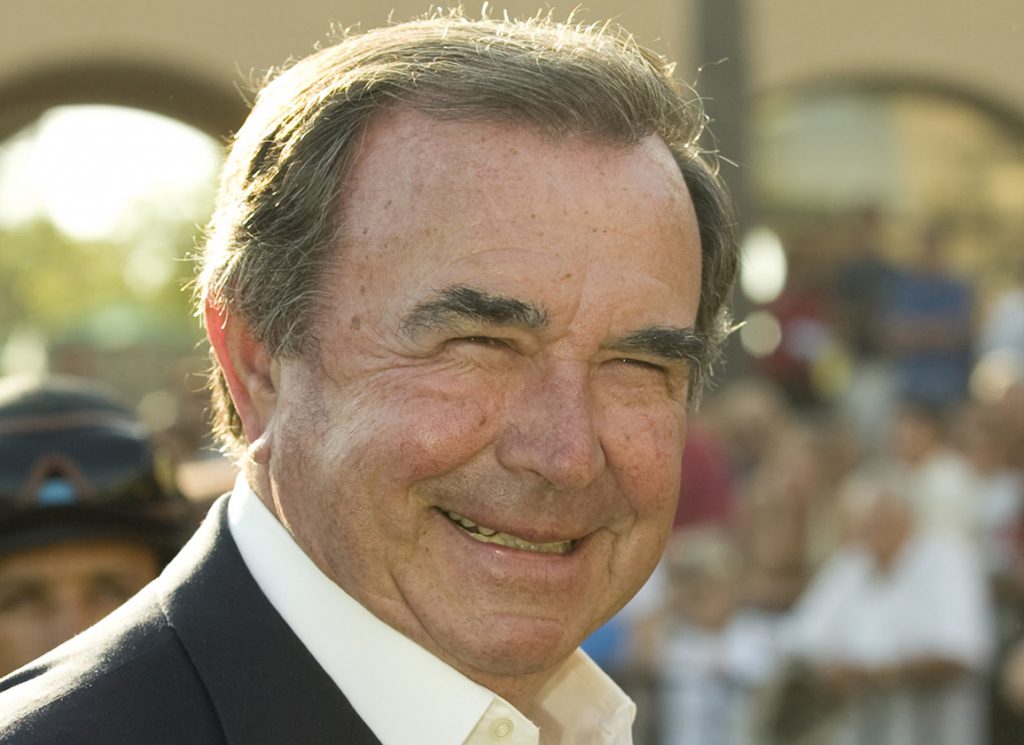
Ron McAnally | Benoit

McAnally, of course, had bred Rock Your World (Candy Ride {Arg}), who won the GI Santa Anita Derby for Sadler a couple of years ago. That connection had given him an extra buzz, and now it was adding something memorable to the Flightline adventure, too.

“That was a special call for me,” Sadler says. “He's one of the good guys and it was great that he wanted to pass that on to me, that he was still thinking of me. Like I said, as a young trainer I relied on the older guys a lot. I had great mentors. You'd sit around in the cafeteria, and these guys were so colorful, some of them in that era were doubtless politically incorrect–but they knew their stuff.”

By the same token, nothing pleases Sadler more today than when a young trainer seeks his counsel. Evidently that doesn't happen as often as a generation ago.

“That's a shame because horsemen are really very generous with their knowledge,” Sadler says. “I think to be a good horseman is intuition based on experience. And I do have the background: I walked hots, I groomed, I came up from the bottom of the stable. I didn't come in at the management level. So, I put in the years. And it's been a great journey. None of this happened overnight. It's like the guy that did 50 movies before he won the Academy Award. It's a lifetime of work.”

The post Sadler Staying On Flight Path appeared first on TDN | Thoroughbred Daily News | Horse Racing News, Results and Video | Thoroughbred Breeding and Auctions.

Source of original post
Verified by MonsterInsights
