Johnny Collins: ‘I Bounce Out Of Bed Every Morning – I Love This Job’

No shortage of hard work and bundles of perseverance lie behind Johnny Collins's achievement in turning his Brown Island Stables into one of the finest nurseries of equine talent there is.

It is all the more remarkable in that he achieved this with no racing background and just his own eye and pocket to get the whole thing off the ground.

Competitive and ambitious, the 46-year-old counts several million euros worth of stock at his County Cork base, which is the culmination of over 15 years producing top-class horses over both codes.

And when it comes to identifying young stock, few do it better. Mshawish (Medaglia d'Oro), a dual Grade I winner and the best Flat horse that Collins has had through his hands, cost just $10,000 as a yearling at Keeneland but rocked into €170,000 at the Arqana breeze-up sale the following summer in 2012.

“You have to experience the disappointment for when they don't work out to appreciate the satisfaction for when it does,” – Johnny Collins

Then there has been mammoth success over jumps as well. Irish Champion Hurdle winner Petit Mouchoir (Fr) (Al Namix {Fr}) and Champion Bumper winner Relegate (Ire) (Flemensfirth) were the first big names to fly the flag in that sphere for Collins, who is now a regular sale-topping consignor at the major breeze-up and store sales in Europe.

With this year's breeze-ups on the horizon, Collins can count 24 2-year-olds to represent him from Dubai to Deauville. But it's not a case of just turning up. Oh no. Last year was forgettable to say the least as Collins took a haircut on a lot of his breezers and it was the stores that came to his rescue later in the spring.

It takes a certain amount of resolve to make this game pay. A great deal more of the stuff is required when things aren't exactly going your way. Taking his medicine is something Collins became accustomed to in the early days and, while success has been more plentiful in recent times, he has dealt with the disappointments the same right the way through: by building back bigger and stronger.

“My horses weren't good enough last year,” says Collins, straight to the point. “Even in tough years, if we had good horses and they performed well, we never had any trouble selling them. It's when your stock is below average, that's when you'll suffer.

“But, every now and then, you need a shake to keep yourself focussed in this game. That will open your eyes and remind you that it's not that simple. If it was only a matter of going around and buying them with your eyes closed, well then anyone could do it.”

He added, “You can get complacent at this job. You could think you can walk on water sometimes and that everything you touch will turn to gold. We didn't have a good year last year. Our first sale was our best sale at the Craven and after that we probably just held our own. I probably just about washed my face with the breezers. But then I'd a very good year with the stores.

“The one thing you wouldn't want to do when you've had a bad year is to go and change too many things. What we've done in the past few years in developing horses and the system here, it works, so there's no point in changing that. All that part of it is fine. We just didn't have enough good horses last year. It's all about the horses.”

An operation the size of Brown Island Stables is only ever a few bad years away from hitting the rocks. This is a ship that navigates the most unpredictable of waters and one that carries millions of euros worth of cargo. With so much at risk, one would forgive Collins for resembling a German Shepard with a headache on a mid-February work morning, but he and his loyal bunch of staff are unfailingly helpful.

One by one, 20 2-year-olds whizz up the grass gallop close to Collins's base, with crucial notes made on the closest thing he has to hand, which in this case is a white envelope.

“I like to see them dropping their heads there now and going about their work,” says Collins in between lots. “If they are doing that and trying for you, there's a good chance they will go the right way because they'll do the same in their races.”

In the group of workers we have colts by Twirling Candy and Blame, who are bound for the first breeze-up of the year in Dubai on Mar. 21. There's six for the Craven and the same number will go to Doncaster with the remainder being divided up between France, Fairyhouse and Newmarket.
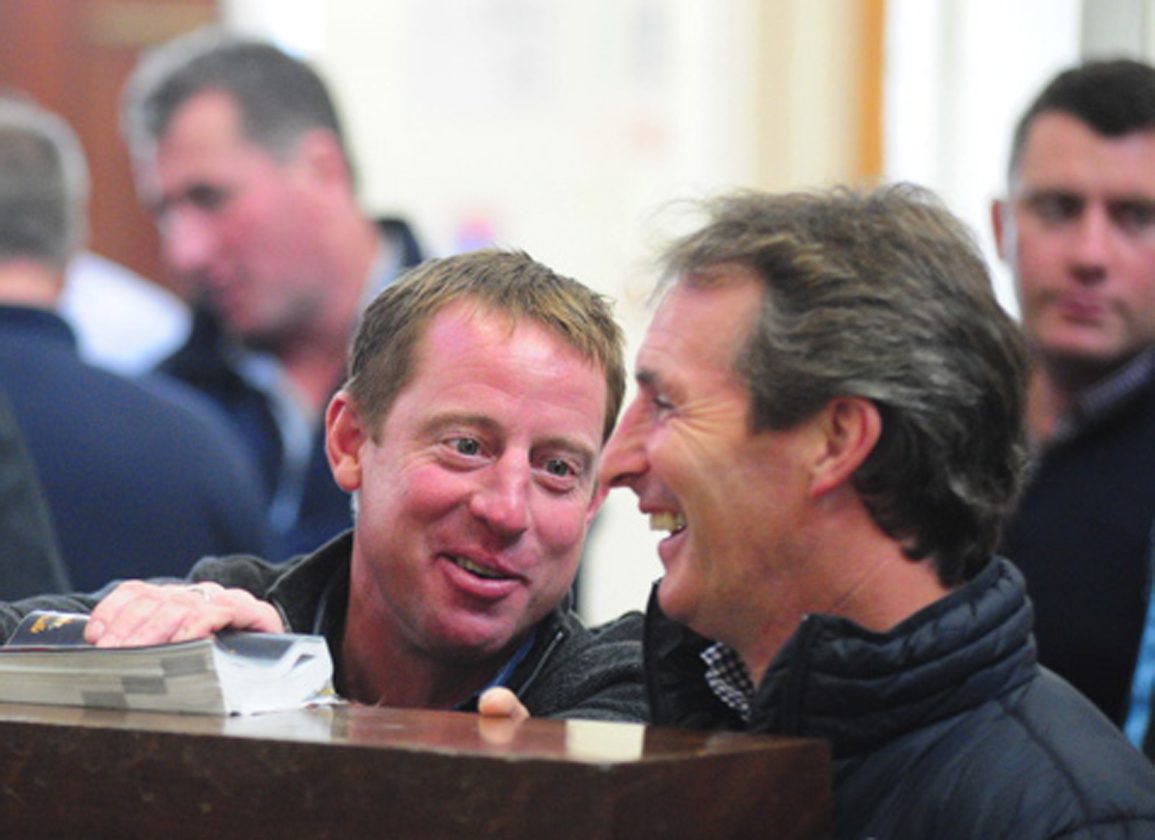
Johnny Collins and Norman Williamson | Tattersalls

“When I started breezing horses, we were buying ready-to-rock 2-year-olds. They were little five and six-furlong horses. It's changed an awful lot now. Look at last year for example, an Irish Guineas winner [Native Trail (GB) (Oasis Dream {GB})] and a St Leger winner [Eldar Eldarov (GB) (Dubawi {Ire})] came through the breeze-ups. It's amazing really.

“The yearlings were a great trade last year and it was hard to get them. I bought five at Book 2, two at Fairyhouse, two at the Somerville Sale, two at the Orby and the lads helped me out with six from America.”

The lads, as referenced by Collins, are international bloodstock agent Chad Schumer and his European representative Nancy Sexton, who have helped him to source stock from America while he was unable to travel to the States.

He continued, “I like a horse with a bit of strength and a bit of movement. There probably are sires who I wouldn't buy the progeny of because they haven't been lucky for me or they aren't commercial enough but I do try and go to the sales with as open a mind as possible. I'd cast a broad net and would look at as many as I could at a yearling sale.

“You can't overthink it, either. When you've your bundle of horses bought, you can only do the best with the horses you have. Of course it gets to you when they're not progressing the way you'd like them to be. For me, the beauty of it with the breezers is that I have a bunch of National Hunt horses to sell every year as well. So, even if you didn't have a great year with one code, you would be hoping to have a better year with the other. I'd be telling you a lie if I said that, coming close to the sales, there isn't an odd night where I'd be lying awake in bed thinking about it all. Of course there are.”

Collins endured his share of sleepless nights at the start. Whilst riding trackwork in America, he began to trade a few horses on the side but, by his own admission, was forced to learn by his mistakes.

“I went buying horses not really knowing what I was doing,” he explains. “I knew how to ride a horse but that was as far as it went. I had to make all of my own mistakes. I was at this a good while before I started making money. But, if you can sustain it, you won't keep making those mistakes. It would sharpen up your ideas and you won't make the same mistake twice. You get to look at your mistakes all year. Now, I wouldn't always buy a horse with perfect conformation but I'd know now what I could live with and what I could work with.”

So, when did the tide turn?

“For the first five or six years I really struggled. Even though I sold a couple of good horses, I was only barely making ends meet. The year I sold Mshawish, I also sold a horse by Street Boss, who made around €260,000. That really got the thing going.”

He added,  “I was only making enough to survive and that was with no staff. Hopefully we can keep it going now. It takes a while to break into it. You've to make a lot of mistakes and you need connections, too. It doesn't happen overnight. It takes time to build up a relationship and a bit of trust. It's easy to break it then as well.

“With the best will in the world, you can never be sure what a horse will do when it's put to the pin of its collar. You could have a horse working well but he might not deliver on a racecourse. That happens to trainers as well. You could genuinely think you have a good one but they let you down. Horses have a habit of doing that.

“When push comes to shove, they might not have the heart or the mind to go through with it. That's why it's so satisfying when they work out because, you know, everything is on the line as a trader. You have to experience the disappointment for when they don't work out to appreciate the satisfaction for when it does.”

Like most people who are good at what they do, Collins lives for his work and that passion fuels a hectic but rewarding lifestyle surrounded by horses.

“I love it. I enjoy this job, I must say. I like bringing on young horses and watching them progress. Even the National Hunt horses, I love bringing them on as well. And if they go on to do well for the next man, it's just a great feeling. That's what defines success for me but, at the same time, you can't do it if it's not financially viable.

“Especially when you start off, you need to have good results in the sales ring to keep the whole thing going and to develop the business. Luckily enough, we've sold a few nice horses but you're always looking for the next Cheltenham winner or the next good horse on the Flat.”

He added, “When you have the operation built up, bar you have it in your head to scale down, you have to buy the same amount of stock each year if you want to keep the same number of staff and the thing going the way you have it.

“Look it, I'm happy with the way I have it. As long as I have enough help, I've no interest in scaling back. I wouldn't see myself slowing down ever, as long as my health allows, because I do live for it. I could retire if I sold all my stock but it wouldn't make me happy.
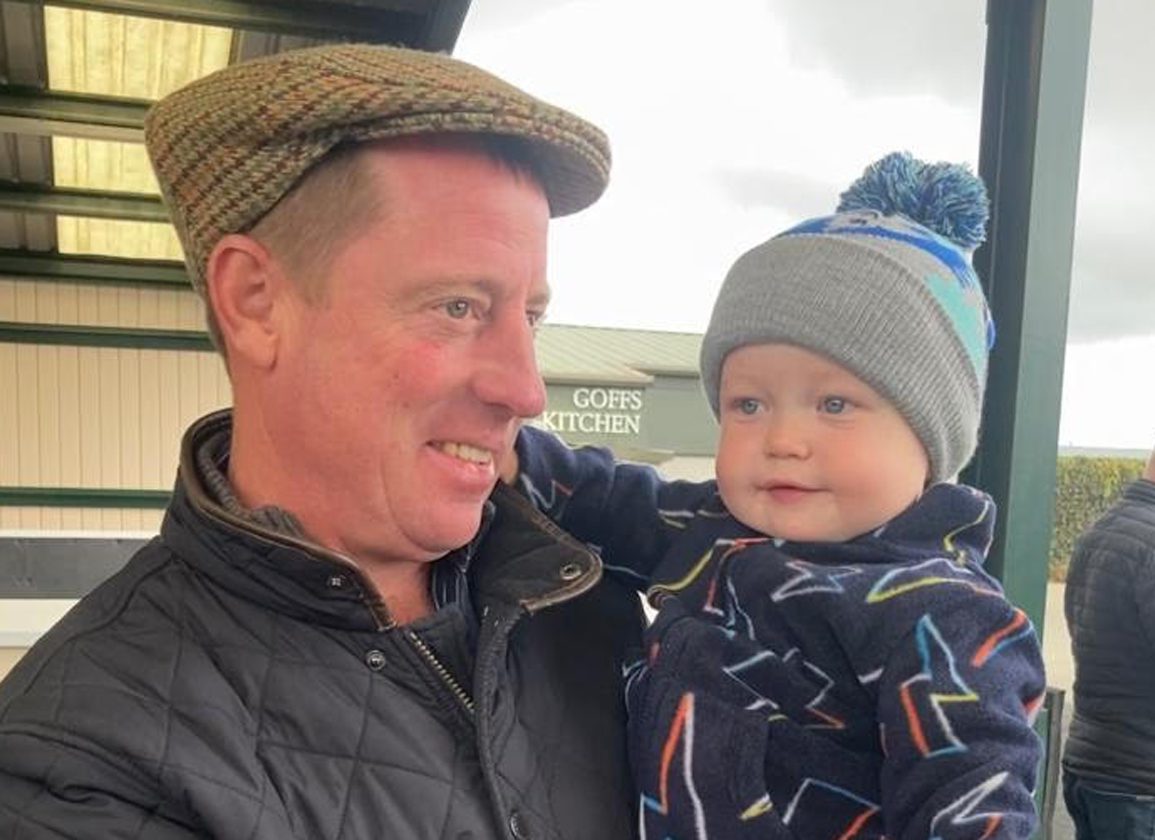
Johnny Collins with his son Daniel | Barbara Collins

“You could kick up your feet but what would you do then? I'm a late starter with regards to my family. My wife Barbara and I have a son, Daniel, and he's only 18 months old.

“I've a lot of friends working in jobs they don't like. They get up every morning to go to work and it's a struggle. I bounce out of bed every morning to go at this. It's not like work at all. It's very enjoyable.”

Facing the reality that comes with preparing over 120 horses for resale and the need to clear a couple of million euros annually to keep the business afloat would be enough to make most people baulk. Not Collins, whose search for a star–and to make a few quid along the way–sustains him.

“There was an old man I used to drink with below in the pub in Middleton, Denis Twomey was his name. He's since passed away but he used to have a great saying, and it stuck with me.

“He'd say, 'There are 20 years to come and there are 20 more to back it, now where is the man who can tell the man who wore the ragged jacket?' Every time I'd see Denis, I'd ask him to say it for me. No matter how many times I'd heard it before, I loved listening to it. It's a great saying, you know, and it's very true.”

The post Johnny Collins: ‘I Bounce Out Of Bed Every Morning – I Love This Job’ appeared first on TDN | Thoroughbred Daily News | Horse Racing News, Results and Video | Thoroughbred Breeding and Auctions.

Source of original post

Catalogue Released For Tattersalls Online March Sale

The catalogue for the Tattersalls Online March Sale is now available on the Tattersalls Online website and features a total of 24 entries to be offered in the timed auction to take place on Mar. 8 and 9, 2023. The catalogue includes 14 horses in and out of training from both Flat and National Hunt codes, two broodmares, a selection of 2-year-olds and a pair of point-to-pointers.

One of the catalogue highlights is Malina Girl (Ire) (Malinas {Ger}) (lot 22), a winner of four of her six starts to date, including placed efforts in the Dawn Run Mares Novice Chase and the Coolmore Mares Novice Chases. Another is Optional Mix (Ire) (Carlotamix {Fr}) (lot 12), a five-time winner at the races for trainer Eoin Doyle and is out of an own sister to the winning hurdler Tramp Stamp (Ire) (King's Theatre {Ire}).

The 15-year-old mare Misrepresent (Distorted Humor) (lot 2) is set to be offered by Ballinahown Stud in foal to Dandy Man (Ire), meaning she is carrying a full-sibling to Countess Rosina (Ire), third in the Listed Unzip Me S. at Santa Anita. Misrepresent is a daughter of Grade II winner and Grade I-placed Halory Leigh (Halory Hunter).

Ballet Blanc (GB) (Highland Reel {Ire}) (lot 17) is part of a draft from Amanda Perrett's Coombelands Racing Stables and exits a promising runner-up effort at Lingfield on Mar. 1.

The sale has been supported with entries from trainers Mick Appleby, Ed Dunlop, Edward Lynam, Rebecca Menzies, Amy Murphy, Jamie Osborne, Henry Spiller and Tom Lacey.

Prospective buyers are required to register or logon to join the sale ahead of the commencement of bidding from 12 noon, Wednesday, Mar. 8. Bidding is scheduled to close from 12 noon on Thursday, Mar. 9.

The post Catalogue Released For Tattersalls Online March Sale appeared first on TDN | Thoroughbred Daily News | Horse Racing News, Results and Video | Thoroughbred Breeding and Auctions.

Source of original post

Half a Century of One Wholehearted Guy

A Monday morning at Glencrest Farm, early in the spring of 1973, and here comes this teenage kid to see what it might be like to work with horses. The dairy where Gene Guy had been employed was closing down, but its owner W.W. Greathouse also had some Thoroughbreds on a place out near Midway and his son had said why not come out and give that a try. Guy lasted until lunchtime.

It sounds as though John W. Greathouse, Sr. had maybe tested him out a little.

“He told me to grab this mare and bring it to the teasing board,” Guy remembers. “And, man, she was kicking and bucking and screaming and, to tell you the truth, I was scared to death. And I guess my eyes got big, and John, Sr. and his son Johnny [ Jr.] were over there laughing. And then it was, 'All right. You can put her up.' And, boy, was I glad to do that. She wasn't in heat, didn't want to be bothered with no teaser. But I didn't realize all that. Now that I know, I see that was all pretty wild. But at the time I said to myself, 'Oh, Lord, I don't know if I want this job or not.' Those Holsteins never did carry on like that!”

And actually Guy felt sick by lunchtime and never came back in the afternoon. John, Sr. telephoned early evening.

“You all right?”

“Yeah.”

“You going to come back tomorrow?”

“Well…” And Guy pictured that livid old mare. He hesitated, thought for a minute. “Yeah, I'll come back. I'll give it another day.”

That was exactly half a century ago, on Friday, and for the bulk of that time Guy has been working for the Greathouse family as farm manager, becoming not merely cherished, but more or less indispensable. His caliber was so obvious, from the outset, that every week that March he received a bigger envelope.

“The first month, I got four raises,” he recalls. “So that felt pretty cool. And the rest is history. I must have been 18 or 19, a year out of school. And I'm still here, 50 years on. Guess I liked it!”

In the meantime, the young man who watched Guy struggle with that mare first succeeded his own father, alongside his brothers; and now their respective sons, John III, Deuce and Bucky have stepped up to various roles on the farm and beyond. But Guy's unstinting work ethic, plus an instinct for managing both horses and people, have made him a fixed point of reference throughout.

“Gene has been running at least our broodmare division and the main farm since I've been born,” says John Greathouse, III. “And I'm almost 40 years old. So, yes, he's been doing this a whole long time. And he taught me just about everything I know about horses. The thing about Gene is that he cares so much. The guy really, really cares: about the animals, about doing a good job. For six months a year, during the breeding season, he would never take a day off.”

That was evidently the way Guy was brought up–and that was also, no doubt, how he won over John Greathouse, Sr.

“When someone says 'hardboot,' he was what they mean,” Guy recalls of his first boss. “When I got here, his sons were about to take over and he was pretty strict. He just wanted everything done right. If you did it right, he was happy with you.”

And if you didn't?

“Well,” Guy replies with a chuckle. “You would hear about it! But I guess I caught on pretty fast. We milked 50 Holsteins every day, my daddy and I, so I was no 'slackard.' I had a great work habit, never needed an alarm clock. And I just started taking it over: doing the teasing, meeting the vets, holding the mares. A little bit of everything.”

Which, on this farm, meant a little bit of plenty. For a medium-sized operation, Glencrest has always had a very diverse portfolio. As a result, Guy has not only maintained continuity between generations, but also between disciplines.

“For a time we had a breeding shed here,” he recalls. “I learned a lot about that from Johnny [Jr.], after his dad stepped down. He was in the stallion barn with me the first year and then it was my turn to handle it. We had Clever Trick. He was a good-natured horse. He'd just come in, do his business and was done. And Wavering Monarch the same. Stallions were hard work, but seeing their babies going on to the track and doing so well was fun, and good for business.”

But Guy's principal satisfaction has always been foaling.

“I like to see new life come in the world,” he says. “And then, when you turn them out the first time, their little legs going every which way, wobbling and running and playing. And you see them thinking, 'Wow, so this is life outside that stall.' That's the best part: just a couple days old and they realize they've got legs and can run and jump and kick. And mama running after them, so proud.”

In his prime, Guy was a powerful specimen. Once he brought down a deer with his bare hands before hoisting it onto his truck. But that prowess was evidently less pivotal to team discipline than a more fundamental authority.

“Gene has always had the 'doer' mentality,” explains John III's cousin Bucky, who supervises the farm's agricultural division. “Obviously as you move up the ranks, you can get out of some jobs. But it helps when you've led by example, like he has. Everybody knows that you're not above any job. You've done the same as they're doing and, if need be, they know you'll help do it at any time.”

Guy, equally, only has praise for those who have worked under him.

“There's been big changes, from where it used to be,” he remarks. “We have a lot of foreigners here now. But thank God for them, because it's hard to find Americans that want to work anymore. And we've got a really good team right now. John III and Bucky can relate to them all, and that helps too. They have a good rapport with our workers, so everybody's on the same page. But I never had a problem, with race or anything else, everything has gone along fine all the way.”

That fleeting reference acknowledges that it remains rare for African Americans to have senior roles in the breeding industry. But while Guy insists that he has never experienced any issues, he surely deserves celebration as a role model for any who aspire to improve the wider situation.

“I really haven't thought about that,” he says. “Not many African Americans go into the horse business, so that's why you don't have a big pool to choose from. It's not bias or anything like that. That's the way I look at it.”

John, III agrees that Guy can be a model for anyone, regardless of ethnicity or background.

“Probably when he first started, the African American presence in the industry was a lot stronger as far as racetrack and guys taking care of horses,” he reflects. “Over the years, that has slowly transitioned. But Gene, when I was born, was an African American working with a bunch of Caucasian guys. He was in charge of all of them–and he made it work.”

Nobody, of course, can testify to Guy's contribution better than “Johnny, Jr.,” as he still calls him.

“Gene's not going to toot his own horn,” John Greathouse, Jr. says. “Nobody is looking to be an all-star here. They're just looking to get the job done right. Make sure all the animals are okay. If the animals are okay, we're all okay. And he's just one of those guys that understands horses.

“He's been around them a long time now. He was always willing to work, just had to acquire the knowledge. And after all these years, foaling mares with me and then with John, he knows what he's doing. And that's just something you can't replace, 50 years of experience. It's not something you can hand over to somebody else and say, 'Okay, you go do it.'”

Though Glencrest will inevitably have episodes of colic, vets have suggested that they tend to be caught earlier than elsewhere. And John, Jr. credits that to Guy's eternal vigilance.

“He's never far from the farm,” he says. “He's always driving around and, even when he's not working, he'll be taking these wonderful pictures to share on Facebook. Gene's just the kind of person that anyone would love to have work for them, as reliable and steady as any human being I've ever been around. And a nice person to go with it–and the same goes for his wife and daughter.”

Those long-suffering ladies have long reconciled themselves to sharing Guy's dedicated nature with his employers.

“Yeah, I was gone a lot of the time,” admits Guy wryly. “Especially during the foaling season. But my wife [Cathy] did a good job and my daughter [Carly] has turned out great.”

There have, of course, been labor-saving advances since 1973, but somehow life doesn't seem much more relaxed to Guy.

“You used to have to bale your own hay and straw, but now we have tractors picking up those big hay rolls,” he says. “Same with the manure truck coming through the barn. As far as that goes, our work is more efficient than it was. But I think it's more hectic than back then. Horses are worth so much these days, people have a lot of money invested. So you better be on your toes and make sure you do a good job. If people send a horse in here to be taken care of, to me that's a big responsibility.”

And that, of course, is precisely why the Greathouse family has been able to trust him through every stage of every cycle. As John, Jr. notes, for instance, Guy foaled and raised Wavering Monarch, but also supervised his return to the farm as a stallion.

“In any business, it counts for a lot to have somebody you can trust,” Bucky says. “Gene has essentially been part of our family for almost his entire life. And he's still an asset, still brings something to the table. He's not just working with some honorary title, not just here because of longevity. Gene still brings value to the job every day. And I think that speaks volumes about his character. It's not just the loyalty factor, but the dependability. If ever there's been a problem with a horse, you've known that you can always call Gene and Gene will know what to do.”

That integration with the Greathouse dynasty obtains a nearly literal quality when Guy, talking with the latest generation at the helm, refers to their grandfather as “Old Dad.” He's a living link to their family history, to the foundations of the farm. John, III and Bucky both mention how they turn to Guy to chart the waterlines, and that subterranean knowledge almost seems a metaphor for the very lifeblood of Glencrest.

“I think that for Gene, with my cousins John and Deuce on the horse side, it's like you're working with somebody, not for somebody,” Bucky adds. “Everybody's worked and grown up together, everybody has a good relationship, and that's what makes it work.”

John, III has never even mentioned the “r” word (retirement) to Gene.

“I'm afraid to bring it up, in case he might actually do it!” he says. “He's never once talked even about slowing down. If ever he did, he can be here as long as he wants, in whatever capacity he wants. He could ride out into the sunset or he stay here until he's in the ground! It's up to him.

“When I took over the farm, the place wasn't in great financial shape. We weren't real sure how long we were going to stay open. We could certainly have gotten smaller, run 30 horses without needing all the help we had. But most of the guys here have been with us a long time. I've another gentleman, Ricky Evans, here 35 years. And we felt like we owed it to them to make it work, to try and keep them around. And now the farm's in as good shape as it's been in a long time, because of Gene.”

In any walk of life, 50 years with a single employer is a remarkable achievement. In one as demanding as that embraced by Guy, it's quite astounding.

“John, Sr. ran the place when I came,” he reflects. “Then it was Johnny, David, Allen and Teddy for 20-some years. And now their sons are running it. It's still kind of odd, without Johnny on the farm every day, like he used to be. And of course David passed away. So it's different. I built John, III a treehouse when he was three or four years old–and now he's running the whole thing! Can you imagine? But yeah, 50 years since my first day on Glencrest. And it just feels like yesterday.”

The post Half a Century of One Wholehearted Guy appeared first on TDN | Thoroughbred Daily News | Horse Racing News, Results and Video | Thoroughbred Breeding and Auctions.

Source of original post

Verified by MonsterInsights