HISA Gives Turf Paradise March 31 Deadline To Improve Rail Safety Or Face End Of Simulcasting/ADW

In a continued effort to get the track up to speed with national safety regulation, a panel of three board members with Horseracing Integrity and Safety Authority issued a notice to Turf Paradise about its track railing on March 17.

A dangerous track rail was one in a list of alleged safety rule violations the Authority had cited the Phoenix, Ariz., facility for earlier this year. The Authority and Turf Paradise entered into an agreement Feb. 24 outlining an agreement for resolving issues with fee non-payment, horseshoe monitoring, whip use monitoring, and void claim policy issues. The inspection of the track railing was the final element from a notice served to Turf Paradise in January that had not yet been resolved.

The Turf Paradise HISA steward and a Jockeys' Guild representative examined the track railing and found “numerous gaps and exposed edges in the railing material that could inflict serious harm upon jockeys who might be unhorsed during a race and thrown into or over the railing.”

They then testified before the panel of the Authority presenting their findings at a hearing held March 16. The panel included Steve Beshear, Adolpho Birch, and Joseph De Francis, who heard evidence from the local HISA steward, the Guild, and track management, as well as attorneys for the Authority and for the racetrack.

The extent of needed repairs was characterized as unanticipated by track management, who voiced concern about a timeframe for getting repairs done while the track was in use for training and racing.

Counsel for the Authority urged the panel to require Turf to come into compliance by March 24 and to fine the track for allowing the issues to linger. Instead, the panel chose to require the track make repairs to the railing by March 31 and declined to impose a monetary sanction for not repairing the railing before now.

“If the repairs are not completed on or before March 31, 2023, or if there is evidence of any other deficiency in compliance with the Authority's rules as set forth in the Agreed Order of February 24, 2023, Turf Paradise shall be prohibited from conducting Covered Horseraces as of April 1, 2023, pending any further action taken by the Authority,” the decision from the panel read.

If Turf Paradise fails to comply with the panel's order, or the February order, it would no longer be able to legally export its simulcast signal or accept wagering through advance deposit wagering on April 1.

The post HISA Gives Turf Paradise March 31 Deadline To Improve Rail Safety Or Face End Of Simulcasting/ADW appeared first on Horse Racing News | Paulick Report.

Source of original post

‘They’re Going To Take Down All Of Racing’: Here’s Why Legitimate Tracks Should Be Concerned About The Bush Circuit

On the morning of Aug. 5, 2022, the eyes of the American Thoroughbred racing world turned to Saratoga Springs, N.Y., where the sport's luminaries streamed into the Fasig-Tipton sales pavilion wearing their best dresses and freshly-pressed suits. It was induction day for the year's class of new Hall of Famers, a day that's often filled with pomp and nostalgia for those gathered, and a lead-in to another dreamy weekend of summertime stakes for racing fans elsewhere.

It's hard to say how many of them had the time to read a story published that morning by the Washington Post titled “A horse track with no rules,” the broadest and most pointed indictment of the bush racing circuit's lack of care for horses and riders in mainstream media thus far. The story acknowledged that author Gus Garcia-Roberts, a sports-focused investigative reporter for the Post, received some information about the abuses at bush tracks from animal rights group People for the Ethical Treatment of Animals (PETA) but also that Post reporters independently confirmed many of the group's claims. Blatant injections of horses on the track with syringes later revealed to contain methamphetamine and methylphenidate (Ritalin) and open carrying of electrical shock devices by jockeys were noted by Post reporters on scene. Videos and photos readily available on social media show gruesome fatal breakdowns of horses on poorly-cultivated track surfaces where no official veterinarians are present.

For many people who live in the world of state-regulated Thoroughbred racing, the problem of bush racing probably seems like an abstract one. If they've heard of bush racing at all, they probably think of it as small potatoes — two horses running in someone's hay field from time to time with a few neighbors gathered around. They may know that bush racing is also mostly limited to Quarter Horses (though cases of unsanctioned harness tracks have also been known). It's easy for licensed Thoroughbred participants to look at it and say, 'This is a whole different world. It doesn't impact me.'

But regulators who have spent years studying the challenges of bush tracks say those distinctions may not be important. They say that what matters most as the bush tracks grow is, how is the sanctioned racing world going to respond to them?

What the bush circuit looks like

Once upon a time, before the advent of state racing commissions, all racing was a sort of bush racing. The sport evolved from the tendency of one owner to make a proposition to another that their horse could run faster than their neighbor's. Horses and riders raced over open country in the days before formal tracks, and until actual drug testing evolved in the 1930s, integrity was nothing more than a gentlemen's agreement. State racing commissions came about from a recognized need to maintain safety standards for horse and rider and confidence for the people betting on the events.

The “bush racing” that was a point of concentration for the Washington Post, for PETA, and for state racing regulators these days, is not the rustic, casual pastime of bygone days with a few dozen friends in attendance, whooping and hollering. As social media has become a greater presence in modern culture, bush racing has grown like a brush fire.

It's still legal for two horses to race each other in someone's backyard to satisfy pride or curiosity. It's not legal for organizers to accept wagering on the activity outside the purview of the state, which collects taxes from the proceeds and uses part of them to fund purses and to ensure participants are sticking to the rule book.

“This is not a couple of guys who get together and match race in their back pasture,” said Dr. Angela Pelzel-McCluskey, equine epidemiologist for USDA/APHIS. “This has now morphed into a very sophisticated, highly-marketed league of things happening across the country.”

Support our journalism

If you appreciate our work, you can support us by subscribing to our Patreon stream. Learn more.

Pelzel-McCluskey has become something of an unintentional expert on bush racing. Her job as an equine epidemiologist requires her to do contact tracing on horses that test positive for communicable diseases. Her work tracing equine infectious anemia and piroplasmosis cases has led her to make contact with many horses and horsemen who race on the bush circuit.

In the course of disease tracing, Pelzel-McCluskey has documented the existence of 111 bush tracks in 28 states. Some are no longer active, but were running at some point in the last few years. She has kept notes on facility addresses and other information she finds about their events online in case she needs that data for the next disease outbreak. Those 111 facilities are just the ones she's happened across in the course of her tracing work – they're not a representation of a concentrated effort to locate all the tracks in the country.

She's confident there are more she just hasn't found yet.

The reason Pelzel-McCluskey (and PETA) have been able to gather so much information about illegal racetracks is that they routinely post promotions for upcoming events as well as photos and videos of races on their Facebook pages and on YouTube. Spectators often openly share race videos on Instagram, TikTok, and elsewhere.

To the average person scrolling through Facebook, it may not be immediately obvious that the content they're seeing is not coming from a legal racing facility. Many bush tracks have mechanized starting gates and some form of fencing or railing along the sides of the track surface, which is always a dusty straightaway since races are short. Typically, there are not water trucks or harrows visible near the track, and most racing strips appear to be tilled farmland with minimal cushion. Horses are piloted by riders who are sometimes wearing silks, and may also carry saddle towels or customized bridles colored to match the ownership's branding.

Sometimes, those riders are professional jockeys who show up wearing their trademark white pants emblazoned with logos familiar to watchers of sanctioned Quarter Horse races, including the Permanently Disabled Jockeys Fund, Track Magazine, or Speedhorse magazine.

“If you will look closely at the Track logo on some of those pants that some of the riders at those unsanctioned tracks you will find that the pants are counterfeit,” said Ben Hudson, owner/publisher/editor of Track Magazine. “That logo is very hard to reproduce and we do not give the pants to riders that are not participating in Grade 1 races at major tracks.

“Track magazine has been in business since 1975. We deplore match racing and the way they treat horses and riders. We do not go to match tracks.”

“We do not sponsor any riders,” said John Bachelor II, president of Speedhorse. “Our pants are available to jockeys who want to wear them for advertising purposes at no cost. It is grievous to see them show up at the unsanctioned tracks. We have no control over this.”

Nancy LaSala, president of the PDJF, said their logo on rider gear has been a public awareness boon for the organization at sanctioned facilities. She suspects as many riders become successful, they pass their racing gear down to younger up-and-comers, and this may be one avenue through which the charity's logo is appearing on the bush circuit.

Horses are paraded in front of the crowd – which is nearly always hundreds, if not thousands, of people – similar to a post parade, save for the fact that pony riders often don't wear helmets and may be carrying needles. One thing you won't see in the background is an equine ambulance, or often a human ambulance, either. Breakdowns are not tallied in any kind of uniform national system but do seem to occur with some regularity, and are often left in video of the race broadcast afterwards. While the bush tracks don't have a vet handy, someone usually does have a gun and euthanizes the fallen runners by shooting them.

Many times, the races are documented by a photo finish camera and one or more professional photography or videography companies which sell connections win photo montages similar to what you'd see after a race at a sanctioned track. The main difference is that there is no winner's circle at most of these tracks, and instead connections huddle around the horse as they stand in the middle of the racing surface.

In many ways, bush racing has managed to achieve what sanctioned American racing has failed to. Facebook pages for unsanctioned tracks are published nearly exclusively in Spanish, and photos and video from the events show an enormous, enthusiastic, and predominantly Hispanic crowd.

“A lot of times some of the bigger venues will have live music,” said Pelzel-McCluskey. “They sell beer and alcohol (no, they don't have a liquor license). They market these events and a lot of the marketing is sort of family-friendly. They want the race fans to come and bring their kids and bring their friends and pay money to get in and to park, and then bet while they're there.”

Bush tracks have also been able to promote their athletes in a way conventional racing hasn't. Horses often run under pseudonyms that are different from their American Quarter Horse Association-registered names to evade detection, and heavily Photoshopped digital posters advertise two runners like boxers ahead of a fight. Pelzel-McCluskey said that she has seen a variety of journeys for horses on the bush track circuit; some start their careers at legal tracks and transition to bush racing because the money is better. Others may use the bush tracks as a testing ground for young or unproven horses before their ownership decides whether to send them to sanctioned tracks. Others seem to go back and forth. Long, repeated gaps in a horse's Equibase record can be a sign of a horse who switches.

The horses have their own fan bases, even though they, like their counterparts at legal tracks, tend to come and go. In case the individual retires or breaks down, there are still match-ups for fans to get invested in. Ownership of bush runners is organized into teams called “cuadras,” with multiple horses running for each team. Match-ups between two or three horses generate buzz for the horses' rivalries as well as the teams'.

Organizers of bush races make some of their money from illegally taking bets, but also by charging attendees. Sometimes they pay a low price per carload, but on at least one day of illegal racing in Georgia it cost $100 per person to get in – far higher than general admission at any sanctioned Quarter Horse races.

Why is this a problem?

The activities at bush tracks are a thorn for many different enforcement agencies.

State racing commissions are concerned by the illegal wagering that takes place at many bush tracks, since the state and the tracks aren't getting a cut of that. And, as the entities charged with safeguarding racehorse welfare, they're also worried about the abuses that have been well-documented at bush tracks.

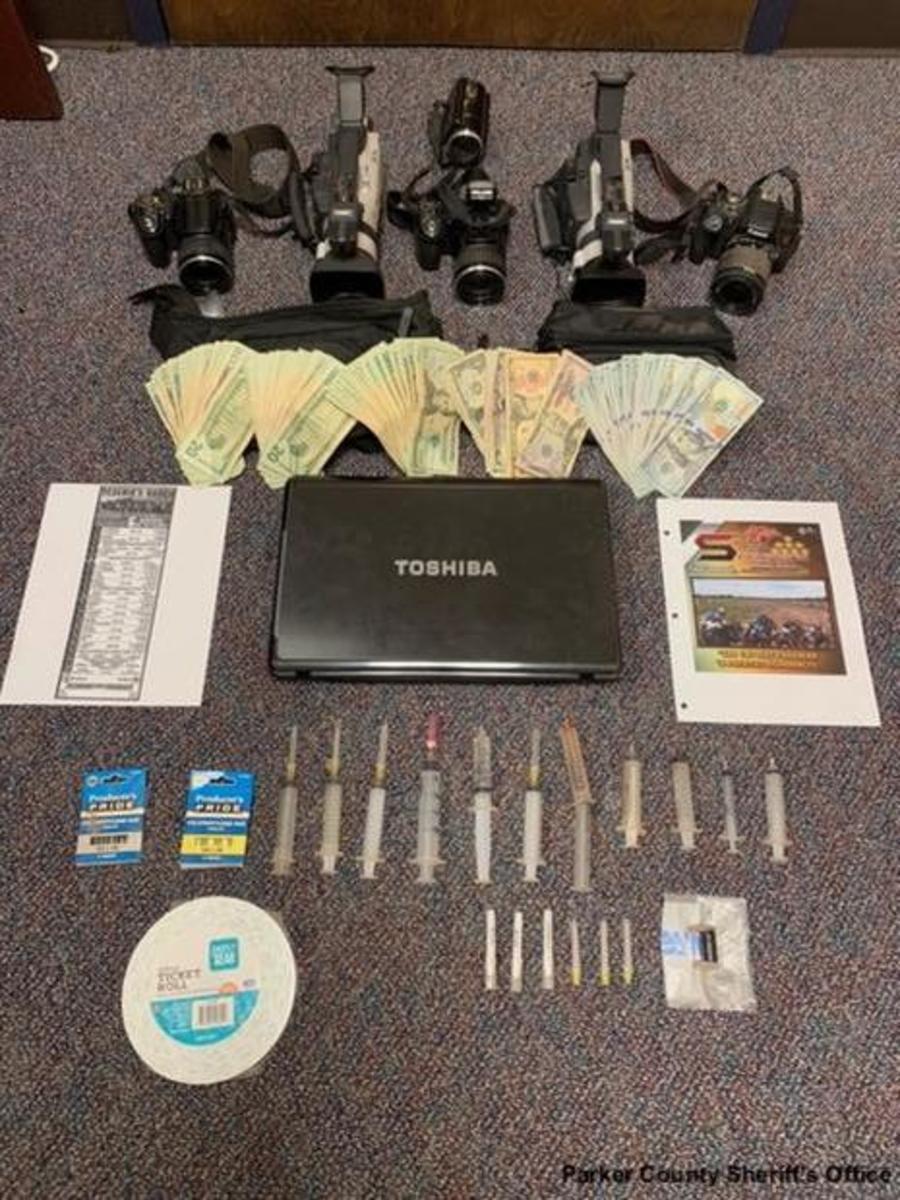
Evidence collected from a raid of an unsanctioned racetrack in Texas in 2019

“The laws that apply to it have always been tied to parimutuel wagering, because that's the unsanctioned part,” said Scott Chaney, executive director of the California Horse Racing Board.  “Frankly, from a CHRB perspective, we don't care that much about the parimutuel part. We would prefer it not go on, but in some ways it's probably like trying to address home poker games — technically illegal but probably not something anyone's ever going to do anything about. What we care about is the animal welfare component.”

Speaking to the Post, Horseracing Integrity and Welfare Unit chief of science Dr. Mary Scollay alleged that some of the substances found in syringes used on bush track horses in the post parade could be of interest to the Food and Drug Administration and Drug Enforcement Administration. One 2019 incident described in the Post recalled a horseman headed to an unsanctioned Georgia track who was pulled over. Police discovered “boxes” of amphetamines and anabolic steroids in the trunk of his vehicle.

In an October 2022 report to the Texas legislature, the Texas Racing Commission characterized unsanctioned tracks as “largely ungoverned spaces that allow for a wide range of organized criminal activity, to include human trafficking, unlicensed alcohol sales, tax evasion, [as well as] turning a blind or knowing eye to illicit drugs and shocking devices that can injure or maim racing horses and undermine the sport's integrity.”

The frequent use of injectable drugs and associated cases of transmissible diseases among bush track horses makes the operations dangerous for horses stabled nearby those from the bush circuit.

Read our previous reporting on the transmissible disease risks in unsanctioned racing here.

And roughly a decade ago, of course, the FBI busted members of the Los Zetas drug cartel for using Quarter Horse breeding and racing – both sanctioned and unsanctioned – to launder the organization's money.

Support our journalism

If you appreciate our work, you can support us by subscribing to our Patreon stream. Learn more.

Setting aside the welfare and legal considerations, Pelzel-McCluskey thinks the sanctioned racing world should be equally concerned about another aspect of the bush races – people with no knowledge of horse racing may not necessarily recognize the difference between a race at Los Alamitos and a race at Georgia's Rancho El Centenario. And most people who don't work in the racing world can't tell the difference between a Thoroughbred and a Quarter horse, no matter where it's running.

“When you look at what we're doing in sanctioned racing, with HISA, with surface monitoring, with all the rules, we're trying our best,” she said. “I'm not saying it's perfect. We've got lots of problems still. But we're trying our best to make this sanctioned sport work for the horse and the rider, to assure the spectator we're doing everything possible to make these horses happy and comfortable and have a lifelong trajectory. And yet, you have this other thing going on that's just putting horses in the ground. It's very difficult to explain this.

“The more the general public start to see, I'm very concerned the things they see in bush tracking are what we allow to happen in sanctioned racing. The perception is terrible.”

Enforcement challenges

It's not difficult for a casual racing fan to uncover Facebook pages devoted to illegal racetracks or to racing cuadras, which goes to show how unbothered operators are by the prospect of attracting regulators' attention. Besides the fact that social media brings their life blood – their audience – routinely promoting events hasn't had many serious consequences for them.

On its face, it may seem like the easiest thing sanctioned racing could do to discourage bush tracks is to dole out stiff penalties to people who cross back and forth between the bush tracks and the sanctioned tracks.

Ownership of a cuadra is not detailed in most Facebook posts, and trainers aren't often named either, but jockeys sometimes are. Some riders have a nom de course for bush racing, but other licensed riders may attend illegal races wearing their name or initials on their clothing, and many will post photos from bush tracks on their own profile pages to brag about a win. After only a few hours' searching, the Paulick Report discovered ten jockeys who had ridden in sanctioned racetracks in 2022 or 2023 and who had also identified themselves in Facebook photos or YouTube videos as having piloted winning bush track horses. One was a multiple graded stakes winner, while another was multiple graded stakes-placed, both in Quarter Horse stakes races.

Most state regulations don't specifically prohibit a licensed rider from participating in unlicensed activity. Even if they did, photos from a bush track may not always be enough to prosecute.

“Given where we are with deep fakes and AI, it's not as straightforward from an evidentiary standpoint as people think,” Chaney said.

In California, it's the wagering that's illegal, but it's hard to prove that a facility is collecting bets outside the parimutuel system. Even if investigators can prove it, it's only a misdemeanor charge.

In New Mexico, regulators also wanted to take action against licensees crossing the line but are still trying to figure out how to make it work.

“The agency has contemplated promulgating a rule that would cause for revocation of a racing license if you were caught on the premises of unsanctioned racing, whether race riding or eating a taco,” said New Mexico Racing Commission executive director Izzy Trejo. “We have tested it against the excuses we think we would receive, and it may a difficult to build cases in the very liberal courts here in New Mexico.”

Trejo believes that fewer trainers than riders cross back and forth between regulated and unregulated racing.

“To combat these people from infiltrating our industry as trainers, we have created a trainer's test that is so difficult to pass,” he said. “It's easy pickings because these guys do not know the rules of racing, nor do they care to learn them.

“Also, we have diligently gotten rid of one paper trainer after another due to rule violations, hence all the rulings we disseminate. Paper trainers and match racers go hand in hand.  We have taken that approach because paper trainer cases are also hard to crack due to our limited resources.  I think that has helped our drug violations decline from over 170 in 2016 to just 42 in 2022.”

If the bush races are illegal, you may wonder, why don't authorities show up at post time and shut it down?

Shuttering an illegal track in the middle of a card is an enormous logistical undertaking. Because so much of a bush track's business is done in cash, attendees and participants are often heavily armed. Organizers often hire off-duty local police to serve as event security, which raises questions about how objective local law enforcement could be about pursuing illegal activity going on there. Even without potential alliances between track operators and local police, the size of the crowds at bush events makes the job too big and too dangerous for one or two unarmed racing commission investigators to handle on their own.

In its 2024-25 legislative appropriations request, the Texas Racing Commission requested an additional $679,154 for each year to add personnel who could network with other state agencies to address an estimated 20 bush tracks in Texas. The report estimates that effectively addressing the state law violations at bush tracks would require cooperation from the state's comptroller, department of agriculture, department of public safety, alcoholic beverage commission, animal health commission, veterinary board, secretary of state and parks and wildlife.

New Mexico has two investigators working for the racing commission, and Trejo says most horsemen know them by sight, so gathering intelligence at a bush track is impossible. Even without the risk of recognition, state racing commission investigators don't have the power to make arrests and often may not have enforcement authority off sanctioned properties.

“I understand the feeling on trying to regulate these facilities,” Trejo said. “The bottom line is it is tough. Many facilities are also 'training centers' and the argument will always be that they are training their horses. The fact of the matter is it is not illegal to have two horses compete against one another on private property. The problem with these unsanctioned locations is that they are funneled by drug money or other illegal activity.

“We thought the best way to attack the unsanctioned racing is to have law enforcement back into busting them using the RICO [Racketeer Influenced and Corrupt Organizations Act] statutes. That of course, takes some time to investigate since you must trace the origin of money and then follow it as well and prove how that money is tied into the purchasing of horses and land, illegal beer or alcohol sales, prostitution, and drug trafficking.”

Some track operators are cleverer than others when it comes to evading state or local laws that should dissuade them. The Post's reporting told the story of a Georgia bush track operator who learned he couldn't legally sell tickets to bush races, so he sat at the facility entrance and offered people the chance to buy $20 pecans; one pecan meant the person was entitled to watch races for free. The Post also noted that track operators who apply for zoning changes for their facility may claim the property will be used for events or parties as a means of explaining the traffic and noisy music that can sometimes come along with a race weekend.

There have been cases of large scale, multiple-agency raids on bush tracks. In 2007, some 200 law enforcement agents arrested 100 people at an unsanctioned track in Oklahoma on charges including racketeering, money laundering, and illegal gambling. Authorities in Washington and Texas have conducted multi-agency raids of unlicensed tracks in recent years. Trejo recalled several cases roughly nine years ago in New Mexico where law enforcement took action against bush track operators, but said it didn't halt the surge of bush racing's popularity in more recent years.

Solutions

There are a couple of routes by which sanctioned racing may choose to address bush racing – by strengthening state regulations, or by pushing for it to be banned at a federal level.

In California, Chaney pointed to Assembly Bill No. 1298, which was introduced in this year's California legislative session and would make unsanctioned racing operators subject to up to a $25,000 civil fine for each day of racing that takes place without a license from CHRB. The bill was introduced by Assemblymember Avelino Valencia, whose district includes Los Alamitos Race Track.

Beyond the state legislature, Chaney also says that the CHRB is trying to determine what, if anything, it may do with photographic evidence given to the staff by animal welfare groups and by this publication of licensed participants in bush racing.

“Although I cannot comment on the likelihood of filing complaints, I can say we are investigating this evidence as we speak,” Chaney told the board during a March 16 meeting. “Staff has developed language for a CHRB regulation that specifically prohibits licensees from participating in unsanctioned racing. We anticipate presenting that language to the board next month.”

Chaney also reported he sent a letter to the American Quarter Horse Association ahead of its annual convention, expressing the CHRB's concerns about the practice.

For its part, the AQHA was asked by this publication whether it had any official policies on the eligibility of participants in bush racing for AQHA-recognized stakes races, awards programs, or the eligibility of horses into the AQHA studbook. The organization was also asked whether it has offered investigative resources to state or federal agencies that may have an interest in shutting down bush tracks.

Chief racing officer Janet VanBebber provided the following statement to the Paulick Report in response:

“AQHA is collaborating with other key industry stakeholders such as the American Horse Council and the American Association of Equine Practitioners regarding efforts to address unregulated racing. As a breed registry, we do not endorse or condone unregulated racing. Should animal welfare charges or convictions result from unregulated racing, our rules allow us to suspend a member or prevent someone from becoming a member.

“Regarding sanctioned racing, AQHA supports the penalties issued by racetrack authorities. AQHA maximizes all efforts to partner with authorities in protecting the horse and the industry through the deployment of integrity teams and through supporting presiding authorities' investigations. Moving forward, we are working to take further actions to protect the welfare of the American Quarter Horse and are opening conversations with new partners who share this goal.”

Support our journalism

If you appreciate our work, you can support us by subscribing to our Patreon stream. Learn more.

Two years ago, Arizona ramped up classification of unsanctioned racing where gambling is taking place, making it a type of racketeering charge that would be a class six felony in the state. Maxwell Hartgraves, spokesman for the Arizona Department of Gaming, said the state body “investigates illegal horse racing on an ongoing basis and has taken action multiple times in recent years regarding illegal races. This included shutting down illegal racing near the area of Picacho Peak as well as multiple cease and desist letters at a variety of other locations.”

Although sanctioned Thoroughbred racing now has national regulation for safety and medication regulations through the Horseracing Integrity and Safety Authority, the group says it does not have the legal ability to address illegal bush racing.

“HISA does not have authority over bush tracks,” said HISA spokeswoman Mandy Minger. “If a training facility is providing official works and it's hosting unofficial races, there might be something we could do.”

The Jockeys' Guild does refuse to pay out certain benefits to riders who are injured while participating in unsanctioned racing.

“The Jockeys' Guild  for decades has been opposed to unsanctioned racing,” said Terry Meyocks, president and CEO of the Guild. “Due to safety concerns, members of the Guild do not receive temporary disability payments if injured at a track that is not sanctioned.”

Chaney and Pelzel-McCluskey believe that the most effective solution will be federal legislation making unsanctioned racing illegal, the same way cockfighting and dog fighting are now illegal at the federal level.

Unlike cockfighting and dog fighting, however, there are legal forms of horse racing, and training. Chaney points out that the sculpting of language on a federal prohibition could be tricky so as to not accidentally outlaw training at legitimate training centers or casual riding. He noted that there are animal rights and animal welfare organizations which are also paying more attention to the bush tracks. PETA senior vice president Kathy Guillermo made a presentation before the CHRB at the commission's December meeting, detailing similar findings to the Post's story last summer. Several commissioners expressed surprise and disgust at the evidence of welfare abuses uncovered by the organization.

“To have racetracks and commissions and animal rights activists all pushing for the same thing is strange bedfellows but I think all of our advocacy aligns at this point,” said Chaney. “None of us likes these places because of the animal welfare piece.

“It feels like for the first time it may be reaching a critical mass; that there are enough groups with disparate interests talking about it and writing about it that maybe there's some chance something could happen.”

Pelzel-McCluskey thinks that the interest of animal welfare groups could backfire on legitimate racing if stakeholders don't seize the opportunity to stamp out the bush tracks now – or at least make a clearer attempt to separate themselves from the unsanctioned racing.

“The equine industry is my industry,” said Pelzel-McCluskey. “I'm here to help and support them and make everything the best I can under USDA rules and regulations. What I tell them is I'm really worried about sanctioned racing, because the leaders in ferreting out what's going on on bush tracks are welfare activists.

“Get ready. If you, the industry, are not stepping forward to put legislation in place to deal with the problem to separate yourselves and protect yourselves, I don't think these activists are going to protect you. They're going to take down all of racing.”

The post ‘They’re Going To Take Down All Of Racing’: Here’s Why Legitimate Tracks Should Be Concerned About The Bush Circuit appeared first on Horse Racing News | Paulick Report.

Source of original post

$2-Million Good Magic Colt Paces OBS March Tuesday

by Jessica Martini & Christina Bossinakis

OCALA, FL-The Ocala Breeders' Sales Company's March 2-Year-Olds in Training Sale, which had four million-dollar juveniles a year ago, has matched that mark with another day to go as a colt by Good Magic topped Tuesday's trade with a sale co-record final price of $2 million. Bob Baffert, sitting in the press box alongside Donato Lanni while on the phone with Amr Zedan, made the winning bid, which matched the $2-million price tag of Chestertown (Tapit), who sold at the auction in 2019.

“It was a good day,” said OBS Director of Sales Tod Wojciechowski. “We equaled a March sale record and there were two other million-dollar sales. It shows that consignors are not afraid to bring a nice horse to the March sale. They know they can get the money for them.”

OBS president Tom Ventura added, “And the horses' race records is what brings the buyers back, so it's a good combination.”

Through two sessions, OBS has sold 293 head for a gross of $46,044,500. The two-day average of $157,148 is up 17.8% from last year's two-day auction, while the median is up 13.3% to $85,000.

With 110 horses reported not sold during the two sessions, the buy-back rate of 27.3% continued to be well ahead of last year's figure of 13.7%.

“The good horses are selling well, and some of them may be even over-selling,” consignor Eddie Woods said. “There are a lot of very average horses here and they are bringing what they are supposed to bring. Just because they go really quick doesn't mean they are nice. So when the whole package shows up and it vets well and it looks and acts like a runner, the money shows up.”

The OBS March sale concludes with a final session beginning at 11 a.m. Wednesday.

$2-Million Good Magic Colt Lights Up OBS
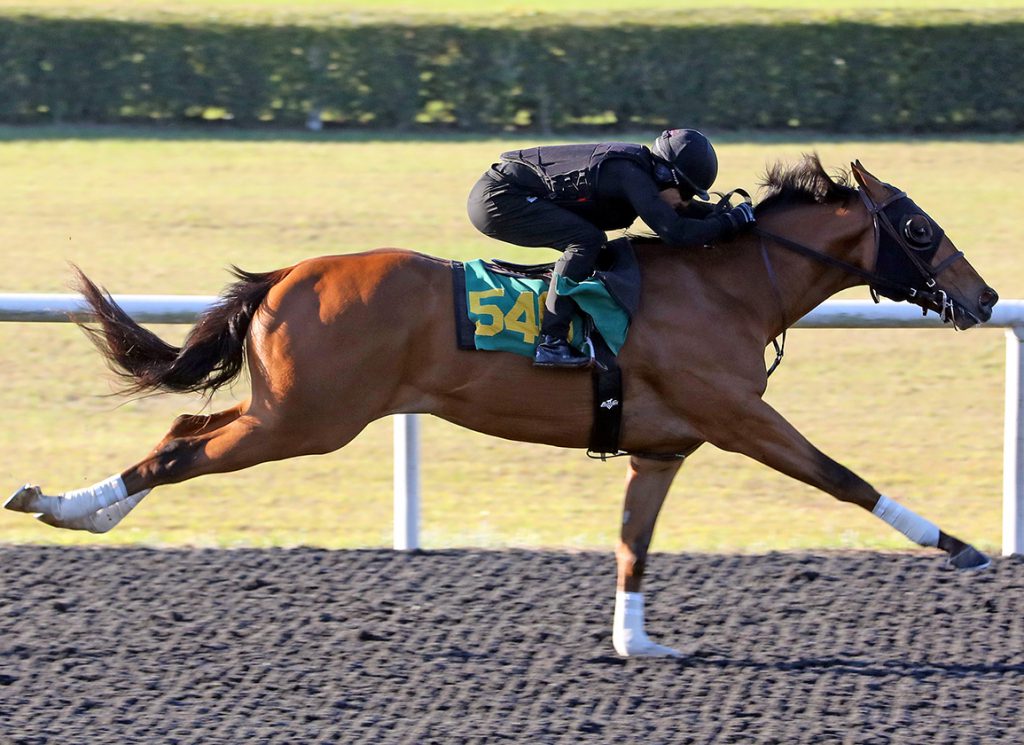
The topper's :9 3/5 work last week | Photos by Z

Bob Baffert sat in the press box on the phone with Saudi businessman Amr Zedan as Donato Lanni handled the bidding, ultimately securing a colt by Good Magic (hip 546) for $2 million late in Tuesday's second session of the OBS March sale. The bay colt, who turned heads with a :9 3/5 furlong work followed by a monster gallop-out during last week's under-tack preview, was consigned by Torie and Jimbo Gladwell's Top Line Sales.

“I kind of expected it because good horses command good prices and he was a standout,” Zedan said by phone Tuesday. “We were just waiting for this moment to come to get the opportunity to bid for him. He demonstrated an amazing breeze and he looked the part. And most importantly, Bob just fell in love with him. Donato flagged the horse. Bob–we call him the boss–arrived and he basically loved what he saw. We huddled up and the rest you know.”

Zedan was asked if either he or Baffert had hesitated at any point in the bidding as they saw off every volley of trainer Steve Asmussen, who sat in the pavilion on the phone.

“Not at all,” Zedan said. “It's very difficult to find this quality of horse. And if there is a horse that we like, our motto is we stop when we own him. I think we've demonstrated that in the past. I don't mean to come across as arrogant, but good horses command a premium and that's what it takes to get winners. Let's just hope he demonstrates that on the racetrack and he makes us all proud.”

The colt's attributes were in plain sight, according to Lanni.

“Everybody saw what he did,” Lanni said. “You come to the sales long enough, you see few horses do what he did. His breeze was extraordinary and how he came back from his breeze and how he handled himself. We are here to buy the top-end horses and he was one of the top-end horses, I believe. He did everything right.”

Zedan has made no secret that his goal in racing is to win the Kentucky Derby.

“Absolutely,” he confirmed. “That's the dream. That's our program. We start with the Derby in any given year, and we work backwards.” @JessMartiniTDN

More Magic for Gladwells
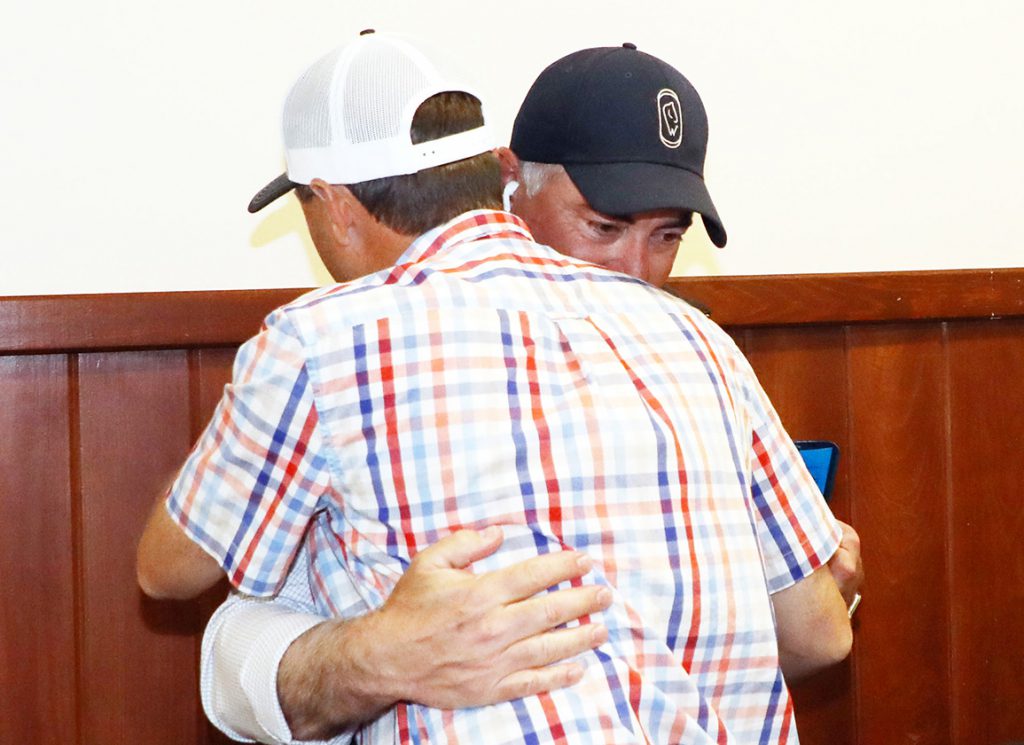
Jimbo Gladwell and Donato Lanni | Photos by Z

Torie and Jimbo Gladwell had already had success with a son of Good Magic at this OBS March sale–selling a colt by the champion for $725,000 during Monday's first day of the auction–but that result proved just a warm-up for the Top Line Sales team which watched as the colt the family's pinhooking partnership purchased for $190,000 at last year's Keeneland September sale sold for an eye-popping $2 million to Amr Zedan.

“I could cry, easy,” Jimbo Gladwell admitted after watching the colt sell. “We are just thrilled. It's just an unbelievable result.”

Zedan has made a habit of purchasing seven-figure juveniles out of the Top Line consignment. He gave the Gladwells their first million-dollar sale when buying future Grade I winner Princess Noor (Not This Time) for $1.35 million at the 2020 OBS April sale and he acquired this year's GIII Southwest S. winner Arabian Knight (Uncle Mo) for $2.3 million at OBS last April.

“This game is not easy by any means,” Torie Gladwell said. “Every day you wake up knowing something is not going to go right. We just pray every day that we have good luck. And we have a very good team behind us. We are very blessed.”

The $2-million juvenile, bred by Don Alberto Corporation, is the first foal out of Hoppa (Uncle Mo), a 7-year-old mare who won once in just three starts for the Solari family's operation.

“We took a shot buying that horse at the Keeneland sale,” Torie Gladwell said. “He was a little light on page, but his physical is just an 11+–that horse is just amazing on the shank. Good Magic was kind of so-so at the time that we purchased the horse. So we took a little bit of a risk. Good Magic is hot right now and the horse just bloomed into an amazing athlete. He is an average-sized horse, but he has a huge stride. And he does it so effortlessly. He is just a machine on the track. It will be fun to watch him progress.”

Don Alberto purchased the mare Handoverthecat (Tale of the Cat), with Hoppa in utero, for $170,000 at the 2015 Keeneland November sale. The mare produced a filly by Violence last year and was bred back to Tacitus. @JessMartiniTDN

Arrogate Colt Heads to Japan
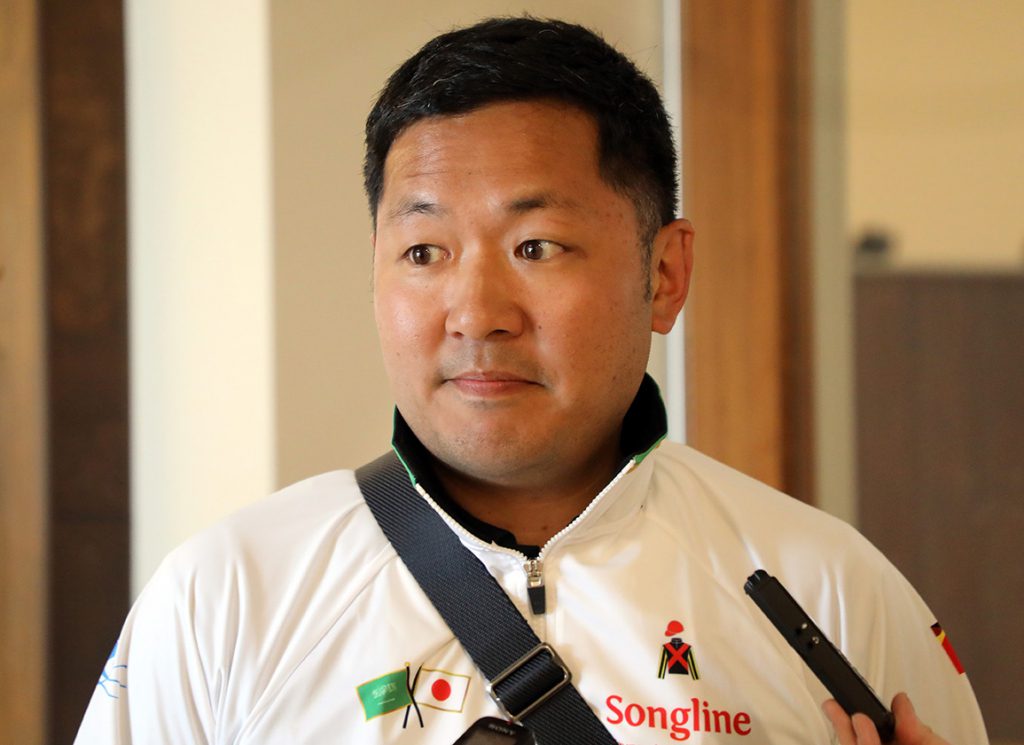
Shingo Hashimoto | Photos by Z

A colt by Arrogate (hip 489), who topped last year's Fasig-Tipton New York-bred Yearlings sale when selling for $700,000 just days after his full-brother Cave Rock debuted with a 'TDN Rising Star'-worthy victory, will be heading to Japan after selling for $1.05 million to the bid of Northern Farm's Shingo Hashimoto.

“Obviously, I thought he was the best horse in the sale,” Hashimoto said. “He's from the last crop of Arrogate. We are going to take him back to Japan.”

The dark bay colt is out of graded-stakes winner Georgie's Angel (Bellamy Road). Since the colt was purchased as a yearling last summer, Cave Rock has gone on to win the GI American Pharoah S. and GI Runhappy Del Mar Futurity and was second in the GI Breeders' Cup Juvenile.

Hip 489, who was consigned by Tom McCrocklin on behalf of Michael Sucher's Champion Equine, worked a quarter-mile last week in :21 1/5.

“The time itself wasn't fast,” Hashimoto said. “But he was very well balanced and he looked very attractive. When we saw him at the sales barn, he walked very nicely, which I liked a lot.”

Asked if expected the seven-figure price tag, Hashimoto said, “Yes. We were trying hard to buy yesterday and we couldn't end up with some of the good ones, so we are happy to get this good colt.” @JessMartiniTDN

Arrogate Pays for McCrocklin
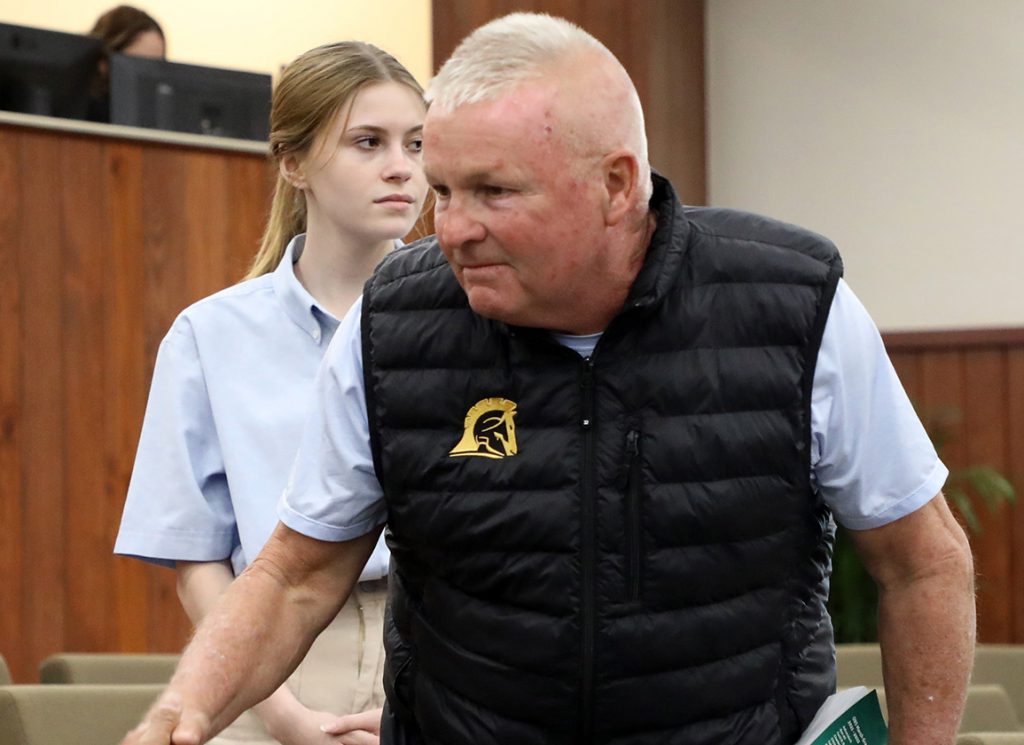
Tom McCrocklin | Photos by Z

After watching a colt by Arrogate he had purchased for $700,000 last August at the Fasig-Tipton New York-bred Yearling Sale bring a final bid of $1.05 million Tuesday in Ocala, bloodstock agent Tom McCrocklin said, “This is a success story.”

The colt was one of several high-end yearlings McCrocklin purchased last year on behalf of Michael Sucher's Champion Equine.

“It was a game plan that may not work consistently over time, but it worked today,” McCrocklin said. “I think we sold a very classy, Classic-type horse to some really good people. My goal is that he's a very good racehorse for them. The money comes and goes and pinhooking is a high wire act to begin with, but it feels really good when you bring a good, sound, beautiful horse to the sale and he is well-received and somebody takes him home. My end-goal is to sell those people a really good racehorse. It's not about me, it's about the horse and it's about the horse going forward.”

McCrocklin had more success with Arrogate just a few hips later when selling a filly by the late stallion for $950,000 to Lee Searing's CRK Stables. The filly, who worked a quarter-mile in :20 4/5 last week, was acquired on behalf of Champion Equine for $250,000 at last year's Keeneland September sale.

“Class and quality,” McCrocklin said when asked what he saw in Arrogate's offspring. “They are quality horses. And they show up when you need them to show up. And they sustain their weight and their mental toughness and they are extremely sound. They are very willing, genuine horses.” @JessMartiniTDN
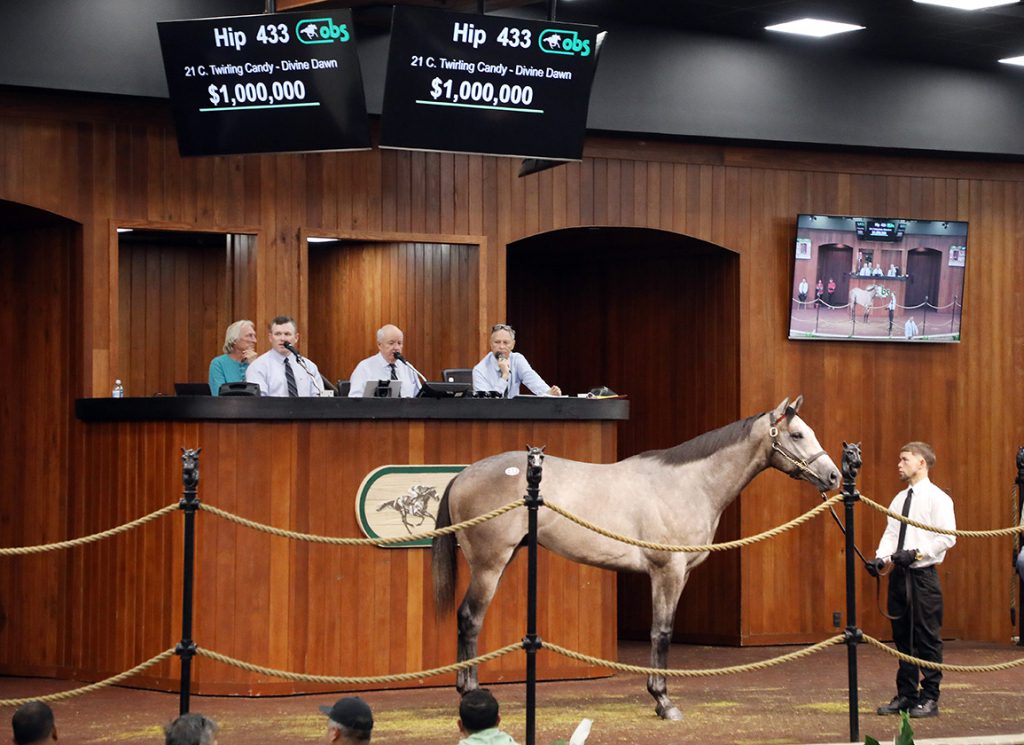
Twirling Candy Colt Lights Up OBS

Hip 433 | Photos by Z

Solidly into Tuesday's session, the first juvenile of the day to realize seven figures lit up the board with a $1-million final bid for a son of Twirling Candy (Hip 433). Securing Hip 345–a filly by Bernardini–earlier in the day for $600,000, Sean Flanagan was back in action later to land the day's third-biggest prize. John Kimmel signed on the day's second-leading filly earlier in the session, while Jeff Mackor was on-hand to handle the signing duties on the son of the Lane's End stallion.

“I have always wanted a Twirling Candy–he's a fantastic sire,” said Flanagan, who was flanked by trainer Saffie Joseph, Jr. and Mackor during the bidding. “I didn't think he would go that high..but we're here having fun. That's the main thing.”

The Feb. 11 foal is out of GSP Divine Dawn (Divine Park), a full-sister to GSW and GISP Divine Miss Grey.

“I have a great team,” added Flanagan. “John Kimmel is a dear friend of mine and he also signed on a couple of them today. And Saffie will train all of them.”

Consigned by Eddie Woods, the colt breezed an eighth in :9.4 last week. Bred by International Equities, the grey was a $200,000 purchase at Keeneland last September.

“This horse is a magnificent horse,” said Woods. “He's been a lovely horse from the first day we worked him. He showed up every day and worked fantastic and he galloped out really well. We had a lot of the top-end people on him.”

He continued, “I didn't think he'd bring seven figures. I thought maybe he'd bring $750,000, if everyone went in on him. Twirling Candy is a very good stallion. But to say you're going to get a million might be a stretch. When you're dealing with Uncle Mo, Arrogate, Curlin, Into Mischief and all those fancy stallions, you can expect to get a million for some of them because it happens. But for this horse, I was just delighted. He's been a smart horse all year, he's found a good spot and I hope he's good to them.”  @CBossTDN

Searing Gets His Arrogate Filly
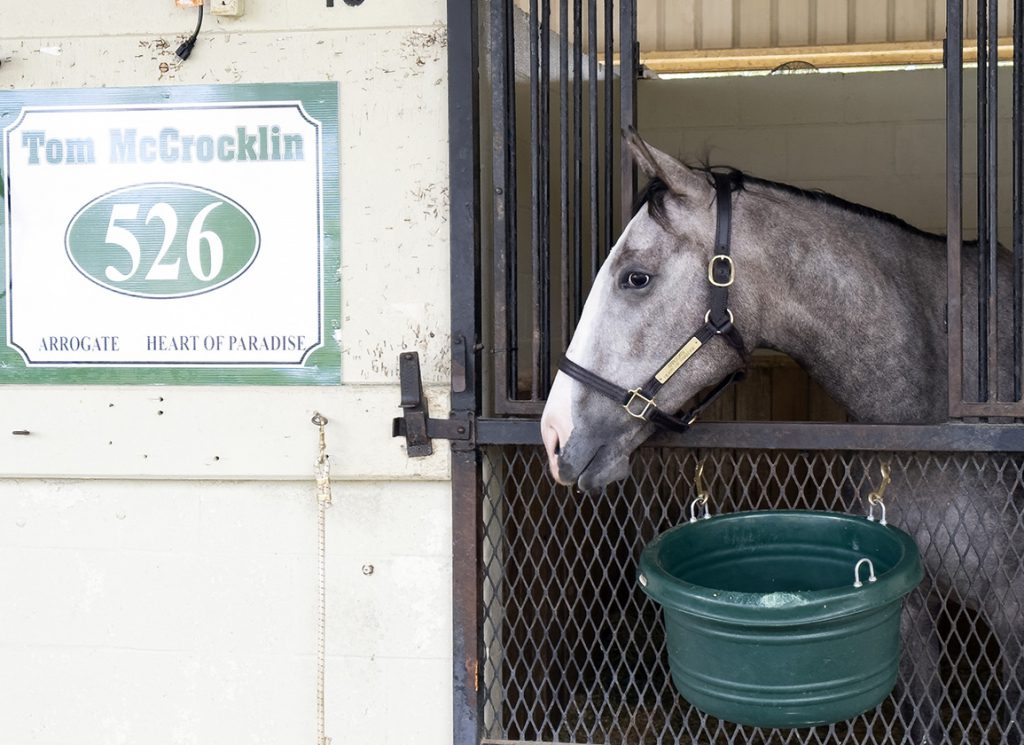
Hip 526 | Photos by Z

Lee Searing of CRK Stables had his eye on a small group of horses, but he came away with his pick of the group when acquiring a filly by Arrogate (hip 526) for $950,000 Tuesday in Ocala. Consigned by Tom McCrocklin, the gray filly is out of graded-placed Heart of Paradise (More Than Ready). She worked a quarter-mile last week in :20 4/5.

“We came here to look at four or five horses,” Searing, who did his bidding while sitting alongside trainer John Shirreffs, said. “But we loved this horse from the minute she breezed to the time we bought her. She didn't turn a hair. And Arrogate is a top sire. It's such a shame he died.”

Searing was prepared for the filly's final price tag.

“I knew it,” he said with a rueful smile. “That was the horse. We bought one other one, but that was the horse [we wanted].”

CRK Stables has been represented over the years by Grade I winners Express Train, Switch, Beyond Brilliant and Honor A.P.

“It's always fun,” Searing said of Tuesday's bidding. “I've bought some expensive horses before, but when I can get John Shirreffs a really nice horse, it's really nice to be able to do it.” @JessMartiniTDN

Curlin Colt Brings $900K at OBS Tuesday
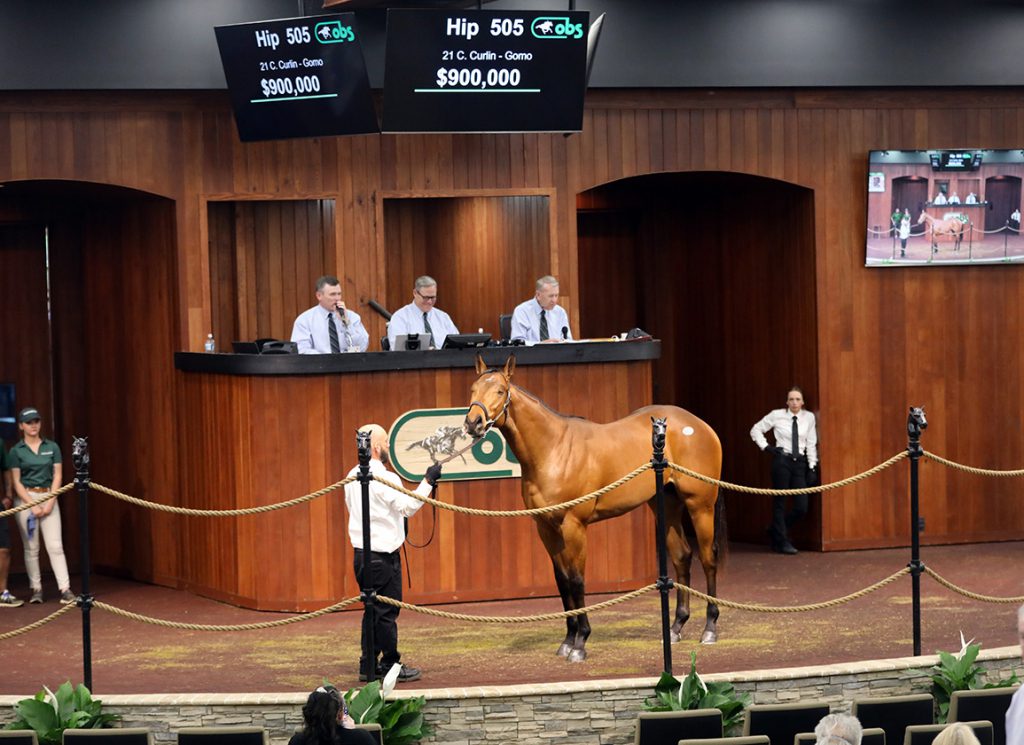
Hip 505 | Photos by Z

The fireworks continued late into the session with Hip 505, a colt by Curlin, realizing a $900,000 final bid. Terry Finley, situated out back, signed the ticket on behalf of a partnership between Talla Racing, Woodford Racing and West Point Thoroughbreds. Consigned by Al Davis's Old South Farm, the Florida-bred is out of GI Alcibiades S. winner Gomo (Uncle Mo). The colt will be trained by California-based John Sadler.

“He is a beautiful physical and is very well bred,” said Will Farish III, speaking on behalf of Ingordo Bloodstock. “We're really excited we had the chance to buy him.”

When asked about the price, he said, “We thought it would be somewhere in that range, and we were hoping it wasn't going to get out of control.”

He continued, “He was just an amazing mover. He looked great during the breeze and we went to see him a few times at the barn and we just loved the way he was walking.”

Bred by Bridlewood Farm, the bay was a $250,000 Keeneland September yearling purchase by Hoby Kight on behalf of Beryl 'Sonny' Stokes, who just passed away last week at age 89. According to Kight, Stoke's daughter Lauren is expected to take over her father's equine operation.

“I was expecting north of $500,000 by the amount of play at the barn and as well as he worked,” said Kight, who was visibly moved by the passing of his longtime friend. “He's such a beautiful horse with pedigree and everything went his way.”

He added, “I like to buy fast horses with pedigree. Every once in a while one falls in my lap. I try to scatter them out with good guys and I hope I come out with a runner.” @CbossTDN

Nyquist Colt to Ryan

Bloodstock agent Mike Ryan, bidding on behalf of an undisclosed client, purchased a colt by Nyquist (hip 472) for $600,000 during Tuesday's second session of the OBS March sale.

“I am very partial to Nyquist–I pinhooked him as a yearling to 2-year-old a number of years ago,” Ryan said. “He's a sire that we feel has tremendous upside potential. He has a couple Grade I winners in his first crop. And this colt is out of a very good mare–she won $600,000 on the dirt and was Grade I placed and a stakes winner in New York. This is a horse who is going to go two turns. That's what we are looking for, 1 1/8 miles and 1 1/4 miles, we hope he has that potential.”

The colt, consigned by Wavertree Stables, is out of Flora Dora (First Dude), who was third in the 2016 GI Coaching Club American Oaks. He was bred by Coffee Pot Stables and RNA'd for $185,000 at last year's Fasig-Tipton Saratoga sale.

Asked if a trainer had been picked out for the juvenile, Ryan said, “We are not sure. I will let the owner decide that.” @JessMartiniTDN

Flanagan Stays Active Day 2 at OBS
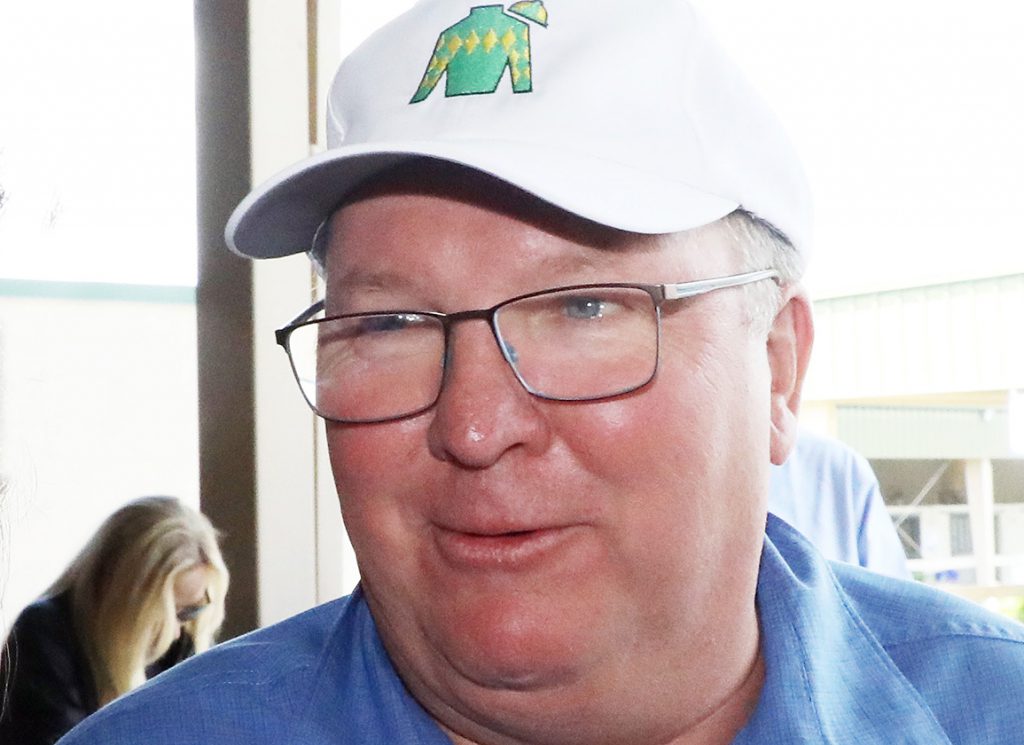
Sean Flanagan | Photos by Z

In addition to Tuesday's third highest-priced colt, Sean Flanagan also secured the session's second-leading filly, a daughter of Bernardini out of SW Cartwheelin Lulu (Bustin Stones). Consigned by Gene Recio, Hip 345 brought $600,000. Flanagan also purchased a filly by Midnight Lute (Hip 223) for $370,000 on Day 1.

“Gene had said to me what a nice filly she is,” explained John Kimmel. “And from a physical standpoint, she really looks the part. In this marketplace, even though it's a big price, it's kind of what you need to spend to acquire these kind of horses. I can't say anything other than at least he got himself a horse that's physically beautiful and very appealing and has the ability to be a nice 2-year-old with enough substance that can race on as a 3-year-old.”

Kimmel, acting as an agent for Flanagan at OBS, signed for both the Bernardini filly in addition to a colt by Laoban (Hip 168, $425,000) during Monday's session.

“To me he was a smacking, good-looking colt,” said Kimmel of Monday's purchase. “He looked like a racehorse and he was super clean, passed the vet and looked great on the racetrack. I was done at $300,000 and Sean carried it the rest of the way.”

He added, “He was also the underbidder on the Uncle Mo of Hartley/DeRenzo and he was the underbidder on Jimmy Gladwell's Good Magic colt [Monday]. But he's got a filly who would be a nice horse to add to his collection as a broodmare.” @CBossTDN

Vino Rosso Colt Reels in $550K on Day 2
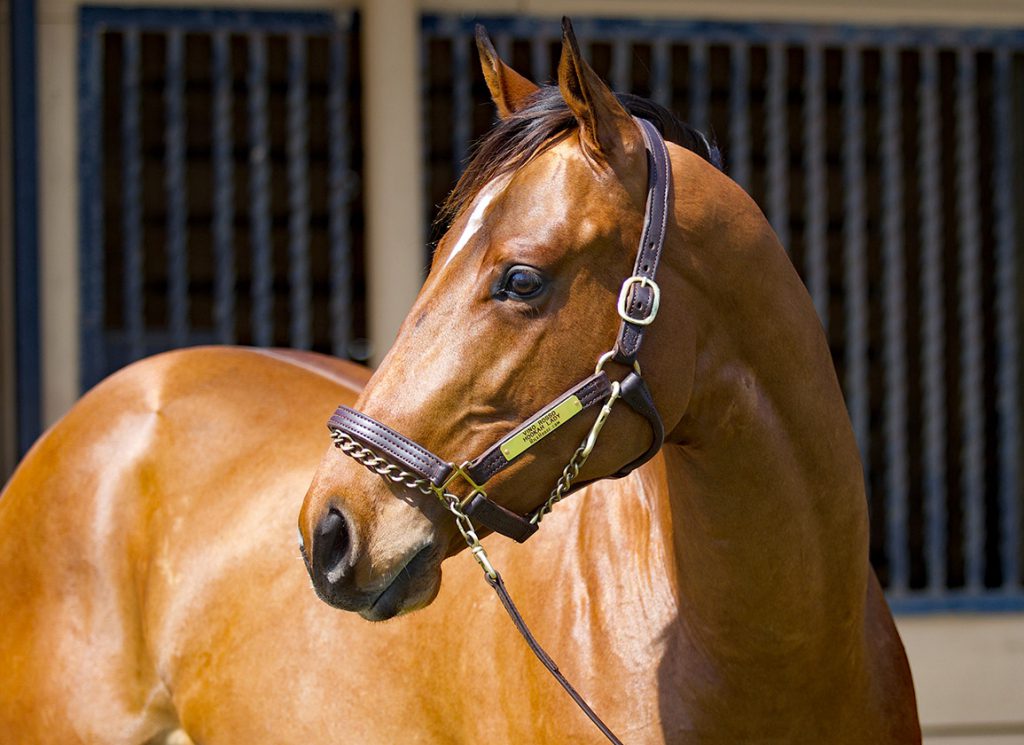
Hip 544 | ThoroStride

In the waning moments Tuesday, Hip 544, a colt by Champion older horse Vino Rosso, brought $550,000, leading the Spendthrift stallion's offerings through the second day of selling. Purchased by Alex and JoAnn Lieblong, the colt was consigned by Brandon and Ali Rice's RiceHorse Stable.

“He looked like a 3-year-old among 2-year-olds,” said Alex Lieblong. “I really think Vino Rosso has a good shot at being a really good stallion. I liked the pedigree, but to me, the consignors count even more than that.”

When asked who the colt would go to, he said, “I haven't made up my mind yet who he will go to yet. I have two or three trainers, Norm Casse and Riley Mott, a couple of guys starting out, so I have to figure that one out now.”

He added with tongue firmly planted in cheek, “They're both on the plane home so they'll be arguing all the way home!”

The colt is out of the Smoke Glacken mare Hookah Lady, who is already responsible for multiple graded stakes winner Get Smokin (Get Stormy). This is also the family of female grass champion Dayatthespa (City Zip) and GSW Clev Er Tell (Tell).

The sale also represented a coup for Dr. David Suarez Fuentes, who was represented by his first yearling-to-2-year-old in training pinhook.

Explaining how his relationship began with the Rice family and his foray into the pinhooking game, the veterinary surgeon said, “I started pinhooking two years ago with [Dr. William] 'Bo' Rainbow, who introduced me to Brandon. But I have been around horses my whole life. My dream was always to be able to buy and sell horses.”

A $32,000 RNA at Keeneland November, the bay was secured for $35,000 at Keeneland last September by Establo Rafanil, Suarez Fuentes's family operation in Puerto Rico.

“He had some little things, but nothing major,” he said when asked about the bargain yearling price. “But he was beautiful and sound. After I looked at the horse and pedigree myself, and I looked at the scope since I'm my own vet, I made the decision to buy him.”

He continued, “Last year was the first time I was free to [physically] go to the sale to buy horses myself. I had been doing my residency the past few years which was very intensive. We didn't get many breaks. So, I was finally able to go to the sale and buy horses, and I selected this Vino Rosso colt.”

The Mar. 8 foal worked :9.4–the co-second fastest time for an eighth–during last week's breeze session.

“From the beginning, he looked like he would be a star by the way he looked and trained,” he said. “And the Rices have done an amazing job with him.”

Of the colt's sire, he added, “He was an amazing horse. Irad Ortiz, Jr. rode for us in Puerto Rico, so I followed Vino Rosso [ridden by Ortiz] from the beginning. That's why he was always at the front of my mind when I looked at the sale catalogues. I always looked for something by him.” @CBossTDN

Going Rogue

Most of the stallions are already well established as either sires or on the racetrack (or both) by the time they make it onto the OBS catalogue page. Freshman sire Rogueish (Into Mischief), responsible for Hip 320, was clearly not among those. However, after the sole offering by the sire to sell drew a $220,000 final bid from Michael Sucher's Champion Equine LLC Tuesday, that may have all changed.

A $1,500 OBS Winter yearling purchase, the Apr. 3 foal returned to the ring to bring $50,000 from South Florida-based trainer Saffie Joseph, Jr. at OBS later in October. According to Joseph, he subsequently sold the son of Born to Jazz (Student Council) to a few of his partners, and they decided to run him through the sale to see if they could get a fair price. And if not, they were happy to keep him and put him in training.

Consigned under the Golden Rock Thoroughbreds banner, the Florida-bred worked an eighth in :10 flat during last week's breeze show.

“He's a big colt but he's also very forward,” said Joseph. “He's a big, good-looking horse. You would never think he should be doing what he's doing.”

The 2-year-old's sire, Rogueish, was trained by Steve Asmussen and campaigned by Ed and Krista Seltzer and Beverly Anderson. The son of GSW Verdana (Rahy), he sparkled in what would be his sole career start, a 6 3/4-length victory going six furlongs at Fair Grounds in the fall of 2018.

Retired after that due to injury, the Kentucky-bred took up stud duties at the owner's Solera Farm in Williston, Florida. The 7-year-old stands the current season for $2,500.

“I was introduced to him by Ed Seltzer, who I train for. When I saw the stallion at the farm, I looked at his record and saw that he had been trained by Steve Asmussen and he won his first start impressively. He was also by into Mischief, so I was very impressed by him,” said Joseph of the juvenile. “So when I went to the sale, I thought I could buy value by the stallion. He was obviously talented and had his career cut short by injury. I was intrigued by the horse.”

With 32 foals to his credit and 14 of racing age, the stallion was represented by six yearlings to sell in 2022 at an average of $18,783, while a total of eight weanlings averaged $22,437. Hip 320 was the stallion's highest priced sale last season. @CBossTDN

The post $2-Million Good Magic Colt Paces OBS March Tuesday appeared first on TDN | Thoroughbred Daily News | Horse Racing News, Results and Video | Thoroughbred Breeding and Auctions.

Source of original post
Record-Tying $2-Million Good Magic Colt Tops OBS March Sale’s Second Session

Hip No. 546, a son of Good Magic consigned by Top Line Sales LLC, Agent, was sold to Donato Lanni, Agent, for a sale record equaling $2 million to top the second session of the Ocala Breeders' Sales Company's 2023 March Sale of 2-Year-Olds in Training.

The bay colt, whose Under Tack eighth in :9 3/5 on Thursday was the sale's co-fastest at the distance, is out of Hoppa, by Uncle Mo, from the family of graded stakes winner Wandering Star.

The price equaled the previous March record, set in 2019 for Chestertown, a stakes winning son of Tapit.

Hip No. 489 a son of Arrogate consigned by Tom McCrocklin, Agent, was purchased for $1.05 million by Katsumi Yoshida. The dark bay or brown colt, who worked a quarter in :21 1/5 at Thursday's Under Tack Session, is a full-brother to Grade 1 winner Cave Rock, out of graded stakes winner Georgie's Angel, by Bellamy Road.

Hip No. 433, a son Twirling Candy consigned by Eddie Woods, Agent, went to Jeff Mackor, Agent for Sean Flanagan, for $1 million. The gray or roan colt, who breezed an eighth in :9 4/5 at Thursday's Under Tack Show, is out of graded stakes placed Divine Dawn, by Divine Park, a full sister to graded stakes winner Divine Miss Grey.

Parks Investment paid $950,000 for Hip No. 526, a daughter of Arrogate consigned by Tom McCrocklin, Agent. The gray or roan filly, whose quarter in :20 4/5 was co-fastest on Thursday, is out of graded stakes placed Heart of Paradise, by More Than Ready, from the family of graded stakes winning OBS March graduate Megascape.

Hip No. 505, a son of Curlin consigned by Old South Farm LLC, Agent, went to Woodford & Talla & West Point for $900,000. The bay colt, who breezed an eighth in :10 flat on Thursday, is out of grade one stakes winning OBS graduate Gomo, by Uncle Mo.

Hip No. 345, a daughter of Bernardini consigned by Gene Recio, Agent, was sold to John C. Kimmel, Agent for Sean Flanagan, for $600,000. The dark bay or brown filly, who breezed an Undtaner Tack eighth in :10 flat at Wednesday's Under Tack session, is out of Cartwheelin Lulu, by Bustin Stones, from the family of graded stakes winner Rockport Harbor.

Mike Ryan, Agent, went to $600,000 for Hip No 472, a son of Nyquist consigned by Wavertree Stables, Inc. (Ciaran Dunne), Agent. The bay colt, who worked an eighth in :10 flat, is out of graded stakes placed stakes winner Flora Dora, by First Dude, a half sister to stakes winner Lindisfarne.

Hip No. 544, son of Vino Rosso consigned by RiceHorse Stable (Brandon & Ali Rice), Agent, was sold for $550,000 to Alex & JoAnn Lieblong. The bay colt, who breezed an Under Tack eighth in :9 4/5, is a half brother to graded stakes winner Get Smokin out of Hookah Lady, by Smoke Glacken.

Carolyn Wilson went to $500,000 for Hip No. 450, a daughter of Audible consigned by Top Line Sales LLC, Agent. The bay filly, who breezed an Under Tack eighth in :10 flat on Thursday, is out of Enjoy This Moment, by champion OBS graduate Midnight Lute, a half sister to graded stakes winner Sum of the Parts.

Hip No. 411, a son of Blame also consigned by Top Line Sales LLC, Agent, was purchased by Michael Maker for $450,000. The Irish bred bay colt, who turned in an Under Tack eighth on Wednesday in :10 1/5, is out of graded stakes winner Daring Dancer, by Empire Maker, from the family of Grade 1 winner Crowded House (GB).

Hip No. 418, a daughter of Classic Empire consigned by de Meric Sales, Agent, went to Jonathan Thomas, Agent, for $450,000. The bay filly, who breezed an eighth on Thursday in :10 flat, is a half-sister to stakes winner Out of Sorts out of stakes placed Dear to All, by Tale of the Cat.

Hip No. 499, a son of Cairo Prince also brought $450,000, consigned by White Lilac (Katie Miranda), Agent, and sold to Klaravich Stable, Inc. The dark bay or brown colt, who breezed an eighth in :10 flat, is out of Glide On By, by Pure Prize, from the family of graded stakes winner Bandini.

Hip No.493, a colt by Candy Ride (ARG) consigned by de Meric Sales, Agent, went to MyRacehorse & L and N Racing, LLC for $410,000. The chestnut colt, who breezed an eighth in :10 1/5, is a half brother to graded stakes winner Family Tree out of stakes winner Giant Mover, by Giant's Causeway.

Carolyn Wilson went to $400,000 for Hip No. 385, a son of OBS graduate and leading sire Into Mischief, consigned by Eddie Woods, Agent. The bay colt, who breezed an eighth in :10 1/5, is out of Conquering, by War Front, a half-sister to champion Will Take Charge.

For the session, 151 horses sold for a total of $25,178,000 compared with 169 grossing $22,201,000 at last year's second session. The average price was $166,742, compared with $131,367 a year ago, while the median price was $90,000 compared with $70,000 last year. The buyback percentage was 26.7 percent; it was 15.5 percent in 2022.

Hip No.'s 557 – 833 will be offered at the March Sale's third and final session on Wednesday, March 22 beginning 11 a.m.

The post Record-Tying $2-Million Good Magic Colt Tops OBS March Sale’s Second Session appeared first on Horse Racing News | Paulick Report.

Source of original post

Verified by MonsterInsights