Stallion Spotlight Presented By New York Thoroughbred Breeders Inc.: ‘Soundness, Consistency, Athleticism’ Has Taken Central Banker To The Top

Stallion Spotlight offers stud farm representatives a chance to address breeders and answer questions as they plan their future matings.

In this edition, John McMahon of McMahon of Saratoga Thoroughbreds discusses Central Banker, a Grade 2-winning son of Speightstown who has developed into one of New York's perennial leading sires.

Central Banker
B. h., 2010, Speightstown x Rhum, by Go for Gin
Race Record: 13-4-3-2; $598,786
Advertised Fee: $7,500
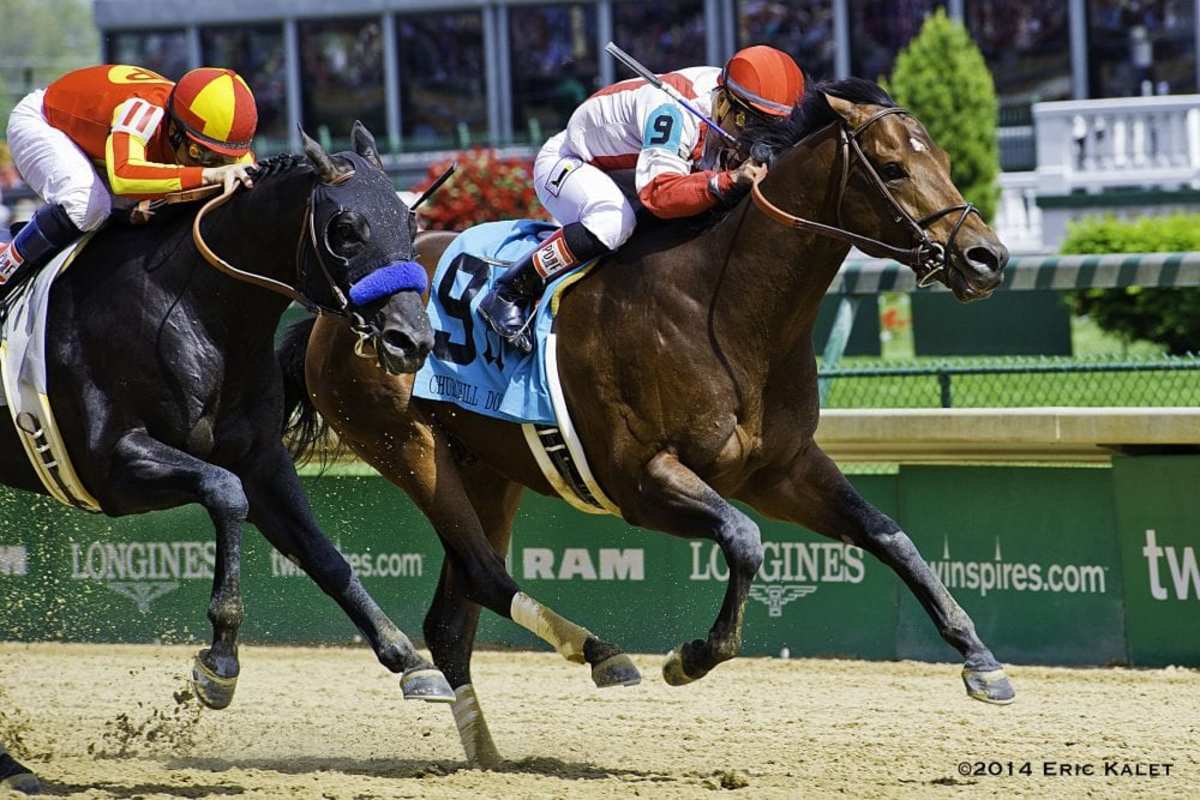
In winning the G2 Churchill Downs Stakes, Central Banker recorded a 107 Beyer Speed Figure in 2014.

Question: What makes Central Banker an attractive stallion for potential breeders?

John McMahon: McMahon of Saratoga Thoroughbreds: He's a proven horse at an affordable price in a market that has extensive racing opportunities. The attributes he puts on his foals are speed, soundness, consistency, athleticism. All those things that have helped bolster his career are the things that make him an attractive stallion prospect.

He moves his mares up, and we feel like he does it in a safe manner, without a lot of exposure to his stud fee. Our main objective as a farm is for our breeders to make money, and we've never wavered with that in regards to his stud fee.

If I've got a mare lacking in a physical aspect, what can Central Banker best contribute to that equation?

McMahon: Balance and athleticism are his primary physical characteristics. His foals are so consistent. I've always told breeders he makes unattractive mares have attractive foals. He makes a mare that throws small foals have a medium-big foal, he makes a mare that throws too big and makes it a more athletic individual.

What would a breeder looking to capture the Speightstown line find familiar in Central Banker?

McMahon: Soundness. Bankit has displayed tremendous soundness throughout his long career. He's run against a lot of horses, and Central Banker gets a lot of horses to the racetrack that are all sound. That's what we also look for in an elite stallion like Speightstown.

Central Banker still has Bankit competing well in stakes competition going into age seven. What does it mean to Central Banker's resume to have one maintain high-level form this long?

McMahon: It helps a stallion's resume tremendously to have a horse like Bankit, who we've been watching seriously since he was a newborn. We always felt he was special. He was just born beautiful and kept outperforming expectations. I hate to just keep saying “soundness,” but it's just so important that a horse has a good mind and a sound body to go with it. Speed is a necessary ingredient, because the best trainers in the world can't make a horse perform if it's not inherently fast. Central Banker himself as a racehorse was quite handy, and his foals display plenty of speed.

What do you think has made Central Banker such a good fit for the New York program?

McMahon: Soundness, speed, durability, and dirt racing, and all those things that we see a lot of, he's been the horse for the course, because he's been able to keep up with the demands of the racing schedule.

What are some of the crosses that you have found work best with Central Banker, either through pedigree or physical?

McMahon: Pedigree-wise, we've seen a lot of variability. Northern Dancer, Seattle Slew, Indian Charlie, Halo are all stallion lines which come to mind immediately. Hoist the Flag, which is a speed stallion, and In Reality, through Relaunch to Colonel John. The majority of the broodmare band, I think, fits very nicely with him, because he doesn't seem to be falling upon just one main broodmare sire line to gain success.

Interestingly enough, no one really talks about inbreeding as much as they should, but the most recent stakes horse my parents have bred, Bank Sting, is a Mr. Prospector line, so we've in-bred to Mr. Prospector and had some success.

Where do you think the sweet spot is for a Central Banker runner, in terms of distance and surface?

McMahon: I'd say six furlongs to 1 1/16 miles is their sweet spot. Surface-wise, we love dirt racing, and that seems to be where they hit. We had a great Saratoga meet. From juveniles to horses breaking their maidens at three at Aqueduct, the purses are great and the distances lend themselves to be helpful.

For potential buyers at auction, what does one typically see from a Central Banker foal as a yearling, and as a 2-year-old in terms of their physical? What do the best commercial Central Bankers do to separate themselves from the rest?

McMahon: I think the best Central Bankers have balanced that athleticism with that size attached. There are always horses within your consignment that display a little bit more bone, more overall mass, and Central Banker has that really nice body type that he puts on that horse. I think that whole combination of consistency with that hip and shoulder, tied into a horse that looks mature, are usually the ones people pick out, and I think the market has rewarded those horses quite readily.

Support our journalism

If you appreciate our work, you can support us by subscribing to our Patreon stream. Learn more.

What is something about Central Banker that you think goes overlooked?

McMahon: When he broke his maiden, it was in Saratoga, and the horse that ran second ended up being the Breeders' Cup Juvenile Sprint winner later that year (2012 winner Hightail). We didn't ever advertise that when he was first starting, and that's probably something nobody knows without going back and looking at the charts.

What else should readers know about Central Banker before picking up the phone?

McMahon: His Average Earnings Index is three times higher than his Comparable Index, so he moves your mare up. We just recently did a study on the Beyer Speed Figures of his winners, and 30 percent of Central Banker's winners display a Beyer of 90 or higher. Regardless of where you're racing, that Beyer number is something consistent to judge a horse's performance on.

The post Stallion Spotlight Presented By New York Thoroughbred Breeders Inc.: ‘Soundness, Consistency, Athleticism’ Has Taken Central Banker To The Top appeared first on Horse Racing News | Paulick Report.

Source of original post

Economic Indicators: Wagering Down Seven Percent To Kick Off 2023

Equibase, North American racing's official database, has released its January statistics for the industry's economic indicators, including field size, wagering, and other data.

January's metrics show a 7.19 percent decline in total wagering; with an increase in both races (4.3 percent) and race days (2.32 percent), average daily wagering was also down by 9.29 percent.

Purses continue to trend upward: there was a 9.70 percent increase in purses awarded over the first 31 days of 2023. That continues the trend from the end of 2022, which saw purses up 10 percent on the year for a record high total of $1,309,837,841.

Field size remains fairly steady thus far in 2023. January's figures saw the average field size at 7.73 starters, down just .33 percent from the same period in 2022.

Equibase is continuing to provide monthly reporting of its Economic Indicators Advisories as a service to the industry and in consideration of the economic changes resulting from the COVID-19 pandemic. The Advisory is typically disseminated on a quarterly basis to provide key metrics used to measure racing's performance throughout the year.

January 2023 vs. January 2022
Indicator January 2023 January 2022 % Change
Wagering on U.S. Races* $874,180,855 $941,934,680 -7.19%
U.S. Purses $90,069,945 $82,102,162 +9.70%
U.S. Race Days 265 259 +2.32%
U.S. Races 2,280 2,186 +4.30%
U.S. Starts 17,619 16,949 +3.95%
Average Field Size 7.73 7.75 -0.33%
Average Wagering Per Race Day $3,298,796 $3,636,813 -9.29%
Average Purses Per Race Day $339,887 $316,997 +7.22%

* Includes worldwide commingled wagering on U.S. races.

The post Economic Indicators: Wagering Down Seven Percent To Kick Off 2023 appeared first on Horse Racing News | Paulick Report.

Source of original post

‘It’s In My Blood’: 61-Year-Old Martin Haiber Named Laurel’s Backstretch Worker Of The Year

Martin Haiber, who grew up in the racing industry and was licensed as jockey in 1987, is the 2022 Backstretch Worker of the Year for Laurel Park given his contributions to the Rodney Jenkins barn for the past seven years.

Haiber, soon to be 61 years old, works as a hot walker for Jenkins. But his father owned racehorses before he was born, and Haiber grew up spending time around horses. He received his first Maryland Racing Commission license in 1980 and worked with his father on a breeding farm and at Marlboro racetrack, which for a period of time also served as a training center.

“I've been around horses my whole life,” Haiber said.

Haiber said he always wanted to be a jockey, and that dream came true in 1987. He rode through 1994, and in 1988 won 32 races primarily at Delaware Park and Charles Town. He said a highlight was winning three races and finishing second in four mounts at Marlboro, which at that time only had one or two racing days a year.

“It's what I always wanted to be—a jockey,” said Haiber, who was based at the Bowie Training Center for about 15 years working for his father, Louis Capuano and others. He then went to Laurel to work for Kenny Tucker, and Eveline Kjelstrup, assistant to Jenkins, asked him if he would walk some horses for the Jenkins barn. Haiber did so willingly.

“What's important to me is just being around horses,” said Haiber, who has lived in Bowie, Upper Marlboro, Landover and Chesapeake Beach in Maryland. “If I miss a few days I don't feel right. It's in my blood. I'd like to say 'thank you' to Eveline and Mr. Jenkins.”

The post ‘It’s In My Blood’: 61-Year-Old Martin Haiber Named Laurel’s Backstretch Worker Of The Year appeared first on Horse Racing News | Paulick Report.

Source of original post

Racing ‘Cannot Survive If History Keeps Repeating Itself’: Gagliano Argues Against Status Quo

In Association of Racing Commissioners International (ARCI) President Ed Martin's letter to the Thoroughbred Daily News on Feb. 2, he once again defends the status quo with few facts and no real solutions to racing's lack of national uniformity in rules and regulations for safety and medication control.

Ed has been defending the status quo for years. In 2018, and again in 2020, Ed testified before Congress against the then forerunner to the Horse Racing Integrity and Safety Act saying it was “a radical and unnecessary federalization of a state responsibility that is exercised effectively.”  

Exercised effectively?  

Clearly, he chooses to ignore the March 2020 federal arrests, and ultimate convictions, of the 27 trainers and veterinarians who, incidentally, operated worry free for years under Ed's racing commissioners. He chooses to ignore that our industry is no longer operating in a vacuum, that our equine athletes have advocates outside the racetrack, and they have influence with state and federal legislators. Finally, Ed chooses to ignore that HISA has been working hard, and for the most part cooperatively, with states and racetracks to implement HISA rules. 

Ed needs to be reminded, again, how we got here.  

Over decades, regulators have repeatedly “promised,” to clean up horse racing. There have been countless calls for rule uniformity since I can remember. Virtually every industry conference has touted the future as having standardized nationwide rules with more vigorous enforcement. The concept is nothing new, but because of HISA, this is the first time the goal is truly within our grasp.

The Racing Medication and Testing Consortium did a lot of good for the industry, but the nationwide reform we thought would come from it never materialized. I had hopes for the National Uniform Medication Program (NUMP), but once again, the regulatory authorities of different jurisdictions were unable to enact the same rules and regulations across the nation. In 2020, The Jockey Club developed a scorecard for the NUMP to see if it was effective. It wasn't. Only nine states had fully adopted all four phases of the program; 16 states had adopted only one. Mid-Atlantic states joined forces over the years to come into compliance with NUMP, but most other regions did not.

Ed has long suggested that a federal racing compact among the state regulators is all that we need. He conveniently omits that there already is a compact, and it has attracted virtually no support from the membership of the ARCI. With the ability of individual states to opt out of rules they do not favor, the compact all but guaranteed the same morass of inconsistent and conflicting rules among the states so many key industry participants have long wanted to correct. 

Ed wrote, “It's hard for some of us who have been around for a while to watch as this situation could have been avoided.” In a way, he's right about that point. HISA would never have had an adverse legal decision if the Horseracing Integrity and Safety Act had never become law. But, for those of us who want change, Ed's worn-out proposals to “get everyone in a room and come up with an alternative approach to avoid the endless and costly litigation” reflects an inability to either understand or appreciate that there is a divide in this industry between those who savor the illusionary comfort of the status quo and those who know that if racing is going to truly survive it must make safety of our athletes and integrity of our game our preeminent goals.

Perhaps Ed has been fighting against HISA since the beginning because he's afraid people will realize that the ARCI failed its mission. According to ARCI's website, it sets “…international standards for racing regulation, medication policy, drug testing laboratories, totalizator systems, racetrack operation and security, as well as off-track wagering entities.” So, HISA is making medication regulation standards uniform and meaningful, something ARCI has never been able to do.

It is abundantly clear to anyone inside or outside of racing that our current state-based anti-doping, medication control, and safety rule structure is not equipped to create national uniformity and set high standards for safety and integrity. 

As we learned in March of 2020, it took the resources of the FBI and outside investigators to get the job done and bring justice to the blatant cheaters manipulating racing, while at the same time, laying bare the incompetence of the regulators that were supposed to be protecting the sport. The Jockey Club has long supported the creation of a nationwide approach grounded in federal law because we realize that horse racing, as a national sport, cannot survive if history keeps repeating itself and national uniformity is never achieved. 

Yet once again, Ed Martin is defending the status quo. Don't let him rewrite a history that he deservedly owns.

The post Racing ‘Cannot Survive If History Keeps Repeating Itself’: Gagliano Argues Against Status Quo appeared first on Horse Racing News | Paulick Report.

Source of original post

Verified by MonsterInsights