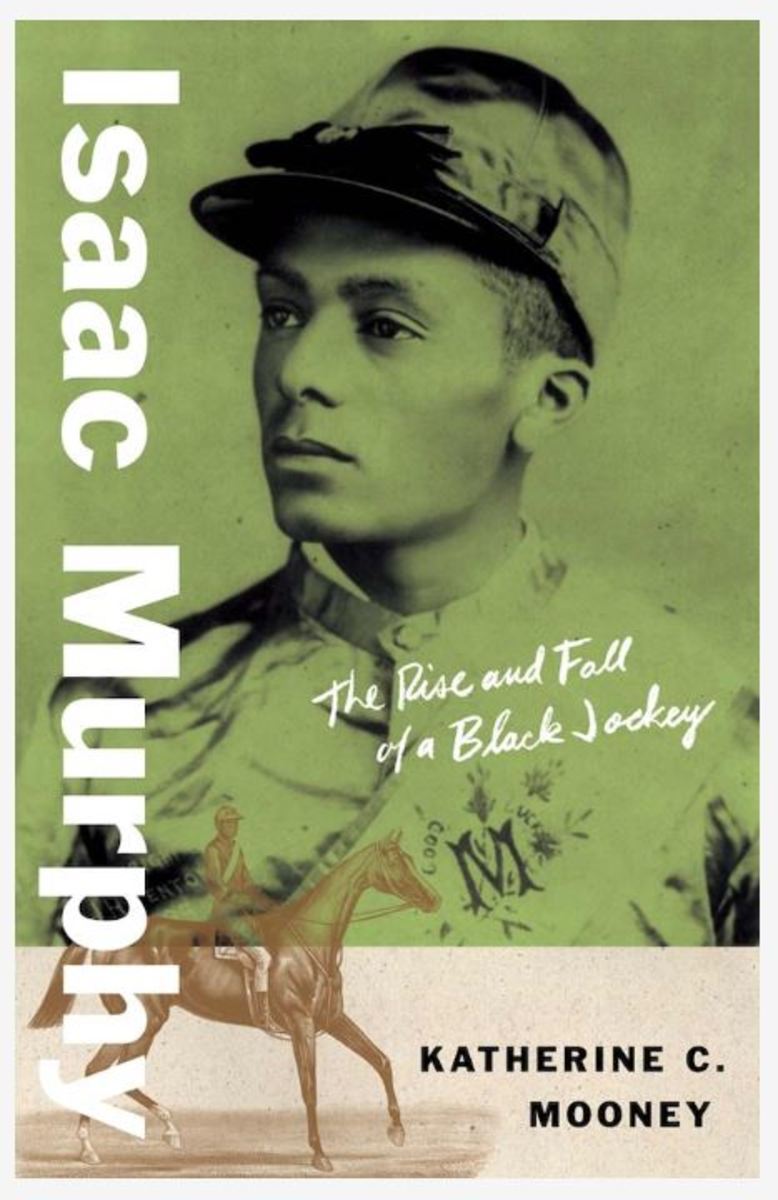
For a decade towards the end of the 19th century, Isaac Murphy was one of the most famous athletes in America. He rode three horses to victory in the Kentucky Derby, made millions of dollars in today's money, and was celebrated as the greatest jockey alive at a time when horse racing was the country's most popular sport. He also was born into slavery, couldn't stay in certain hotels, ride in certain train cars, or speak his mind freely about the oppression Black Americans faced in Reconstruction Era America.
As Professor Katherine C. Mooney captures in her thought-provoking new biography, ISAAC MURPHY: THE RISE AND FALL OF A BLACK JOCKEY (May 2, 2023; Yale University Press), Murphy was both an American hero, employed by the country's elite to ride their prized horses, and a Black man living in a racist country, who for every success he achieved could never be truly seen beyond his skin color.
In ISAAC MURPHY, Mooney uncovers the history of Murphy's troubled life, his death in 1896 at age 35, and his legacy. She shows that the precarious position of being a great Black athlete in America—seen as both hero and threat—started with Isaac Murphy and has continued for more than a century, with Jack Johnson, Joe Louis, Jackie Robinson, Muhammad Ali, and Colin Kaepernick in the present.
In recounting Murphy's personal story, Mooney also tells two of the great stories of change in nineteenth-century America: the debates over what a multiracial democracy might look like and the battles over who could hold power in an economy that increasingly resembled the corporate, wealth-polarized world we know today.
The following is a Q&A with author Katherine C. Mooney, released by Yale University Press:
This book is part of Yale University Press's new Black Lives series. Why is Isaac Murphy's story important to understanding the Black American experience?
I sometimes say that if Murphy hadn't existed, a novelist would have invented him, because his life so perfectly illuminates a pivotal period of American history—the time between his birth in 1861, the year the Civil War began, and his death in 1896, the year the Supreme Court declared segregation constitutional in Plessy v. Ferguson. Those years were the period of emancipation, of Constitutional upheaval, of violent conflict, and passionate debate over whether Black people would be free and equal and what those words meant. And Isaac Murphy shows us what it was like to live through that. But, because he was so extraordinarily successful and famous, he also gives us insight into how people thought about those debates; to many Americans, he was a real-life example of what Black freedom and equality would mean.
Murphy became very well-known and made quite a bit of money during his career. What did that fame and material wealth allow him and what doors were still closed to him because of his race?
People are often surprised when they realize just how many doors were open to Murphy; he was treated as a celebrity in the press, and he seems to have been able to go into spaces like hotels and restaurants that were customarily segregated. But even when he did those things, I think you can see the pressure that came from being the only Black man allowed, of constantly being alone and knowing that he was always being watched. And I argue that part of what ended his career was that white Americans increasingly feared the political consequences of his celebrity.
There is little record of Murphy talking about the pressing political issues of his time. Could he have been more politically active despite being employed by white patrons?
I think it would have been very difficult for Murphy to be more openly politically active. We've seen even in our own time how professionally perilous it can be for athletes to speak out on political issues. A few other horsemen were more politically active than he was, but he was just so much more famous than virtually anyone else in racing. Even though Murphy kept so quiet in public about politics, everything he did professionally and personally was subject to media scrutiny. People always saw him as political, and that was hard enough to navigate, even when he kept his opinions scrupulously to himself.
Murphy died penniless at age 35—it's a trajectory several other prominent athletes of color have traveled. Joe Louis became a casino greeter; Jesse Owens was forced to race horses; Jim Thorpe went bankrupt. Why have we seen this scenario play out so often in American history?
Murphy made a lot of money, and so did his peers when they became very successful, but they were in very temporary, very high-risk employment—as professional athletes usually are. And they were trying to take care not only of themselves but their families and their communities, often because they were making so much more money than anyone else was. They were essentially trying to create what we would call generational wealth and even community wealth in the span of maybe a five or ten-year career—if they were very lucky. And that's just virtually impossible to do, particularly if someone has bad luck or gets bad or even exploitative financial advice. That pattern of Black athletes in financial distress is a clear illustration of the consequences of Black athletes not being able to move into longer-term, more stable employment in their sports. That was what Murphy wanted to do—and some of his friends were able to do it—but he's an early example we can point to of that cost, as we debate things like the Rooney Rule.
Popular history says that the Northeast and perhaps the West were more accommodating to Black people than the South. Murphy rode all over the country. Was he treated differently as a jockey depending on where he was?
I'm not sure how different his situation was depending on where he went. Trains were his main mode of transportation, and they were increasingly segregated. That was more common in the South but not exclusively a Southern practice. The hotels he stayed in during his trips West were customarily segregated, and he typically boarded with Black families in the North or at hotels where he was welcome because he was Isaac Murphy. The start of his career coincides with the Supreme Court's decision against the 1875 Civil Rights Act; the Court decided in favor of several businesses all over the country that refused equal accommodations to Black patrons. So for him the big divide isn't regional, I think; it's always between the cities where he's working and the Black communities in those cities, where he largely stays and socializes.
Murphy's short life spanned vastly different eras of American history, from a post-Civil War agrarian society to an industrial powerhouse on its way to becoming a superpower. What can Murphy's experience tell us about America's trajectory?
I think the main thing Murphy's story tells us is how much that transition happened all at once. We tend to learn and think about American history as this series of snapshots. First, there's the Civil War, so we'll talk about the North and the South. Now there's the expansion West and the growth of big industry, so we'll start talking about places like Chicago and California more. But for the people who lived it, these major upheavals and debates about how the economy should work and who should be a citizen, and what America even was were all tied up together. Murphy lived through them all.
ABOUT THE SERIES
Yale University Press's new Black Lives series launches this spring with two titles: SAMUEL RINGGOLD WARD by R. J. M. Blackett (March) and ISAAC MURPHY by Katherine C. Mooney (April). Henry Louis Gates, an advisor to the series, calls it an “unprecedented endeavor in the history of academic publishing.”
The Black Lives series produces authoritative biographies of individuals of African descent who profoundly shaped history and whose lives illuminate the breadth, diversity, and richness of Black experiences. It will include biographies of the famous: John Lewis and Desmond Tutu; the less well-known, such as the abolitionist Anna Murray Douglass and novelist Paule Marshall; and the fictional: Jim from Huckleberry Finn and Bigger Thomas from A Native Son. In all, it is a daring attempt to capture the complexity of the Black experience, to understand the changing meanings of Blackness over time, and to understand the history that has shaped the contours of Black life today.
The series is being advised by three distinguished scholars: David Blight, Sterling Professor of History at Yale (and author of an award-winning, best-selling biography of Frederick Douglas); Jacqueline Goldsby, chair of the African American Studies Department at Yale; and Henry Louis Gates, the Alphonse Fletcher, Jr. University Professor at Harvard University.
ABOUT THE AUTHOR
Katherine C. Mooney is James P. Jones Associate Professor of History at Florida State University and the author of the award-winning Race Horse Men: How Slavery and Freedom Were Made at the Racetrack. She lives in Tallahassee.
ADVANCE PRAISE
“Isaac Murphy is a concise, yet highly informative, detailed rendering of the world of Thoroughbred horses and jockeys, the Black struggle during the Nadir, and the impact of an extraordinary Black athlete.”—Gerald L. Early, author of A Level Playing Field: African American Athletes and the Republic of Sports
“An eloquent, deeply insightful portrait of an extraordinary athlete at a time when this nation hovered between rising above old racial wrongs and plunging back into a racist abyss. Isaac Murphy's brilliant career and heartbreaking decline embody this era's great potential and its tragic end. Required reading for anyone who wants to understand the forces shaping sports, race, and national character in the nineteenth century and beyond.”—Pamela Grundy, co-author of Shattering the Glass: The Remarkable History of Women's Basketball
“Mooney deftly contextualizes one of the most significant figures in horseracing history. Anyone interested in how American sports and society reflect and affect each other should read this book.”—James C. Nicholson, author of Racing for America: The Horserace of the Century and the Redemption of a Sport
The post New Isaac Murphy Book: Rise And Fall Of A Famous Black Jockey During Era Of American Emancipation appeared first on Horse Racing News | Paulick Report.
