Jockey Leonel Reyes started off the Wednesday at Gulfstream Park seventh in the Championship Meet standings with 14 winners, but a runaway leader in the average-win-payoff category.
Reyes' 14 winners had produced a gaudy $28.50 average win payoff.
The 36-year-old Venezuela native ended his day with an even higher average-win payoff stat after guiding 33-1 longshot Pachanga Loca ($68) to a front-running romp in Race 7 on Wednesday's program.
“It's been great having so many longshot winners, but I don't think about if the horse is a favorite or a longshot. When they open the gate, I think that all the horses I ride have a good chance,” said Reyes after riding his 640 U.S. winner.
The softspoken, low-key rider, who ventured from Venezuela in 2016, is coming off a career year in 2022, during which he rode 168 winners and finished second in the standings at Colonial Downs as well as second in both Royal Palm and Sunshine Meets at Gulfstream.
“Every day, every week, every month, every year is getting better and better,” said Reyes, a two-time national champion in Venezuela, where he rode more than 1400 winners. “I thank my family and my agent [Jose Sanchez].”
The 20-cent Rainbow 6 gross jackpot pool will be guaranteed at $350,000 Thursday at Gulfstream Park.
The popular multi-race wager went unsolved Wednesday for the sixth racing day following a mandatory payout of an $828,941.81 carryover pool that generated a Rainbow 6 handle of $6,265,823.
The Rainbow 6 jackpot is paid out when there is a single unique ticket sold with all six winners. On days when there is no unique ticket, 70 percent of that day's pool goes back to those bettors holding tickets with the most winners, while 30 percent is carried over to the jackpot pool.
Thursday's Rainbow 6 sequence will span Races 4-9, including a maiden special weight race for 3-year-old Florida-breds in Race 6. Bell Racing Inc.'s Free Smoke is scheduled to make his debut. The Carlos David trainee is a son of Bucchero, who proved himself as one of Thoroughbred racing's premier first-crop sires off 2022. Luis Saez has the call on the 9-5 morning-line favorite.
A mile optional claiming starter allowance on turf anchors the sequence in Race 9. Joe Orseno-trained Lamplighter Jack, who has been a force on Gulfstream's Tapeta course, tops a field of 11 older horses assembled for the mile turf race.
Chester and Mary Broman's graded stakes-placed New York homebred Arctic Arrogance will contest graded stakes company for the second time in Saturday's Grade 3, $250,000 Withers, a nine-furlong test for sophomores, at Aqueduct Racetrack.
The Withers, which was rescheduled from last Saturday when live racing was canceled at the Big A due to high winds and extreme cold, is a prep race on the Road to the Kentucky Derby and awards the top-five finishers 20-8-6-4-2 qualifying points towards the prestigious Grade 1 test on May 6 at Churchill Downs. Juddmonte's Jungfrau is the lone newcomer to the field, which includes all six horses who entered last week.
Arctic Arrogance, who is trained by Linda Rice, will be making this third appearance in a Kentucky Derby points race at the Big A. He looks to break through after valiant runner-up efforts in the nine-furlong Grade 2 Remsen on December 3 and the one-mile Jerome on January 7. He is currently 13th on the leaderboard with eight points.
Rice had previously indicated that Arctic Arrogance has proven to be a challenge to keep fit into his races, including the Jerome when he missed a scheduled work leading into the race. Rice said Arctic Arrogance has maintained good fitness through the extra week between races, working an additional five-furlongs in 1:03.22 over the Belmont dirt training track Friday.
“We didn't have any weather and didn't miss any works,” Rice said of the time between the Jerome and the Withers. “Obviously, we were planning on running last week, but with the cancelation, I breezed him before the weather hit us. It was not ideal and the schedule isn't perfect, but it is what it is.”
The son of Frosted displayed his talents on debut with a pacesetting one-length score in a state-bred maiden sprint in September over a muddy and sealed main track at Saratoga Race Course. He followed with a similar frontrunning trip in the seven-furlong Bertram F. Bongard in September at Belmont at the Big A against state-breds, finishing second to upset winner Jackson Heights.
Arctic Arrogance made his open company debut in the Remsen, where he set the pace under returning pilot Jose Lezcano and battled gamely down the lane with the victorious Dubyuhnell to come up a half-length shy of victory. He traveled in second position throughout in the next-out Jerome, finishing a half-length back of the frontrunning winner Lugan Knight.
Rice said she is hopeful a return to nine furlongs will benefit the grey colt.
“He ran well in the Remsen as a 2-year-old, so you would think at this point that the mile-and-an-eighth will be good for him,” Rice said.
Arctic Arrogance will sport blinkers for the first time in the Withers after wearing them for his last few morning workouts.
“Lezcano breezed him in them,” said Rice. “We felt with the blinkers, he went on by himself rather than being reluctant to leave other horses. It's going well.”
Arctic Arrogance will emerge from post 1.
Juddmonte's Kentucky homebred Jungfrau [post 3, Dylan Davis] makes his stakes debut for Hall of Fame trainer Bill Mott on the heels of a third-out graduation on December 31 at Gulfstream Park.
The grey son of Arrogate raced close to the pace throughout the 1 1/16-mile contest under Jose Ortiz before challenging Expect More from the three-quarters call and into the turn. The two continued to battle down the stretch with Expect More carrying Jungfrau wide at the three-sixteenths and crossing the finish line a nose ahead in a final time of 1:46.33. A steward's inquiry and an objection from Ortiz resulted in the disqualification of Expect More and Jungfrau was awarded the maiden-breaking victory.
The win came after two fourth-place finishes at New York racetracks, including his September 3 debut at Saratoga Race Course that was won by subsequent Grade 3 Nashua winner Champions Dream. Garrett O'Rourke, Juddmonte's General Manager, said Jungfrau has gained valuable experience in each of his outings.
“He's a horse that, at this stage of the game, you've got to step it up another notch,” said O'Rourke. “He definitely has been stepping things up with every performance, as 3-year-olds often do. I think professionalism alone will improve his performance. He's been to New York and Florida, he's been inside of horses and outside of horses. He's run green but he's had plenty of experience while doing all of that.”
Jungfrau made his final preparations on Sunday, breezing five-eighths in 1:02.60 at Payson Park Training Center.
LC Racing's Ninetyprcentmaddie [post 6, Abner Adorno] will look to notch his first open-company stakes victory on the heels of a game runner-up effort in the seven-furlong Parx Juvenile on January 3 at its namesake track.
Trained by Butch Reid, Jr., the Pennsylvania-bred son of Weigelia broke from the inside post in the field of eight under Paco Lopez and dueled for the early lead before settling in third at the half-mile call. He angled out down the stretch under strong urging from Lopez, but settled for second 2 3/4 lengths in arrears of the victorious Recruiter.
Reid, Jr. said that while the inside post hampered Ninetyprcentmaddie in his last start, he is confident Adorno can secure outside position with added ground.
“I have no doubt it hurt him last time,” said Reid, Jr. “Paco got him back outside and he made a nice second run. I look forward to getting him a chance to settle on the outside and see what happens. Going a mile and an eighth, he should be able to do it very comfortably and he should be on or near the lead.”
The Withers will be both the first start beyond sprint distances and outside of Parx for Ninetyprcentmaddie, whose lone stakes victory was a wire-to-wire 3 1/2-length score in the 5 1/2-furlong Whistle Pig against fellow Pennsylvania-breds in August. The bay colt's breeding suggests he should relish a stretch out, with his full-sister, Ninetypercentbrynn, earning all four of her lifetime victories around two turns for Reid, Jr.
“I think he'll handle it fine,” said Reid, Jr. “His big sister was a natural route horse. He's got a great head on his shoulders and a grinding way of running, so I think he'll handle it well.”
Ninetyprcentmaddie had his final breeze for the Withers on January 28 at Parx, covering a half-mile in 49.83 seconds.
“He had a sensational breeze the other day,” said Reid, Jr. “He went 49 and change and did it like breaking sticks. He came out of it real well.”
Mr. Amore Stable's New York homebred Andiamo a Firenze enters from a distant fifth-place finish in the aforementioned Jerome for trainer Kelly Breen. There, he stalked the pace under Kendrick Carmouche, but failed to fire after racing in the two-path around the turn, finishing 10 lengths in arrears of Lugan Knight.
Andiamo a Firenze is in search of his first victory since the Funny Cide presented by Rood and Riddle Equine Hospital in August sprinting 6 1/2 furlongs against fellow state-breds at Saratoga. He scored the 5 1/2-length victory after a prominent trip under Irad Ortiz, Jr., notching both his first triumph against winners and his first stakes coup. That effort came on the heels of a third-place effort in the Grade 3 Sanford in July at the Spa and a debut maiden score in June at Belmont Park.
The dark bay son of Speightstown, who is a three-quarter sibling to multiple Grade 1-winner Firenze Fire, earned another stakes placing in October at Finger Lakes Racetrack when defeated a nose by Acoustic Ave. in the New York Breeders' Futurity. There, he finished one length ahead of the filly Stonewall Star, who exited that effort to win the Key Cents in November and the Franklin Square on January 22 at the Big A.
Frankie Pennington, who takes over the reins from an injured Carmouche, will ride from post 7.
Completing the field are trainer James Chapman and Stuart Tsujimoto's graded stakes-placed Prove Right [post 2, Jose Gomez]; Gary and Mary West's Hit Show [post 4, Manny Franco], who scratched out of the Grade 3 Southwest on January 28 at Oaklawn Park in favor of this spot for trainer Brad Cox; and Seacoast Thoroughbreds of New England's stakes-winner General Banker [post 5, Eric Cancel], who finished third in the Jerome last out for trainer James Ferraro.
The Withers is slated as Race 9 on Saturday's 10-race card, which also features the $100,000 Jimmy Winkfield for sophomore sprinters in Race 3. First post is 12:20 p.m. Eastern.
America's Day at the Races will present live coverage and analysis of the Aqueduct winter meet on the networks of FOX Sports. For the broadcast schedule and channel finder, visit https://www.nyra.com/aqueduct/racing/tv-schedule.
NYRA Bets is the best way to bet every race of the Aqueduct Racetrack winter meet. Available to horse players nationwide, the NYRA Bets app is available for download today on iOS and Android at www.NYRABets.com.
The task force, formed at the urging of then-Gov. Andrew Cuomo, was comprised of attorney Alan Foreman, chairman and CEO of the Thoroughbred Horsemen's Association; retired Hall of Fame jockey Jerry Bailey; Dr. Mary Scollay, then equine medical director of the Kentucky Horse Racing Commission and currently chief of science for the Horseracing Integrity & Welfare Unit; and Dr. Scott Palmer, an equine surgeon and former president of the American Association of Equine Practitioners. Palmer was named chairman of the task force.
The task force's mission was to investigate the cause or causes of death in the 21 fatalities; examine the racing surface at Aqueduct; review policies relating to public disclosures, necropsies, track conditions and pre-race examinations; and examine rules and practices concerning claiming procedures, veterinary procedures, and equine drug use.
One of the key recommendations of the task force was the appointment of an equine medical director for the New York State Gaming Commission, a position that Palmer accepted in January 2014.
Palmer and Foreman were also part of a team that developed the Mid-Atlantic Strategic Plan to Reduce Equine Fatalities, a 2019 paper that developed best practices on a variety of safety-related issues for the Mid-Atlantic region.
So, 10 years after the task force report and three years after the Mid-Atlantic strategic plan, have fatal injuries been reduced at Aqueduct and the other New York Racing Association tracks, Belmont Park and Saratoga?
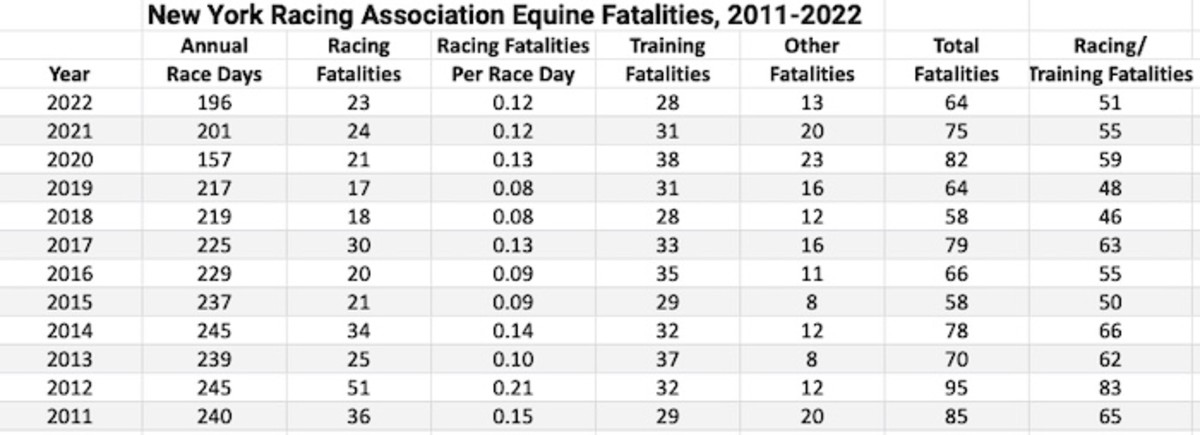
Based on statistics compiled by the Paulick Report from the NYSGC's online database, fatal racing injuries are down significantly from 2012, when 51 horses died. In 2022, 23 horses were listed as having died from racing, either as a result of musculoskeletal injuries or sudden death. That's a decline of 55 percent. Over the same span, the number of racing days has declined by 20 percent. In 2012, there were 0.21 fatalities per race day (roughly one every five days). In 2022, there were 0.12 fatalities per race day (one every eight days).
Training fatalities or “other” deaths (colic and laminitis being the leading causes) have not declined nearly as much as racing fatalities. Training deaths actually increased from 32 to 37 the year after the task force recommendations and there were 28 in 2022, just a 13 percent decline from 2012. Training fatalities saw a 10-year high with 38 deaths in 2020, the year the coronavirus pandemic disrupted racing and training. The number of horses that died from other causes has increased in recent years compared to 2012, also hitting a 10-year high of 23 in 2020.
To review the progress made at New York Racing Association tracks over the last 10 years and the challenges that remain, a number of questions were submitted to Palmer, New York's equine medical director. Following are those questions and answers:
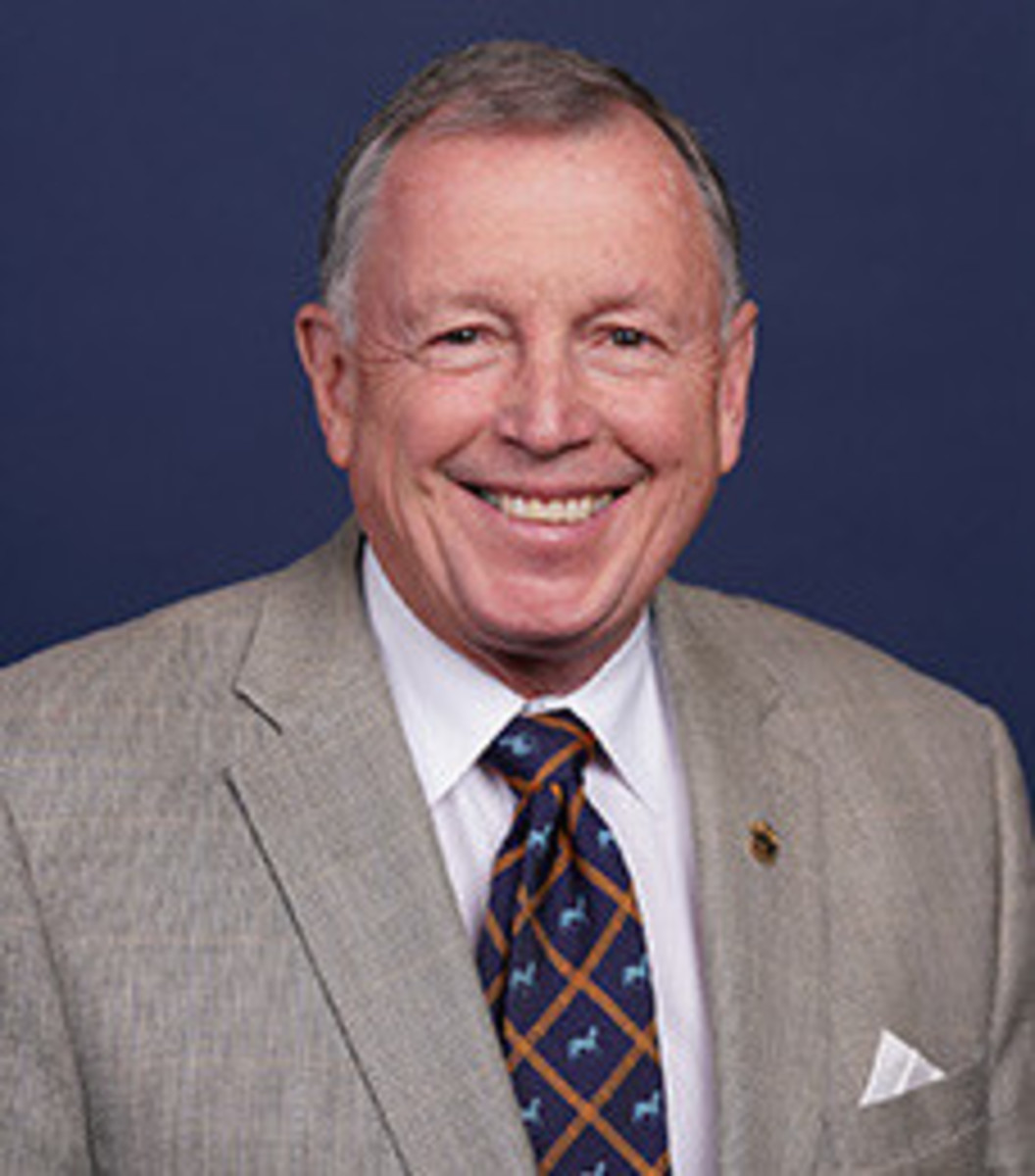
Dr. Scott Palmer (AAEP photo)
Since 2012, when the Task Force was formed to address the spike in fatalities at Aqueduct, racing and training fatalities (not including “other” or “unknown” deaths) at NYRA tracks are down almost 40%. What do you think are the biggest factors that have helped lead to the reduction?
Dr. Scott Palmer: There are many factors that impact equine health and safety. At NYRA tracks, the reduction of equine fatalities can be attributed in part to implementation of a comprehensive risk management program and the recommendations of the New York Task Force on Racehorse Health and Safety. Some specific factors include but are not limited to:
New York's appointment of an Equine Medical Director
Stricter voided claim rules
Claiming purse-to-price restrictions
Prohibition of analgesic medications and joint injections in horses within a timeframe leading up to a race
Strict regulation of thyroid hormone medicine in horses
Enhanced protocols for pre-race inspections of horses
Required continuing education for all trainers and assistant trainers
Real-time race surface monitoring and maintenance procedures
On the other hand, comparing 2022 to 2015 and 2016, the statistics on racing and training fatalities have not improved. When you consider the reduction in the number of racing days the last several years, the numbers look slightly worse. Does this suggest there's no more room for improvement?
Absolutely not. There is ALWAYS room for improvement when it comes to equine health and safety. New York's goal is zero fatalities.
Risk management is an ongoing, iterative process that includes:
Performing a risk assessment to identify risk factors.
Implementing interventions to address those risk factors
Monitoring metrics to determine if interventions are successful
Modifying current interventions or implement new interventions as required to address changes in risk.
With that said, the premise of your question is inaccurate (which is discussed later). Over the past five years, there has been a relative increase in equine training fatalities in contrast to a decrease in equine racing deaths.
One factor is that, by its very nature, training is not regulated in the same manner as racing.
There is a difference in the degree of veterinary scrutiny of horses immediately prior to a race compared with that provided to horses that are training.
For horses that are racing:
On the day of a race, a pre-race inspection is performed in the morning. Based upon the results of this inspection, horses of concern to the regulatory veterinarian are not allowed to race.
All horses are visually inspected by regulatory veterinarians as they enter and walk the paddock, during the post parade, and while warming up before they are loaded into the starting gate.
Similar scrutiny of horses before and during training is undertaken. However, I am encouraged by efforts to further involve attending veterinarians in evaluating horses prior to training. We are considering a requirement that an attending veterinarian attest to the suitability of a horse to train. This cannot, however, just be a paper requirement. To be effective it would require an attending veterinarian to undertake a review.
We are likewise enthused by biometric sensor devices being placed on horses during training as a scalable means to identify Thoroughbred racehorses with subclinical lameness or gait abnormalities. Such lameness is usually impossible to diagnose by veterinary inspection alone. I believe the increased use of this technology can lead to a significant reduction of training fatalities.
In 2019, Santa Anita in California had highly publicized problems with fatal injuries similar to Aqueduct in 2012. Has New York taken anything from the safety protocols they've put in place in California that have successfully reduced the racing and training fatalities?
Yes. California has made a conscientious effort to create a culture of safety at Santa Anita Park. Increased veterinary scrutiny of horses and collaboration between attending and regulatory veterinarians has been critical to their process. Additionally, Santa Anita installed advanced imaging equipment (PET Scan) to help identify horses with pre-existing musculoskeletal lesions that are not evident on routine radiographs. It might be worth examining the interventions implemented due to PET scan availability.
What procedures do you or other regulatory veterinarians undertake when you receive a necropsy report? Does someone meet with the responsible trainer?
Multiple veterinarians review necropsy reports and communicate significant findings with the responsible trainer. The open line of communication between veterinarians and trainers leads to implementation of best practices to protect horses. This process, along with the racing risk management program developed in New York and employed by all Thoroughbred tracks in the Mid-Atlantic region, was incorporated into the HISA safety regulations that are now in place across the U.S.
What types of investigations are done when a horse suffers a sudden death? For example, Herecomesangelina collapsed and died on March 14 and the NYSGC data base note says the investigation is ongoing. What steps are taken during the investigation?
Have you learned anything during those investigations?
Yes. The Commission and/or NYRA searches an applicable trainer's barn to determine if any drugs known to produce cardiac arrhythmia are present. We interview trainers and attending veterinarians regarding medical treatments that may have been administered and consider the clinical history of the horse. Additionally, the necropsy examination for cases of exercise-associated sudden death in racehorses includes a thorough microscopic examination of the heart muscle and conduction pathways in the heart.
The majority of the necropsy examinations of exercise-associated sudden death cases have found no physical abnormalities. However, in some cases we have found evidence of cardiac muscle necrosis, chronic inflammation of the cardiac muscle and one case of congenital abnormality. Similar to findings in human athletes, these horses likely experienced an electrical conduction abnormality in the heart that leaves no trace in the body after death.
Herecomesangelina is one of 10 horses in the barn of Rudy Rodriguez that died in 2021-22, more than any other trainer. What can be done in cases where one trainer has so many horses die?
Based on available information, it's evident that Mr. Rodriguez' stable consists primarily of horses obtained via claiming races. As outlined in the Task Force Report, claiming horses are inherently at increased risk for injury and death.
Our Stewards and I regularly speak directly with trainers – including Mr. Rodriguez – about the increased risk for injury in horses that race in claiming races and encourage them to use increased vigilance when training these horses.
One challenge trainers face is that there is usually no overt clinical sign of lameness in horses that experience exercise-associated musculoskeletal fatalities. This makes it challenging to identify horses at increased risk for injury based upon physical inspection alone.
Use of biometric sensors during training and racing will help to identify horses at risk and prevent musculoskeletal injury, particularly in horses that race in higher risk race categories, such as claiming races.
Do you feel any of the Horseracing Integrity and Safety Authority regulations put into place July 1 have made a difference?
Yes. The HISA whip rule has changed the way that jockeys use the whip during a race. However, with regard to HISA's impact on the number of equine injuries and/or fatalities, it is too soon to tell. Equine fatalities are now so few in number that making an objective comparison of the rate of injuries during a short period of time is challenging.
I am encouraged by HISA's reporting requirement for tracking non-fatal musculoskeletal injuries and look forward to seeing the data, as that will be an important factor in measuring the general soundness of our racing population.
HISA's Anti-Doping and Medication Control regulations have not been approved yet, though you've had time to review them. If the Federal Trade Commission approves regulations similar to those submitted last year, what will be the biggest changes that might reduce the number of fatal injuries or sudden deaths?
As stated previously, there are many factors at play in equine health and safety. New York's present regulations regarding medications are very similar to those in the HISA ADMC regulations. Therefore, I do not anticipate that implementation of the HISA ADMC regulations will have an immediate, dramatic impact on the number of injuries or sudden deaths. However, I do look forward to HISA's required contemporary medication reporting by attending veterinarians, which is part of the existing HISA safety regulations. This required documentation of medication use is likely to help reduce the use of pain control medication in close proximity to the race, in turn reducing the risk for equine musculoskeletal injuries.
Editor's Note: Palmer suggested the data compiled by the Paulick Report would be more accurate had total starts been used rather than race days, then shared the analysis he uses. He also volunteered that fatalities have declined at New York's other Thoroughbred track, Finger Lakes, which is not operated by NYRA.
Palmer: I question the use of “race day” as a metric for the measurement of equine injuries.
The metric used by the Commission's Equine Injury Database of “fatalities per start” is a more accurate measure of risk as it takes into account the variability of the number of starters in each race, which is not considered when using a “race day” metric. The use of starts holds constant the differences that occur because of changes to a racing schedule and is therefore a more consistent year-over-year metric.
Below are the metrics I use to monitor the prevalence of racing, training, and other fatalities:
NYRA Fatality Incidence Rates – 2017-2021
2017
2018
2019
2020
2021
Racing Fatalities
30
19
17
21
24
Number of Starts
16241
14987
14842
11817
14628
Racing Fatalities/1000 Starts
1.85
1.27
1.15
1.78
1.64
Training Fatalities
33
27
32
40
31
Number of OTW
49878
48024
45962
43627
46724
Training Fatalities/1000 OTW
0.66
0.56
0.7
0.92
0.66
Other Fatalities
16
12
17
21
21
Number of Horse-Days
177876
167659
166744
142161
160949
Other Fatalities/1000 Horse Days
0.09
0.07
0.10
0.15
0.13
The Commission classifies fatalities using a different standard than the Equine Injury Database in that the EID classifies only those exercise-related fatalities that occur within 72 hours of the incident, while the Commission classifies fatalities as exercise-related regardless of the time interval after which the death, typically via euthanasia, actually occurs.
Not asked but important to the discussion: Finger Lakes Racetrack has seen a significant reduction in racing fatalities. In 2011, there were 31 racing fatalities (2.9 per 1000 starts) compared to 4 (0.8 per 1000 starts) in the past year. This is relevant because the changes implemented by NYRA after the task force report were also implemented at Finger Lakes. Additionally, the same changes have been implemented at Thoroughbred tracks in the Mid-Atlantic states (14 tracks).
In an ongoing dialogue about the efficacy and feasibility of Horseracing Integrity and Safety Authority, Ed Martin, president of the Association of Racing Commissioners International, levied the following response to what he referred to as an “attack” by Jim Gagliano, president and chief operating officer of The Jockey Club.
Remember the scene from the “Wizard of Oz” when Toto yanked back the curtain to reveal Professor Marvel frantically pulling the levers to maintain the illusion of the Great and Powerful Oz? That's how Jim Gagliano's statement about the ARCI and HISA hit me.
Most amazing is it comes at a time when HISA/HIWU is earnestly negotiating the use of the status quo: the same state testing labs and commission personnel in order to enforce new HISA rules that are remarkably similar to the ARCI Model Rules largely in place in most places.
Yes there are differences and some enhancements, but let's face it the new testing regime appears to be no better than TOBA testing already performed in most jurisdictions. But nobody is supposed to know that or a host of other things because HISA and HIWU have insisted on non-disclosure agreements.
In today's politics too many demonize as “racist” or “socialist” those who ask questions or suggest a different path. It's sad those tactics are being used in racing because those questions or suggestions are about how to best improve upon and move past the status quo. But for some not steeped in the details, such sloganeering can be effective.
George Strawbridge once told me after attending an ARCI conference that he thought the group was “the answer.” I laughed and responded that we can't mandate anything and those in the industry who could empower the group as a central regulatory entity would never work to do so because we are truly independent and our members are publicly accountable. Yet we are attacked for not doing what we were never empowered to do.
In Jim's world I am working against HISA despite spending countless hours in 2021 helping HISA staff understand implementation obstacles to be overcome in the states, offering to assist when USADA bailed, advocating for federal money when the opportunity presented itself, and providing over $1 million in data services to facilitate the registration of covered persons.
I am not pro or anti HISA. I don't have a horse in this race but I am pro reality and against making a mess. The ARCI has not engaged in the legal challenges but did ask the FTC to avoid total regulatory chaos by setting aside HISA's proposed ADMC rules given recent court rulings. To create confusion and expose enforcement actions by either HISA or a State to being struck down was not a risk we thought acceptable for this industry or the public.
In July of 2019, before Senator McConnell's HISA bill was even drafted, the ARCI quietly proposed to the Jockey Club that they use their existing private regulatory authority as the Thoroughbred breed registry empowered by commission rules to impose equine welfare requirements and conditions for registration. This was a way to deal with the jurisdictional limitations of state racing commissions without waiting for legislative actions. The Jockey Club had it within its existing power to act, yet it did not.
As to HISA, they have been totally within their rights to build programs as they see fit. Personally I think they have made things more difficult for themselves and costly for the tracks. If HISA is to stand and programs remain as envisioned, it would be foolhardy to not take an opportunity to get federal funding to mitigate the financial costs. Yet Jim argued against this need and industry lobbyists obviously didn't seek it from a Congress spending $1.7 TRILLION that has found money for all sorts of things like $50 million to promote tourism in Tunisia.
Federal funding would mean transparency, accountability, independent programmatic and financial audits. Perhaps that's not wanted by those who gave birth to this entity despite Ms. Lazarus's claims that transparency and accountability are HISA values. Perhaps she cannot act independently or is constrained by those who have lent HISA money to operate.
Mr. Gagliano is rightly the “Father of HISA” and his overly defensive posture does little to advance the cause of making this work. It's easy to shoot a messenger who says things many quietly think.
Alan Marzelli, Jim's predecessor, once counseled me that progress only happens if everyone pulls in the same direction. That was when the Jockey Club used to function as Thoroughbred racing's consensus builder. Turning the current situation into a win may mean abandoning the “us vs. them” tactic which equates hammering a square peg into a round hole and the personal and organizational attacks on those who want the same thing.