On Feb. 22, 2023 during its regularly scheduled meeting, the Horseracing Integrity and Safety Authority's Board of Directors discussed the HISA enforcement team's recommendation concerning Hot Rod Charlie's participation in the Lukas Classic on Oct. 1, 2022.
The recommendation was as follows: “We conclude that the stewards had a reasonable basis to find that the horseshoes worn by Hot Rod Charlie during the 2022 Lukas Classic did not violate HISA Rule 2276. As a result, we find no grounds to believe the stewards' conclusion was clearly erroneous or unsupported by the evidence. We recommend that the Board take no further action in this matter.”
The HISA Board voted unanimously to accept the enforcement team's recommendation. No further action will be taken.
Photos of the Lukas Classic were purported to show a toe grab on Hot Rod Charlie's front shoe, which would be a violation of HISA regulations. Pursuant to a Voluntary Implementation Agreement between HISA and the Kentucky Horse Racing Commission, HISA previously designated KHRC officials to conduct an initial investigation of the matter. Collectively, Dr. Bruce Howard, Dr. Molly Metz, state steward Brooks Becraft, and chief state steward Borden examined the evidence in the matter, and all concluded that Hot Rod Charlie's shoes were not in violation of Rule 2276.
HISA rule 2276 prohibits traction devices in the forelimb, including but not limited to rims, toe grabs, bends, jar calks and stickers. In late July, HISA altered its original traction device ban on both fore and hind limbs to permit either a full outer rim shoe (up to 4 mm in height) or a toe grab (up to 4 mm in height) on the hind limbs for dirt races. Rule 2276 does not say whether violations may result in disqualification.
Prior to the creation of HISA, the Kentucky commission already had a ban on front limb toe grabs.
One of the major issues of the case was that Hot Rod Charlie's front shoes, which were meticulously examined by the investigators, showed evidence of a previously ground-down toe grab (see images below). Investigators concluded that the ground-down remnant of a toe grab does not constitute a “traction device,” but this most recent report suggests that the HISA Board may determine that further clarification of Rule 2276 is necessary to prevent future uncertainty in the interpretation of the Rule.
“In its current iteration, Rule 2276 does not require reviewing officials to measure toe grabs, or the remnants of a ground-down toe grab,” the report states. “The Rule prohibits “traction devices,” which include toe grabs, among other items. A shoe with a full rim height of 2 mm or less is not considered a traction device. The Rule provides no further definition of what is not a traction device, and does not specify how stewards should interpret the rule when a shoe that was originally equipped with a toe grab has had the toe grab removed.”
The HISA enforcement team's full conclusion was as follows:
First, the shoes worn on the front legs revealed evidence of a previously existing toe grab. Farrier Dean Bault explained in his interview with the stewards that he had ground down the toe grab to comply with HISA's rules. Our independent inspection of the shoes supports Bault's statement that he worked to remove the toe grab. The horseshoes are made of aluminum, and the toe grab was made of steel. A visual inspection of other horseshoes with existing toe grabs reveals a similar distinction between the two materials. The Hot Rod Charlie shoes contain very little remaining steel from the toe grab.Second, when we compared Hot Rod Charlie's horseshoes to shoes containing a 2 mm or 4 mm toe grab, we discerned a clear distinction between the height or existence of the remnant of the toe grab on Hot Rod Charlie's shoes and the shoes equipped with toe grabs. This further supports Bault's explanation that he ground down the toe grab.
To illustrate, compare the following photographs:
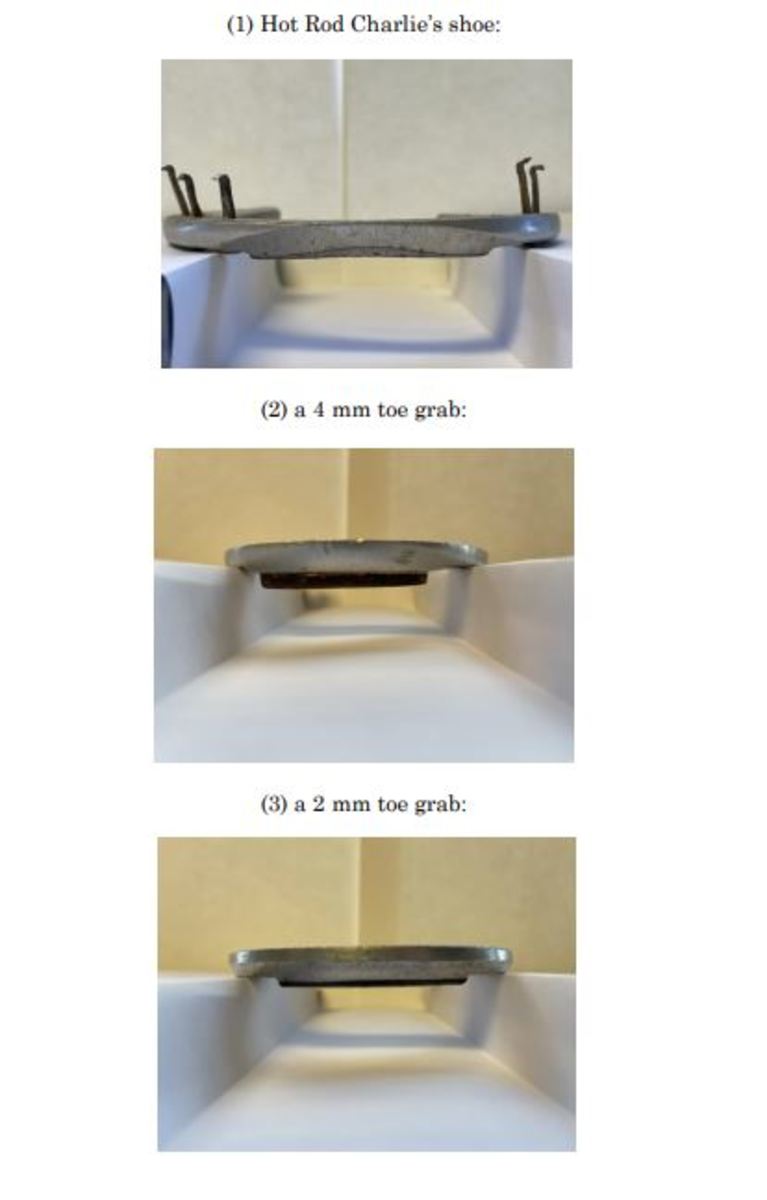
Third, the initial investigation did not focus on whether a toe grab once existed on Hot Rod Charlie's shoes. Instead, the relevant inquiry was whether Hot Rod Charlie's shoes contained a traction device. The officials examined the shoes and concluded that the farrier had ground-down the previously existing toe grab on the shoes sufficiently so that the shoes no longer contained a traction device as defined in Rule 2276.We conducted a tactile examination of the shoes and felt no palpable traction device on the shoes. First, we observed a noticeable difference between Hot Rod Charlie's shoes compared to horseshoes with traction devices. Hot Rod Charlie's shoes felt smooth with no disruptive device jutting out from the surface. Comparatively, when feeling a horseshoe with a traction device, like those shown in the included photos, the examiner would feel a noticeable protrusion of a traction device likely of a different material. As Hot Rod Charlie's shoes had been sufficiently ground down, enforcement counsel could not feel the presence of any attachment to the horseshoes.
Additionally, had the horseshoes not been ground down and were left with a traction device, the traction device would have prevented the horseshoe from running smoothly over a flat surface. This traction would allow the horse to have increased grip on the racing surface. However, when enforcement counsel ran Hot Rod Charlie's shoes over a smooth surface, no disruption occurred. This provides enforcement counsel confidence that whatever traction device may have existed at one time had been sufficiently ground down so that such devices had been eliminated from the
horseshoe.
Fourth, in the materials submitted by Rich Strike's interests, including the photographs with measurements, the remnants of the toe grab were measured from the highest point of the shoe adjacent to the area where the toe grab was originally located on the shoe. The measurements were not made from the ground surface of the shoe. The horseshoes on Hot Rod Charlie were a Kerckhaert Tradition XT model, commonly used for horses in training. According to the farrier, the shoes were placed on the horse on August 30, 2022. Typical “wear and tear” to the shoes is noticeable. A proper measurement of the shoe should include the lowest point of the shoe's ground surface, not the bottom of the shoe's highest point.The highlight in the following photograph indicates the point from which Rich Strike's interests measured the shoe:
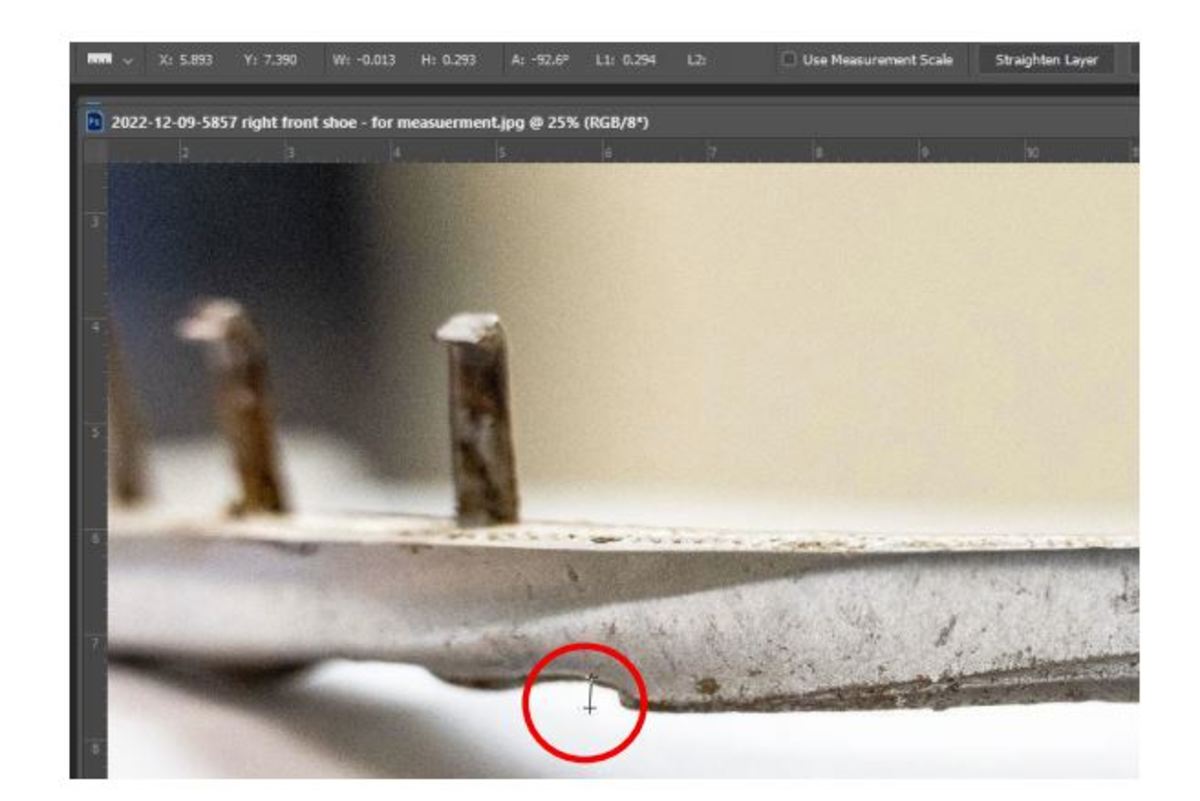
The officials did not believe the state of the shoe constituted a toe grab or a traction device. We agree.
Fifth, Rule 2276 does not specify how to measure a horseshoe for purposes of compliance with the Rule. Instead, the Rule prohibits traction devices. The officials inspecting the shoes focused on whether any remnants of a toe grab constituted a “traction device” and concluded that the remaining material on Hot Rod Charlie's shoes did not constitute a traction device. An inspection of Hot Rod Charlie's horseshoes demonstrates that the officials had ample evidence to conclude that from the front to back of the shoe, insufficient material protrudes from the shoe to generate traction on the racing surface. A lateral observation of the shoe does show a minute rise above the cavity of the shoe running between the shoe's rims where the nails would be inserted. However, the height of the lateral rise is insignificant, and the inspecting officials reasonably concluded that no device remained on the shoe that would constitute a traction device in violation of Rule 2276. Our review of the matter indicates that the evidence supports these findings.
The post HISA Dismisses ‘Shoegate’ Complaint Against Hot Rod Charlie; Enforcement Team Suggests Further Clarification Of Shoeing Rule appeared first on Horse Racing News | Paulick Report.
