The Week In Review: For Syndicate Partners, What’s In A Name (Or Ten)?

Right now within TDN's Top 12 rankings for the GI Kentucky Derby, seven horses are owned by multiple-entity partnerships. One syndicate maxes out at 10 individual owners, another at eight.

If the horses from those larger partnerships (or other syndicates-there are plenty of them and they are growing in number worldwide) make it into the Derby field, they won't have to worry about getting the satisfaction and distinction of seeing their names in print as owners. But that's only because as a courtesy, Churchill Downs takes the extra step of hiring a graphic designer to rework the traditional program page for America's most historic and important horse race so that no owner of a Derby runner gets left out.

Technically, that practice is at odds with a Kentucky regulation that limits the number of individual owners who can appear on the printed program page to five. At a meeting last week of the rules committee of the Kentucky Horse Racing Commission (KHRC), commission staffers and industry stakeholders tried to take a first pass at updating that rule so that every member of a syndicate (or at least more of them) might get recognized as listed owners in all Kentucky races, not just on Derby day.

“I've been approached by several ownership groups that we make room for more names,” said KHRC commissioner Charlie O'Connor. “As syndicate groups in this country are becoming a big deal, [people] who invest their money in the horse business want to see their name on a program.

“These ownership groups and syndicates are spending a large amount of money in Keeneland and Fasig-Tipton and all the sales houses around the world, and I think it's a fair thing for them to ask for their name to be on the program, and I think that we should be able to accommodate it without any huge, big issues,” O'Connor said.

Others in on the discussion thought so too. But it turns out there are practicality limitations and potential unintended consequences that come into play if the KHRC paves the way for more individuals to get inked into ownership lines.

As for the existing rule itself, KHRC chief state steward Barbara Borden explained it this way: “Currently, our regulation says more than five individual persons shall not be licensed as owners of a single horse. That's why we have limited the number on the program to five. It goes on to say if more than five individual persons own interests, then they shall name one person to be the licensed representative.”


Signator | Chelsea Durand

Still, even within that parameter of five, the ownership line on a Kentucky program does get crowded. Several stakeholders at the meeting referenced the trouble being related to a 200-character limit that is a requirement of the Equibase system. The number for that data field was selected some time ago, well before the proliferation of partnerships in roughly the past decade, and it was once reasonable to assume every ownership entity would fit within that amount of space.

But that equates to just 40 characters per syndicate member if five owners are listed, and even then, to make everything fit, the characters are often squished together without spacing to the point where, as Borden said, the line is “illegible” to anyone trying to decipher the program.

“Part of the problem is two things,” Borden said. “First of all, the owners that want to see their names, they might know their name is on the program. But you can't read it, and neither can anyone else. And the other thing is, the reason we put the ownership on the program to begin with, is for public disclosure. So if it's not legible because we have too many names or the font is too small or whatever, we're defeating our purpose of listing the owners at all.”

Frank Jones, Jr., a KHRC commissioner who chairs the rules committee, wondered if it would be feasible to include a “side document” in the program that would fit all the names in full, while the program page itself got printed in a less cluttered way.

Anna Seitz, who works with Fasig-Tipton and with international syndicates, said that in Australia, “they list all the names. They just do smaller fonts. I know it makes a huge difference. Those owners, that's part of the reason they buy in, because they want their name on there.”

Gary Palmisano, Jr., the executive director of racing for Churchill Downs, Inc., said his company is “all for” syndicates. “But just understand that it is space-limited” and the issue is a “bigger-picture problem” than just learning to deal with the limitations of 200 characters.

“We live this every year with the Derby,” Palmisano said. “Obviously, in the Derby, every owner partnership wants to see their names. Equibase currently doesn't have the capability of putting in more than 200 characters. So we have to physically, manually, white-out portions of the owner [line, and then string together] the text, and try to put it in [with everyone listed].”

But if the rule got changed to list more owners, Palmisano cautioned, “tracks every single day are going to have to have a graphics design person, as we do for the Derby, [to] recreate the program line. [That task] is certainly something that takes our team, manually, a lot of time to do for the Derby program.”

Palmisano continued: “Right now [the rule] says five [owners are the maximum listed]. With the racetracks, assuming Equibase can help us with the language, we can figure out the program piece. We're already actively engaging with Equibase to try to figure out the program piece. But I think the [rules] committee, more so than looking at the program piece, should take a hard look if it should be five, eight, seven, ten [owners listed]. Because that helps us frame what we need to do with Equibase.”

O'Connor said 10 names might be the sweet spot, because he's seeing many partnerships now constructed at the 10% buy-in level aiming for 10 syndicate members.

Borden said that brings up another issue related to disclosure.

“This takes us back two years ago when we had partnership forms, which we no longer require,” Borden said. “Every syndicate would have to report to us all the participants in the syndicate.”

While the partnership forms might raise the unwelcome prospect of more paperwork for everyone involved, Borden said there is an upside to those forms that relates to better transparency.

“We currently don't always know the exact ownership of every horse, so that would probably be a bonus for us,” Borden said. “But it would entail us being advised of all the ownership and the [percentages each entity owns].”

But, Borden said, no matter what expanded number the rule night eventually state, common sense inevitably has to intervene.


Gulfport | Coady Photography

“At some point there has to be, in my opinion, a limit,” Borden said. “It's not infinity. If 100 people own a horse, we can't put 100 names on there.”

Keeneland's vice president of racing, Gatewood Bell, raised another potential red flag related to numerous owners being listed: Although Kentucky has recently loosened its rules regarding coupled mutuel entries in an attempt to bolster field sizes, a single owner still can't run two horses in the same race if it excludes another owner's horse from getting in. So what if one individual was a small-percentage owner in one syndicate and owned another horse either outright or as part of a second partnership? How would preference be fairly determined?

“You wouldn't want to discourage the owners from joining these syndicates and also having horses on their own,” Bell said.

Borden pointed out that any overlapping ownership in a single race, even a tiny percentage, still counts as an owner having an interest in two horses.

The committee ended up not proposing or voting on any rule change. Jones, the committee chair, said the entire issue needed more study, but that it would likely be brought up again in the near future.

“The more you listen, the more you see how complicated a problem this could become,” Jones admitted.

The post The Week In Review: For Syndicate Partners, What’s In A Name (Or Ten)? appeared first on TDN | Thoroughbred Daily News | Horse Racing News, Results and Video | Thoroughbred Breeding and Auctions.
Source of original post

The Fair Grounds Stakes Scientist

From his desk in the racing office, Stuart Slagle views stakes coordination as a vocation that is part sales and part diplomacy, but for him, it is also part science.

As a former academic who received a B.S. in Zoology at the University of Texas in Austin and studied biophysics at the University of Illinois in Champaign-Urbana before working with supercomputers as a system engineer, his approach to filling a stakes race is always interspersed with the scientific method and predictive analytics.

“There is nothing like pursuing the science of a favorable outcome,” he said.

Parlaying those experiences into Thoroughbred racing actually was not a major shift. After all, it is a sport built on figures and a breeding structure handed down across generations.

Originally from Ohio, Slagle grew up among the tumbleweeds in Lubbock, Texas. Loving baseball and football in the Panhandle, he was always fascinated how statistics powered the flow of information. He turned to zoology because it was high time to declare a major during his Longhorn junior year. Classification, behavior and the distribution of animals taught him that observation could be a keen skill to develop.

Computer modeling and predictive analysis melded with handicapping races, which he gave up to seek employment in various racetrack positions over the past 20 years from being a placing judge at Sunland Park in New Mexico to the Racing Secretary at Prairie Meadows in Iowa.

“As an academic at heart, I'm fascinated by a horse's biomechanics and how aerobic exercise relates to the analysis of speed figures and their standard deviation,” he said.

Though he has studied the science behind how and why certain equine athletes fit into specific races, stakes coordination is a relatively new experience for Slagle, having been hired by Scott Jones to take the helm at the Fair Grounds in New Orleans last fall.

“There are so many experienced coordinators out there that I deeply respect in this business,” he said. “Scott is one of them, and I am just fortunate to follow in his footsteps.”

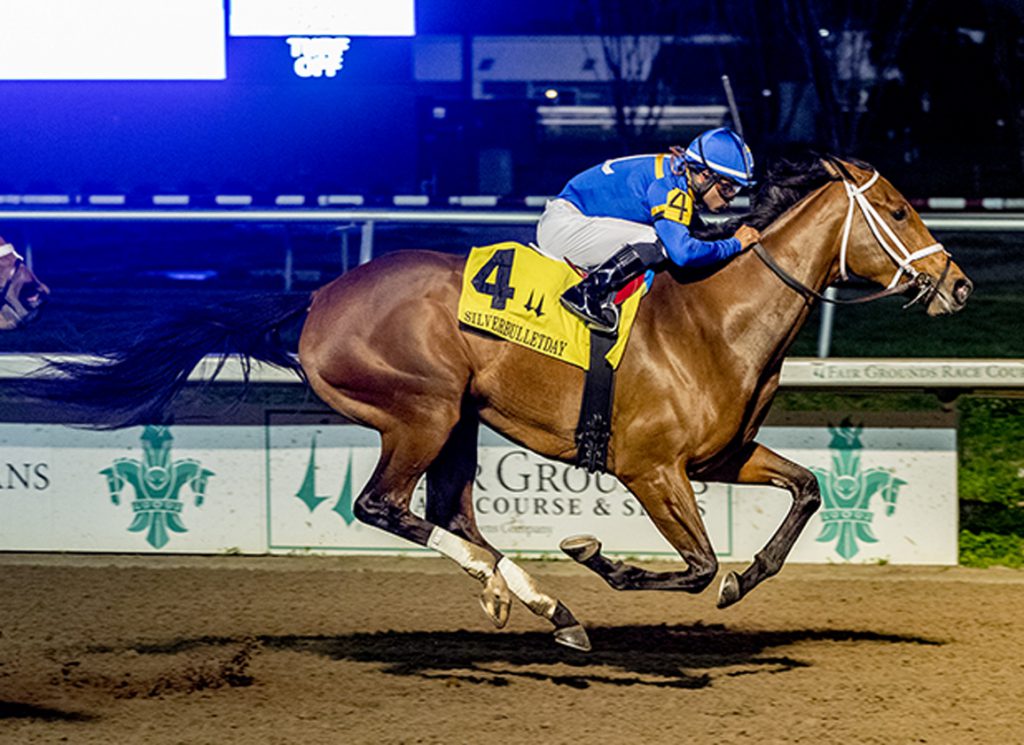
Moving forward, Slagle's job is a complicated one when it comes to selection. Before the completion of the meet Mar. 26, he will have to filled 65 starting gates that are worth a combined $8.5 million. Under Jones's tutelage, his managed lineup includes this weekend's Silverbulletday S. and the GIII Louisiana S., and of course, GI Kentucky Derby prep races like the GIII Lecomte S., the GII Risen S. and eventually, the GII Louisiana Derby.

Part of Saturday's card, The Alys Look (Connect) wins the Silverbulletday S., at the Fair Grounds | Hodges Photography / Lou Hodges, Jr.

The series for both the Derby and the GI Kentucky Oaks has provided some important stops along those trails, and much continues to be criticized on social media concerning the fact that the Fair Grounds does not have a Grade I race. Slagle explains that needs to be tempered, especially when you consider all of the factors that the Thoroughbred Owners and Breeders Association employs to determine what makes a graded race.

“You have to understand that it is out of your control [grading process] because there are the race quality scores based on speed figures, there's the workbook, and how the top four finishers perform after the race, just to name a few,” he said.

Within this construct, a stakes coordinator is constantly looking at the many options before them when it comes to filling the entry box. Sure, they are trying to get the best horses possible and the largest fields, but they are also thinking tangentially about a variety of pieces of data.

“We always want horses with stakes experience,” Slagle explained. “But that is not always easy to obtain, so it is important to also think about ones that are class elevating at the right time.”

What a Thoroughbred does with their career after a race at the Fair Grounds could prove just as important to future grading of a race as what it has done before. Running numbers and looking at potential candidates comprises a sea of data. Slagle begins with a control by cold texting and calling some 70-80 trainers that could have prospective runners in their midst. He will get rapid responses, slow ones will trickle in and some will not respond at all.

The science behind the selection process moves quickly to a sales pitch, and then turns into a series of diplomatic talks as barns are cagey about showing where they are going to run next. Most of the time, they will wait till the last possible moment to declare, so Slagle has to be mindful of the options before a race closes. Poker faces are the norm.

Just as with any business, tracks want their stakes competition to have a race worth betting. In other words, a heavy favorite against a group of outclassed runners does not help the handle, and in an age when horses run less, you are asking connections to risk coming to your race, instead of to another track.

“This is a major financial commitment that owners are making by entering a stakes race, and we are asking for them to invest in the product that we are putting out there,” he said. “At the same time, we are also thinking about our patrons, the betting public, and our own bottom line, so there is no recipe for success because each time we do this it is totally different.”

Balancing all of this in his stakes lab, Slagle is seeking equine athletes with potential for success and he determines that by measuring their patterns of behavior. Looking at their early maiden races and the speed figures they posted can be coupled with the distances that they traveled in an effort to help identify potential stars in the making. The results though of these “tests” will not always come quickly, as sometimes a Thoroughbred's racing maturation develops well after they compete in a Fair Grounds stakes race. That is why decisions that are made now by the stakes coordinator can reverberate into an unknown future.

“When we are putting together a lineup, I still think regularly using the scientific method and hypotheses,” he said. “We know, for instance, which barns run off short rest and all of this data goes into forming a picture of who we should attract.”

With a wealth of experiences, and still much to learn, Slagle is utilizing all of the different disciplines he has encountered over the years at his new job in New Orleans. Like a zoologist in the field, he wants to find the right Thoroughbred that matches his ecosystem. As he builds his hypothesis about each potential entry, the next stakes race slowly, then rapidly takes shape. Then, it is on to the next one.

Returning to Stuart Slagle's desk at the Fair Grounds, there is a definite science behind his method. A background in zoology can't hurt when it comes to this type of selection process.

The post The Fair Grounds Stakes Scientist appeared first on TDN | Thoroughbred Daily News | Horse Racing News, Results and Video | Thoroughbred Breeding and Auctions.

Source of original post

2023 Mating Plans, Presented by Spendthrift: Denali Stud

As we approach the opening of the 2023 breeding season, the TDN staff is once again sitting down with leading breeders to find out what stallions they have chosen for their mares, and why. Today we spoke with Conrad Bandoroff at Denali Stud.

LIAM'S PROMENADE (m, 4, Liam's Map – Promenade Girl, by Carson City) to be bred to Curlin

We just purchased this mare with some partners in the January Sale and are very excited to have her. She hails from the family of MGISW Cavorting (Bernardini), who has of course produced MGISW Clairiere (Curlin). She is an attractive mare with a lot of quality and will suit Curlin quite well. It has worked in the family before!

HARD NOT TO LIKE (m, 14, Hard Spun – Like a Gem, by Tactical Cat) to be bred to Life Is Good

A multiple Grade I winner, this is a mare that we have always believed in. Her newly-turned 3-year-old colt Faustin (Curlin) was named a 'TDN Rising Star' after winning on debut sprinting. He has a ways to go, but looks like he could be a proper Saturday Afternoon Horse.

I have always wanted to breed her to the Into Mischief line and Life Is Good is a perfect physical match for her. She is a strong, powerful mare and needs a bit of size and scope from the stallion. This is the same cross that produced GSW Gerrymander (Into Mischief).

LADY APPLE (m, 7, Curlin – Miss Mary Apples, by Clever Trick) to be bred to Gun Runner

Last year Lady Apple delivered her first foal, a filly by Quality Road, that we like a lot. She's everything you look for in a first foal– good leg, and nice strength and substance to her. She is carrying and will soon foal an Into Mischief, so she is getting started with every chance. She is a multiple graded stakes winner who placed in the GI Kentucky Oaks. Her pedigree continues to blossom under Larry Doyle of KatieRich's management with her newly-turned 3-year-old half-sister American Apple (American Pharoah), a graded stakes winner at two.

Gun Runner needs no introduction and you just have to consider yourself fortunate to have a mare that can warrants a visit to him. This could get you a serious racehorse.

Dream Tree's Into Mischief yearling colt | Patrycja Szpyra

DREAM TREE (m, 8, Uncle Mo – Afleet Maggi, by Afleet Alex) to be bred to Flightline

The winner of the GI Starlet S. at two, Dream Tree is off to a good start in her broodmare career. Her first foal, a Curlin filly, sold for $700,000 to David Ingordo at last year's Keeneland September Sale. She has a highly promising Into Mischief yearling colt and is expecting a Gun Runner for this year. She is a beautiful, powerful mare.

This is a mating we are very excited about. Tapit has done very well over Indian Charlie-line mares. Flightline himself is a prime example. We are intrigued by this 3×3 to Indian Charlie and think it could produce a tremendous amount of speed. A generational talent in Flightline paired with a fast, precocious mare–a promising and potent mix, we hope!

PATHETIQUE (m, 5, Uncle Mo – Dothraki Queen, by Pure Prize) to be bred to Into Mischief

She is an Uncle Mo daughter of GII Pocahontas S. winner and GI Breeders' Cup Juvenile Fillies-placed Dothraki Queen. Pathetique herself had a ton of ability. She broke her maiden second time out at Saratoga for owner Richard Rigney and trainer Phil Bauer and was a stakes-caliber filly, but unfortunately got hurt. She was fast. Really fast.

We decided to breed her to Into Mischief because we think this could produce a freaky fast horse.

STOP SHOPPIN TAMMY (m, 6, Tapit – Miss Shop, by Deputy Minister) to be bred to Curlin

This is a daughter of Tapit that we have high hopes for. She is out of Grade I winner Miss Shop and is a full-sister to the graded stakes-winning Tin Type Gal. She is a gorgeous mare that physically suits Curlin really well. On paper, it is highly productive cross and is responsible for MGISW Cody's Wish (Curlin), not to mention that it goes back to A.P. Indy, which has been the magic Curlin cross.

WINE PRINCESS (m, 14, Ghostzapper – Azeri, by Jade Hunter) to be bred to Constitution

She is a Grade II and Grade III stakes winner by a Horse of the Year and out of a Horse of the Year. Now 14, what we like about her is that four of her five foals of racing age have made it to the races, won in New York, showed promise, have been sound and have earned over $100,000.

We still feel she can produce a good horse. Her 4-year-old Smokin' T (War Front) has shown signs of being one and is stakes placed. He's due to start what we hope will be a good campaign this year.

We rate Constitution as an emerging top stallion. We really like the momentum that he has in some really well-bred crops in the waves. We chose Constitution because Ashiham and Felix the Fox, her two sons by Tapit, had talent and we wanted to send her back to the Tapit line.

The post 2023 Mating Plans, Presented by Spendthrift: Denali Stud appeared first on TDN | Thoroughbred Daily News | Horse Racing News, Results and Video | Thoroughbred Breeding and Auctions.

Source of original post

Colorado Legislation Would Make Equine Slaughter For Human Consumption A Crime

Legislation introduced to the Colorado Senate would make “equine slaughter” a new crime. 

The buyer of a horse would be guilty of the crime if he or she “knows or reasonably should know” that a horse could be killed for human consumption. Violators would face up to $10,00 in fines if found guilty. 

The bill mandates notices be placed at livestock auctions and requires that the import and export of horses bound for slaughter be blocked.

If passed, Colorado would join California, Illinois, New Jersey and Texas in banning the sale of horses for human consumption. 

Read more at the Denver Post

The post Colorado Legislation Would Make Equine Slaughter For Human Consumption A Crime appeared first on Horse Racing News | Paulick Report.

Source of original post

Verified by MonsterInsights