Dublin Fjord Stables, Racepoint Stables, Kevin D. Hilbert and Thomas E. O'Keefe's multiple graded stakes-winning millionaire Drafted, who turned 9-years-old with the New Year, earned a 93 Beyer Speed Figure for his gutsy nose score in the Gravesend on Friday at Aqueduct Racetrack.
Trained by David Duggan, the gray son of Field Commission will now turn his attention to a title defense in the Toboggan (G3) on Jan. 28 at the Big A.
Drafted closed out his 8-year-old campaign in dramatic fashion, flying from last-of-five in the six-furlong Gravesend to nip the stakes-winning Laurel Park shipper Little Vic by a nose at the wire under a well-timed ride from Luis Rodriguez Castro. He defeated a short but talented field that included graded stakes-winner Morello and multiple stakes-placed Three Two Zone after the original field of 12 was reduced to a quintet of runners due to scratches.
“Even though it scratched down to a short field, there were some key runners in there,” said Duggan. “Morello is solid and Little Vic is solid, so it wasn't like they were getting rid of the dead weight. Obviously, we were worried about the pace, but we got a decent enough pace. He showed up.”
The Gravesend was the fourth stakes victory of the year for Drafted, who also notched graded scores in the aforementioned Toboggan and the Runhappy (G3) at Belmont Park, as well as the Mr. Prospector at Monmouth Park.
Duggan said Drafted has shown heart throughout the year despite a handful of tough races when fifth in both the Carter Handicap (G1) at the Big A and the Forego (G1) at Saratoga Race Course.
“He's come back just fine and we just play the hand we're dealt,” said Duggan. “We over-faced a little in two or three of his races this year, but there wasn't a whole lot of options. You always worry how that affects the older horses, but it didn't affect him.”
Drafted first arrived in Duggan's care in late 2020, shipping in from the barn of trainer Doug Watson after competing in Dubai from December 2017 to February 2020. Upon Drafted's arrival, Arturo Parada, a longtime groom for Duggan, was tasked with caring for the seasoned gelding. Parada, who formerly worked for trainer Nick Zito, came to work for Duggan 17 years ago when he decided to stay in New York instead of moving to Florida.
While Parada cares for a handful of Duggan's trainees, he said Drafted holds a special place in his heart.
“He's super,” said Parada. “When I come in the morning, he's very nice and he's very quiet. I take care of five horses, but this one I spend more time with. He's nine, but he doesn't act it. He's perfect.”
Parada said some fine tuning and patience has allowed Drafted to reach his full potential this year.
“Oh my goodness,” said Parada, with a laugh. “When this horse came here, he didn't want his blanket and was scared of everything, so I spent a lot of time working with him. He didn't like the bridle we were using, but we switched the bridle and he's so much better now.”
Duggan, who manages his stable with his life, Lara, said Parada has not only become a key part of his training operation, but of his family as well.
“He just showed up one morning and was fantastic,” Duggan said, with a laugh. “He's like our adopted son. He's been as good and reliable as Drafted.”
Mandy Lynn Delahoussaye, daughter of retired Hall of Fame jockey Eddie Delahoussaye, now a commissioner with the Louisiana Racing Commission, passed away Friday at Ochsner Lafayette General Medical Center in Lafayette, Louisiana. She was 47.
Mandy lived in Arcadia, California with her family from 1979 until 2014, when her family moved back to Louisiana.
The family will receive guests Wednesday at Martin & Castille's Southside location in Lafayette from 1 to 2 p.m. (CT).
A private inurnment will be held at a later date in Holy Family Cemetery & Mausoleum in New Iberia.
Deacon Cody Miller will officiate at the services.
In addition to her father, survivors include her mother, Juanita Delahoussaye, her brother, Loren Delahoussaye and his wife Rachel; her nephew, Luke Austin Delahoussaye; her aunt and nanny, Rose Ann Delahoussaye; and her uncle and godfather, Edwin Paul Delahoussaye.
In lieu of flowers donations can be made in Mandy Lynn Delahoussaye's name to Children's Hospital New Orleans, Shriner's Hospital, or St. Jude.
Santa Anita Park canceled the New Year's Day racing program as steady rain soaked the Southern California area throughout Saturday night and into early Sunday morning. The rain began as a light drizzle Saturday morning but increased in strength throughout the completion of the program, continuing throughout the night.
Racing will resume at Santa Anita on Monday, Jan. 2, with 10 races and a first post at 12 noon Pacific. The program kicks off with the Grade 3 Las Cienegas Stakes for fillies and mares scheduled to run about 6 1/2 furlongs on the downhill turf course.
The popular Corgi Winter Nationals, which was set to be held in the infield on Sunday, has been rescheduled for Sunday, Feb. 19. Pre-purchased tickets have already been transferred to the new date.
Horsemen and horseplayers have been incredibly supportive of Santa Anita's 2022-23 Classic Meet. An all-time handle record was set for an opening day with over $26 million wagered all sources. The December 26th crowd of 41,446 was the largest gathering on-track for a non-Breeders' Cup day since 2016. The strength of the handle continued Friday and Saturday, with more than $10.6 million Friday and over $11.4 million Saturday all sources. Combined with Opening Day, Santa Anita Park has handled nearly $50 million over the first three days of the season.
Behind Normandy Farm's limestone rock fences along Paris Pike in Lexington, horses were sustained by luxuriant green fields and paddocks long before it was cleaved from famed Elmendorf Farm 70 years ago.
A handful of dedicated owners have maintained this land's hallowed tradition of yielding fine Thoroughbreds ever since the 19th century. This year, as the long tree-lined drive to the historic white-columned main house transforms from spring green to autumn shades of wine-red and gold, the farm awaits another proprietor who will write a new chapter.
Listed on the market for $6.2 million after the death of owner Nancy Polk in 2018, Normandy Farm is one of Central Kentucky's most distinguished landscapes, memorable for its stunning European-style barn seen in the movie “Seabiscuit” and an equine cemetery that includes the sire and dam of legendary Man o' War – Fair Play, whose life-sized bronze statue stands as the noble sentry over 25 graves, and Mahubah.
The farm, located seven miles northeast of Lexington on Paris Pike, is naturally scenic; panoramas gently rolling toward the horizon can be viewed from several vantage points, epitomizing the heart of Central Kentucky's horse country. Miles of black board fencing embracing abundantly rich pasturage provide a sense of space and serenity far removed from the city's congestion.
During the tenure of E. Barry Ryan, the owner, breeder, and trainer who established the 260-acre farm as a separate entity in 1951 and named it Normandy, the pastures nourished mares and foals owned by a distinguished American and international clientele that included Paul Mellon of Virginia, England's Queen Elizabeth II, Alec Head of France, and Stavros Niarchos of Greece.
Yet they were just a few of the many intriguing figures who have been connected to this historical piece of Bluegrass.
Ryan's family had enjoyed a long association, dating from the 1880s, with the family of Joseph E. Widener, who in 1920 secured the several-hundred-acre nucleus of Elmendorf, which had been brought to fame by the wildly rich and colorful Kentuckian James Ben Ali Haggin and once sprawled over 10,000 acres.
Joseph Widener, who later acquired more acreage, built the unusual L-shaped Normandy barn and established the equine cemetery originally on a rise at Elmendorf and which now is located within the boundaries of Normandy.
Widener raced a number of top horses in the U.S. and France prior to his death in 1943. His grandson P.A.B. Widener III, who inherited Elmendorf when his father, P.A.B. Widener II, died in 1949, began selling off the farm in parcels in 1948, and Ryan spent $260,500 for the acreage that became Normandy.
Before the property had been acquired by Widener, it was part of a 2,500-acre Elmendorf main parcel at Ironworks and Paris Pikes purchased after Haggin died in 1914 by Hamburg Place owner John E. Madden.
Like Madden, who was known as the “Wizard of Wall Street,” Ryan's grandfather Thomas Fortune Ryan was a well-known New York financier. He partnered with streetcar magnate P.A.B Widener, the father of Joseph E. Widener, and financier William C. Whitney to consolidate the New York City transit system around at the turn of the 20th century.
Thomas Fortune Ryan also had various other interests in tobacco, railroads, coal, typewriters, diamonds in the Belgian Congo, and oil as well as Thoroughbreds, and he stabled nearly 200 horses at his opulent Oak Ridge estate in his native Virginia, near Arrington in Nelson County.
Normandy Farm in 1949.
It was Whitney's influence that drew Thomas Fortune Ryan into the Thoroughbred world, and he became an enthusiastic participant. He acquired the 5,000-acre Oak Ridge, dating from 1802, in 1909 and set up operations with his initial purchase of 20 Irish mares and the English stallion Sea King, a son of 1896 Epsom Derby and St. Leger winner Persimmon. The stallion later shuttled for stud duty at Hamburg Place, where in 1916 he sired 1920 Kentucky Derby winner Paul Jones.
Decades later, while following the path trod by his grandfather Thomas Fortune Ryan and Widener, E. Barry Ryan's interest in Thoroughbred racing and breeding grew to be international in scope as well as stature, and eventually he became a member of The Jockey Club and a trustee of the Thoroughbred Owners and Breeders' Association. Over many years, beginning with the time he had attended races at Saratoga as a youngster with his family, he developed strong opinions on where he thought American racing was headed, opinions that still hold their value in today's world.
“I remember being completely awed at the magnificence of the beautifully turned-out horses that came to the paddock representing the leading stables in America,” Ryan told Sports Illustrated in 1964. “I have had a varied taste of racing in most parts of this country, in Canada and in England and France. …
“Unfortunately, the emphasis here is less on the sport itself than on an ever-increasing handle earmarked primarily for the benefit of state legislatures. We are losing something, and not the least of this something is the number of U.S. owners who are now racing their stock in Europe, where the game is also getting bigger but has managed to save its pageantry, its traditions and its dignity. … Those are the things I miss here. In England, France, Ireland and Australia, there is an actual interest in and love of the sport and the horse as an individual. In the U.S. the interest is purely in numbers.”
With the purchase of the nearly 262-acre tract of Elmendorf in 1951 that he made into Normandy Farm, E. Barry Ryan transferred his racing, training, and breeding operation from his previous base in Paoli, Pa.
He amassed a broodmare band at Normandy that included a number of high-class racemares and influential producers such as the Blue Larkspur mare Alablue, who produced Ryan-bred Grade 1 winner Alanesian, sold privately to William Haggin Perry, great-grandson of James Ben Ali Haggin.
The Normandy Farm residence in 1952.
Alanesian became the dam of 1968 Hollywood Gold Cup winner Princessnesian, who went on to be the third dam of multiple Grade 1 winner and prominent sire Harlan's Holiday, whose bloodlines have become coveted through the offspring of his leading sire son, Into Mischief. Alanesian also foaled Boldnesian, whose son Bold Reasoning sired 1977 Triple Crown winner Seattle Slew.
Additionally, Alanesian's daughter Quillesian produced Revidere, 1976 champion 3-year-old filly. Alablue also is third dam of Grade 1 winner Cryptoclearance, who sired Breeders' Cup Classic winner Volponi and Belmont Stakes winner Victory Gallop.
Among the other famous horses who grazed at Normandy was Segula, dam of 1955 Horse of the Year Nashua. The daughter of Johnstown joined the broodmare band in 1956 after Stavros Niarchos bought her for a record price of $126,000 from the dispersal of horses that had been owned by the estate of William Woodward Jr. That sale came after Leslie Combs II's then-unprecedented syndication of Nashua for $1,251,200.
Six months after Segula arrived at Normandy, a tornado ripped through the farm, downing trees and destroying a number of small structures. Crews from several neighboring farms responded to aid with repairs and cleanup, and among the helpers was Combs, who, rather than watching Nashua win the $100,000 Monmouth Handicap on television, was busy working a saw on some of the downed trees.
Support our journalism
If you appreciate our work, you can support us by subscribing to our Patreon stream. Learn more.
A multi-talented horseman, E. Barry Ryan trained stakes winners on the flat and over the jumps, including homebred multiple stakes winners Middle Brother, Firm Policy, and 1976 champion steeplechaser Quick Pitch. He also established the bi-monthly equine periodical Classic with the backing of 35 Thoroughbred industry stakeholders.
Ryan died from pneumonia at age 73 while living in Manhattan in 1987. That same year, Englishman Sir Arthur Williams, a construction magnate based in New Zealand, where he operated Ashford Park Stud in Otaki, bought Normandy Farm at auction for $2.3 million.
Williams' ownership was short-lived, and the farm was back up for sale two years later. He cited managing the farm from abroad as being too difficult.
In the late 1990s, Michigan native and racing fan Nancy Polk became enchanted by the spell of Elmendorf's deep-rooted history and Kentucky horse country when visiting Normandy with a friend. In 1997, she plunged into the Thoroughbred business, paying, paid $2.1 million for Ryan's Bluegrass gem.
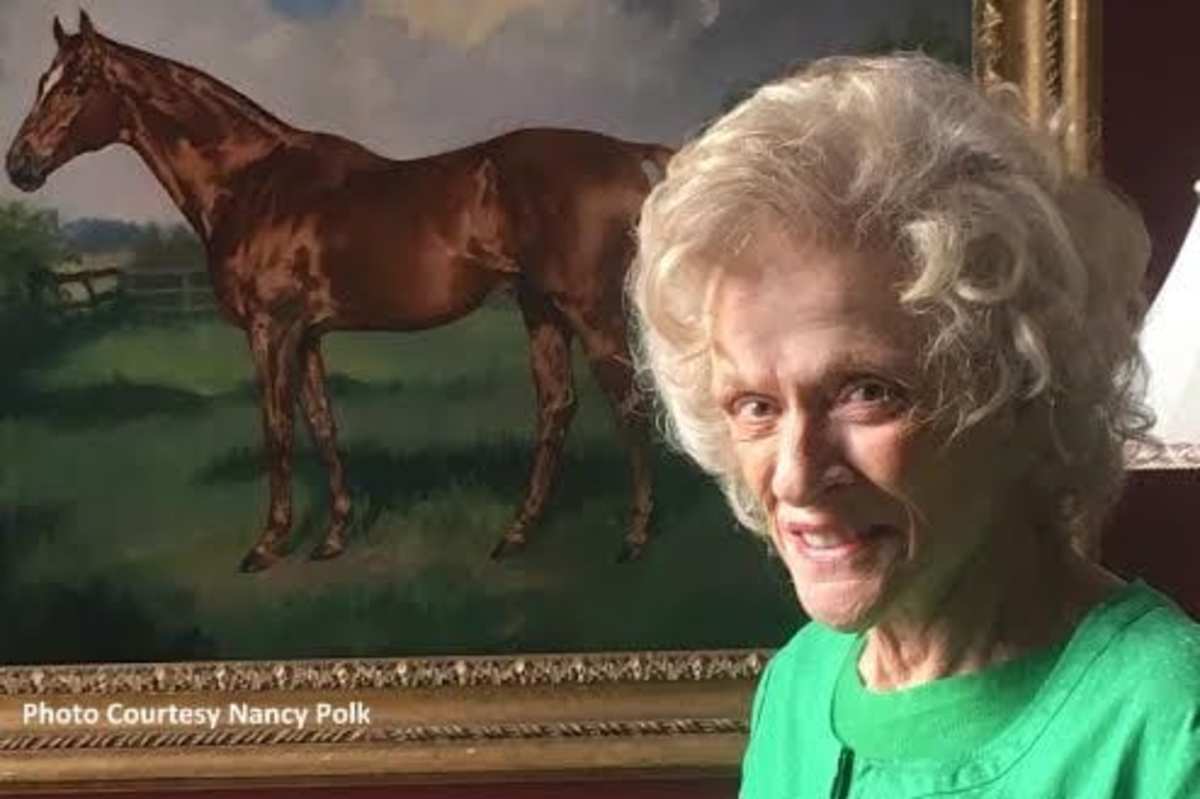
Normandy Farm owner Nancy Polk with a painting of Fair Play, sire of Man o' War.
The origins of the farmland that eventually made up Elmendorf date from at least 1871, when Milton H. Sanford established Preakness Stud on over 500 acres, naming the land for his horse, for whom the middle jewel of the Triple Crown takes its moniker.
Some local historians have suggested that land in the area had probably been previously used for horse breeding by members of Virginia's prominent Harrison family, who bought 1,900 acres in 1822 and named it Elk Hill before expanding to nearly 3,000 acres. Even before then, in 1804, Colonel Abraham Bird of Virginia started construction on what is Normandy's main house, called the Kenney House, which is one of the oldest brick houses in Kentucky.
Afterward, many others left their own marks on the farm's canvas.
Finding inspiration in the pastoral architecture in France, Widener began in 1927 to build the quaint Normandy barn that features a tower rising to a point not unlike an inverted ice cream cone.
His vision for the tower would later include the addition of a clock, so one was imported from a Normandy manufacturer. The clock arrived at the farm in 1935 in 18 hefty boxes bearing weights, pulleys, cogs, discs, and a 150-pound bell, as well as several cast-iron cats, birds, and other creatures to scatter on the barn's slate roof to ward off evil spirits in the French tradition and discourage birds from nesting.
When the clock was assembled, it rang twice on the hour, two minutes apart, a characteristic of Normandy clocks dating from medieval times.
Years later, after time had taken an inevitable toll, Polk lovingly restored the clock and repaired or replaced some of the barn's rooftop creatures.
Another prime attraction of the farm has been the equine cemetery, which has lured thousands of curious visitors over decades.
Widener bought Man o' War's sire, Fair Play, and dam, Mahubah, from the dispersal of horses owned by the estate of August Belmont in 1925.
[Story Continues Below]
Mahubah, bred to no other stallion but Fair Play, produced Man o' War in 1917 at Belmont's Nursery Stud. Winner of 20 of 21 starts he is widely regarded as America's greatest racehorse.
Fair Play was North America's leading sire of 1920, 1924 and 1927, and he also reigned as the leading broodmare sire of 1931, 1934 and 1938. He stood five years at Elmendorf before dying in his paddock in 1929. Mahubah followed in 1931. They were buried side by side at Elmendorf in the shadow of Fair Play's statue, erected at a cost of $100,000.
The cemetery also includes the graves of stallions Chance Shot, Haste, and *Sickle. Twice the leading sire, Sickle is perhaps best known as the great-grandsire of the phenomenal champion and top sire Native Dancer.
Although she did not maintain large numbers of horses after buying Normandy, Polk bred 2015 Breeders' Cup Turf Sprint winner Mongolian Saturday and millionaire stakes winner Daddys Lil Darling, who finished second in the 2017 Kentucky Oaks while carrying Normandy's green-and-white checkerboard silks. Both horses were bred from Polk's mare Miss Hot Salsa, whom she purchased for $100,000 at the 2003 Keeneland November sale.
Daddy's Lil Darling was eventually sold by Polk's estate for $3.5 million to Coolmore at the 2018 Fasig-Tipton November sale.
As part of her love affair with Normandy, Polk built a new 22-stall barn with stunning views, and the farm now includes six barns with 83 stalls. Other improvements she initiated included updates to the main house in 2017, while renovations to fences and other buildings have been completed over the past three years.
Three tenant homes and a carriage house, including the historic structure that once served as a watering hole for travelers between Lexington and Paris, complement the farm's main house, which, according to the real estate listing, “boasts grand opulence throughout.”
Polk often said she thought of herself as Normandy's caretaker, with her goal to leave it better than she found it so that the next owner will be well prepared to craft a new era in the saga of this Thoroughbred landmark.