Welcome to our annual assessment of Bluegrass sire prospects for the approaching covering season. As last year, we're going to confine our focus largely to a “Value Podium” for each intake–rather than attempt, as in the past, an exhaustive (not to say exhausting) assessment of every stallion in the Commonwealth of Kentucky.
Believe me, it wasn't always easy to find something adequately civil to say about every last one! But the fact is that this is only ever one person's opinion and, as such, a hopelessly subjective exercise. By restricting ourselves to three medalists, after a few general remarks and an honorable mention for a near-miss or two, we know that those overlooked–necessarily a large majority–are bound to include many sires who ultimately get their headlines where it really counts. (So we hope that nobody perceives any kind of slight that would not only be unintended but basically invisible!)
Every mating is different, after all. Your mare may be the wrong size or shape for the stallions we like; and, besides, we all know that a choice of mate must, for many people, be more about anticipating the market than anticipating genetic efficacy. The latter, sadly, tends to be rather a luxury when you require a stallion, first and foremost, to put bread on your table.
That's especially true, of course, regarding the group we start with today. The asphyxiating commercial window of opportunity for sires is unfair on everybody: on the stallions themselves, on the farms that stand them, and on the commercial breeders who feel they have no choice but to jump onto the next round of the freshman carousel. As we're always saying, the fault does not rest with the supply but with the demand.
Those directing investment at ringside claim that their only chance of landing on a top-class cover is to be ahead of the curve, before fees catapult beyond affordability. But we know that simply isn't true. For one thing, they hardly ever follow young stallions through as their fees and averages come down, pending a meaningful examination of their stock on the racetrack. And how many agents and managers, moreover, have sufficient courage of their convictions to buy their clients the stock of an apparently unfashionable stallion like Lookin At Lucky, for instance? Yet his record of achievement, punching miles above his fee, will remain far beyond the vast majority of those rookies annually launched with huge books at what will usually turn out to be a career-high fee.
We'll see whether a place can still be found for him at the other end of the spectrum, once we come to proven sires. But it's a sad state of affairs when hardly anyone today accepts the logic that there should be nothing more commercial than putting a winner under your mare.

Flightline | Sara Gordon
Regardless, today we start with a uniformly clean slate. To reiterate: we're not looking for the new stallion “most likely.” Of course, we send our compliments to anyone who can afford $200,000 to tap into the most blatant racetrack talent seen in a while. True, value is relative. Flightline (Tapit) himself, after all, was a seven-figure yearling who turned out to be cheap. Nothing automatically disqualifies the highest fee of the intake from being its best value. Perhaps Flightline will do a Frankel (GB), and become every bit as important an influence as his track career encourages you to hope–albeit to do that, obviously, his stock will have to move on from a template of six starts across three years in training.
Each to their own. Acknowledging that objectivity must be limited to the spirit of inquiry, and that subjectivity must kick in with the first breath of an answer, let's begin our quest for the most horse for your buck. And if we do happen to turn up another Not This Time to top the podium, we accept that it will again be more by luck than judgement!
Bubbling Under
The overall quality of the intake feels strong, perhaps the strongest in a few years. If one generational talent bestrides the cohort, there are several following him into a second career absolutely entitled to close the current gap in their stature.
I also feel that a number of farms have risen to the challenge laid down in recent years by the Spendthrift team, who have expertly converted the momentum of their pioneering incentive schemes to upgrade their recruitment. There must have been times when the opposition felt as though they were being left irretrievably behind. But while Spendthrift welcomes another four newcomers for 2023, the fresh blood at several farms will reassure breeders that the Bluegrass retains a healthy depth of competition.
Ashford, most conspicuously, has assembled as many as five new sires all of sufficient standard to be starting out between $25,000 and $45,000. Our pick of those will duly be found on the podium, but we must also acknowledge the sheer solidity offered by Epicenter (Not This Time). His brilliance is underpinned by some extremely sturdy European influences, such that he really offers something really quite different, and precious, to the American gene pool.
Gainesway, meanwhile, has looked to the future, with the great Tapit in the evening his career, offering a couple of contrasting but attractive new packages in Olympiad (Speightstown) and Drain The Clock (Maclean's Music). Really, there are quite a few farms that can take their new guys to market with deserved confidence. Strictly in terms of value, however, I feel that none has stepped up to the plate better than Airdrie.
With the emerging star Girvin arriving from Florida, the Airdrie team have added further momentum by pricing both their rookies to give their clients every chance.
The one who narrowly misses the podium is Highly Motivated, a can't-miss $7,500 son of Into Mischief with two track records to his name. A horse with this kind of profile, at this kind of price, would at some farms assuredly be loaded with over 200 mares. But that's not the Airdrie way–and those who can get to him are unlikely, therefore, to find themselves inundated by alternative stock once they get into a catalogue.
Highly Motivated was classy enough to run Essential Quality (Tapit) to a neck when stretching out for the GII Blue Grass S., but his unmistakable forte was Into Mischief speed, showcased by a 96 Beyer eclipsed only by Jackie's Warrior (Maclean's Music) among the juveniles of 2020. That secured Highly Motivated a Keeneland track record, while the one he added as a 4-year-old at Monmouth was wrested, after 37 years, from a Horse of the Year. His name was Spend A Buck, and that sounds like a pretty good plan with Highly Motivated.
BRONZE:
GREATEST HONOUR (Tapit-Tiffany's Honour by Street Cry {Ire})
$7,500 Spendthrift
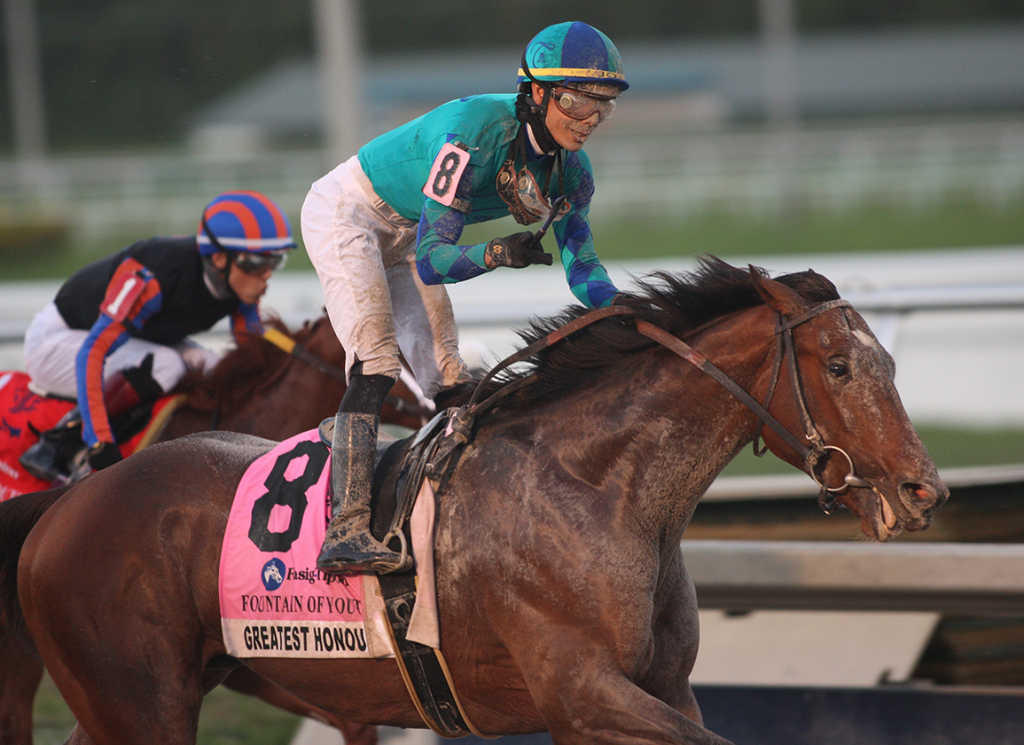
Greatest Honour wins the Fountain of Youth | Horsephotos
No denying that this guy's derailment from the 2021 Derby trail was made to seem a long time ago when he resurfaced to rather tame effect this spring. But his fee makes ample allowance for that, and if you just rewind to the unmistakable brilliance of his original emergence, then you can only be excited to have cut-price access to such a regal bloodline.
Second and fourth dams are both Broodmares of the Year, divided by a GI Kentucky Oaks winner, with the family seeded by distaff influences of corresponding stature: Street Cry (Ire), Deputy Minister and Blushing Groom (Fr). Greatest Honour's dam was admittedly one of the least distinguished runners in this family, but she's a half-sister to Rags To Riches (A.P. Indy), Jazil (Seeking The Gold) and Casino Drive (Mineshaft) (a successful freshman sire in Japan, by the way) out of the broodmare icon Better Than Honour.
And there was no doubting that this blood had told when Greatest Honour was a flourishing sophomore in Florida. Even his juvenile grounding had been of exceptional substance: he took four starts to break his maiden, but was learning his trade by consecutive bouts with Olympiad (Speightstown), Speaker's Corner (Street Sense) and Known Agenda (Curlin)! Sure enough, when he did win a maiden, it was by beating subsequent Grade II winner Dynamic One (Union Rags).
So he was scarcely raised in grade when romping in the GIII Holy Bull S.; and he then overwhelmed Drain The Clock (Maclean's Music) in the GII Fountain of Youth S. And while the speed figures measured up, the way he appeared to be hitting his stride only deep in the stretch made him look like a horse just getting started. I was stunned that he did not follow through in the GI Florida Derby, but he disappeared for a year and then never really retrieved the thread.
But I am definitely keeping the faith, at this price. After all, the template isn't dissimilar from his sire, who started out at a lower fee than anticipated after fulfilment of his potential had likewise been thwarted by physical issues.
Above all, Greatest Honour passes the ultimate test of pedigree depth. His fourth generation is saturated with genetic potentates (Weekend Surprise, Narrate, Moon Glitter, Coup De Folie, Best In Show) corroborated far more widely than simply by those sons or daughters that happen to put them on this particular page.
This aristocratic blood, harnessed to Spendthrift's dynamic commercial program, will presumably benefit from plenty of opportunity. I wouldn't be at all surprised if that were to result in one or two candidates to redress his own misfortune on the road to the Derby–and you can't say that of too many stallions at this kind of fee.
SILVER:
EARLY VOTING (Gun Runner-Amour d'Ete by Tiznow)
$25,000 Ashford

Early Voting (right) wins the G1 Preakness S. | Mathea Kelley
Hats off to the Klaravich program, which missed the podium by a cigarette paper with Highly Motivated while also reaching its second step with this fellow, in our view the outstanding value among Ashford's exciting new quintet.
The three Ps–physique, pedigree, performance–are all lavishly present and correct.
This is a knockout specimen and, while Gun Runner will become still more extraordinary if also proving an instant hit as sire of sires, the family tree brings its own guarantees in that regard. For Early Voting's dam is, of course, a sibling to one such in Speightstown (as well as to the very talented but ill-starred Irap).
Performance, admittedly, was vexingly confined to just half a dozen starts. But Early Voting followed up his debut success with a daylight score in the GIII Withers S. before being collared by a neck, in a duel of future Classic winners with Mo Donegal (Uncle Mo), in the GII Wood Memorial. He confirmed his place among the elite of his generation when holding off Epicenter (Not This Time) in the GI Preakness, only for his career to derail in Saratoga.
Sure, he was a fresher horse at Pimlico than his new studmate; and he also got first run. But Early Voting was arguably only in a position to do that by superior early speed and, regardless of which side of the quibbling fence you fall, they were plainly in the same vicinity in terms of talent. And the relative durability of Epicenter is amply measured by the difference in their fees.
In this slightly more accessible tier, you seldom find such quality through so many dimensions: looks, natural ability (won a Classic, remember, off three starts) and genes. What worked for Speightstown (first three dams by Storm Cat, Chieftain and Buckpasser) has obviously worked for his sister, too. She is of course by a deeper staying influence (Tiznow, as against Gone West) but Gun Runner has done his stuff to produce a very alert runner. Gun Runner himself, remember, is out of a Giant's Causeway mare, which not only doubles up Storm Cat but entwines his influence with that of his nemesis Tiznow.
These are all very wholesome brands, and just look at the four mares in Early Voting's third generation. Without exception, they've shown that there is more than one string to their genetic bow. From the top: Candy Girl (Arg) (Candy Stripes) is here as dam of Candy Ride (Arg), but is also third dam of Tom's D'Etat; Quiet Dance (Quiet American) is here as granddam of Gun Runner, but is also dam of Saint Liam; Tiznow's dam Cee's Song (Seattle Song) famously produced not just classy performers like Budroyale but also the dams of Paynter and Oxbow; and Silken Doll (Chieftain), as we've already seen, unites Speightstown and Irap as well Early Voting.
That's a pretty copper-bottomed array of repeatable genetic excellence and, combined with the physical and performance attributes he has placed in the foreground, makes me confident of this horse's eligibility to last the course.
GOLD:
HAPPY SAVER (Super Saver-Happy Week by Distorted Humor)
$12,500, Airdrie
If you don't give this horse a shot, at this kind of money, then I guess you don't really buy into the only principles that ever make sense of this chaotic industry of ours.
Okay, so he was not quite a champion. But only an elite talent, and a very natural one, could win the GI Jockey Club Gold Cup as an unbeaten 3-year-old making just his fourth start; and only a matching resilience could maintain him in maturity as benchmark, in three consecutive races earlier this year, for Olympiad (Speightstown), Flightline (Tapit) and Life Is Good (Into Mischief).
That trio, needless to say, are all starting out at much bigger fees. Maxfield (Street Sense), similarly, stands at $40,000 after being pushed all the way by Happy Saver in the GI Clark S. last year. But now they all resume with a clean slate and, in terms of his eligibility to prove a conduit of genetic quality, none is in a stronger position than Happy Saver. His third dam is Weekend Surprise herself; and standing directly opposite her, as damsire of Super Saver, is her son A.P. Indy.
Super Saver will concern some people, despite Runhappy and Letruska, but the key here is that he has produced a very good racehorse by combining one spectacular maternal line with another. His own extends through generations of Ogden Phipps bluebloods; and obviously Happy Saver's dam, herself a stakes sprinter, belongs to a family that has famously produced several other stallions besides A.P. Indy.
Sure enough, the pedigree overall is heavily seeded with the right brands. For instance, Super Saver's grandsire Wavering Monarch was out of a Buckpasser mare; Super Saver's celebrated fourth dam, Numbered Account, was by Buckpasser; and so, too, was Weekend Surprise's mother Lassie Dear. That's typical of what happens when families extend their quality back to the days of much smaller books. Access to a top-class stallion was a privilege, earned by blood or performance or both. The mares behind Happy Saver, as celebrities in their own right, have corresponding consorts: after his mother by Distorted Humor, the next four dams are by all-time distaff legends in Deputy Minister, Secretariat, Buckpasser and Sir Gaylord.
The quest for value in stallions is about seeking the potential to punch above their presumed weight. If stallions couldn't sometimes produce foals better than themselves, the breed would stagnate at best and mostly decline. And a stallion's ability to elevate his potency, relative to his track career, must lurk in his blood. Yes, you want to see evidence on the track of a functional vitality in his genetic make-up. Happy Saver gave us that in spades. But he has every right to surpass even that exalted standard in his next career.
Like many horses going to stud, for one or two reasons we didn't see his very best as he closed out. But he had previously been a set-your-clock campaigner at the highest level, moreover one blessed with real flair. If you rewind to the very beginning, for instance, he won a sprint on by 5 1/2 lengths on debut in essentially the same time as the GI Woody Stephens S. winner on the same card.
This, in other words, is a horse whose stock can someday make us grateful that “Happy” days are here again.
The Value Podium: New Sires
Gold: HAPPY SAVER Airdrie $12,500
An elite competitor with aristocratic pedigree at an accessible fee
Silver: EARLY VOTING Ashford $25,000
A pacey Classic winner out of Speightstown's half-sister
Bronze: GREATEST HONOUR Spendthrift $7,500
Another of royal blood and made a lasting impression early


The post Value Sires For 2023 – Part I: New Stallions appeared first on TDN | Thoroughbred Daily News | Horse Racing News, Results and Video | Thoroughbred Breeding and Auctions.
Source of original post
