“Twelve-thousand dollars going once…twice…SOLD!” It was the Keeneland November Sale and for the second time in a year I had to watch my big beautiful chestnut mare slip out of reach. The former black-type runner was vanned 2,100 miles away to her next venture as a broodmare prospect despite having previously failed to conceive.
Six years later, I would be paying that mare's bail from a Texas livestock yard after she failed to produce but one foal who has yet to race. A graded stakes-placed mare from humble beginnings with six-figure earnings was reduced to a whopping $1,500 valuation of literal horse flesh.
What happened to the funding and the programs designed to prevent this from happening? Where were the aftercare advocates? At the end of the day, I was the only one left–an average racing fan who became her advocate.
Let's start from the beginning.
I first met Ragdoll on the backside of Monmouth Park. She was a big-boned, imposing filly standing at 16.3 with a stellar physical. The kind of filly that makes you do a double-take because surely, she was actually a colt, but her delicate face and doe-eyed expression gave her away every time.
In the barn she was sweet natured and affectionate, willing to hang her head over the stall door eternally if you held it just so. I spent two summers doing just that.
On the track, her heavy legs lumbered beneath her and she lacked the turn of foot of her nimbler, light-boned counterparts. Eager to please, she came down the stretch like a freight train when asked and found herself rising up the ranks, even hitting the board in a pair of graded stakes. That was the end of us.
I knew our racetrack romance would end if she made black-type; she would be more valuable as a broodmare than anything else. My lofty hope of owning her when her racing career ended would never come to fruition. She was privately sold for $70,000 to a breeding farm in Kentucky.
A couple of years would pass and I had the opportunity to visit Ragdoll after reaching out to her new owners. They were kind enough to welcome me to the farm where I was able to soak in the expansive bluegrass hills she now called home. Despite my loss, I was genuinely happy this was her new life.
My visit coincided with the farm veterinarian doing follicle scans on the mares and I watched as the team gave a forlorn sigh after ultra-sounding Ragdoll. I learned she had not been successfully bred, not even a failed embryo. Nothing at all. She simply wouldn't take.
The Falstaff of their Shakespeare, I chimed in, “You know who to call if she needs a home!” but wished them the best as they continued their efforts.
After arriving back home, I followed up with the farm, offered my gratitude for the visit and (more professionally) reiterated my desire to purchase her if things didn't go their way.
As fate would have it, the next year I found myself down a similar path–trying to conceive a child with equally devastating results. I have never been so exhausted in my life; emotionally, physically, psychologically…I was running on empty in absolutely every capacity.
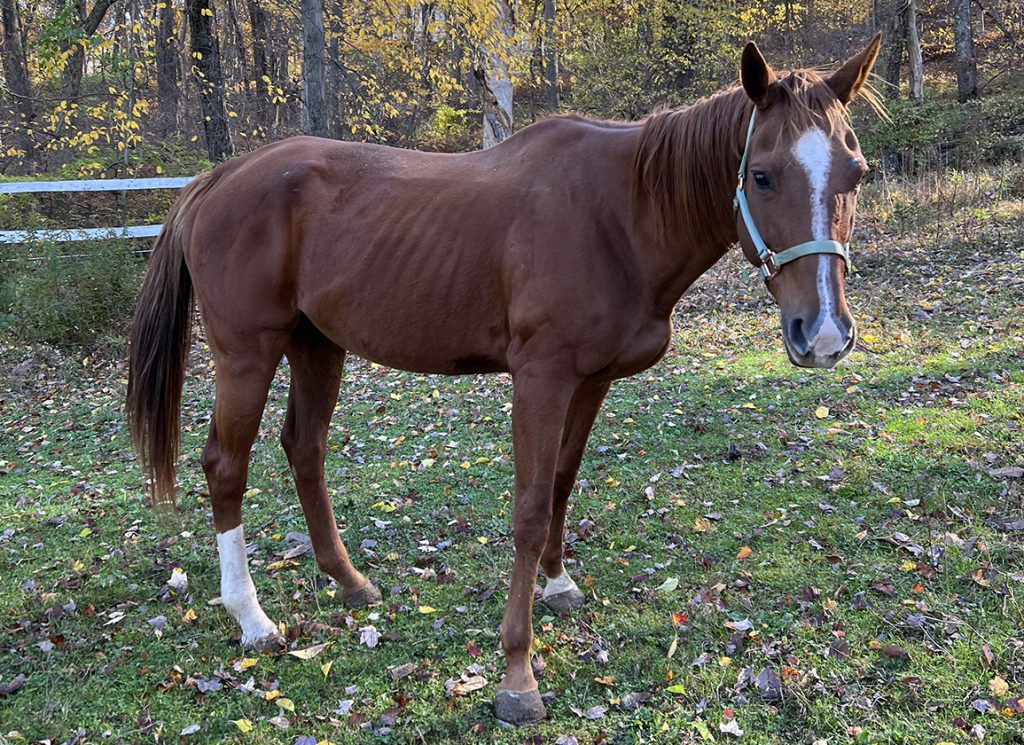
Ragdoll when she first returned home with Forbes in October | Nicole Forbes photo
Eager for a distraction, I decided to lookup Ragdoll on various online information systems and lo and behold, she was listed in the upcoming Keeneland November Breeding Stock Sale.
Shocked, I pulled up her catalog page and saw the big bold letters at the footer “believed to be NOT PREGNANT” after being covered by four different prominent stallions that year. My heart ached for her and the unexpected barren road we both found ourselves on. If this wasn't a sign (albeit a very sad, hormonally surged one) I don't know what is, but this time she was going to be mine.
I immediately applied for credit with Keeneland and was promptly, and rightfully, denied. My meager per-diem racing marketing gig left more of a jingle in my wallet than padding. I turned to my father-in-law, a former trainer and respected horseman who once owned a part of this very mare, and pleaded for guidance.
Wise and soft-spoken, he listened as I cried on the phone for longer than either of us expected before stating, “Well, sounds like this is something you need to do.”
We agreed on a maximum bid of $10,000. Ten thousand dollars that I did not have, but would walk the ends of the earth to repay him for.
“It's only money,” he said and repeated to me again and again as if it were a mantra. I scoffed– only money. But I leaned into like it was a life raft and…swam with it.
The gavel went down and the rest is history. I was outbid by $2,000. I had been so close.
Not shy of persistence, I emailed the purchasing agent within minutes of her sale and disclosed everything I knew of her breeding history; I'd save them the trouble and offered to buy her flat out. The gentleman politely declined and guaranteed me “she'd have a home for life” regardless of the outcome of her broodmare career.
He was right. She would have a home for life. But no thanks to him.
This past September I received a cryptic Facebook message from someone with whom I was unfamiliar. It included a link to a horse's profile from a livestock auction in Texas, a well-known hub of killer buyers, alerting me a former racehorse was in the slaughter pipeline and listed for sale by weight.
It was my chestnut mare. Ragdoll had reached the end of the line.
It took a dozen individuals–a complete stranger from social media, three Thoroughbred aftercare executives, two racing executives, a racing insider, a horse hauler from Oklahoma, two family members and a literal guardian angel to get this mare home.
All because a racing fan was her advocate.
Where were we? The industry that so relied on her to bolster their pocketbooks; the industry that should be behind each and every one of the Thoroughbreds that ends up in this scenario, of which there are plenty.
The system has failed.
We've been playing economic checkers for a century when we should have been playing chess. Excluding the upper echelon of racehorses, each horse is measured as a one-to-four-year commitment and turned over as such. In actuality, every Thoroughbred is a 25-year commitment. At minimum.
How the industry continues to rely on 501(c)(3)'s to pick up our failed promises is astonishing and yet in Atlassian fashion, they continue to hold the burden.
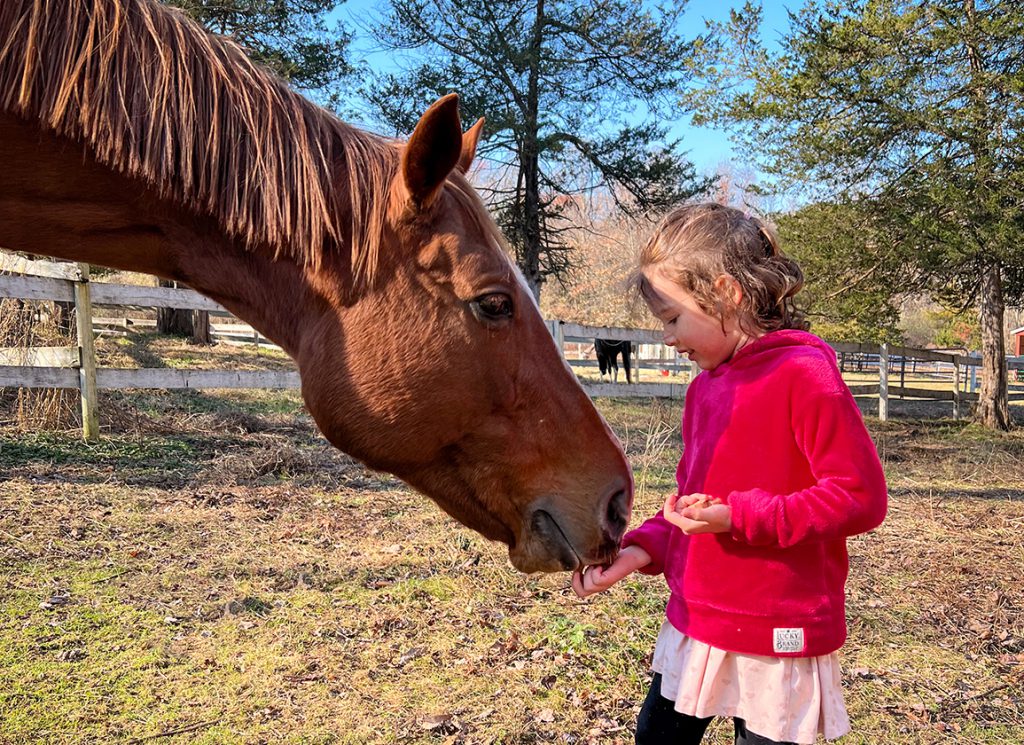
A happier, healthier Ragdoll bonding with Forbes's daughter Avery | Nicole Forbes photo
Grass-roots efforts have provided a lifeline for us (and an innovative one at that–a broodmare division at the Retired Racehorse Project's annual Thoroughbred Makeover, giving these mares the chance at a third career?! *applause*) but the truth of the matter is their efforts are not to scale and may never be. There simply aren't currently enough funds or enough farms to support the number of retired athletes of our sport.
Only very recently has the idea of a “lifetime guarantee” been spreading among noteworthy breeding farms and syndicates who have pledged to care for a horse for its entire life, whether that is by partnering with rehabilitation and retraining facilities or by permanently retiring the horse on their property. Something, I daresay, that strikes me as incandescently sad to be so novel.
As of late, there is also at least one racing entity (1/ST Racing) that has included aftercare liaison managers in their business model, and during our two-day Championship series, thousands is pledged to the flagship of aftercare and retraining that is New Vocations. It's progress.
But what about the other 363 days of the year? The other racing jurisdictions?
Some jurisdictions do give beyond the required race day “aftercare taxes” comprised of per-start fees and a miniscule percentage of handle (of which the legislation varies state to state and is extremely convoluted to say the least) but the fact it is unregulated and voluntary is problematic.
Ultimately though, it starts at the top. The economic model is not viable and is past due for a complete overhaul.
The per-start fees are not enough. The registration fees are not enough. Our big ticket donations made during racing's spotlight moments and fundraising in general are not enough.
I implore The Jockey Club, HISA, NTRA and any jurisdiction that oversees our Thoroughbred athletes to reconsider the fundamental economics of the racing industry and how best to build aftercare into the founding principles of our sport, instead of as an addendum.
Fans cannot be their only advocates.
To be frank, it might be too late. I'm honestly not sure if we can act fast enough on an industry-wide solution to eliminate this crisis. And crisis it is–no matter how neatly swept the room may seem, there's a mortuary under the rug.
For a sport whose marquee race owns the title of the “oldest continuously held sporting event in America,” how are we still in the starting gate when it comes to aftercare?
The post Op/Ed: The System Has Failed appeared first on TDN | Thoroughbred Daily News | Horse Racing News, Results and Video | Thoroughbred Breeding and Auctions.
