The History Of Five Card Stud Poker

Poker has a long and indistinct history. Some hold that it originated in Persia as it closely resembles a game called As Nas and may have been brought to the United States via Persian sailors in New Orleans. This game was played with 25 cards with 5 different suits. This game was played similarly to modern Five Card Stud with many of the hand combinations such as three of a kind. It seems likely that the name “Poker” descended from the French poque, which originally came from the German pochen, ‘to knock’.

The game was reportedly played in New Orleans around the late 1820’s, with a deck of 20 cards and players betting on the value of their hands. The earliest known form of Poker was played with a 20-card pack (A-K-Q-J-10) evenly dealt amongst four players. There was no draw, and bets are made on a narrow range of combinations: one pair, two pair, triplets, and ‘full’ – so called because it is the only combination in which all five cards are active – and four of a kind. Unlike classic Poker, in which the top hand (royal flush) can be tied in another suit, the original top hand consisting of four Aces, or four Kings and an Ace, was absolutely unbeatable. The spread of the game after this seems to have been facilitated by the practice of gambling on Mississippi riverboats.

Soon after this the deck was expanded to the present day 52 cards and the flush was introduced. The additional cards were introduced mostly to allow more players. The game was expanded and developed further during the Civil War, with many of the variants of the game being introduced then, including Five Card Stud. Poker was initially played with only one round of betting with all five cards dealt face down and no draw cards, very similar to today’s Five Card Stud game.

Professional gamblers later added variations and rule changes in order to increase the profitability of the game. Wild cards and bluffing became common occurrences and the draw was added around 1850, allowing yet another round of betting. Many of the features of modern Poker, such as the draw and some versions of different hands, as well as the straight and the flush originated in the earlier forms of the British game Brag or Bragg. Brag’s modern form differs greatly from modern day poker, however.

Keeneland Breeders’ Spotlight: An Apple From a Blooming Orchard

It was 2007: compared with a year or two later, not the best timing in terms of what was on the market and how much it would cost you. “And it was a little bigger than we wanted,” admits Larry Doyle. “But once we had the farm, well, we had to fill it.”

That might sound a bit cart-before-horse, as a strategy for repurposing 330 acres of cattle pasture for the rather more expensive models that nowadays graze KatieRich Farms outside Midway, Ky. But Doyle accepts that the Thoroughbred game is played to different rules to the one by which he made the money required.

“That's what I love about this business,” he says with a chuckle. “I make my money on Wall Street. But that's too easy. That's tic-tac-toe. This? This is hard, this is challenging. On Wall Street, you always look for that 20% return, year on year. Here, people try to improve on a 30% negative return. So it's always something to weigh. But sometimes you're a lot better off being a riverboat gambler than an accountant or financier!”

It was as a born “numbers guy” that Doyle was first intrigued by the handicapping side of the Turf, fatefully led astray by his older brother when growing up in Babylon, Long Island. But when the first horse race you ever see happens to be the 1973 Belmont S., then there will always be unquantifiable elements in the equation. All Doyle knows is that he's still paying his dues, and enjoying every minute.

And if Secretariat was hardly a representative introduction to the game, then nor was the first yearling Doyle bought, who won a stakes. “They put the needle in my arm quite early!” Doyle says. “It was easy, right? No way back after a start like that.”

Remarkably, things quickly became better yet–and that's why we're talking, a couple of decades later, on the eve of the Breeders' Cup. Because the KatieRich homebred American Apple (American Pharoah), who lines up for the GI Juvenile Turf Sprint on Friday, is a daughter of only the third horse Doyle ever purchased. Whatever she can do at the adjacent racetrack, moreover, she's already highly eligible–as winner of the GIII Matron S. and half-sister to a GI Kentucky Oaks-placed millionaire–to improve the balance sheet when offered as hip 234 in the Keeneland November Sale, just a couple of days later.

American Apple's dam Miss Mary Apples (Clever Trick) was bought in the same ring in 2001, with Doyle's buddy Chris Connors, for $37,000 at the September Sale.

“She was just a gorgeous yearling in Book 5,” Doyle recalls. “When she won on debut at Keeneland, she went off favorite and that was just on looks. Then she went up for the Fashion S., where against the track bias she ran down a big Lukas filly and lost by a head. And then we took her up to the [GII] Schuylerville and again ran a close second. The money they were throwing at us then was just crazy. I remember talking to a bloodstock agent about the offer and he goes, 'Kid, 11 times out of 10, you take that deal.'”

Ah, yes, but remember that the numbers guy was using a different abacus for the ponies. The Schuylerville winner dropped dead a week later, after all, apparently clearing a path for Miss Mary Apples in the GI Spinaway S.

“Unfortunately she came up with a throat problem that needed a surgery,” Doyle recalls. “So maybe not taking the money looked a bad deal then. But she came back the next year, placed in a few stakes, and then just became a very productive mare. She threw off 11 winners, plus one filly that didn't win but went on to produce [GISP] Parlor (Lonhro {Aus}). Miss Mary Apples was a great mother, very protective, and we only lost her last year three months after she delivered American Apple.”

And nor did she protect only her foals. Though KatieRich is always striving to make commercial sense, this mare simply didn't produce commercial foals. Time after time, that proved a win in the longer game.

“We got her pregnant to Empire Maker, $100,000 stud fee,” Doyle recalls. “We put her filly through the sale, she didn't make $85,000, so we brought her back. That was Miss Red Delicious: she won stakes herself, her daughter [Nootka Sound (Lonhro {Aus})] won a graded stakes, and another one Zapple (Ghostzapper) won her debut by nine lengths this summer. Then Miss Mary Apples had a filly by Curlin, another $100,000 stud fee. But she was small, didn't bring $75,000. So we brought her home, too, and that was Lady Apple. Won a million and sold for $1.2 million. Any time we tried to sell something out of that mare, they just didn't look precocious enough. But then they would blossom.”

By the time American Apple came along, then, the lesson had been thoroughly absorbed. She was never put through the ring at all.

“She'd only have been weaned three months, she was immature, she had a pot belly,” Doyle reasons. “So we ended up holding on to her–and here we are at the Breeders' Cup. She's always been brilliant in the morning. Gerardo [Corrales, jockey] told us in early March, 'This is my Breeders' Cup horse.' And we were laughing at him.”

The real thrill about the whole ride, with this filly, has been the early boost to the career of the program's 28-year-old trainer Daniel Leitch, who took over when Mark Hubley–who goes back a long way with Doyle and his brother, and indeed trained Miss Mary Apples–stepped back into the role of managing consultant only a year or so ago.

“Danny's been with us since he was working weekends at 15,” Doyle's wife Karen notes. “And he's always been the same, even now he stops at the barns after training in the morning to see if he can help out in any way. We were so happy for him when she won the Matron, I still get chills thinking about it.”

“Yes, he's just a solid, solid citizen,” agrees Doyle. “Always a helping hand, great personality, always upbeat. His confidence in this horse has never wavered. I'm 64, I've been around a bit longer, and I would say, 'All right, kid, we'll see. And he's like, 'We've got this!'”

After a couple of starts on dirt and a two-turn experiment on grass, American Apple won a valuable sprint maiden at Kentucky Downs.

“We had no reason not to believe that she'd run on dirt,” Doyle reflects. “I just think she needs a pace to close into. She has this burst of speed, that's why she's better suited to grass. We still think she can run long, but going short is just the way the races have played out for us. After she won at Kentucky Downs, we opened the condition book and there was only one place to go; and then it was the same after we shipped to New York and won up there. She's made the choices for us, really.”

American Apple | Horsephotos

The tougher choice, naturally, was to put her into the sale. But those numbers do have to stack up a little.

“This is just hedging,” Doyle says. “I'm a trader. A horse isn't worth what you think it's worth. It's worth what they pay you. But if you don't do it, you'll pay. And if you do, you can get rewarded. Remember, I have three half-sisters. We have stakes-winning daughters of the sisters. So the family is going to be well represented [in the program], and her mother's legacy is going to live on for many years.”

Zapple is another already promising to contribute. After her dazzling debut she tried stakes company, but came out with a few cuts and has been recuperating on the farm. She'll be resuming soon, and overall KatieRich–named for the Doyles' two children–appears to be evolving with persuasive energy: these days there's a sales prep division, there's training and pre-training, there's constant upgrading of stock.

“I think we're looking for different types of mares, to breed more two-turn horses,” Doyle reflects. “But basically we just want to keep learning, to get a better and better product out there. At the age I am, probably I'd be looking to breed to race a bit more, going forward. I think we've got some nice foundation mares. In terms of numbers, we're up a little high at 33, so we actually have nine going into the sale. But meanwhile we're keeping daughters, we're breeding them to nice sires, it's just time to look down the road a little bit.”

One intriguing measure of that perspective is that Doyle elected to retain an Uncle Mo colt–out of the Phipps mare Enhancing (Forestry), and therefore a half-brother to farm graduate Instilled Regard (Arch)–as a $475,000 RNA at the September Sale.

“I think that's a potential sire,” he explains. “Though it was me really stepping out, for a big colt, because it's selling those horses that pays the bills. But right now I feel let's take a shot with this one, and see how we go.”

Karen adds with a laugh that she was not present on that occasion to restrain her husband, and “didn't hear from him for two days after, either!”

But Doyle has been at the game long enough now to make calculations of this kind.

“My brother Jimmy owned a piece of a horse with Mark maybe as long ago as 1983, and I went in a few years later, in 1992,” he recalls. “I had no right to own a horse in those days. But I started the first internet mutual fund, and after that took off around 1999, 2000, I was able to go back to what I had seen years before, when I got an entry-level job with Thomas Mellon Evans on Park Avenue. He bred Pleasant Colony, and I got to meet with his bookkeeper and learn a bit more about ownership. He was very big into getting good mares. I didn't have the money then, to put it to use, but I was learning a lot.”

The physical imprint of the farm over the past 15 years, under Robert “Elmo” Richardson, has reflected conspicuous flair and ambition. But the real bedrock, not least given that the Doyles still spend much of their time in New York, is the caliber of the people.

“I had a very experienced horsewoman come to the farm, helping out for a while,” Doyle says. “And she was saying, 'Oh my God how do you get these people?' Everything's working well: you drop anybody in, they know how it works. We now have another very gifted young horseman in [farm president] George Barnes: he and Danny are working very well together, and that's so nice to see. And that has all been Mark and [farm manager] Tammy Ingebritson, it really has: they're the whole foundation of this farm. They have helped me to do this without mistakes, to have enough good sales along the way. That way we hope we can stick around and hopefully someday get a big horse.”

Who's counting? The numbers guy, that's who. Hence this filly being up for sale. But it's not just about the bottom line: he's counting on people, and on the intangible magic of the Thoroughbred.

The post Keeneland Breeders’ Spotlight: An Apple From a Blooming Orchard appeared first on TDN | Thoroughbred Daily News | Horse Racing News, Results and Video | Thoroughbred Breeding and Auctions.

Source of original post
Breeders’ Cup Classic Notes: Happy Saver Misses Wednesday Training With Quarter Crack

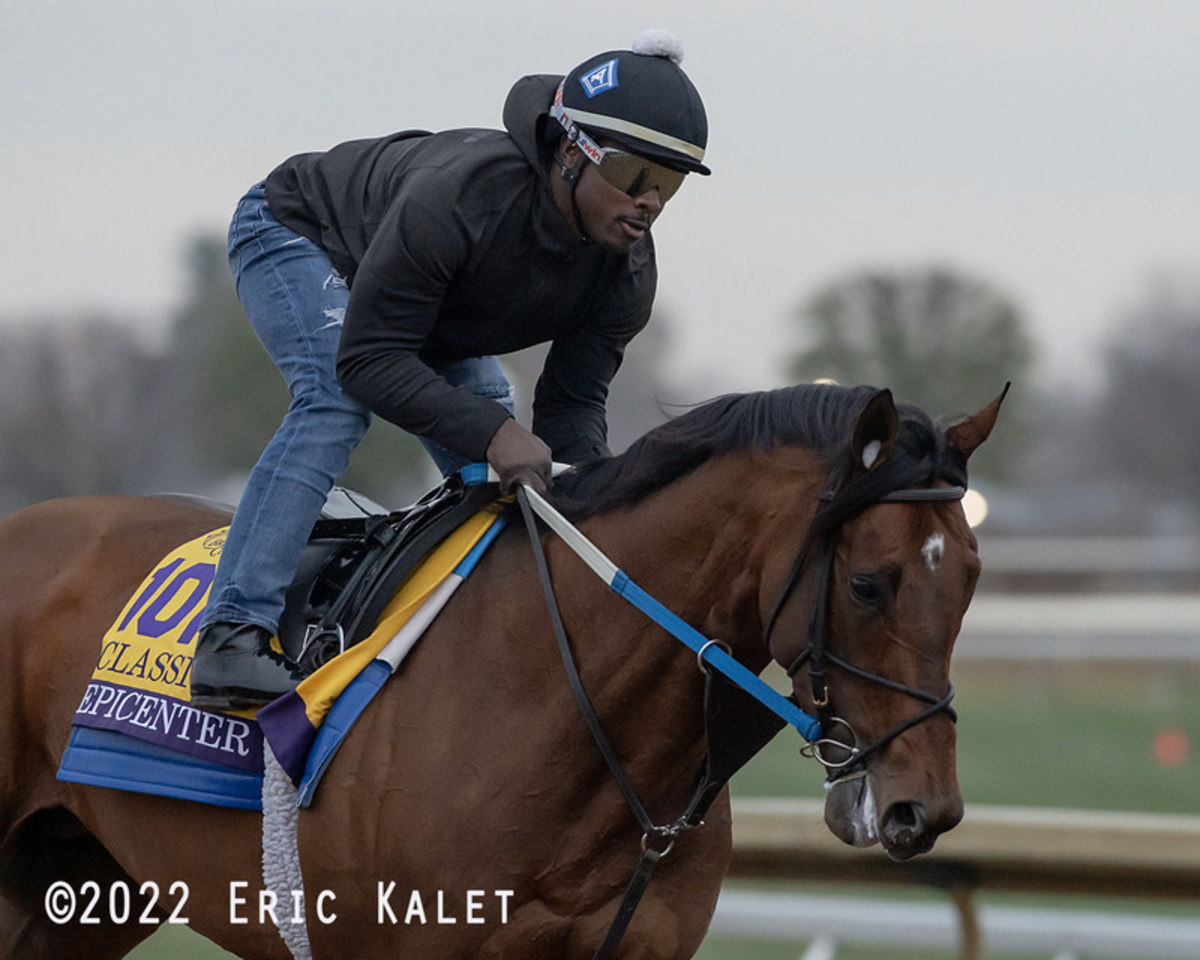
Epicenter – Winchell Thoroughbreds' Epicenter continued to impress in his gallops as he went out shortly after 8 a.m. on Wednesday at Keeneland. The 3-year-old went 1 1/2 miles under regular exercise rider Roberto Howell.

“He's just a fabulous horse,” said trainer Steve Asmussen, who is seeking a third Longines Breeders' Cup Classic victory. “I really love how he's physically matured throughout the year. It's a tough running of the race. It's easily the best race he's ever been in, but his confidence level is where you would want it. He's training beautifully.”

Epicenter gallops at Keeneland on Nov. 2, 2022

Flightline – Hronis Racing, Summer Wind Equine, West Point Thoroughbreds, Siena Farm and Woodford Racing's Flightline again was one of the first horses on the track Wednesday morning, galloping 1 1/4 miles with regular morning partner Juan Levya aboard.

Leyva, who is one of 18 riders to have won a Breeders' Cup race with his first mount, has been with Flightline since he arrived in the barn save for three weeks when he was with trainer John Sadler's horses at Oaklawn Park.

So, what was it like getting on Flightline for the first time?

“Best horse I ever sat on,” Leyva said.

And riding that “best horse”?

“I can't describe it,” Leyva said. “There is a certain amount of pride that they entrust you with this kind of horse.”

Ironically, every morning that Flightline goes to the track there are some early departures from the runway across U.S. 60 at Blue Grass Airport.

“I tell him to chill out,” Leyva said with a big grin. “You don't have to take off yet!”

November 01, 2022: Flightline, trained by John W. Sadler, exercises in preparation for the Longines Breeders' Cup Classic at Keeneland in Lexington, Kentucky on November 01, 2022. Evers/Eclipse Sportswire/Breeders' Cup

Happy Saver/Life Is Good – Wertheimer and Frere's Happy Saver did not train Wednesday morning because of a quarter crack in his left hind foot. The crack will be patched today and trainer Todd Pletcher hopes to make Saturday's Classic.

Meanwhile, CHC Inc. and WinStar Farm's Life Is Good visited the starting gate and then galloped 1 1/2m with Amelia Green aboard.

Pletcher said the gate schooling was normal operating procedure with Life Is Good not having any issues at the gate in the past.

Life Is Good is scheduled to school in the paddock Thursday.

November 1, 2022: Life Is Good, trained by Todd A. Pletcher, exercises in preparation for the Longines Breeders' Cup Classic at Keeneland Race Course in Lexington, Kentucky on November 1, 2022. John Voorhees/Eclipse Sportswire/Breeders Cup

Hot Rod Charlie – It was a routine 1 1/8 m gallop for Longines Classic contender Hot Rod Charlie on Wednesday morning under exercise rider Connor Murray as the colt prepares for his third Breeders' Cup start on Saturday. Owned by Roadrunner Racing, Boat Racing, Gainesway Stable and Strauss Bros Racing, Hot Rod Charlie's only other start at Keeneland was a second-place finish in the 2020 TVG Juvenile at odds of 94-1 for trainer Doug O'Neill.

“I think you're seeing a taller, more filled out version now,” O'Neill said. “He just continues to be so competitive, and he brings it every time. I think the biggest change from what we saw a couple of years back (when he ran in the 2020 Juvenile) is just a taller, bigger version of himself who continues to try just as hard every time we run him.”

Tyler Gaffalione, who has the mount Saturday, also rode the colt in the Breeders' Cup in 2020.

“He's grown up a lot (since the 2020 Juvenile),” Gaffalione said. “He's much bigger, much more powerful and much more mature. Right now it seems like he's the complete package.”

O'Neill will be looking to capture his first Longines Classic win and add to his five previous Breeders' Cup wins this weekend.

November 1, 2022: Hot Rod Charlie, trained by Doug F. O'Neill, exercises in preparation for the Longines Breeders' Cup Classic at Keeneland Race Course in Lexington, Kentucky on November 1, 2022. Carolyn Simancik/Eclipse Sportswire/Breeders Cup

Olympiad – Grandview Equine, Cheyenne Stables and LNJ Foxwoods' Olympiad had an easy gallop Wednesday morning with veteran rider Neil Poznansky aboard. The $700,000 Keeneland September 2019 purchase has been patiently managed by trainer Bill Mott, including a 364-day layoff between his 2yo and 3yo campaigns. He has earned $2,007,560 from 12 starts, including victories in five of his past six efforts.

“If you've got a nice horse and want to give them a career, you've got to be patient,” Mott said. “You have to watch and observe and if you think they have issues that need to be taken care of early on. Fortunately, with him, we had some baby issues and gave him the time and he's repaid us for it.

“Everybody wants a (Kentucky) Derby winner and I have got one in the barn right now that we can start prepping in the spring for it, but the reality is that there's only 20 horses going into that gate out of 20,000 foals born, so not everybody can do it,” Mott concluded. “A lot can't make it for one reason or another, some aren't good enough and some aren't ready for it, but if you get one that's good enough and ready, let's go.”

November 1, 2022: Olympiad, trained by William I. Mott, exercises in preparation for the Longines Breeders' Cup Classic at Keeneland Race Course in Lexington, Kentucky on November 1, 2022. John Voorhees/Eclipse Sportswire/Breeders Cup

Rich Strike – RED TR Racing's Rich Strike galloped 1 1/2m with Gabriel Lagunes aboard before 6:30 Wednesday morning.

“He was wicked strong this morning,” trainer Eric Reed said. “The difference between before the (Kentucky) Derby and now is that he can control that wicked strong. He knows what he's doing out there.”

Lagunes came back to Lexington after riding six horses Tuesday night at Mountaineer Casino Racetrack and Resort in New Cumberland, West Virginia.

“That's dedication right there,” Reed said. “I was going to get him a helicopter but I couldn't get one.”

Lagunes, who won one race Tuesday and was to make the 6 ½-hour drive back tonight for six more mounts, said he got back to Lexington at 3 a.m. this morning.

“I drove part of the way and my girlfriend drove the rest and I slept,” Lagunes said. “We win Saturday, I'm going to get a plane.”

November 2, 2022: Rich Strike, trained by Eric R. Reed, exercises in preparation for the Longines Breeders' Cup Classic at Keeneland Race Course in Lexington, Kentucky on November 2, 2022. John Voorhees/Eclipse Sportswire/Breeders Cup

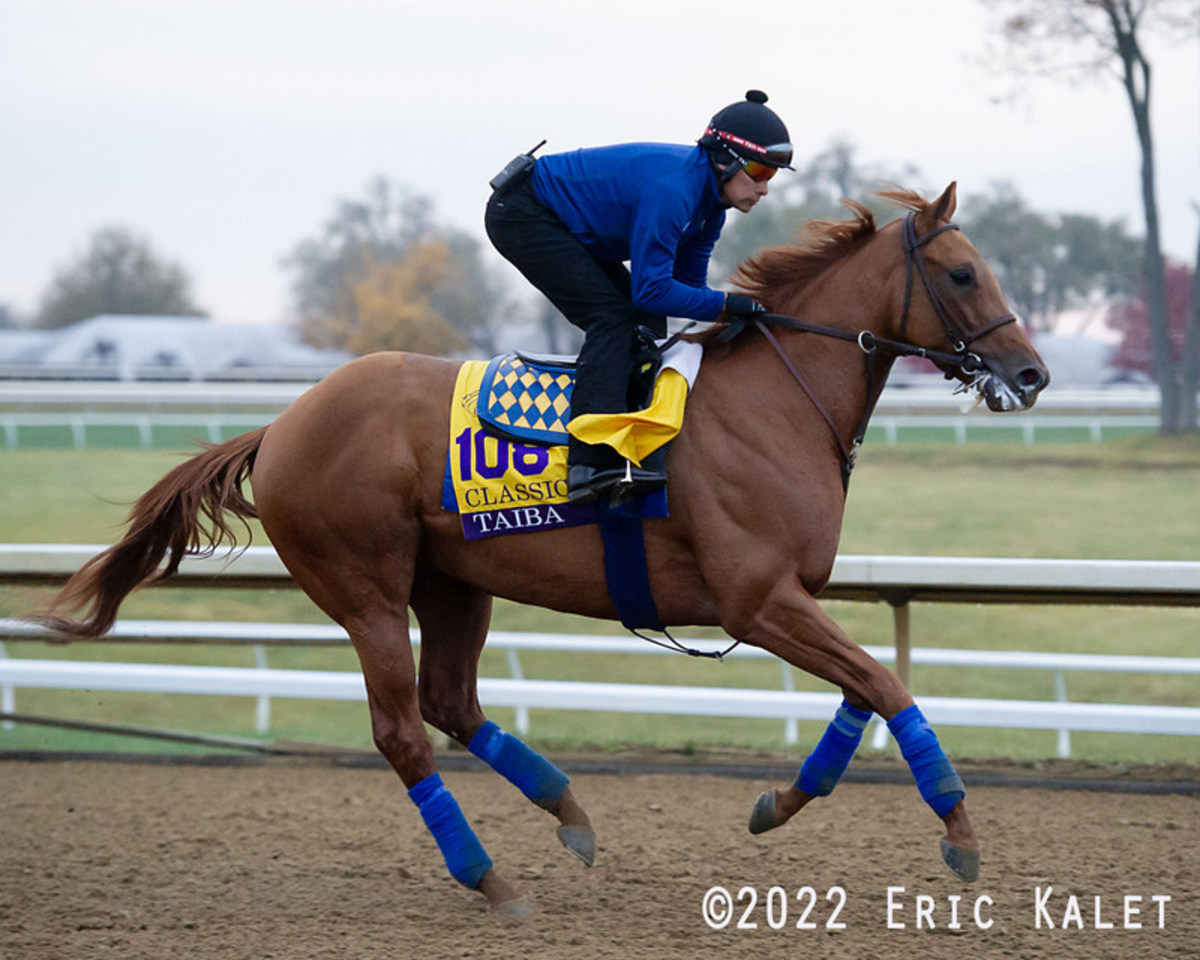
Taiba – Zedan Racing Stables Inc.'s Breeders' Cup Classic contender Taiba had a busy Wednesday morning at Keeneland. The chestnut Gun Runner colt galloped on the main track shortly after it reopened at 8 a.m. and schooled in the paddock at 10:30.

The two-time Grade 1 winner trained by Hall of Famer Bob Baffert will face older horses for the first time in the Classic. The race is headlined by the unbeaten John Sadler-trained Fightline, who was rated at 3-5 on the morning line. Taiba and jockey Mike Smith drew the rail and are 8-1 on the morning line.

Baffert is based at Santa Anita Park and said he has paid close attention as Flightline has emerged as the leading horse in the country. He was so impressed, he said, that he decided to skip the Classic and prepared Juddmonte's Laurel River for the Big Ass Fans Dirt Mile (G1).

“I love watching him work. I'm out there and I've seen all of his works,” Baffert said. “John and I sit up there in the same area and we watch the way he does everything. He's very aggressive. Horses like that are very easy to get ready.”

Baffert has a record four wins in the Classic. He put together a back-to-back-to-back run starting with Bayern in 2014. At Keeneland in 2015, Triple Crown winner American Pharoah concluded his brilliant career with an impressive victory. Arrogate completed the hat trick in 2016 and Authentic picked up the fourth Baffert win in 2020. This year, Baffert finds himself sending out an accomplished horse against a superstar.

“I know how people felt when they ran against American Pharoah,” Baffert said. “I know what they felt like because he's Pharoah at 4. He just moves like him. He's an extraordinary horse. He just moves over the ground and when he takes off he just takes off. The thing is that the only way a horse like that gets beat is just racing luck. Racing luck can get them all beat.”

However, Baffert said he was not predicting Taiba was poised to spring an upset against Flightline.

“Coming in here it's like I'm not thinking that I might go up there…” he said, leaving a few words unspoken and setting up the rest of his thought. “Some of these horses I feel I have a really good chance of winning with, but him with him I'm just thinking if I could run second or third.”

In his most recent start, Taiba won the Pennsylvania Derby by 3 lengths on Sept. 24. He has been most effective when he has been able to sit a stalking trip and take on the competition in the stretch.

“He ended up in the one-hole, but he probably would have ended up in the inside anyway,” Baffert said. “Taiba, he breaks really well. He breaks like he's going to go to the lead and then all of a sudden he sort of falls back. He likes to run at a target and I just hope he can see his target.”

Taiba gallops at Keeneland on Nov. 2, 2022

The post Breeders’ Cup Classic Notes: Happy Saver Misses Wednesday Training With Quarter Crack appeared first on Horse Racing News | Paulick Report.

Source of original post

HISA Timetable Outlined at Breeders’ Cup Press Conference

As the Breeders' Cup is on the cusp of running its two-day championships for the first time under the regulations of the Horseracing Integrity and Safety Authority (HISA)'s Racetrack Safety Program, and with the roll-out of HISA's Anti-Doping and Medication Control rules expected to be implemented in under two months, HISA chief executive officer Lisa Lazarus detailed a timetable for industry stakeholders at a Keeneland press conference Wednesday morning.

“January 1 will not only be the start of the year, it will be the beginning of a new era in racing,” Lazarus said. “For the first time we will have all 28 or so jurisdictions that run Thoroughbred races operating under one set of uniform anti-doping rules.

“The most critical points to be aware of [are that] every single sample will be analyzed for the exact same substances across every jurisdiction. We are working with the laboratories to make sure that they're all reporting positive results at the same levels. So, you know, it's one thing to have uniform rules. But having uniform implementation is really important to make sure you have a generally uniform system.

“This is what everyone's been waiting for. And we're going to be able to deliver that on Jan. 1. There are 14 states that are racing Jan. 1, and the Horseracing Integrity and Welfare Unit (HIWU) is very, very deep in preparations to deliver that program,” Lazarus said.

HIWU is the entity that will operate HISA's anti-doping program. Lazarus explained that HISA creates the rules HIWU will enforce, and that those  rules first have to be approved by the Federal Trade Commission (FTC). Lazarus said she expects that to happen “in short order.”

According to the FTC, the public commentary period for those new rules ends on Nov. 14.

“What's great about [this regulatory framework] is that you have genuine independence, impartiality, across all of the states,” Lazarus said. “You have consistent enforcement, consistent adjudication. You'll see that cases will be decided quickly. It will be a lot quicker than you're used to. They'll be decided through an arbitration system, and an appeal system through the FTC process, not in state courts. And the importance of that uniformity, we really believe is going to be a game-changer for horse racing.

“It's important, obviously, as we enter into this era that we have cooperation from the states, from the racetracks,” Lazarus continued. “And I'll say that since we've gotten started with the Racetrack Safety Program, that cooperation has gotten better and better every day. Understandably, anything completely new and sort of transformational takes some time, and takes kind of fixing a little bit of trial and error.”

HIWU executive director Ben Mosier noted that “HIWU will maintain its own investigations team, and we hope to also work with state racing commissions and others that can help us with 'boots on the ground' and investigations in live settings. We will also be establishing a tip line for whistleblowers, starting Jan. 1, and it will be a great for information to be shared with us for possible anti-doping and controlled medication concerns.

The post HISA Timetable Outlined at Breeders’ Cup Press Conference appeared first on TDN | Thoroughbred Daily News | Horse Racing News, Results and Video | Thoroughbred Breeding and Auctions.

Source of original post

Verified by MonsterInsights