On Saturday at Parx Racing, 11 talented 3-year-old Thoroughbreds will square off going 1 1/8 miles in the $1 million, Grade 1 Pennsylvania Derby.
Month: September 2022
A Farrier’s Intervention
Curtis Burns is passionate about horses. Like many in the horse industry, he credits the horse for everything that he has. A lifelong horseman, he grew up in the Minnesota, noting his then small stature had him poised to be an exercise rider or jockey prospect. However, at around age 14 a chance opportunity led him to the racetrack.
“Pretty much from there I never went home,” he said.
Burns now wears many hats–farrier, innovator, teacher, and the manufacturer of the Polyflex Shoe and other farrier products. He told the TDN he was willing to step out of the shadows of the backside to lend a voice to ongoing concerns he has fielded in recent weeks from multiple farriers from several jurisdictions about one of the new Horseracing Integrity and Safety Act (HISA) regulations.
Burns shared photos of recently removed horseshoes provided to him by farrier Gary Gullo highlighting the severely compromised integrity of front shoes lacking extra toe, in accordance with HISA rules. Burns explained that the issue was popping up at tracks where the horses traverse the backstretch on pavement or macadam, which was leading to severe wear in the front of the shoe. He said that without the extra toe, the realities of maintaining the aluminum shoes' integrity is proving challenging.
Additionally, reports include observations of abnormal dorsal hoof wall wear, with some back to the white line, which is not good for Thoroughbreds, who are famously thin-walled and sensitive.
Queen XT horseshoes–widely worn until the new regulations came into effect–offer a hardened steel toe piece extending two millimeters above the aluminum, acting as an additional durable layer for the aluminum plate when coarse surfaces are encountered.
“We are just about a month in a half into the new rules,” said Burns. “We are not seeing the problem everywhere. However, the Queen XTs, with a hardened steel strip on the toe no more than the width of quarter, eliminates the aluminum wearing away with each foot fall. Honestly, I wasn't overly concerned when the initial rules came out, however, some of the shoes are wearing significantly.”
Burns said that he was a staunch HISA supporter, noting that during his years of travel around the country, “I struggled a lot just getting licenses and with the differing regulations. I often thought, 'why in the world are we not able to get a uniform license, we are all doing the same thing?'”
Burns indicated he was optimistic for HISA's mandate and future, and hopeful that HISA regulations will level the playing field. However, he also added his hope that HISA would reevaluate the shoeing rules in light of this new evidence and allow for the use of Queen XTs.
By design, he said, having the additional steel better maintains the integrity of the soft metal aluminum toe, offering better resistance to the abrasive surfaces horses encounter at some backside stabling areas.
Burns also reinforced the need to change certain vocabulary, clearly defining what should be considered a 'traction device.'
“It's not a traction device,” he said. “It's a wear plate. All we are asking for is the Queen XT, which eliminates the wear problems that we are starting to see. Most of the top barns have generally always used these. If they would have just said Queen XTs all the way around, I wouldn't have thought that much of it the new HISA rulings. I didn't see how that would be detrimental to the horse.”
Burns said that the unusual wear pattern he described has also created issues for trainers who are forced to “short cycle” the normal four-week interval for shoeing to avoid the potential for injury or catastrophic consequences caused by the shoe's deteriorating integrity. With a shortened shoeing cycle, farriers are faced with limited amounts of hoof to trim, as well as an additional possibility that the hoof wall will be further compromised with additional nailing. Additional consequences of the shortened shoeing cycle include the further cost outlays for trainers, owners, and farriers.
Burns said that he hoped that HISA would consider these findings and further contemplate an amendment with an allowance for the usage of a wear plate up front. He noted the organization's willingness to amend a shoeing rule to allow for traction devices to be used behind after reports of slippage due to a lack of traction behind, the source of the horse's power.
When asked to comment, HISA offered the following statement: “HISA's shoeing rules were created and refined in collaboration with horsemen, and HISA will continue to listen to feedback from farriers and other experts as we implement HISA's rules. The rules were drafted with equine safety and welfare as the top priority above all else. HISA's decisions have been consistently rooted in research, and as additional research continues to emerge, HISA will ensure its policies are always grounded in the latest science. HISA also continues to work directly with manufacturers to ensure they are producing shoes that comply with HISA's rules and prioritize equine safety.”
The post A Farrier’s Intervention appeared first on TDN | Thoroughbred Daily News | Horse Racing News, Results and Video | Thoroughbred Breeding and Auctions.
Multiple Graded Stakes Winner, $3.65 Million Purchase Cezanne Euthanized Over Fungal Infection
The Thoroughbred Daily News reports that multiple graded stakes winner and $3.6 million 2-year-old purchase Cezanne has been euthanized due to a fungal infection. Owned by Mrs. John Magnier, Michael Tabor, Derrick Smith, and St. Elias Stable, Cezanne was trained by Bob Baffert to win both the Grade 2 San Carlos Stakes and the G3 Oaklawn Mile.
A 5-year-old son of Curlin, Cezanne had been transferred to the barn of Todd Pletcher when the infection was discovered.
“Cezanne developed a fungal infection in June and was sent to a clinic for treatment as soon as the infection was discovered,” Pletcher told TDN. “He recovered well initially, but sadly, the infection returned. He was admitted to Hagyard Medical, where he underwent another intensive course of treatment. Unfortunately, the infection took over, his condition deteriorated, and upon veterinary advice, it was deemed necessary to euthanize him.”
Out of the Bernardini mare Achieving, Cezanne is from the family of Belmont Stakes winner Rags to Riches. He was a $3.65 million 2-year-old purchase at the Fasig-Tipton Florida Select sale. A four-time winner from seven career starts, Cezanne earned $347,000 on the racetrack.
Read more at the Thoroughbred Daily News.
The post Multiple Graded Stakes Winner, $3.65 Million Purchase Cezanne Euthanized Over Fungal Infection appeared first on Horse Racing News | Paulick Report.
View From The Eighth Pole: Marriage Of Online Sports And Horse Betting Is In Racing’s Best Interest
The stakes for sports betting across the country are sky high, but this is especially true in California, the most populous state in the nation with over 39 million residents. There are two ballot propositions concerning sports betting that Californians will have the opportunity to vote on this fall.
Proposition 26, supported by California's horse industry, would permit sports betting only at brick and mortar facilities at four racetracks (Santa Anita, Del Mar, Los Alamitos, Golden Gate Fields) and at tribal casinos throughout the state. It also would allow the Native American tribes to expand their casino wagering menu to include roulette and craps.
Proposition 27, supported by sports wagering giants FanDuel and DraftKings, among others, would permit online wagering on sports using cell phones, computers, etc.
Supporters and proponents of both ballot initiatives are blanketing the airwaves with advertising that will cost an estimated $500 million before election day Nov. 8. During sports programming, pro-Prop 27 ads herald the excitement of betting on your phone. During non-sports programming, anti-Prop 27 ads warn that passage would turn every cell phone and computer into a gambling machine. Other ads point out that Prop 27 will help solve California's homeless crisis while opponents say 90 percent of profits will leave the state, leaving little for programs to assist the homeless.
While California tracks and racing stand to gain if Prop 26 passes, there is nary a mention of the horse industry in any of the ads I've seen. In fact, tribes that support Prop 26 seem to be spending most of their ad dollars trying to defeat Prop 27, the online sports betting measure some believe eventually will lead to expansion into online poker and casino games. The latter would deal a serious blow to the monopoly the tribes currently enjoy at their California casinos.
At this stage, if there is a consensus, it is that neither initiative will pass in 2022, but that the online betting Proposition 27 stands a better chance than the bricks and mortar initiative favored by the racing industry. No matter what happens at the ballot box this November, it's a sure bet that sports wagering before long will be back on the front burner in California and other states. It is inevitable.
At least 25 states have jumped onto the sports betting bandwagon since the 2018 Supreme Court opinion striking down a federal law prohibiting states from offering such activities. The wagering numbers generated thus far are mind-boggling.
According to Legal Sports Report, two states – New York and New Jersey – each topped $1 billion in sports betting handle in a single month during the past year. Another six states (Illinois, Pennsylvania, Arizona, Colorado, Michigan and Indiana) each recorded handle between $500 million and $1 billion in a month. Not far behind those states are Virginia, Tennessee, and Iowa, with between $300 million and $500 million wagered in a single month. Other states that have legalized sports betting include Delaware, Mississippi, Rhode Island, West Virginia, Arkansas, Oregon, New Hampshire, Montana, Wyoming, South Dakota, Connecticut, Louisiana, Maryland, and Massachusetts, plus Washington, D.C.
Before the Supreme Court decision, the American Gaming Association estimated $150 billion was bet annually on sports in the U.S., yet only $5 billion of that – wagered in Nevada – was legal. Most recently, the AGA reports that legal sports bets totaled $57.7 billion in 2021, more than doubling from $21.6 billion in 2020.
Now let's take a look at racing.
A sport that once had its own near-monopoly on legal gambling, racing has seen its share of the wagering dollar decline with the arrival of state lotteries, tribal casinos, riverboat and land-based casinos, on-line poker, and now sports betting. This happened despite racing getting federal approval for internet wagering in states where it is legal and benefitting from unprecedented television coverage to accompany online betting.
U.S. pari-mutuel handle on Thoroughbred racing topped out at $15.2 billion in 2003. As the chart below shows, in the last 10 years it's been as low as $10.6 billion in 2014 and rose to $12.2 billion in 2021. These numbers are not adjusted for inflation. Adding that component would make it look that much worse.
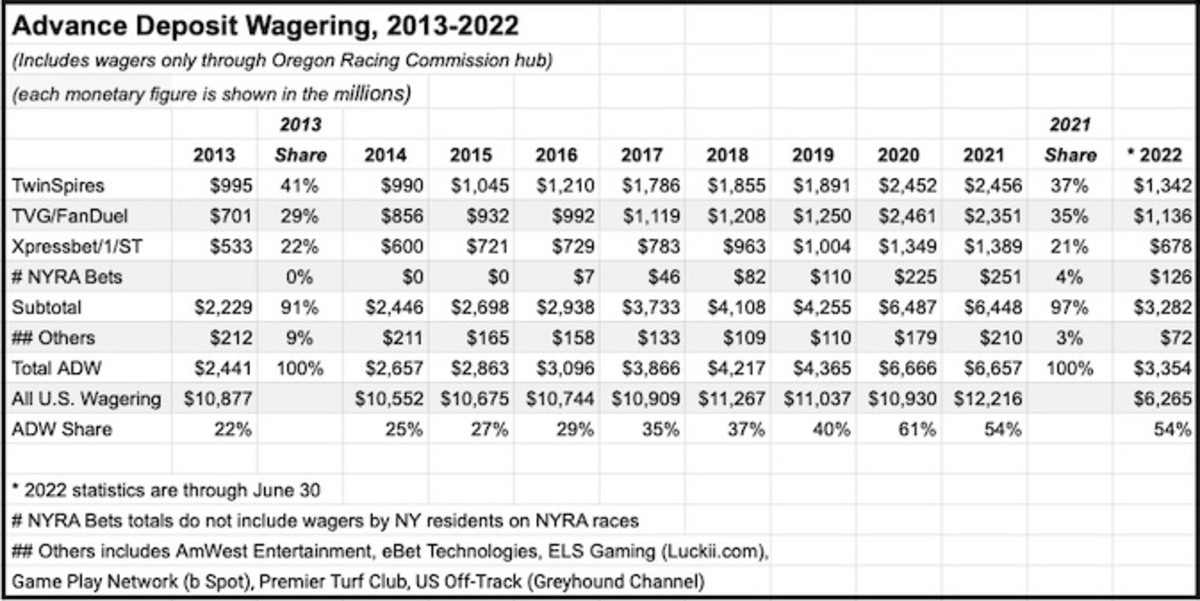
From 2013 through 2021, U.S. pari-mutuel handle increased by 12.3 percent. Over the same period, advance deposit wagering increased by more than 173 percent. The so-called “big four” ADW companies – TwinSpires, TVG/FanDuel, Xpressbet/1ST Bet, and NYRA Bets (which launched in 2017) account for the vast majority of those bets.
That said, there are some caveats in the data. The statistics in the accompanying chart are from the Oregon Racing Commission, which serves as a multi-state hub for nine ADW companies, including the “big four.” There's another $750 million or so wagered annually with a dozen, mostly smaller ADW companies through the North Dakota Racing Commission multi-state hub. The North Dakota Racing Commission does not supply individual ADW wagering totals.
The chart demonstrates ADW's share of all U.S. pari-mutuel wagering grew steadily from 22 percent in 2013 to 40 percent in 2019. It then skyrocketed to 61 percent market share in 2020, the first year of the coronavirus pandemic when most tracks were closed to on-track wagering and many other sports were temporarily shut down.
With on-track attendance largely restored in 2021, the ADW market share declined to 54 percent, and it's at that same rate for the first six months of 2022. Looking at nearly 10 years of data, it appears that advance-deposit wagering hasn't attracted new players as much as it has made wagering more convenient for existing ones. It's moved brick-and-mortar players to bet on their phones or computers.
Keep in mind, these ADW totals do not include the estimated $750 million wagered through North Dakota's ADW hub. It also does not reflect some of the game's biggest players – including computer-assisted wagering operations – who get substantial rebates through licensed, legal offshore shops like Elite Turf Club and Racing and Gaming Services. Add those unknown variables into the equation and the share of ADW bets as a percentage of total handle would be much greater.
The computer-assisted rebate players are not going to help the game grow. If anything, their crushing last-second wagers that can dramatically change the odds are a growing frustration that may chase some of the existing players out of our game and into the sports betting landscape. Thoroughbred Idea Foundation executive director Patrick Cummings published his thoughts on that earlier this week suggesting that sports bettors will not find the pari-mutuel waters very inviting because of late odds changes. Cummings believes racing must embrace fixed-odds wagering.
But that concern notwithstanding, there is a very good opportunity for horse racing to attract players from the sports betting world.
Don't take my word for it. William Carstanjen, CEO of Churchill Downs Inc. (CDI), said as much with the company's recent announcement that it was entering into a multi-year agreement with its former nemesis, TVG/FanDuel. CDI owns TwinSpires, which for all but 2020 has been the leading ADW company over the last decade in terms of betting volume (based on Oregon Racing Commission hub data). TwinSpires and TVG/FanDuel have been battling for market share among existing horseplayers and, at times, the rivalry has gotten downright ugly. For the two companies to reach this kind of agreement on content, television, technology, and market access is a very big deal.
In 2023, when the agreement goes into effect, Thoroughbred racing content from CDI's flagship track that hosts America's biggest race, the Kentucky Derby, will be in front of millions of FanDuel's sports betting customers. That is significant. Just as significant is FanDuel's plans to let sports bettors and horseplayers use a single wallet (betting account) for both sports and horse betting. Once that goes into effect, anyone with a sports betting account with FanDuel will be able to bet on the Kentucky Derby or any other race that TVG/FanDuel offers on its wagering platforms or FanDuel TV. This will provide a major betting lift to the Derby and should have a positive impact on all racing.
Opposing the spread of sports betting is fruitless. It is here and isn't going away. A marriage between sports and horse betting can and should be in racing's best interest.
That's my view from the eighth pole.
The post View From The Eighth Pole: Marriage Of Online Sports And Horse Betting Is In Racing’s Best Interest appeared first on Horse Racing News | Paulick Report.
