Weekend Lineup Presented By NYRABets: Blockbuster Travers Showdown

Four Grade 1 winners will enter the eight-strong starting gate for Saturday's Midsummer Derby, the $1.25 million Travers Stakes (G1) at Saratoga. The winners of both the Kentucky Derby and the Preakness, Rich Strike and Early Voting, are expected, as well as the runner-up from both of those races, Epicenter. The only dual Grade 1 winner in the field is Cyberknife, who has captured the Arkansas Derby and the Haskell this year.

Saturday's Saratoga card features four other Grade 1 races, offering top-class contenders from multiple divisions. Reigning champion Jackie's Warrior will star in the Forego, while the Personal Ensign features another matchup between exciting distaffers Clairiere, Malathaat, and Letruska. The “Win and You're In” Sword Dancer drew a solid field of 10, including international millionaire Broome for trainer Aidan O'Brien.

Friday's graded stakes action takes race fans to the West Virginia bullring at Charles Town, where Art Collector will seek a repeat victory in the $1 million Classic (G2).

On Sunday, reigning champion Ce Ce ships to Saratoga from the West Coast to take on the G1 Ballerina.

Also worth noting that Monmouth Park will offer a $200,000 stakes for 2-year-olds on Saturday, which could offer a preview at talent for future graded stakes races.

Here's a quick look at some of this weekend's graded stakes:
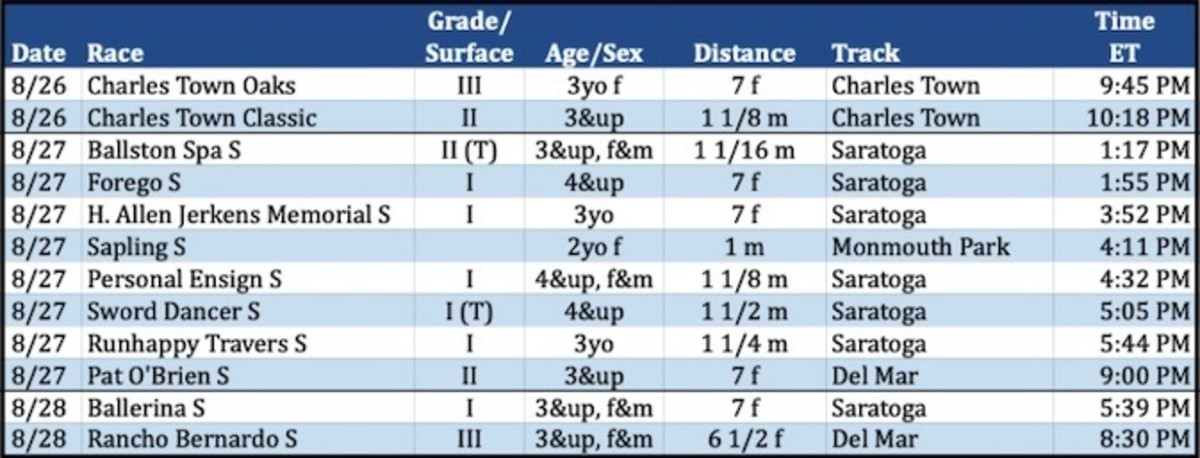
Friday

10:18 p.m. – Grade 2 Charles Town Classic

Art Collector returns to Hollywood Casino at Charles Town Races on Friday night as he looks to defend his crown in the track's marquee event of 2022 – the $1,000,000 Charles Town Classic (G2). Art Collector will look to replicate the path he took to West Virginia's eastern panhandle in 2021 when he also captured the Alydar Stakes at Saratoga prior to his run in the Classic. Unlike last year, Art Collector came into the 2022 Alydar off a lengthy layoff following his trip to the Middle East and the $20 million Saudi Cup but didn't disappoint with a dominating effort that could have signaled a return to his 2021 form that saw him capture the Charles Town Classic and Grade 1 Woodward.

Charles Town Classic Entries

Saturday

1:55 p.m. – Grade 1 Forego Stakes at Saratoga

Reigning Champion Sprinter Jackie's Warrior, who raced his way into history last month, will continue his assault on the Saratoga Race Course record books when he goes for a sixth career stakes victory over a track where he is undefeated in Saturday's Grade 1, $600,000 Forego.

Jackie's Warrior won as he pleased in the six-furlong Alfred G. Vanderbilt July 30, a two-length triumph that made him the first horse in Saratoga's 154-year history to win a Grade 1 race for three consecutive years following the Hopeful in 2020 and H. Allen Jerkens in a memorable 2021 throwdown with Life Is Good.

Forego Entries

3:52 p.m. – Grade 1 Allen Jerkens Memorial Stakes at Saratoga

Jack Christopher, who suffered his first loss last out in the Grade 1 Haskell Invitational on July 23 at Monmouth Park, will return to the sprint distance in search of a third Grade 1 triumph in Saturday's $500,000 H. Allen Jerkens Memorial.

Trainer Chad Brown will also saddle maiden winner Accretive, who nearly defeated Gunite last out in the Grade 2 Amsterdam on July 31 at the Spa. The gelded son of Practical Joke was an impressive winner on debut by 5 3/4 lengths sprinting 6 1/2 furlongs on June 26 at Belmont. He followed with a gutsy neck loss in the Amsterdam after closing from 3 1/2 lengths off the pace and coming up just shy to earn a 101 Beyer.

Gunite returns to the scene of his Grade 1 Hopeful victory in search of another top-level score for Hall of Fame trainer Steve Asmussen. A son of Winchell-owned and Asmussen-trained 2017 Horse of the Year Gun Runner, Gunite returned to graded form with gusto last time out in the Grade 2 Amsterdam, earning a neck victory over the aforementioned Accretive in the 6 1/2-furlong sprint.

Allen Jerkens Entries

4:32 p.m. – Grade 1 Personal Ensign Stakes at Saratoga

This spring, multiple Grade 1-winner Clairiere was an underdog when facing reigning Champion 3-Year-Old Filly Malathaat, never having finished ahead of her in four matchups last year. Now, Clairiere has gotten the better of her familiar rival twice and will look to do so once again in Saturday's Personal Ensign. Trained by Hall of Famer Steve Asmussen, Clairiere arrives from a strong victory over Malathaat in the Grade 2 Shuvee on July 24 at the Spa.

Clairiere's abilities will be tested once again in the Personal Ensign as she faces a loaded field that includes two champions. In addition to the aforementioned Malathaat, she'll face the reigning Champion Older Dirt Female Letruska, who was the quick pacesetter in the Ogden Phipps and faded to be a well-beaten fifth-of-5.

Hall of Fame trainer Todd Pletcher is hopeful Shadwell Stable's Malathaat will bounce back from a disappointing runner-up effort behind Clairiere in the Grade 2 Shuvee last out. The day of the Shuvee was particularly hot and humid, which Pletcher blames for the dullness Malathaat showed in the paddock and while warming up for the race. She broke well under Hall of Fame rider John Velazquez, but settled in third-of-4 before making a mild run down the stretch and coming up 1 1/2 lengths shy.

This year, Letruska boasts wins in the Grade 3 Royal Delta at Gulfstream and a repeat win in the Apple Blossom, an effort in which she bested Clairiere by 1 1/4 lengths. Letruska has been training strongly at Churchill Downs leading up to the Personal Ensign, posting four bullet works since July 10 and breezing one mile in 1:40.80 on August 4 at the Louisville oval. Her latest move was a half-mile in 48 seconds flat on August 19.

Personal Ensign Entries

5:05 p.m. – Grade 1 Sword Dancer Stakes at Saratoga

Internationally acclaimed trainer Aidan O'Brien will be represented by Group 1-winning millionaire Broome in the Sword Dancer. The 6-year-old Australia bay has made three starts this season led by a 3 1/4-length score in the 12-furlong Group 2 Hardwicke on good-to-firm ground in June at Ascot. He enters from a prominent fourth in the Group 1 King George VI and Queen Elizabeth at 12 furlongs on July 23 at Ascot.

Gufo posted a neck score over the O'Brien-trained Japan in last year's Sword Dancer for conditioner Christophe Clement. The multiple Grade 1-winning 5-year-old son of Declaration of War, who captured the 2020 Grade 1 Belmont Derby Invitational, boasts a ledger of 18-8-3-5 for purse earnings in excess of $1.5 million. He has made four starts this season, including a win in the Grade 2 Pan American in April at Gulfstream Park ahead of a runner-up effort to Highland Chief in the Grade 1 Man o' War in May at Belmont Park. Last out, the Kentucky-bred chestnut closed to finish fifth in the Grade 1 United Nations on July 23 at Monmouth Park, defeated 2 1/2-lengths by returning rival Adhamo.

Channel Maker will make his fifth Sword Dancer appearance which includes a win in 2020 en route to Champion Turf Male honors. The 8-year-old English Channel gelding has amassed earnings in excess of $3.6 million through a record of 46-9-6-5. His other Grade 1 wins came at Belmont Park in the 2018 and 2020 Joe Hirsch Turf Classic Invitational and the 2019 Man o' War. Channel Maker has won 2-of-3 starts this season, taking the Grade 2 Elkhorn in April at Keeneland and the Grand Couturier by a neck over Soldier Rising last out on July 8 at Belmont Park.

Chad Brown will saddle a trio of contenders in Adhamo [post 1, Flavien Prat, 124 pounds], Rockemperor [post 5, Irad Ortiz, Jr., 122 pounds] and Tribhuvan [post 7, Manny Franco, 124 pounds].

Sword Dancer Entries

5:44 p.m. – Grade 1 Travers Stakes at Saratoga

Three-time graded stakes winner Epicenter leads a competitive group of eight in this year's Travers, including four Grade 1 winners. Epicenter enters from a victory in the Grade 2 Jim Dandy on July 30 and will attempt to become the 12th horse to sweep the Jim Dandy-Travers double. One of five millionaires in the field, Epicenter boasts field-best earnings of $2,270,639 and a record of 9-5-3-0.

Chad Brown will unleash three contenders in Grade 1 Preakness winner Early Voting [post 7, Jose Ortiz, 8-1], Grade 1 Blue Grass winner Zandon [post 8, Flavien Prat, 5-1] and rising star Artorius [post 5, Irad Ortiz, Jr., 9-2]. 

Reigning Eclipse Award-winning trainer Brad Cox will try for a second straight Travers with Cyberknife, who is the only two-time Grade 1-winner in the race. The son of Gun Runner was a last out-winner of the G1 Haskell on July 23 at Monmouth Park against fellow Grade 1-winners Taiba and Jack Christopher. The last horse to capture both the Haskell and Travers was Point Given in 2001. 

Rich Strike will seek his first win since his memorable 80-1 upset victory in the Kentucky Derby for trainer Eric Reed. The son of Keen Ice, who upset Triple Crown winner American Pharoah in the 2015 Travers, skipped the Preakness in favor of the Grade 1 Belmont Stakes presented by NYRA Bets on June 11, where he finished a distant sixth. The last Kentucky Derby winner to capture the Travers was 2007 winner Street Sense. 

Gilded Age is only horse in the field without a stakes victory, but arrives off a late-closing second to Artorius in the Curlin for Hall of Fame trainer Bill Mott. 

Completing the field is Iowa-bred Ain't Life Grand for trainer Kelly Von Hemel. The son of Not This Time owns five lifetime wins in eight starts, including wins against his Hawkeye State-bred counterparts in last year's Iowa Cradle and the last out Iowa Stallion on July 23, both at Prairie Meadows. He also defeated open company in the July 9 Iowa Derby as well as last year's Richard Radke Memorial at the Altoona, Iowa oval. 

Travers Entries

9:00 p.m. – Grade 2 Pat O'Brien Stakes at Del Mar

Speaker's Corner, a 4-year-old colt by Street Sense who has been shipped west from Hall of Fame trainer Bill Mott's barn at Saratoga for the test, comes into the feature with a stellar record that shows six wins, two seconds and two thirds in 11 starts for earnings of $722,130. He's been hooking into some of the best horses in the country of late – namely Flightline and Life Is Good – and though the O'Brien is hardly a soft spot, it surely will be an easier one for the homebred bay.

Sunday

5:39 p.m. – Grade 1 Ballerina Stakes At Saratoga

Now a 6-year-old, Ce Ce won last year's G2 Princess Rooney at Gulfstream Park to earn a berth in the Breeders' Cup, then ran third behind Gamine in the Ballerina before reeling off wins in the G3 Chillingworth at Santa Anita and G1 Breeders' Cup Filly & Mare Sprint at Del Mar, beating Gamine to unseat her as North America's top female sprinter. Impressive as she was winning last year's Princess Rooney, Ce Ce was even more so last month in a 6 1/2-length romp July 2 that matched her career-best Beyer Speed Figure of 101. It was the 10th win from 20 lifetime starts for the daughter of Elusive Quality to go along with nearly $2.3 million in purse earnings.

Lady Rocket will be chasing her fifth career stakes win, third in graded company and first in a Grade 1 in the Ballerina. The front-running 5-year-old mare exits a gate-to-wire 2 3/4-length triumph in the G3 Chicago June 25 at Churchill Downs under Ricardo Santana Jr., who returns to ride from post position 4 at 120 pounds.

Bella Sofia is looking to bounce back in the Ballerina after running third as the favorite in the Grade 2 Honorable Miss July 27. The 4-year-old Awesome Patriot filly won the G1 Longines Test last summer at Saratoga and began this year with victories in the G3 Vagrancy Handicap May 14 and G2 Bed o' Roses June 10, both at Belmont.

Hall of Fame trainer Bill Mott entered the trio of Caramel Swirl, Obligatory and Travel Column, and Chad Brown trainee Midnight Olive is the final entrant in the seven-horse field.

Ballerina Entries

The post Weekend Lineup Presented By NYRABets: Blockbuster Travers Showdown appeared first on Horse Racing News | Paulick Report.


Source of original post

Lifetime Well-Spent: Ron McAnally To Be Recognized With Pincay Award Saturday At Del Mar

Hall of Fame trainer Ron McAnally can be found in the mornings seated in a chair on the second floor balcony of his Barn I on the backside of the Del Mar racetrack. That's been his special spot for more than 50 years. High enough to see over the fence and view the horses putting in their morning works. Very unassuming for a living legend whose career spans decades and whose accomplishments are unequaled.

McAnally will be honored this weekend with the prestigious Pincay Award, bestowed annually to an individual who has served horse racing with “integrity, extraordinary dedication, determination and distinction.” Past award winners include Noble Threewitt, Mel and Warren Stute, Jerry and Ann Moss, Art Sherman, Eddie Delahoussaye and Chris McCarron, to name a few.

McAnally and Pincay, who'll hand McAnally his award Saturday, go back a long way and, in fact, they still hang out together.

“I work out in a gym (in Arcadia) with him,” the 90-year old McAnally says, “and I tell everybody, he (Pincay, who is 75) could ride tomorrow. He's kept his weight down real good.”

You know you're in the presence of racing royalty when McAnally talks about the riders he used to employ.

“Laffit and Chris McCarron and (Bill) Shoemaker, some of the best,” McAnally says. “We won a lot of races.”

You won't find anyone who's been coming to a particular racetrack for as long as McAnally's been coming to Del Mar. This is his 74th summer here. He first came to the seaside oval in 1948, and yet, McAnally will tell you, he didn't set out to be a horseman.

“Many years ago I went to the University of Cincinnati,” McAnally begins. “I was going to be an electrician, a repair man and all that. But it was something that needed a lot of math and I was bad in school. We were raised in an orphanage in Kentucky, five of us. My mother and father died when we were very young. My uncle (Reggie Cornell of Silky Sullivan fame) came to me and wanted to know if I wanted to work at the track, at Rockingham Park in New England. So I was walking horses and cooling them off. I started at the bottom making $30 a week. That's how I learned to love horses.”

After that, he was a groom and then an assistant trainer and in 1952 he started training at Hollywood Park.

“If you have a good horse, you can train him,” McAnally says. “(Bob) Baffert tells me what he does, how he worked him a mile and that stuff and I tell him, 'Bob, I don't want to hear that; just give me the horse.' Like John Henry, I had the horse.”

John Henry was Ron McAnally's wonder horse. The smallish, nondescript gelding came to him as a 4-year-old.

“Sometimes a horse needs a little psychology,” McAnally says. “The guy that had him before me used to beat him because he was so mean. And then they gelded him so when we got him, he wasn't a pretty horse. At the sale he brought $1,500. So I started thinking, treat him nice. Give him sugar and apples and carrots and be as nice as you can.

“We'd go to the track and usually, if a horse stops and doesn't move, the exercise boy might beat him. I said 'No, let him take his time.' So he took his time after that and then we started running him and he finished second and I said 'He might be okay.' Then we ran him back again and he won.”

Soon John Henry was winning in bunches. In 1980, he rattled off six straight wins, capped by a victory in the G1 Hollywood Invitational. In 1981, he won five in a row including the first of two G1 Santa Anita Handicaps. After finishing fourth in the Hollywood Gold Cup, he won five of his next six races including his first Arlington Million.

As for which John Henry race does McAnally consider to be the best he ever ran?

“There were so many, I can't tell you,” McAnally says. “The Arlington Million, I guess. The most important thing is this: Horses, when they're five or six, like any athlete, they start to tail off. Basketball players, football players they start to go downhill. Yet John Henry was Horse of the Year at age nine.”

John Henry won his second 'Big Cap' in 1982 and his second Arlington Million in 1984 before retiring later that year. Amazingly, when he was retired, he was in the midst of a four-race win streak and had won six of his last seven races.

He was the Eclipse Award winning grass horse four years running and was named Horse of the Year in 1981 and '84. John Henry was inducted into the Racing Hall of Fame in 1990.

Most of the time, a trainer has a great horse and that's it, that's why they call them a Horse of a Lifetime. But McAnally had not one, not two, but three Hall of Famers, which is more of a testament to his training ability than he's willing to admit. In 1988, a horse named Bayakoa came to him from Argentina.

“She was fast and won a Breeders' Cup for us,” he said. “Laffit rode her. He said it was the best filly he had ever ridden. A connection down in South America told us there's a real nice filly down here, so we bought her and she won everything.”

Bayakoa won five in a row in 1989 including the Santa Margarita, the Vanity and the Milady, all Grade 1 races at the time. After a loss in the Chula Vista at Del Mar, she clicked off another five straight wins including the 1989 Breeders' Cup Distaff.

The winning continued in 1990. Bayakoa won five of six races including her second Breeders' Cup Distaff. She won the Eclipse Award for best older mare in both 1989 and 1990 and was voted into the Racing Hall of Fame in 1998.

A few months after Bayakoa left the barn, another Argentine-bred named Paseana came to McAnally. From November of 1991 to July of 1992, she won seven in a row and would go on to give McAnally his third Breeders' Cup Distaff win. She won the Eclipse Award for older mare in 1992 and '93 and was inducted into the Hall in 2001. He remembers her owners.

“Sid and Jenny Craig. They were very good clients, just like the man who owned John Henry, Sam Ruben,” McAnally recalled. “The ones (owners) that are bad, they start telling you what to do. When that happens you get confused; they want to run them here, they want to run them there. That's what they pay you, the trainer, to do. They want to treat it like their own business, but I'm here seven days a week and I think I know what I'm doing.”

Who could argue with that? McAnally has been named an Eclipse Award winner as trainer of the year three times — 1981, 1991 and 1992. He was inducted into the Hall of Fame along with John Henry in 1990. At Del Mar, he was the track's leading trainer for number of wins for a dozen years and now still ranks fourth with 447 firsts, as well as third in stakes victories with 77.

He has always enjoyed his summers at Del Mar and holds the highest regard for the man who runs the place.

“Joe Harper is one of the best,” McAnally says. “I've known Joe all my life. His mother had horses. You see that grandstand? It was half that big when he went to work here. He got the new one built and it's great. Joe is one of the ones.”

McAnally has five horses in his barn at Del Mar this summer, four of which he owns. He can't do it anymore, but back in the days of the old grandstand, McAnally would take his horses to the beach.

“We used to take them out there, under the railroad tracks,” McAnally remembers. “They'd lay down in the sand and roll. We'd take them out in the water. They loved it. They'd relax. It would give them a chance to get out. I feel sorry for horses sometimes because they're in their stalls for 23 hours out of 24. When we took them to the beach it gave them more time to get out and stand in the salt water. But those days are gone now.”

When you've been around something for as long as McAnally's been around racing, you're going to see a lot of changes and his ability to adapt to those changes contributed to his longevity. There was a time when horses ran a prep race on a Tuesday and came back to run in a stakes race that weekend. Not in McAnally's barn.

“If you run a horse every week,” McAnally says, “they're not going to run good. With three weeks they get a chance to build themselves up, get their strength back, eat better, train and relax. If you run them every week, they're not going to run their best.”

That's how you compile 70-plus years of experience training horses and reach the highest pinnacle of your sport. This week he'll be making more room in his trophy case for the Pincay Award, which he will receive in the winner's circle between races on Saturday. He most certainly is a deserving recipient.

The post Lifetime Well-Spent: Ron McAnally To Be Recognized With Pincay Award Saturday At Del Mar appeared first on Horse Racing News | Paulick Report.

Source of original post

Speightstown Colt From Family of Newgate Supplemented to Keeneland September

A Speightstown half-brother to Grade II winner My Majestic Rose (Majestic Warrior) from the family of impressive 2022 juvenile maiden winner and 'TDN Rising Star' Newgate (Into Mischief) has been supplemented to the 2022 Keeneland September Yearling Sale and is scheduled to sell Sept. 12 on opening day of Book 1 as hip 182. St George Sales, agent, consigns the colt, who is out of the winning Pleasant Tap mare Victory On Tap. He also is from the family of Canadian Grade III winner Victress (Include). Victory On Tap is a half-sister to Majestic Presence (Majestic Warrior), the graded stakes-placed dam of Newgate, who won his career debut by 3 1/2 lengths July 30 at Del Mar.

The post Speightstown Colt From Family of Newgate Supplemented to Keeneland September appeared first on TDN | Thoroughbred Daily News | Horse Racing News, Results and Video | Thoroughbred Breeding and Auctions.

Source of original post

In Ontario, Racing Is Thinking About The ‘LongRun’ For OTTBs

LongRun Thoroughbred Retirement Society's farm in Hillsburgh, Ontario is the kind of place that, if you were reincarnated as a racehorse, you'd want to come to.

Retired Thoroughbreds graze in their verdant, rolling fields or in stalls with ample relief from electric fans, lazily mugging visitors for carrots. No matter how long they've been here, they've figured out that visitors equal carrots, but that manners never go amiss.

Founded in 1999, the organization operates as part sanctuary, part rehoming organization with the aid of .5% of purse money from Ontario horse racing. It started humbly, with a few dozen horses scattered at various foster homes around the province, until a bequest from Lana Hershelle Sniderman gave them the funds to buy their 100-acre property. The facility used to be a small breeding and training operation, so was already set up with two barns, a walker, and plenty of paddocks. It also includes indoor and outdoor arenas.

Co-founder and board chairperson Vicki Pappas estimates the organization has about a 60/40 split between sanctuary and adoptable horses. In the time Pappas has been doing her work, she has seen a significant shift in demand for sound horses leaving the track to go straight into riding homes. While the increasing popularity of the breed among amateur riders is a net gain for aftercare non-profits, it also means that many of them are getting fewer quick-turnaround types, who are ready to embark on their new career right away. That has been the case at LongRun, Pappas said.

When that type of horse does come in, it goes back out quickly. Pappas said one horse recently was in and out within three weeks because it retired with no limitations or known issues.

Many of the horses LongRun takes in are coming with some kind of issue that predicated their retirement. Since most (though not all) are leaving the track in Ontario, where the racing surfaces are turf and synthetic, Pappas said she doesn't often see fractures on new retirees. She does see soft tissue injuries, which unfortunately, take longer to heal and are less predictable.

It's also not uncommon to have a horse retire apparently sound, only for lingering issues to become more prominent once they're living outside and in a different type of work.

“That's one point that's tough to get across to people,” she said. “They go, 'oh, they're sound,' but they don't understand [the horses] build up all this fitness at the track. When they get here, they realize 'oh, maybe this does hurt.'”

Sanctuary residents at LongRun look for more carrots

LongRun's approach is slow and methodical in the face of these challenges, however. Pappas says the staff usually give horses a little more than the time their veterinary team suggests for healing, and put on basic walk/trot/canter work before listing the horse for adoption. For horses who will continue to have limitations on their activity levels due to old injury, Pappas has had good luck finding trail riding homes, often with older riders who just want a relaxing, slow ride.

The facility has also begun opening itself to groups of children and adults for equine-assisted therapy, which is the perfect vocation for horses with lingering soundness challenges because most of it is non-mounted or just requires an ambling walk.

Horses who aren't able to be adopted out stay at LongRun as sanctuary horses, many of them with the sponsorship of their former racing connections. Pink Lloyd and Riker are two of the most accomplished, but Kentucky Derby also-ran State of Honor and multiple graded stakes winner Something Extra also fall in this category. The organization hosts fans to visit their lifetime residents, much like Old Friends Equine Retirement in Central Kentucky.

But besides serving the horses, the adopters, and the racing fans, Pappas says a part of LongRun's mission is trainer education. Like many non-profit aftercare groups, LongRun's population demonstrates that in lieu of significant financial commitment from connections, it's far less burdensome for the organization (and the horse) to place a horse who has retired sound.

The organization puts out newsletters and other written material for horsemen, but at the end of the day, it's face time that Pappas believes makes a difference here – along with bragging about the loyal owners and trainers who consistently send retired horses to LongRun, rather than selling them cheap off the backstretch.

“I hotwalked the whole time during COVID … I'd go in six days a week and hotwalk. So you're there and you can go around the shedrow and talk to people,” she said. “You have to be there with them so you can display some sort of understanding about what their life is like.”

Aftercare as a charitable endeavor is a comparatively new concept in the racing world; the word didn't really exist two decades ago. Many in the sport became more aware of the need for it as the public focus on equine welfare has become sharper. Kevin Attard said he thinks many of his colleagues at Woodbine have caught on to the problem of One Last Race Syndrome and actively try to avoid it.

“I'm fortunate enough to have people own these horses who really care for them and want to see them thrive in their off-the-racetrack career, so we try our best to pull the plug at the right time,” said Attard. “Everybody's been really obliging and I've never had anyone say no.”

Attard trainee Melmich, a multiple graded stakes winner, went through LongRun's program and was adopted.

“He could have come back to run again, but we decided enough was enough. He'd had an illustrious career and he was sound, so we decided he'd make someone a great pet or companion,” said Attard, who reported Melmich became a trail horse for someone else on the Woodbine backstretch.

[Story Continues Below]

Attard and Pappas agree that the seasonality of racing in Ontario also makes the decision easier for horsemen, since many of them have to take the winter off anyway.

“I think it helps prolong their racing career a little bit,” Attard said. “They're rested for 60 to 90 days I think that's a big benefit to those horses. The key with these horses having careers, which I pride myself on as a trainer – Starship Jubilee, Calgary Cat, Melmich – those horses all went into their seven- or eight-year-old careers. I think that's good management. We stopped on them when we needed to, we rested them when we needed to. We treated them well and they rewarded us.”

Pappas points out that horses in the Ontario-sired program don't have purse incentives to run anywhere during the winter, and it can be a good time to decide whether it's financially worthwhile to keep that horse on the books.

“We've donated horses people offered us money for,” said Pappas, who also owns and breeds racehorses. “But what, are you going to keep a horse in training over the winter and run him back for $5,000 in the spring instead of $10,000? Or sell a horse for $5,000 who might end up in a chuck wagon race?”

There's a great emotional award for owners and trainers who make the responsible call. Pappas said that two of her homebreds recently ended up facing each other in an eventing competition earlier this summer. They came second and fourth. Although she'd hoped one would be her farm's next superstar, she's thrilled to see their athleticism at work – even if it's in different tack.

The post In Ontario, Racing Is Thinking About The ‘LongRun’ For OTTBs appeared first on Horse Racing News | Paulick Report.

Source of original post

Verified by MonsterInsights