Bloodlines Presented By CTBA Sales: Coast-To-Coast Scores Boost Late Arrogate On Second-Crop Leaderboard

With stakes winners on the West Coast and the East Coast on successive days, at Del Mar on July 28 and at Saratoga on July 29, Arrogate (by Unbridled's Song) doubled his total number of stakes winners.

From the sire's first crop, now three, Arrogate's first stakes winner, Alittleloveandluck, came on New Year's Day, then subsequent Grade 1 winner Secret Oath won the G3 Honeybee on her way to victory in the G1 Kentucky Oaks and becoming one of the best fillies of the year, and a third filly, Fun to Dream, won the Fleet Treat Stakes at Del Mar on Thursday.

Bred in California by Bob Baffert and Connie Pageler, Fun to Dream is unbeaten in two starts. The filly made her debut on May 28 at Santa Anita and won the maiden special by 6 ¼ lengths as the odds-on favorite while trained by Sean McCarthy.

Back to being trained by Baffert after his return from the wilderness, Fun to Dream made her second start in the Fleet Treat, an event restricted to California-bred or -sired fillies, and again was favored. This time, the gray filly won by 9 ¾ lengths in 1:22.67 for seven furlongs.

The dam of Fun to Dream, Lutess (Maria's Mon), was claimed by Bob Baffert on behalf of Live Your Dream Stable for $8,000 on Feb. 17, 2012, and Lutess thus became a broodmare. Fun to Dream races for Pageler and Natalie Baffert.

The day after Fun to Dream became her sire's third stakes winner, Artorius won the Curlin Stakes at Saratoga and became the first son of Arrogate to win a stakes.

Bred in Kentucky by Juddmonte Farms, “Artorius isn't an overly big horse,” according to Juddmonte farm manager Garrett O'Rourke, “and he isn't especially heavy either. He's more of a greyhound type, very athletic. He had shins, and things like that delayed his progress.”

Now a winner in two of his three starts, Artorius is clearly progressive and drew off to win the listed Curlin Stakes at Saratoga by 4 ¾ lengths in 1:50.34. The dark bay colt was the second choice in the field of eight.

Artorius had been second in his debut on April 16 at Keeneland, then came back on June 10 to win a maiden special at Belmont, racing a mile in 1:35.07. The colt seemed notably professional in racing inside, then between horses, before going on to win his race. Furthermore, the form seems solid, with Preakness third Creative Minister (Creative Cause) finishing 6 ¼ lengths back of the winner.

The Curlin was the third start for Artorius, and the race was both a step up in class and forward in distance. And it is tempting to say that the Arrogate stock want distance, but Fun to Dream showed plenty of speed in California, racing the six furlongs in 1:09.53 before finishing the seven furlongs in quick time.

Juddmonte supplied a substantial portion of Arrogate's book each year the gray champion was at stud, and O'Rourke has seen as many of the horse's offspring as anyone. He said that, in addition to the farm's 3-year-olds, “we have plenty of 2-year-olds and plenty of yearlings. I always felt our 2-year-old crop was deeper than the 3-year-olds. Some of the 2-year-olds have already gone into training.

“The pattern that I think is emerging is giving them time, and when you get a good one, it's worth the wait. That was what we found with Arrogate himself. Shins were the problem with Arrogate at two that prompted Bob to send him back to the farm. Then when he went back to training in California, he was ready.”

After winning a maiden and a pair of allowances as a 3-year-old, Arrogate went to Saratoga for the 2016 Travers, where he scorched the earth in a memorable performance. From then through the Breeders' Cup Classic and Pegasus to his victory in the Dubai World Cup, Arrogate was the best horse in the world.

And Juddmonte was planning for the day when he went to stud.

The farm acquired Paulassilverlining (Ghostzapper) privately from breeder Vincent Scuderi after the G2 winner had finished a good third in the 2016 Breeders' Cup Filly Sprint, then won the Garland of Roses in December 2016. The filly promptly continued to compile a four-race winning streak, earning victories for Juddmonte in the G1 Madison at Keeneland, the G1 Distaff at Churchill Downs, and the G2 Honorable Miss at Saratoga.

Paulassilverlining ran below her best form in her final two starts, the G1 Ballerina and G1 BC Filly Sprint. Then both she and Arrogate were retired to stud in Kentucky, and Artorius was the result of the mare's first mating. The multiple G1 winner has a 2-year-old filly named Parameter (Into Mischief) with Chad Brown, like the half-brother.

The second-crop sires all toil far in arrears of record-setting Gun Runner ($7.5 million), but Arrogate is a highly respectable third behind Keen Ice (Curlin) ($3.9 million) with $3.5 million in his sire account so far this year. Those are the only second-crop sires with more than $3 million in progeny earnings for 2022.

Arrogate has the smallest number of starters among the top 10 sires on the list; so to be ranked that highly, and with only four stakes winners, the colts and fillies winning maidens are clearly doing so in good company and for good purses. The likelihood is that we will be able to assess the stallion's overall contribution to greater advantage in 18 to 24 months.

The post Bloodlines Presented By CTBA Sales: Coast-To-Coast Scores Boost Late Arrogate On Second-Crop Leaderboard appeared first on Horse Racing News | Paulick Report.

Source of original post

Letter To The Editor: The Medina Spirit/Otomax Theory Really Isn’t That Complicated; It Also Doesn’t Nullify DQ

The recent release of the information that Medina Spirit was negative for betamethasone on a pre-Derby test, while demonstrably positive on a post-Derby test, is being waved about as a stunning mystery. Has no one on either side ever been around a real live horse before?

This new revelation is not likely evidence of a nefarious plot to nail Bob Baffert. The new revelation is not likely evidence  of dirty deeds and an effort to cheat by anyone in the Baffert barn.

How could he be treated the same way with Otomax every day, and only the post-race test be positive??? All that had to happen was for Medina Spirit to have acted like a normal horse, at just the wrong moment, just after an application of Otomax to his rash.

Discard all the wild theories and just go with the one explanation that fits ALL of the facts we know. Shortly after the Otomax was applied, Medina Spirit reached around and scratched his itchy backside with his teeth. He therefore got a mouthful of Otomax at a point close to the race. Possibly the day before the Derby, maybe the day of (though it is against the rules to use any topical containing a steroid on race day). We can't tell. It probably does not happen very often, hence why is is commonly, and legitimately prescribed by vets. (As was done in this case.) Should Bob Baffert have known that Otomax contained betamethasone? Maybe, but he had probably been using it without issue for years. Even his vets did not realize it could give a positive test.

This is an entirely likely scenario and explains everything:
1) How Medina Spirit could test positive in a post race sample, after the Kentucky Derby.
2) How Medina Spirit could test negative while on the same regime, before the Kentucky Derby.
3) Why Bob Baffert was so certain that Medina Spirit had not had any joints injected with betamethasone, resulting in his disastrously vociferous public denials of betamethasone use.
4) Why the special Baffert ordered lab tests (even if perhaps not sufficiently validated) showed betamethasone valerate and no betamethasone acetate or sodium phosphate.

Horses are horses, and do not read rule books. There are obvious ways after the fact, to prevent a positive test from occurring after use of Otomax. But no one had to do anything nefarious or odd, to simply explain what most likely occurred to cause all of these problems.

The blind “haters” do not have evidence of blatant cheating, the blind “defenders” do not have evidence of anyone out to get Bob Baffert. Bob Baffert in complete innocence had something fall through the cracks, and the results have been obvious.

——

What should be done? That is tougher. The KHRC list of banned substances just lists betamethasone in the substances not allowed to be found in a post-race sample. There is no distinction made regarding the form of betamethasone. Testing is not widely available to distinguish between chemical forms. The KHRC used the only available test for betamethasone. Yet their only detailed information on use of betamethasone does specifically distinguish the forms of concern as betamethasone acetate and betamethasone sodium phosphate — forms not apparent in Medina Spirit's samples. These are withdrawal *recommendations* directed specifically at preventing injection of joints in the two weeks prior to racing. This restriction is critically important to reduce catastrophic breakdowns. Systemic use of betamethasone gets a toss comment, that systemic use of betamethasone might result in longer withdrawal times. The pubic also needs to understand that these recommendations are only that, and DO NOT protect a trainer who follows those recommendations and still gets a positive test.

If one goes by the rules, as written, are the rules no matter what, then the disqualification is inevitable. The nature and amount of any suspension or fines, is not, and the board has discretion.

If one goes by the primary intent of the rules – to prevent joint injections close to a race – it is pretty clear that did not happen.

Respectfully,

Sarah McCarthy, DVM

Veterinarian/breeder/owner


If you would like to submit a letter to the editor, please write to info at paulickreport.com and include contact information where you may be reached if editorial staff have any questions.

The post Letter To The Editor: The Medina Spirit/Otomax Theory Really Isn’t That Complicated; It Also Doesn’t Nullify DQ appeared first on Horse Racing News | Paulick Report.

Source of original post

With Legalization of Sports Wagering, Renewed Hope That Racing Will Return to Massachusetts

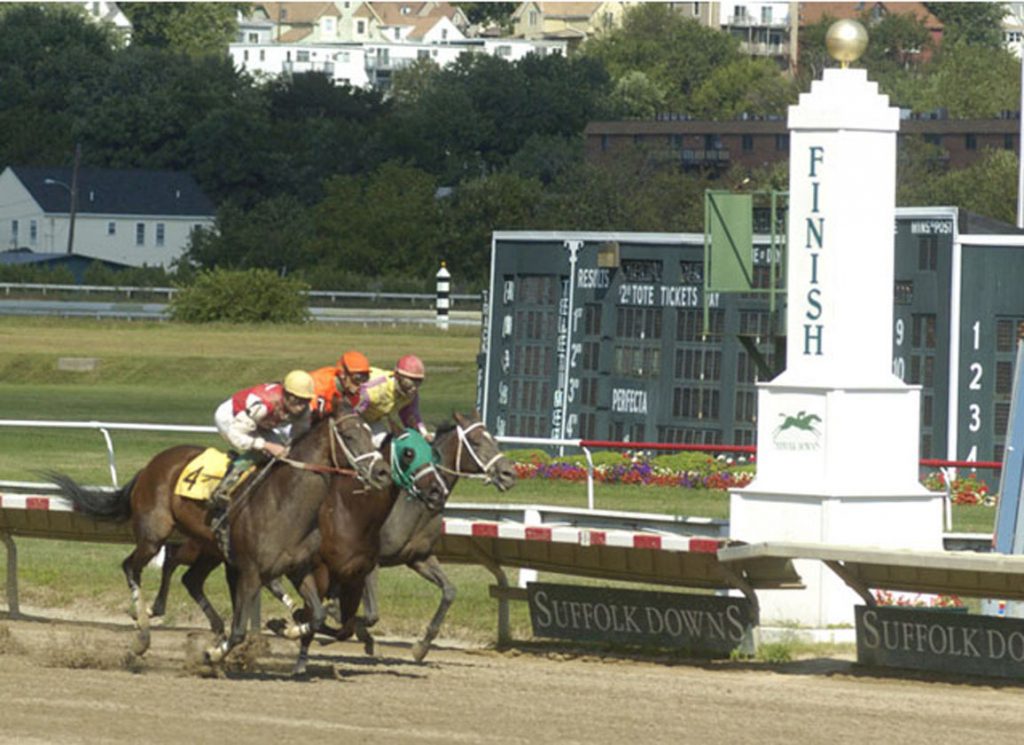
A compromise agreement on a bill authorizing sports betting in Massachusetts was reached Monday, which could be the final piece of the puzzle when it comes to horse racing returning to the Bay State. Behind the scenes, a group of investors has been working to open a new track in the state ever since Suffolk Downs closed its doors in 2019, but understood that their plans would not be practical without there being a source of revenue beyond what can be made off of selling bets. With sports betting about to become a reality in the state and with the bill granting sports betting licenses to anyone operating a racetrack, the group is prepared to move forward and plans to apply to the Massachusetts Racing Commission for a racing license some time this fall.

“When it comes to the project, sports betting has been the catalyst all along because there has to be some sort or of revenue source,” said Lou Raffetto, the former vice president of racing at Suffolk Downs who is advising the group, which calls itself Commonwealth Racing. “We all understand it's not going to come from just racing itself. They are very serious about this and the intent will be that by October we need to apply for a racing license.”

Suffolk Downs' days were numbered in 2014 when the track lost out on a bid to get a casino license. It remained open over the next five years, running short meets that were a requirement to retain its simulcast license. In 2017, the property was sold to HYM Investment Group, which is in the process of converting the land into a mixed-use neighborhood that will include 10,000 housing units.

Without any realistic hope that a Massachusetts Thoroughbred track could cash in on a casino, the sport appeared to be dead in the state, where racing dates back to 1935 when Suffolk first ran. But the principals behind Commonwealth Racing, Armand Janjigian, his wife Robin, and former Suffolk Downs owner Richard Fields, believed they could make this work. While having a sports betting license may not be as a lucrative as operating a casino, it could prove to be enough to make operating a track in the state feasible.

Raffetto said the investors are well beyond the kicking-the-tires stage.

“I've been working for them for well over a year and this is nothing new,” he said. “If you had any idea how much money they have already spent on architects and engineers you'd shake your head and you'd see that they are very serious. They wouldn't be going down this road if they didn't think it was a good business decision. They understand there will be a lot of competition in the sports betting market but they've already spent a lot of money. That's how I know this isn't pie in the sky. They are a lot of smarter than I am and they know what they are doling when it comes to a running a business.”

Their task has been made easier by the fact that the state is holding on to about $22 million that is earmarked for Thoroughbred purses, meaning track owners, at least initially, may not have to contribute much to the purse account. Even though there has not been Thoroughbred racing in the state for more than three years, the industry still receives a cut from slot revenues from Plainridge Park, a Standardbred track. The money keeps piling up.

“The money is there to at least get things going,” Raffetto said. “I am imagining a meet where purses will be similar to what we had at Suffolk toward the end for the festivals. I think we could easily be giving out a half-million dollars each racing day.”

Massachusetts has not had Thoroughbred racing for more than three years | Horsephotos

Raffetto said the group has yet to decide where to build a track, but said two locations are under consideration, both in the western part of the state. Finding a municipality that will allow a racetrack to be built within its borders has been an issue. Commonwealth Racing thought it had found its home when putting forth a proposal to build a track in Sturbridge. Zoning changes were needed to approve an agriculture and zoning overlay district to move the project forward, but, last October, Sturbridge voters rejected a proposal that called for the building of a track and a community center.

“A month from now we will be ready to release the site,” Raffetto said. “We have found two places. Now it's matter of seeing what makes most sense. There are pros and cons to each one.”

The plan is to build a small facility that can comfortably hold 3,000 to 4,000 fans. Raffetto said building the track may cost about $60 million.

“A lot depends on the nature of the facility,” he said. “How big and ornate do you want the facility to be? Are you building permanent barns, are you bringing in barns that would be temporary structures set up just for the meet? If you are going to build a track from scratch, the building, the barns and everything else that goes with it, it probably would end up costing you $60 million for a simple structure. Does it mean that's what we will spend? It could be. Some of the estimates we've gotten have been greater than that. It really depends on the location. It could be $50 million, it could be $90 million. We want a first-class facility, don't get me wrong. But we want something that makes sense in this day and age.”

There is a glut of racing already operating in the Northeast and the horse population shrinks every year, which could make it hard for a new Massachusetts track to find enough horses to put on a show. With that in mind, Raffetto said the plan is to run a short meet, most likely in the fall. In addition, there will be just one racing surface–a grass course.

“Racing the way we knew it, with a track running for 100 or more days, well, the horse flesh is just not there to do that,” he said. “You have to keep it special. Those festival meets we did at Suffolk worked. We're trying to make this more of a festival-type thing rather than an everyday humdrum-type operation. We will have one course–a wide turf course where we can have two or three positions for the rail. Trainers want to run on the grass.”

As far as when the proposed track, which does not yet have a name, might open, Raffetto said it will happen “sooner than a lot of people might expect.” One possibility, he said, is that racing could get underway before the stands are built.

“It wouldn't be something like three years out,” he said. “Who knows? It could wind up being next year.”

Racing isn't expanding. It is contracting. Just last year alone the sport lost Arlington Park and Calder and several tracks are being kept alive only so that their owners can keep their casinos. Can a new track, far removed from a major city, one where the owners have no expectations of profiting from a casino, make it? It won't be easy, but in Massachusetts they appear ready to give it a try.

The post With Legalization of Sports Wagering, Renewed Hope That Racing Will Return to Massachusetts appeared first on TDN | Thoroughbred Daily News | Horse Racing News, Results and Video | Thoroughbred Breeding and Auctions.

Source of original post

Jockey Of The Week: Reigning Champ Joel Rosario Wins Three Graded Stakes At Saratoga

The Joel Rosario graded stakes express train is at Saratoga. The reigning Eclipse Award winner for Outstanding Jockey, Rosario won three graded stakes including the Grade 1 Alfred G. Vanderbilt at Saratoga, earning Jockey of the Week honors for July 25 through July 31. The award, which is voted on by a panel of racing experts, honors jockeys who are members of the Jockeys' Guild, the organization which represents more than 1050 active, retired and permanently disabled jockeys in the United States.

With a stakes race carded every day of the Saratoga meeting, Rosario naturally started Week 2 with a win in Wednesday's feature, the G2 Honorable Miss, riding for trainer Wesley Ward aboard Kimari. Racing on the outside in the compact field of four, Kimari was third down the backside and fourth around the turn but came running in the stretch to post a half- length win in 1:10.78 for the six furlongs, pulling off a minor upset over race favorite Bella Sophia.

“She ran good,” said Rosario who was riding Kimari for the sixth time in her last seven starts. “She's a nice horse and always tries.”

On Saturday, Hall of Fame trainer Steve Asmussen gave a leg up to Rosario on reigning champion male sprinter, Jackie's Warrior in the G1 Alfred G. Vanderbilt. The result was never in doubt as Jackie's Warrior cruised to a two-length win in 1:09.74 for the six furlongs.

“He's a special horse,” Rosario said. “These horses don't come along every day and he's just incredible. He's always there for me. I know when I ask him to go, he's there for me.”

Rosario capped off his four-win Saturday with a victory in G2 Jim Dandy again riding for Steve Asmussen. With Rosario aboard, Epicenter went off as the favorite in the four-horse field breaking from the rail. Epicenter was last of four after the opening quarter mile and still last on the backside as the field hit the top of the stretch, but Rosario and Epicenter took command as they reached the eighth pole and edged away to win decisively by 1 1/2 lengths in 1:48.99 for the 1 1/8-mile race. 

“It looked like there were a couple of the horses that wanted to go and get position, so I just let him be where he was happy,” Rosario said.

The stakes win was Rosario's seventh graded victory of the young Saratoga meet.

For the week Rosario's statistics were 30-7-7-1 with $1,052,728 in total purses to lead all jockeys.

Other nominees for Jockey of the Week were Joe Bravo with an upset win in the G1 Bing Crosby, Alfredo Juarez, Jr. with two stakes wins opening weekend at Albuquerque, Mike Smith who won the G2 San Diego Handicap, and Dakota Wood who won 13 races while riding at Great Falls.

The post Jockey Of The Week: Reigning Champ Joel Rosario Wins Three Graded Stakes At Saratoga appeared first on Horse Racing News | Paulick Report.

Source of original post

Verified by MonsterInsights