Sixteen Supplemental Entries Added To 2022 Texas Summer Yearling Sale

Sixteen yearlings have been added to the 2022 Texas Summer Yearling Sale supplement catalog ahead of the Aug. 29 sale at Lone Star Park in Grand Prairie, Texas.

The additions bring the total offering at the 2022 Texas Summer Yearling Sale to 228 yearlings, featuring national and regional stallion power and pedigrees.

“The interest in our sale has been strong since we released our catalog late last month,” TTA sales director Foster Bridewell said. “These additions only help boost our sale and we're thrilled to offer these additional yearlings later this month.”

The supplement catalog features yearlings bred in Arkansas, Louisiana, Kentucky, Oklahoma, and Texas, including a Texas-bred filly by exciting first-crop stallion Vino Rosso whose yearlings sold for as much as $550,000 at the Fasig-Tipton Saratoga Sale this week. A full-sister to 2021 Texas 2-Year-Old Colt/Gelding Champion Tengo Mis Papeles will also be offered as Hip 223.

The interactive catalog, including the supplements (Hips 213-228), is available now at www.ttasales.com. The full catalog is also available for download on the Equineline IPad App. Supplement catalogs will also be available on the sales grounds and at the Lone Star Park Sales Pavilion.

The post Sixteen Supplemental Entries Added To 2022 Texas Summer Yearling Sale appeared first on Horse Racing News | Paulick Report.

Source of original post

Op/Ed: Robert M. Beck, Jr.

During one of the most politically polarizing times in our country's history, Congress passed the Horseracing Integrity and Safety Act of 2020 (HISA) with bipartisan support. What did this rare display of unity say about the health of the Thoroughbred racing industry? To say it kindly: the industry needed help. HISA handed over the reins for regulating Thoroughbred safety and anti-doping and medication control matters to a private, self-regulatory organization named the Horseracing Integrity and Safety Authority (Authority). Before HISA, Thoroughbred racing in the United States was regulated by a patchwork of individual state racing commissions with different, and often conflicting, rules. HISA represents a significant change for an industry used to parochial and inconsistent governance–and even more disorderly enforcement. Perhaps more important, HISA is the solution to stop horse racing from going the way of the circus and dog racing, as many commentators and animal rights activists have warned.

Sadly, some in the industry have chafed at Congress' mandate that Thoroughbred racing must be safe, clean, and fair. Since the passage of HISA, the Authority has been attacked on all sides through meritless lawsuits that willfully ignore more than 80 years of binding legal precedent.  Nothing about HISA or the Authority's structure is unique, let alone legally questionable. HISA is modeled after a law called the Maloney Act of 1938, which designated what would later become the Financial Industry Regulatory Authority (FINRA) to oversee financial regulation under the oversight of the Securities and Exchange Commission. Like FINRA, the Authority is self-funded, independent, and overseen by a federal agency. In other words, the Maloney Act and HISA are constitutional for the same reasons:  Congress is well within its power to delegate its regulatory authority to private entities so long as a government agency retains ultimate decision-making authority as to rules and enforcement; Private organizations such as the Authority and FINRA are not subject to constitutional restraints on appointments and removal of board members; and Private self-funding of such organizations does not unconstitutionally compel states to enforce federal law.

For those keeping score, the Authority is winning the battles against its detractors. Two Federal District Courts–one in Kentucky and another in Texas–have soundly rejected the constitutional challenges lodged against HISA and the Authority, and the reviewing appellate courts are expected to affirm these decisions. No court has found HISA unconstitutional. Having lost their challenges to the Authority's constitutionality, the Authority's opponents have resorted to nitpicking the Authority's implementation of its rules. Thus far, these attempts have also failed. In one case, filed in Louisiana Federal District Court, the plaintiffs argued that the Authority failed to satisfy certain technical requirements of the Administrative Procedures Act. Significantly, the Louisiana Federal District Court found zero constitutional violations, but it did initially agree with the plaintiffs that the Authority's definition of “covered horse” and its search and seizure rule expanded beyond the scope the statute ever so slightly. Practically speaking, this portion of the ruling has no impact, because the Authority has already revised one of the rules and the other rule is revised in the ADMC rules. The District Court also questioned the Authority's rule on funding and the length of the notice and comment period, though it recognized that any of the claimed deficiencies could be easily remedied by the Authority even if the Authority is ultimately unsuccessful on the merits. It was perhaps not surprising then that the Authority recently sought and received an emergency stay of enforcement of a Louisiana Federal District Court's order halting implementation of the Authority's rules in Louisiana and West Virginia. This stay makes clear that the Authority's safety rules will continue to be enforced nation-wide.

Unfortunately, during the interim, the Authority's enforcement of its rules in Louisiana and West Virginia was delayed. Racing in both states suffered. For example, one jockey in Louisiana whipped a horse 17 times in one race, 11 times more than the Authority's strike limit. Under the Authority's rules, such behavior is prohibited and would have been swiftly and uniformly punished. But horses are not the only ones suffering as a result of these meritless lawsuits. A fourth federal lawsuit challenging the Authority and HISA was filed in Texas at the end of July. It recycles many of the failed legal claims. Like the cases that came before it (and those that will come after it), the new lawsuit merely serves as a distraction and a waste of industry resources. Ironically, under HISA, horsemen and racetracks will be the ones who bear the brunt of these additional legal costs. It is clear that litigation against the Authority will continue to burden the industry and threaten the safety and integrity of our equine and human athletes. The Authority is doing this good work despite the distractions of the ongoing litigation, and it continues to win the courtroom battles. Sadly, the Authority's legal costs to defend these lawsuits will only increase the costs to all racing participants, horsemen included.

Beck is an equine lawyer and member of Stites & Harbison, PLLC in Lexington, Kentucky. He previously served 7 1/2 years as the Chairman of the Kentucky Horse Racing Commission.


The post Op/Ed: Robert M. Beck, Jr. appeared first on TDN | Thoroughbred Daily News | Horse Racing News, Results and Video | Thoroughbred Breeding and Auctions.

Source of original post

Equibase Analysis: Santin, Set Piece Top Win Contenders In Arlington Million

The Grade 1, $1 million Arlington Million Stakes, run in its traditional place during the summer but now run at Churchill Downs and on a special one-day of racing at the storied track this Saturday, still packs a lot of horsepower. Nine turf stars have signed on to run, including two horses who have already earned over $1 million in their career. Six of the other seven will go over the $1 million mark in career earnings if they succeed.

Smooth Like Strait has the highest career bankroll at $1.5 million, with 15 of his 20 career starts having resulted in wins or runner-up finishes including when last seen on May 30 finishing second in the G1 Shoemaker Mile Stakes. Field Pass brings a strong record into the race with $1.1 million earned and nine career wins, the most recent of those in the G2 Seabiscuit Handicap last fall.

Santin has only run seven times to date compared to at least double that for most of his opponents, but he's made the most of those starts with three wins including the nearly identical Turf Classic Stakes run on Kentucky Derby day this spring. Set Piece (GB) won the G2 Wise Dan Stakes in June of last year as one of four wins on the Churchill Downs turf from five starts on the course. He also won the G2 Dinner Party Stakes in May.

Sacred Life (FR) enters the Arlington Million following a win in the G3 Monmouth Stakes and rarely runs a bad race, having finished first or second in 17 of 26 career races on grass. Megacity crossed the wire in front of Field Pass last month in the $300,000 Texas Turf Classic Stakes before being disqualified and placed second for interference.

Admission Office also has credentials to be competitive in this field as he won the G3 Arlington Stakes on the Churchill Downs turf course this past June. Likewise, Cellist won the Grade 3 Louisville Stakes over the course in May.

Cavalry Charge won the Fair Grounds Stakes on turf in February at the distance of the Arlington Million and enters the race off a second-place finish in a stakes behind multiple Grade 1 stakes winner Ivar.

About the top two win contenders – Santin and Set Piece (GB):

Santin is one of only two 4-year-olds in this year's Arlington Million (the other being Cellist), and he has only run badly in one of seven career starts. That was when sixth in his most recent start which came in June in the G1 Manhattan Stakes, possibly because one of his shoes had to be repaired in the paddock just before the race. That poor effort might also have been due to the 10 furlong distance of the race he was running for the first time, or the fact he was racing at Belmont for the first time. Prior to that Santin ran the best race of his career, at the nine furlong distance of the Arlington Million and at Churchill Downs. That effort came in the Turf Classic Stakes in May, where the colt earned a career best 115 ™ Equibase® Speed Figure. In that race Santin battled head-and-head for the entire last three-sixteenths of a mile. That was his first start in blinkers and it really seems to have made a difference. Jockey Tyler Gaffalione was aboard that day and rides back and since shipping from New York back to Churchill Downs Santin put in a very sharp three furlong blowout in the morning to put him on edge for a repeat of his Turf Classic effort in the Arlington Million.

Set Piece (GB) also should bounce back to his best form shipping in from New York to race at Churchill Downs, where he has won four of five on this turf course. The best of those efforts came 14 months ago when rallying from last of 10 to win the Wise Dan Stakes in visually impressive fashion, earning a strong 112 ™ figure. After taking seven months off from September of last year until this April, Set Piece (GB) got back into the winner's circle in his second start on the comeback trail, rallying from next to last to win the Dinner Party Stakes in May. Next, in the Forbidden Apple Stakes last month, Set Piece (GB) moved up from 11th to within just about one length of the leaders when he found himself behind a wall of horses, getting a path to run much too late to have an impact and finishing fifth. Before shipping from New York, Set Piece (GB) put in a fantastic morning drill when running four furlongs in 47.8 seconds, the best of fifty-nine workouts at the distance on the day. As such, it is very reasonable to expect Set Piece (GB) to return to form good enough to win this race.

Regarding one of the likely betting favorites, Smooth Like Strait, there's little doubt he fires nearly every time, having finished first or second in 15 of 20 career starts on grass. He missed by a half-length in the Breeders' Cup Mile last fall, earning a career-best 119 figure. He also finished third in the Maker's Mark Mile this past spring and other than that has been first or second in his last six races, all grade one or grade two stakes. Still, he does his best running at a mile, not this mile and one-eighth trip. The last two times he ran this distance, Smooth Like Strait led with an eighth of a mile to go and although game to the wire was beaten by a neck on the finish line in both of those races.

The rest of the field, with their best ™ Equibase Speed Figures, is Admission Office (114), Cavalry Charge (107), Cellist (109), Field Pass (113), Megacity (109) and Sacred Life (FR) (111).

Top Win Contenders:
Santin
Set Piece (GB)

Arlington Million Stakes – Grade 1
Race 11 at Churchill Downs
Saturday, August 13 – Post Time 6:25 PM E.T.
One Mile and One Eighth on Turf
Three Year Olds and Upward
Purse: $1 Million

The post Equibase Analysis: Santin, Set Piece Top Win Contenders In Arlington Million appeared first on Horse Racing News | Paulick Report.

Source of original post

NYRA, StrideSAFE Sensor Technology Study Begins New Stage

Since last summer, the New York Racing Association (NYRA) has trialed on thousands of runners a discreet sensor technology capable of detecting minute changes in a horse's gait at high speed.

Called StrideSAFE, the biometric sensor mechanism slips into the saddle cloth and works like a traffic light signal, providing a green for all-clear, an amber for possible warning (light amber better than dark amber), and a red for possible danger.

The ultimate aim of StrideSAFE–a focus of discussion during the recent Grayson-Jockey Club Research Foundation Welfare and Safety of the Racehorse Summit–is to detect soundness problems undetectable to the naked eye before they turn potentially catastrophic. Nearly 6,500 races later, the results are in.

Of the 20 horses that suffered fatal musculoskeletal injuries during the period of the trial, 17 of them had received a red rating in a race before suffering a catastrophic breakdown. One of the 20 had received a prior dark amber rating.

Crucially, these red and dark amber ratings were issued in either the race immediately prior to the breakdown or else two or three races back.

Just from the results of this study, therefore, the StrideSAFE technology detected 90% of those horses that suffered a catastrophic injury, sometimes weeks or even months in advance.

“This is obviously a very important group for the trainers to be on top of,” said Dr. David Lambert, founder of StrideSAFE.

Which leads to the next step along the path–a comprehensive program to first identify and then properly manage and diagnose the most at-risk horses.

That's because the 17 horses fatally injured which had received a red rating in prior races were among hundreds of horses red flagged throughout the trial.

While some of these flagged horses are at higher risk of suffering a catastrophic breakdown, others are also more likely to suffer a non-lethal career-ending injury, while some are just slow or ill-disposed to trying, said Lambert. The trick will be to quickly and accurately identify each.

“At this point last year, we were just observing trying to figure out what this all means. Now we know enough to say that a [cautionary] alert means you've got to get the horse looked at,” said Dr. Scott Palmer, equine medical director for the New York State Gaming Commission, about a new trainer email alert system to be unveiled at Saratoga.

“That means we're not just going to look what happens anymore,” Palmer added.
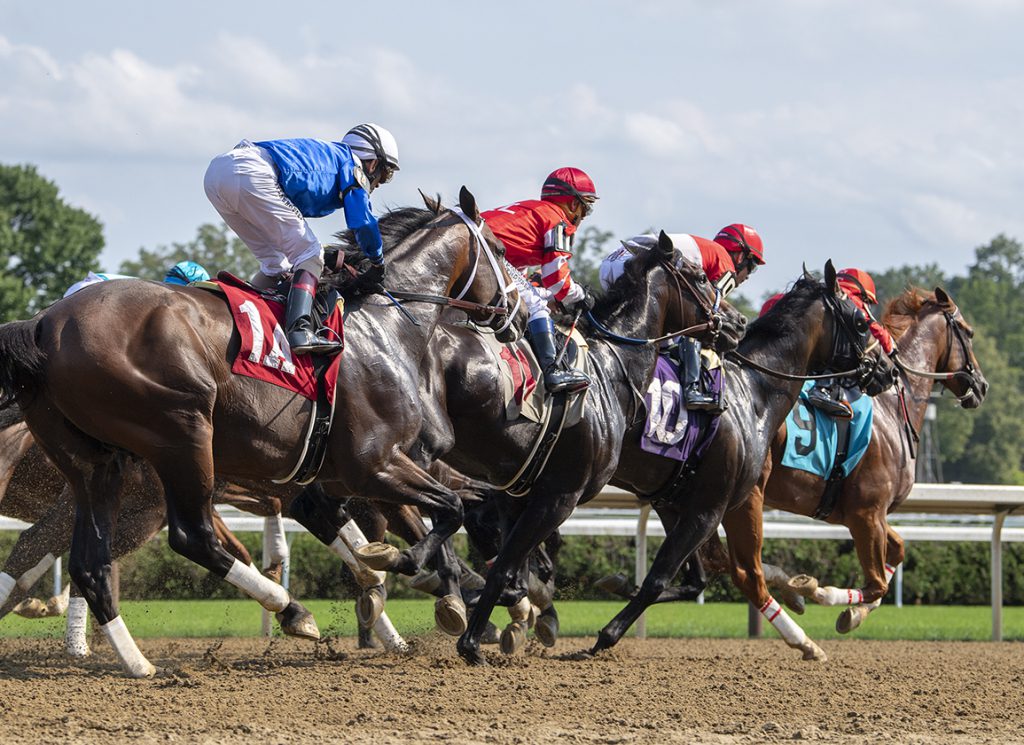
Sarah Andrew

What is StrideSAFE?

This wireless iPhone-shaped device fits snugly into the saddle towel, and eight hundred times a second, it takes an assortment of measurements to capture in minute detail the movement of the horse at high speed.

These measurements include the horse's acceleration and deceleration, the up-and-down concussive movement of the horse, and its medial-lateral motion–what is, in other words, the horse's movement from side to side.

Ultimately, the sensors capture the sorts of high-speed lameness invisible to the naked eye but significant enough to cause major musculoskeletal failures at some point down the line–unless, of course, someone intervenes on the horse's behalf first.

To understand exactly how StrideSAFE identifies almost imperceptible signs of lameness, it helps to break a single stride into three distinct stages.

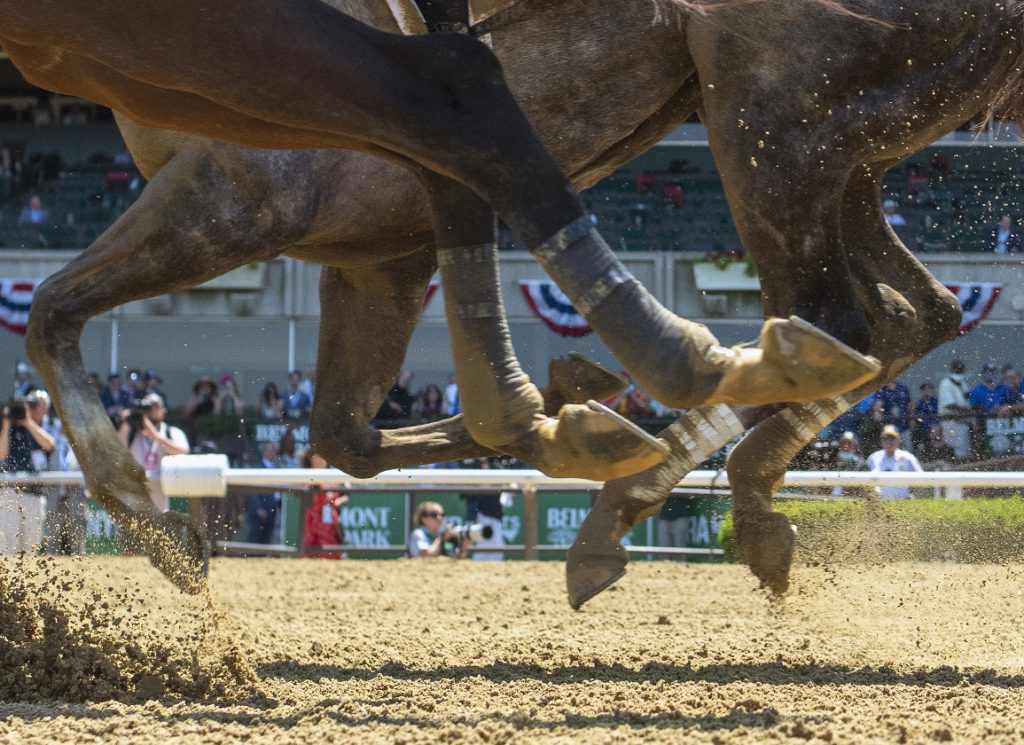
In the first phase of the gallop, the hindlimbs load and propel the horse forward. In the second, the horse shifts its weight toward the front, its forelimbs acting like shock absorbers. This is followed by the lynchpin of the equation: A period of suspension, a mere fraction of a second, when the horse is entirely airborne.

If that horse is suffering a physical ailment or injury, it cannot adjust its body to compensate when its feet are grounded. It can only do this in midair, rotating its spine and pelvis in preparation for a more comfortable landing.

Imagine a racecar hurtling along at high speed, one of its bolts working loose.

“The horse does all kinds of things in the air, twisting and shaking and moving,” Lambert had previously explained to the TDN.

Which leads to the next important question: How are the red, amber and green ratings calculated?

While some 151 subtle variables are measured within each stride, only 15 are vital to highlight the important differences between individual horses, said Lambert.

Put together, they create a basic standard running from 0 (which is the safest green rating) to greater than eight (which is at the red-hot end of the spectrum) against which all horses can be compared.

At the highest end of that spectrum–a standard deviation greater than eight–the findings were remarkable. Horses awarded this rating in a prior race were more than 50% likely to suffer a fatal injury in a subsequent race or breeze.

More broadly, of the 6,458 individual runs in the NYRA study, 74.5% were rated green, 6.6% were rated light amber, 5.5% were rated dark amber and 13.4% were rated red.

This means that 865 horses were red flagged–a relatively small percentage of the overall runners.

But given how these horses aren't visibly lame–and as such, are tough to diagnose if harboring an underlying physical issue–that's still a lot of horses to sift through in order to identify the few most likely to breakdown.
Sarah Andrew

Lambert developed this technology with Mikael Holmstroem, a Swedish Ph.D. with expertise in equine conformation and locomotion, and Kevin Donohue, Ph.D., professor of electrical and computer engineering at the University of Kentucky.

And so, Lambert and this team tweaked the algorithm to identify the most at-risk horses and shave off the horses in less immediate danger. In doing so, they zeroed in on 7.4% of the population.

“You find the pattern and then you direct the modeling,” explained Lambert. “And when we did that, we found that 40% improvement and got us down to around 7% without missing any of the [fatally injured horses].”

That's not to say the other red-flagged horses should be ignored, for the study proves how physical deterioration leading up to a catastrophic musculoskeletal injury is typically a long degenerative process over weeks and even months.

This tallies up with the scientific literature on fatal breakdowns which shows just how frequently pre-existing lesions appear at the actual site of the injury.

“This is not a case of them being sound one moment and broken the next. This process is a continuum,” said Lambert. “It's not reliable as a soundness screen,” he added, “it's intended as a breakdown screen.”

Of all the horses that received a green rating during the NYRA study, 77% were racing again in less than 60 days, and 85% were racing again in less than 120 days.

That same study hasn't yet been done for red-flagged horses, says Lambert. But an analysis at the start of the program found that only about 40% of the horses that had a red classification were able to race at all over the next four months after the analyzed race.

This means that once a horse has received a cautionary flag, there needs to be a process in place to funnel it toward the right tool to diagnose the brewing issue.

“The analogy is the check engine light in your car,” said Palmer, agreeing with Lambert. “When that check engine light goes on, what does it mean? It means you've got to get someone to check your car.”
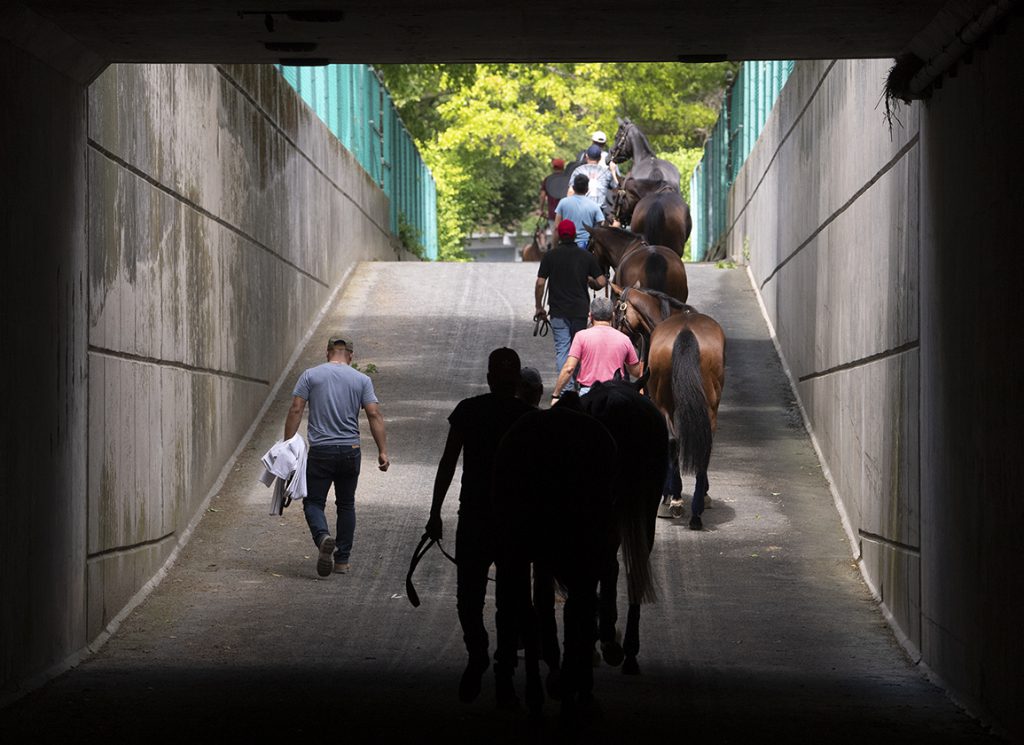
Sarah Andrew

According to Palmer, he and the New York Thoroughbred Horsemen's Association (NYTHA) have recently launched a new system at Saratoga whereby the trainer of a horse given a cautionary flag in a race subsequently receives an email alert, or what is coined an “advisory letter.”

“A [cautionary] alert is not a 'Scarlet Letter'–it does not mean [the horse is] going to die or it's going to get a fracture,” said Palmer, about what such an email means. “The gist of it is, you need to get the horse examined by a veterinarian. That's the bottom line.”

Because StrideSAFE can detect lameness not visible to the naked eye, some of the brewing problems will only be detected using some of the more sensitive diagnostic technologies that are making their way onto the marketplace–but not always.

“Some of them [veterinarians and trainers] are going to be able to find something using flexion tests and usual diagnostic exams, hoof testers,” said Palmer. “These are not the sorts of things that are ordinarily done to a horse every day.”

Nevertheless, Palmer stresses that in the majority of cases, the added veterinary scrutiny will result in a diagnostic thumbs-up, calling it a “not one-size-fits-all” scenario.

“If it's a minor problem, the horse can get some time off, come back and everything's fine,” he said. “In some cases, I fully expect that we'll find nothing, and the horse will be able to go right back and race again.”

Given the work that lies ahead, NYTHA President Joe Appelbaum turned to a baseball analogy, describing the program at first or second innings.

“This is great,” said Appelbaum. “But we need as wide-ranging data set as we can find. We need to share that data and research it hard. We're at the beginning of this game, not the end.”

The post NYRA, StrideSAFE Sensor Technology Study Begins New Stage appeared first on TDN | Thoroughbred Daily News | Horse Racing News, Results and Video | Thoroughbred Breeding and Auctions.

Source of original post

Verified by MonsterInsights
